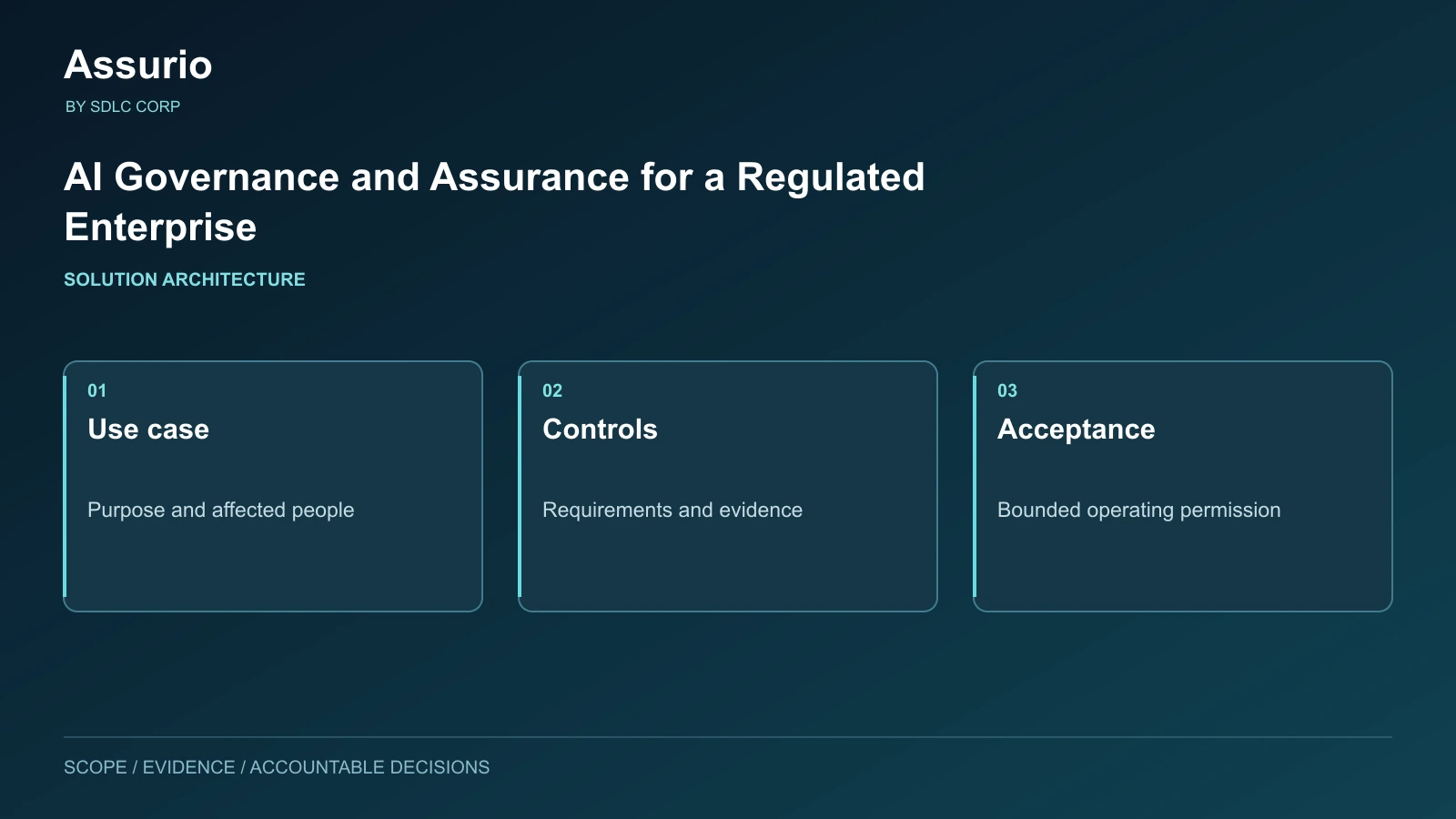
AI Governance and Assurance for a Regulated Enterprise
Connect enterprise AI ownership, control evidence and acceptance decisions across business, risk and technology teams.
The enterprise decision behind the governance program
A regulated enterprise wants an internal assistant to summarize approved operating procedures for employees. The application uses a third-party model and a controlled document collection. Business teams want broader access, while risk reviewers need to understand which information may be exposed, how answers are checked and who can authorize expansion.
This is an illustrative solution architecture, not a report of a customer deployment. The organization, workflow and decision examples are hypothetical; no implementation outcomes or regulatory approval are claimed. The design shows how Assurio can connect governance records to an explicit permission to operate.
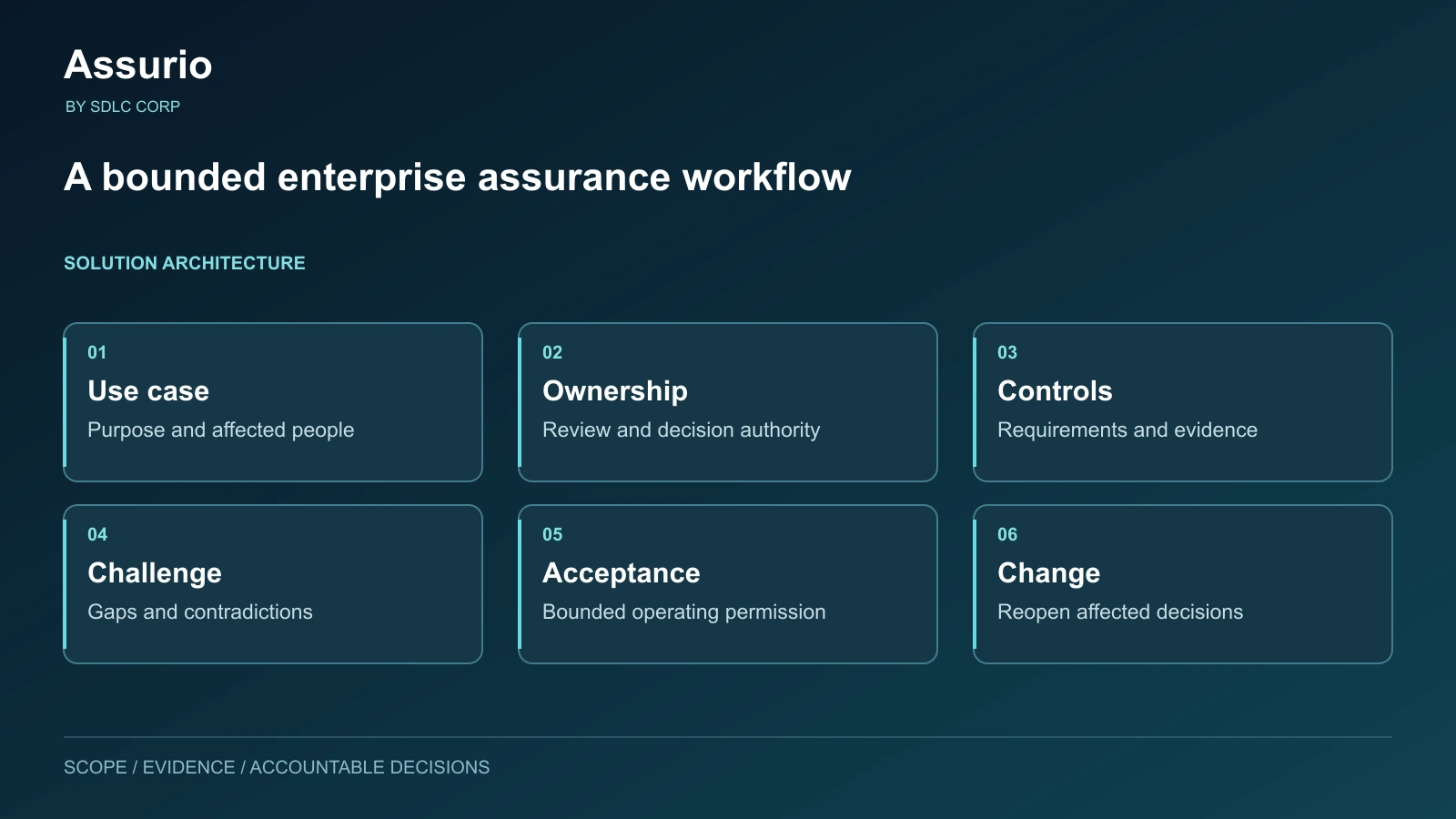
Start with a bounded use and accountable owners
The proposed scope is employee assistance using approved documents. The assistant does not make customer eligibility decisions, alter official records or replace the responsible employee. Each exclusion has a corresponding control: restricted tools, source entitlements and a visible escalation route. A broad statement such as “internal use only” would leave too much ambiguity.
Business ownership, technical operation, evidence review and acceptance authority are separate responsibilities. One person may hold several roles in a small team, but the record should expose that concentration. The review asks who can challenge the evidence and who remains accountable when a supplier changes the underlying service.
NIST describes its AI Risk Management Framework as a voluntary resource for managing AI risks. It supports an organized risk discussion; using a framework does not itself establish compliance. NIST AI RMF.
Map controls to the evidence reviewers actually need
| Control objective | Implementation question | Evidence to review |
|---|---|---|
| Source entitlement | Can users retrieve only authorized material? | Access tests with different identities and denied requests |
| Grounded answers | Can reviewers follow the answer to the approved source? | Source snapshots, citations and adjudicated evaluations |
| Human escalation | Can staff recognize and resolve an uncertain answer? | Workflow trials and exception records |
| Supplier change | Can an update affect prior acceptance? | Version notice, impact record and reassessment decision |
Requirements reference the actual system baseline, including model identifier, retrieval settings, document snapshot and application release. An assurance package should retain contradictory results and unresolved dependencies, rather than assemble only the best demonstrations.
Challenge the package before expanding access
Consider an illustrative review in which retrieval tests pass for ordinary employees but fail for a contractor group. The appropriate response is to retain the finding, investigate the entitlement mapping and restrict that group until the control is supported. Averaging the failed access check into a general answer-quality score would obscure the decision that matters.
A separate trial examines how a policy exception is handled. If the assistant provides a confident answer where the approved source is ambiguous, the review checks the escalation behavior and the employee instruction together. Technical behavior and operating procedure jointly determine the permitted use. The evidence checklist helps organize that challenge.
Make the acceptance conditions enforceable
An acceptance record specifies the baseline, users, purposes, document collection, excluded actions and expiry or review triggers. Conditional acceptance is useful only when the restriction has an owner and an implementation. “Use carefully” is not an enforceable condition; a limited user group or disabled write operation can be.
The acceptance criteria template separates critical gates from quality targets. The risk register keeps residual risks and treatment actions visible after the review. Neither document automatically authorizes deployment.
What the architecture makes possible
The proposed outcome is a reviewable chain from intended use to controls, observations and decisions. It can support an audit conversation without pretending every artifact proves the same claim. The most consequential design choice is connecting operating restrictions to the people and systems that enforce them.
Assurio provides the intended governance and assurance workflow around that chain. During implementation, establish which evidence sources can be integrated, who operates each control and which capabilities require configuration. Evaluate success by whether a reviewer can reconstruct a specific decision and its limits, then identify what a later change invalidates.
Continue with the next step
Discuss enterprise AI governance
Bring your system scope, evidence sources and next decision to a focused Assurio discussion.