AI Governance for ERP-Connected Automation
Govern AI recommendations and write actions where enterprise automation reaches financial and operational records.
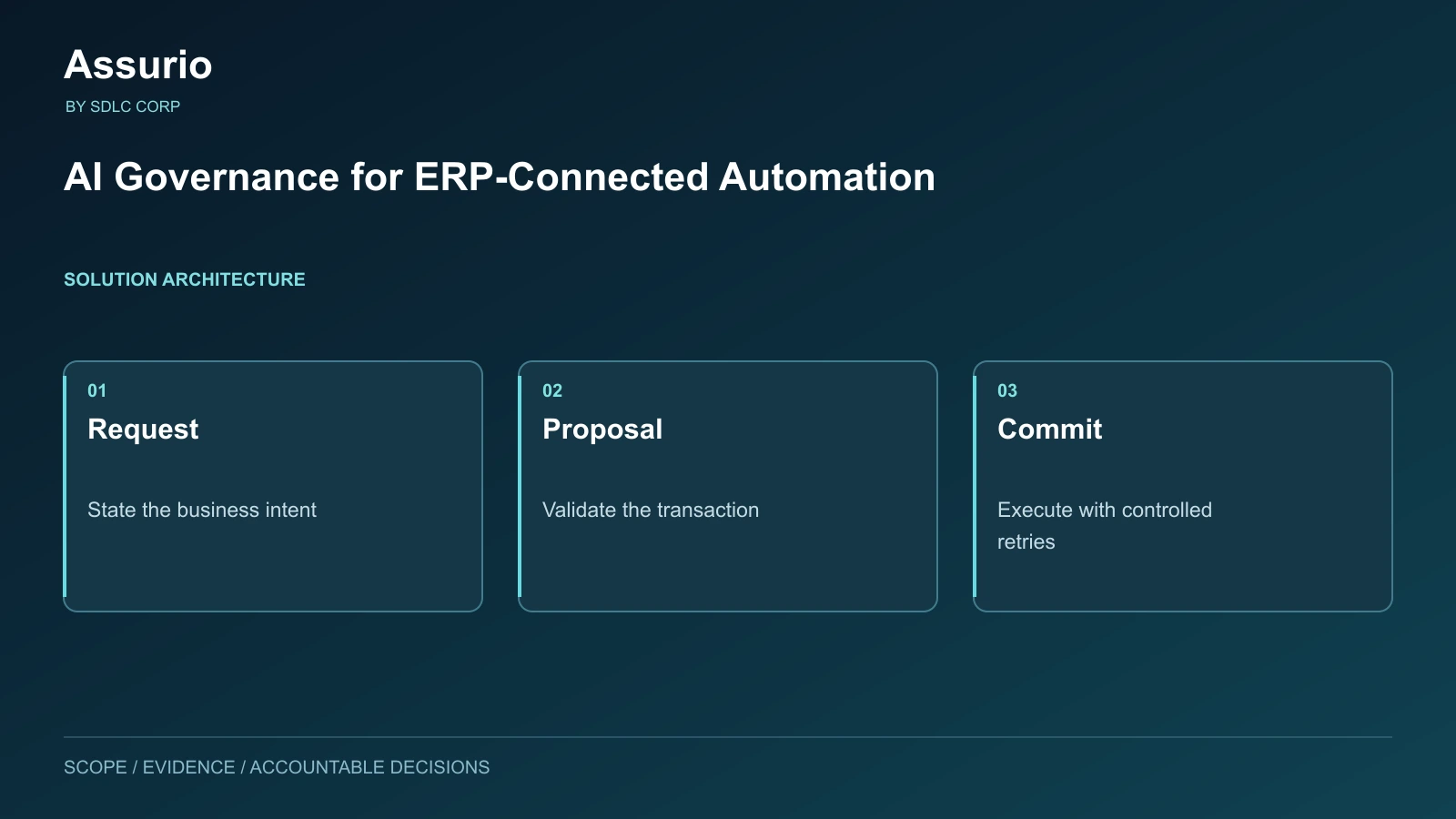
An assistant reaches the transaction boundary
An enterprise wants an AI assistant to help staff resolve purchase-order exceptions. The assistant can inspect approved records, propose corrections and explain missing information. The business also wants selected actions to reach the ERP system. That transition from advice to a write operation creates the core governance problem.
This illustrative solution architecture describes a hypothetical workflow. It does not represent a named customer, a completed integration or measured business results. Its purpose is to show how ERP controls and AI assurance can work together without giving a model unrestricted transaction authority.
Separate the proposal from the authority to execute
The model proposes a structured action. A deterministic service validates the schema, checks record state and applies business rules. Authorization is checked against the requesting identity, the agent identity and the particular operation. A plausible explanation from the model cannot grant a permission that the ERP system would otherwise deny.
For example, an accounts-payable assistant might read invoice status and draft a correction while remaining unable to change bank details or release a payment. A purchasing assistant might prepare a quantity change but require approval when the change affects an existing commitment. These boundaries belong in the connector and ERP permissions as well as the agent instructions.
Build a control matrix around side effects
| Action | Suggested boundary for this example | Evidence |
|---|---|---|
| Read purchase order | Entitlement-filtered read | Allowed and denied identity tests |
| Prepare correction | Draft only; validate required fields | Schema and business-rule tests |
| Commit approved change | Bind approval to exact record and payload | Approval reference and transaction response |
| Retry after timeout | Check prior commit before repeating | Idempotency and reconciliation tests |
| Change supplier bank data | Excluded from this assistant | Denied-operation evidence |
These are design choices for the illustrative system, not universal ERP policy. Actual segregation of duties, thresholds and approval rules must come from the organization. The agent permission model helps express these choices at tool level.
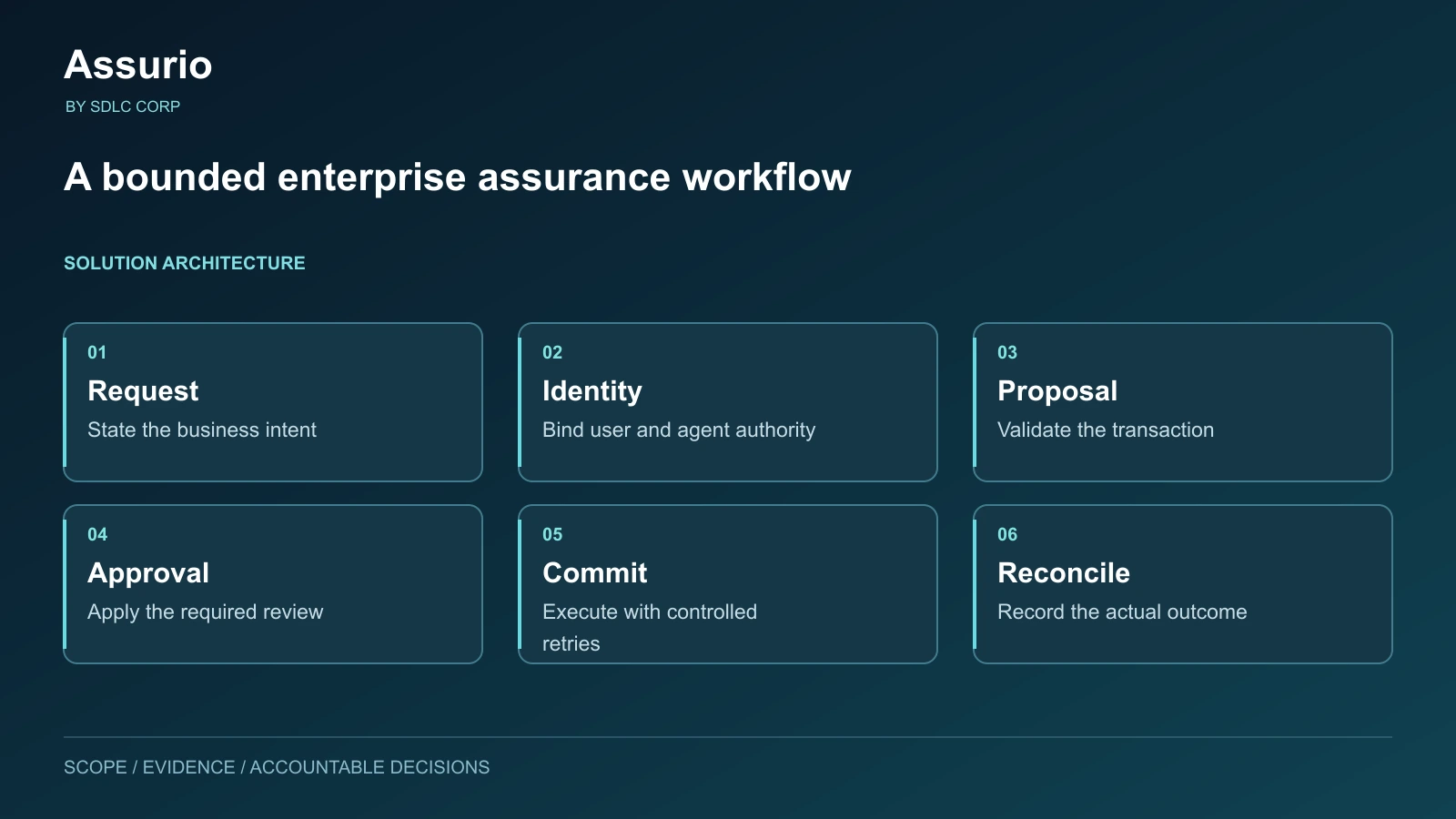
Test ambiguous outcomes as carefully as rejected actions
A timeout does not prove that the ERP transaction failed. The request might have committed while the response was lost. Retrying without a stable operation identifier can create a duplicate or apply the same update twice. The integration should reconcile the external record before deciding whether to retry, escalate or stop.
An illustrative campaign includes stale records, conflicting edits, revoked permissions, duplicate requests and a changed approval payload. If the user approves a change to one order, the approval must not be reused for another. Preserve the intended action and the actual ERP outcome separately; they can differ even when the agent reports success.
Keep a transaction-level audit chain
Record the requesting user, agent identity, selected tool, target record, permitted action, policy version, approval reference and final transaction identifier. Retain sensitive payloads only where justified and authorized; use protected references in the general governance record. The audit trail guide explains how to connect events without turning logs into an uncontrolled data repository.
For delegated API access, RFC 9700, published January 2025 provides OAuth security guidance, including privilege restriction. The practical implication is to evaluate the actual token audience, scope and enforcement behavior, rather than treat possession of a credential as permission for every operation.
Accept a bounded workflow and reassess its changes
The acceptance package covers both business correctness and control behavior. A good extraction score does not compensate for a duplicated transaction or a bypassed approval. Use the TEVV plan to connect failure scenarios to evidence and the acceptance template to define non-negotiable gates.
Assurio can organize the intended chain from workflow scope through evaluation and acceptance. Connector permissions, ERP controls and transaction recovery remain explicit integration responsibilities. Reopen the affected review when a tool gains write privileges, a business rule changes, an approval path changes or the model begins proposing a different action type.
Continue with the next step
Plan governance for ERP-connected AI
Bring your system scope, evidence sources and next decision to a focused Assurio discussion.