Custom Software Cost Guide

Custom Software Development Cost: Key Drivers & Pricing

Understand what impacts pricing, typical cost ranges, and how to plan a realistic software budget without guesswork.

Clear breakdown of scope, complexity, and technical decisions that shape estimates.
Realistic ranges and budgeting inputs you can use before requesting proposals.
Common cost traps to avoid when requirements evolve during development.
Team reviewing software project scope and budget

Define Your Evaluation Scope

Get vendors to quote apples-to-apples

Your selection process breaks down when vendors interpret the project differently. Start by defining:

A Outcomes

  • What business metric improves if this succeeds?
  • What user problem is solved?
  • What does “done” look like in 90 days vs 12 months?

B Scope Boundaries

  • In scope: platforms, integrations, analytics, admin panel
  • Out of scope: brand redesign, data migration, growth marketing

C Constraints

  • Timeline (hard deadlines vs flexible)
  • Budget range (even a band helps)
  • Tech constraints (must use / can’t use)
  • Compliance requirements (GDPR, HIPAA, PCI, SOC2)

D Decision Drivers

  • Speed to MVP
  • Enterprise-grade security
  • UX excellence
  • Domain expertise
  • Total cost of ownership

Download the Vendor Scorecard

Get the weighted scorecard spreadsheet, RFP pack template, and reference-check script.

Build a Shortlist That Matches Your Needs

Quality over quantity

Planning workspace with checklist

A strong shortlist is usually 3–6 vendors. More than 6 creates noise; fewer than 3 reduces leverage.

Where to source vendors

  • Referrals from people who shipped similar products
  • Companies with proven work in your domain and stack
  • Vendors with a “discovery-first” approach for complex builds
  • Specialists (e.g., mobile, AI/ML, fintech compliance) when needed

Quick Pre-Qualification Filter (15 minutes per vendor)

Ask for:

  • 2–3 relevant case studies (not “we built an app”)
  • Team structure and seniority mix (who will actually work)
  • Delivery model (agile cadence, QA, DevOps)
  • Security posture (basic controls at minimum)
  • Availability + time zone overlap

If they can’t answer clearly, don’t advance them to RFP.

3. The RFP Pack

Your biggest leverage tool

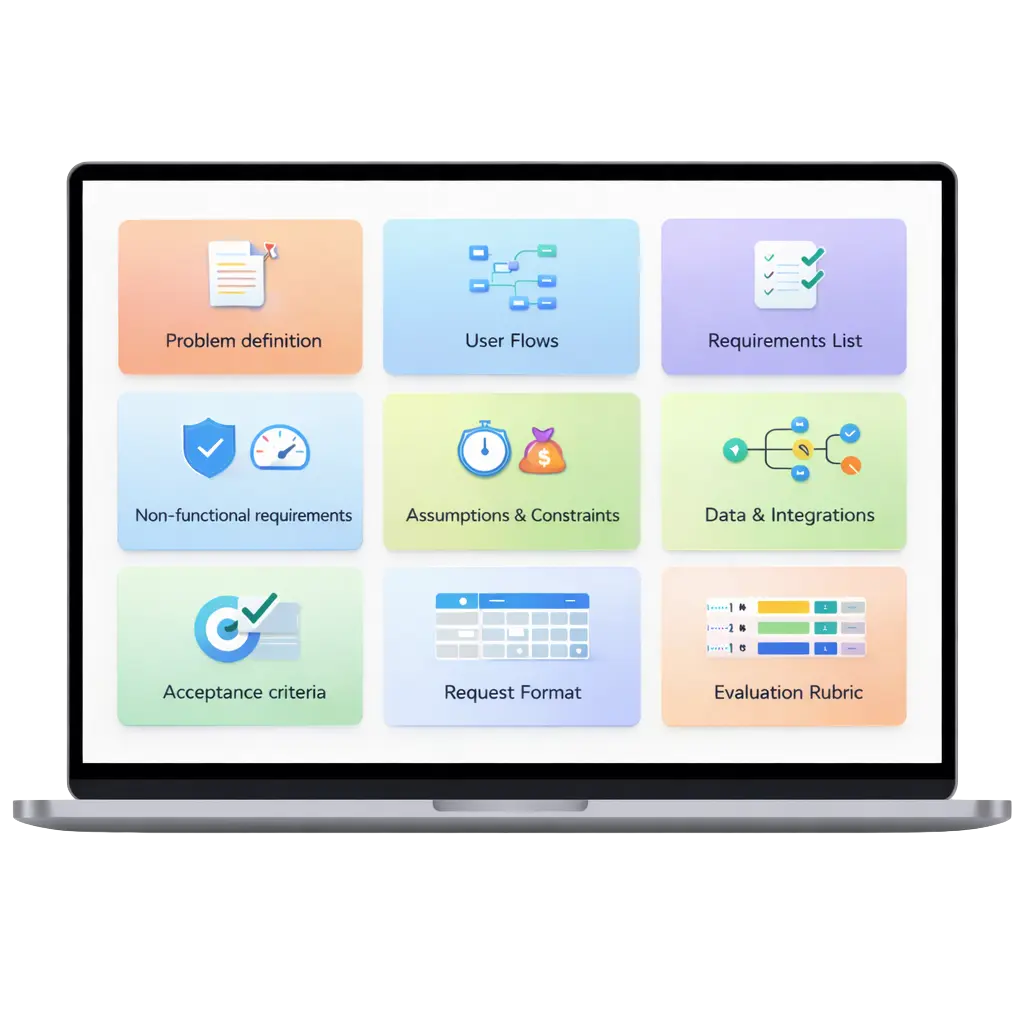
An effective RFP doesn’t ask for marketing decks. It forces specificity.
1
One-page problem statement (what you’re building and why)
2
User flows or simple wireframes (even rough)
3
Requirements list (MVP must-haves, phase 2, integrations)
4
Non-functional requirements (performance, uptime, security)
5
Assumptions and constraints (timeline, budget band, stack)
6
Data and integrations (APIs, third-party tools, data sources)
7
Acceptance criteria (how you’ll judge “done”)
8
Request format (so responses are comparable)
9
Evaluation rubric (tell vendors how you’ll score them)
RFP checklist and structured vendor evaluation illustration

Vendor Evaluation Scorecard

Weighted, evidence-based

Recommended Scoring Scale

1

Weak / unclear / risky

3

Acceptable

5

Excellent / proven / low risk

CategoryWeightWhat “5/5” looks likeEvidence to request
Domain & problem understanding10%Clear grasp of users, workflows, risksDiscovery notes, user flows, clarifying questions
Delivery capability15%Mature agile, predictable planning, strong PMSample sprint plan, ceremonies, delivery artifacts
Engineering quality15%Clean architecture, code standards, reviewsCoding standards, PR process, repo examples
QA & reliability10%Test strategy, automation, release disciplineQA plan, test pyramid, bug SLAs
Security & compliance15%Strong controls, secure SDLC, audit readinessPolicies, SOC2/ISO evidence, security checklist
Team composition & seniority10%Senior leads, stable team, low churn riskNamed leads, org chart, resumes/LinkedIn
Communication & transparency5%Clear reporting, risk escalation, stakeholder mgmtStatus report samples, governance model
Cost realism & commercials10%Clear assumptions, change control, fair termsPricing breakdown, rate card, scope assumptions
Cultural fit & collaboration5%Works like an extension of your teamTrial workshop, meeting dynamics
References & proof5%Verified outcomes and long-term retentionReferences, case study metrics

Scorecard Criteria Cards

Blocker Criteria (Fail Fast)

If any of these fail, pause or reject before spending more time.

  • ×Won’t sign NDA (if needed) or won’t discuss IP ownership
  • ×Cannot explain delivery control for scope and quality
  • ×No clear dev/QA ownership for complex builds
  • ×Won’t name leads / hides seniority or team structure
  • ×No change control process (scope creep guaranteed)

Download the Scorecard Spreadsheet

Get the weighted vendor scorecard (Google Sheet / Excel) with all criteria and scoring columns—ready to copy for your project.

Get Scorecard Template

Domain & problem understanding

What “good” looks like: clear grasp of users, workflow, risks

10%
Evidence to request
Discovery notes, user flows, clarifying questions

Delivery capability

Cadence, planning, demo rhythm, PM/QA presence

15%
Evidence to request
Sample sprint plan, weekly reporting, delivery metrics

Engineering quality

Architecture maturity, maintainability, code standards

15%
Evidence to request
Coding standards, PR process, review examples

QA & reliability

Testing depth, bug triage, SLA mindset

10%
Evidence to request
QA plan, test coverage approach, release checklist

Security & compliance

Controls, audits, data handling, SDLC discipline

10%
Evidence to request
Policies, pen-test readiness, security checklist

Team composition & seniority

Who builds, stability, true senior coverage

10%
Evidence to request
Named team, roles, engagement model details

Communication & transparency

Risk reporting, decision logs, visibility

5%
Evidence to request
Status report samples, governance model

Cost realism & commercials

Assumptions, change control, rate transparency

10%
Evidence to request
Pricing breakdown, rate card, scope assumptions

Cultural fit & collaboration

How well they work with your team & pace

5%
Evidence to request
Working agreement, escalation path

References & proof

Third-party validation and outcomes

5%
Evidence to request
Customer references, metrics, case study details

Blocker Criteria (Fail Fast)

If any of these fail, pause or reject before spending more time.

  • ×Won’t sign NDA (if needed) or won’t discuss IP ownership
  • ×Cannot explain delivery control for scope and quality
  • ×No clear dev/QA ownership for complex builds
  • ×Won’t name leads / hides seniority or team structure
  • ×No change control process (scope creep guaranteed)

Download the Scorecard Spreadsheet

Get the weighted vendor scorecard (Google Sheet / Excel) with all criteria and scoring columns—ready to copy for your project.

Get Scorecard Template

Run Capability Interviews

Validate real delivery ability with the people who will lead your build

Team interview discussion to evaluate delivery capability

Tip: ask for examples and artifacts (plans, reports, PRs), not just verbal assurances.

Interview #1

Delivery

Project management, planning, scope control, QA, delivery rhythm.

Interview #2

Technical

Architecture decisions, engineering maturity, reliability, security baseline.

Delivery Interview Questions

  • Walk me through your delivery cadence (planning, weekly demos, reporting). What artifacts do you share each week?
  • How do you estimate work when requirements are uncertain?
  • How do you prevent scope creep? What is your change-control process?
  • What does QA look like in your team (who owns it, what’s tested, when)?
  • Show an example of a status report and how you surface risks early.

Strong signal

They show real artifacts (plans, reports, QA checklist) and explain how they keep scope and quality under control.

Weak signal

Answers stay generic (“we’re agile”), with no examples or clarity on change control and QA ownership.

Technical Interview Questions

  • Explain your architecture approach for a similar system. Why did you choose that design?
  • How do you enforce code quality (PR reviews, standards, CI checks)?
  • What’s your testing strategy (unit/integration/e2e) and expected coverage by phase?
  • How do you handle deployments, monitoring, and incident response?
  • Describe your security baseline: secrets management, access control, logging, and vulnerability handling.

Strong signal

Clear, specific answers tied to real practices (CI/CD, tests, monitoring) and tradeoffs they can explain.

Weak signal

Hand-wavy architecture, no concrete testing plan, vague security posture, or unclear ownership.

Copy the Interview Scripts

Standardize your vendor interviews so answers are comparable, bias is reduced, and scorecard decisions are easier.

Includes delivery + technical question bank View Question Bank

Security & Compliance Evaluation

Minimum viable due diligence

Security-focused code and data visualization

Even if you’re not “enterprise,” you’re still responsible for your user data and operational risk.

Minimum Security Checklist

Ask vendors to confirm:

  • Secure SDLC (security review, dependency scanning)
  • Access control (least privilege, MFA)
  • Secrets management (no secrets in code)
  • Encryption in transit and at rest (where applicable)
  • Vulnerability management and patching policy
  • Incident response basics (how they handle breaches)
  • Data processing locations and subcontractors
  • Backup and disaster recovery approach

Compliance Signals

SOC 2 / ISO 27001

Maturity or roadmap

GDPR

DPA, data minimization, retention

PCI

Payment security considerations

If vendors can’t provide anything beyond “we take security seriously,” you’re absorbing risk.

For regulated environments or sensitive coverage (payments, healthcare, identity), use our approach to systematic delivery with audit-ready engineering and SOC 2 / ISO-aligned controls.

Download Checklist

Commercial Evaluation

Pricing, risk, and change control

Price is never just price — it’s a reflection of assumptions and risk transfer.

Common Pricing Models

Time & Materials

Best when scope is evolving. Requires strong governance and sprint discipline.

Fixed Price

Best when scope is stable. Watch for hidden buffers and change-order friction.

Discovery + Build

Paid discovery reduces early risk. Works well for complex products.

What to Require in Commercial Proposal

  • Rate card by role (and seniority)
  • Named team allocated to your project
  • Assumptions list (“If this quote assumes X”)
  • Change control process (how scope changes are handled)
  • Payment milestones tied to deliverables (not dates alone)

Get the Pricing Comparison Tables

Download commercial evaluation templates with rate card format and assumptions checklist.

Download Pricing Template

Contract & IP Checklist

Lock down early

Signing a contract and reviewing terms

This is where many teams get burned — especially on IP and handover.

Must-Have Contract Clauses

  • IP ownership: you own the work product upon payment
  • Open-source usage policy: disclosed, approved licenses only
  • Confidentiality and data protection
  • Acceptance criteria and sign-off process
  • Warranty / bug-fix window
  • Termination and transition assistance
  • Subcontractor disclosure and approval rights
  • Non-solicit (if relevant)
  • SLA (for support/maintenance agreements)

Handover Requirements

Don’t skip these:

  • Source code repo access and ownership
  • Documentation (system architecture + runbook)
  • Infrastructure as code (where feasible)
  • CI/CD pipelines and environment config
  • Credential transfer process (secure)

If you can’t take the product in-house later, you don’t truly own it.

Get the Contract Checklist

Download the IP ownership clause checklist and handover requirement templates.

Download Checklist

Make the Final Decision

How to pick confidently

Team reviewing finalists and comparing vendors

Simple Decision Meeting Format

  1. Review scorecard totals AND blocker list

  2. Compare top 2 vendors on: Risk (delivery/security), Maintainability and quality, Cost realism and transparency

  3. Choose the vendor with the best risk-adjusted value, not the lowest quote

  4. Align on governance: cadence, reporting, decision makers, escalation

  5. Start with discovery/pilot if the scope is complex

Vendor Red Flags

Don’t rationalize these

  • “We can start tomorrow” with no discovery and no questions

  • Won’t introduce the actual tech lead until after signing

  • Vague QA approach (“we test everything”)

  • No examples of delivery artifacts (status reports, sprint outputs)

  • Refuses to document assumptions in the quote

  • Over-promises on timeline without trade-offs

  • No defined change control or scope management process

  • Hesitates on IP ownership or repo access

Vendor Evaluation Templates

Copy/paste ready resources

A) Scorecard Spreadsheet Columns

  • Vendor name
  • Category
  • Weight
  • Score (1–5)
  • Weighted score
  • Evidence link/note
  • Blocker? (Y/N)
  • Risk summary

B) Reference Check Script (10 minutes)

  • What did they build, and what was the outcome?
  • Was delivery on time? If not, why — and how was it handled?
  • How was communication and transparency?
  • How did quality and maintainability hold up six months after?
  • How did they handle bugs, scope change, and pressure moments?

C) RFP Question Bank (High Signal)

  • What assumptions are you making about scope and constraints?
  • What are the top 3 risks you see, and how would you mitigate them?
  • Show a sample delivery plan for the first 4–6 weeks.
  • How do you ensure code quality and prevent regression?
  • What security controls are standard in your delivery process?
  • What is your approach to documentation and handover?

Frequently Asked Questions

Common questions about vendor evaluation

How many vendors should I evaluate?

Shortlist 3–6. Run deeper evaluation on 2–3. If you evaluate 10+, you’ll lose consistency and speed.

Is a discovery phase really necessary?

For anything beyond a simple build, yes. Discovery reduces misunderstandings, improves estimation, and surfaces risks early.

Should I choose a local, nearshore, or offshore vendor?

Choose based on the combination of overlap hours, communication maturity, seniority, and governance — not geography alone.

How do I avoid being locked into one vendor?

Own your repos and accounts, require documentation, enforce handover clauses, and avoid proprietary frameworks without clear justification.

Get the Complete Vendor Evaluation Framework

Download the scorecard spreadsheet, RFP pack, interview scripts, and contract checklists

Download the Vendor Evaluation Framework

Get instant access to: weighted scorecard spreadsheet (XLSX), RFP pack template, delivery & technical interview scripts, reference-check script, and contract clause checklist.

No spam. Unsubscribe anytime.

Tell Us What you Need ?

Share Your Idea, Get Expert Insights Instantly

20+

Years of Experience

100+

 Developers