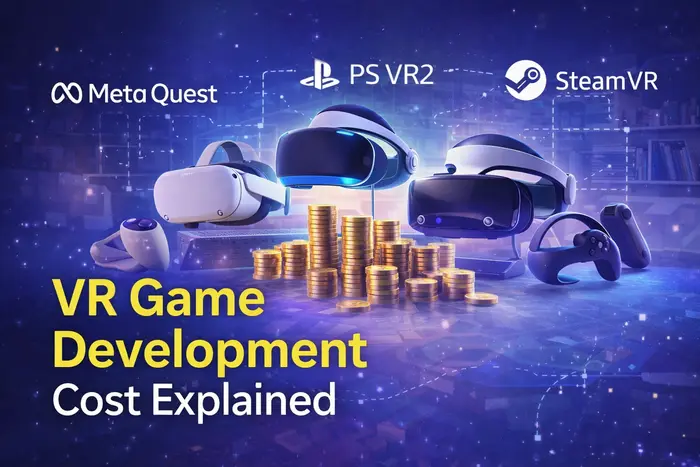
Quick answer: VR game development cost ranges from $20,000 for a simple experience to $600,000+ for a large production. A simple VR game costs $20,000–$60,000. A mid-range VR game runs $60,000–$180,000. A large VR game with full production costs $180,000–$600,000+. The biggest variable is which headset you are building for and whether you need multiplayer.
Virtual reality game development costs more than mobile game development and more than AR game development at the same scope level. The reasons are specific: VR requires a stable frame rate to prevent motion sickness — for Meta Quest, most apps target 72 FPS, and some devices support higher refresh rates — the headset hardware is more varied than a phone, and each platform (Meta Quest, PC VR, PlayStation VR2) has its own certification process and SDK.
This guide breaks down VR game development cost by headset, game type, and what drives budgets up. The ranges are based on real project scopes, not list prices.
Why VR Games Cost More Than Regular Mobile Games
Three things make VR development consistently more expensive than other game types at the same scope:
Frame rate is non-negotiable
For Meta Quest, most apps target 72 FPS, and some devices support higher refresh rates. Keeping frame rate stable is critical for comfort — a frame rate drop that is barely noticeable in a flat game causes motion sickness in VR. Hitting stable frame rates across the device range you are supporting requires performance work that a flat mobile game does not need.
Comfort is a separate discipline
VR UX design is not the same as mobile UX design. Movement design, interaction reach, height calibration, and locomotion systems all need specialist attention to prevent discomfort. Teams without VR experience frequently underestimate this budget item.
Platform certification is strict
Meta Quest, PlayStation VR2, and SteamVR all have separate certification processes. Each one adds testing time and potential revision cycles before your game can go live. Console VR (PSVR2) is the most strict.
3D environments are fully immersive
In a VR game the player can look in every direction. That means every surface, every corner, every ceiling needs to be finished — unlike a flat game where the camera angle hides unfinished areas. Art scope is typically 30–40% higher than a comparable flat game.
VR Game Development Cost by Game Type
What kind of game you are making is the biggest single factor in cost:
| Game type | Example | Typical cost | Build time |
|---|---|---|---|
| Simple VR experience | Escape room, puzzle, short narrative | $20,000 – $60,000 | 3–5 months |
| Mid-range VR game | Action, rhythm, sports, casual adventure | $60,000 – $180,000 | 5–10 months |
| Multiplayer VR game | Social VR, competitive shooter, co-op | $120,000 – $300,000 | 8–14 months |
| VR training simulation | Medical training, industrial, flight sim | $100,000 – $400,000 | 6–18 months |
| Large open-world VR game | RPG, exploration, live service game | $300,000 – $800,000+ | 12–24 months |
VR Game Development Cost by Platform
Platform choice is the second biggest cost driver after game type. Each headset has different hardware limits, different SDKs, and different store certification requirements:
| Platform | Typical cost range | Why it costs this |
|---|---|---|
| Meta Quest (standalone) | $20,000 – $100,000 | Most popular headset, largest audience. Standalone means no PC required — but the mobile-grade processor requires heavy optimisation to maintain stable frame rates. For most Quest apps, 72 FPS is the target, though some devices support higher refresh rates. Every polygon and texture needs tighter budgets than PC VR. |
| PC VR (Steam / Valve Index / HTC Vive) | $50,000 – $250,000 | High-end PC hardware allows much higher visual fidelity, which means more art, more complex shaders, and larger environments. Developer audience is smaller but spends more per title. |
| PlayStation VR2 | $60,000 – $200,000 | Console-grade hardware. Sony certification is the strictest of the major platforms — plan for at least one revision cycle. Eye-tracking and adaptive trigger support adds interaction design scope. |
| Meta Quest + PC VR | Add 35–50% to Meta Quest cost | Two separate performance targets. The PC VR version can use higher-fidelity assets, but you still need to maintain the Quest version separately. Schell Games reported that porting from PC to Quest doubled the number of performance passes required. |
| Apple Vision Pro | $100,000 – $400,000+ | Spatial computing with eye and hand tracking as the primary inputs. Requires completely different UI and interaction design from controller-based VR. Very small user base in 2025 — most studios build for Quest first, Vision Pro second. |
VR Game Cost Estimator
Select your options — the estimate updates instantly.
1 — Game type
2 — Platform
3 — Multiplayer
4 — Visual quality
5 — Team location
Estimated budget range
$20k – $60k
Typical timeline: 3–5 months
Planning ranges based on typical project scopes. Does not include platform store fees, post-launch SDK updates, or ongoing hosting.
Get a scoped estimate →What Drives VR Game Development Cost Up
Five variables account for most VR budget overruns:
1. Comfort engineering
This is the cost driver most VR development guides do not mention. Preventing motion sickness is not automatic — it requires deliberate design of movement systems, frame rate budgeting, and interaction reach. Teams building their first VR game consistently underestimate how much engineering time comfort takes. Budget 15–20% of your total engineering scope for comfort work alone.
2. Platform count
Meta Quest and PC VR have completely different performance targets. A game that looks great on a high-end PC VR headset may drop below 60fps on a Quest standalone — which causes motion sickness. Porting between them requires a separate performance pass, not just a recompile. Each additional platform adds 35–50% to the base build cost.
3. 3D environment scope
Players can look in any direction in VR. Every wall, ceiling, and corner needs to be built. Art scope in VR is typically 30–40% higher than a flat mobile game with the same number of levels. High-fidelity photorealistic art (needed for PC VR and PSVR2 games that compete on graphics) can push art budget to 35–40% of total project cost.
4. Multiplayer and social features
Real-time VR multiplayer is significantly harder than flat game multiplayer. You are syncing full body position, head orientation, and hand controller state for every player in real time. Latency that is invisible in a flat shooter is noticeable and disorienting in VR. Plan for $35,000–$90,000 in additional engineering cost for real-time multiplayer.
5. Certification and store submission
Every major VR platform has a certification process. Meta submits through the Meta Horizon Store review flow — all titles go through VRC (VR Compatibility) requirements regardless of whether you target the full storefront or App Lab discoverability. PlayStation VR2 certification through Sony is the strictest — build in at least one revision cycle. SteamVR is the most lenient. Each failed certification pass adds 2–4 weeks to your timeline. Budget for revision cycles in your schedule, not just your cost estimate.
What These VR Cost Estimates Include
The cost ranges in this guide cover a standard full VR game build:
- Discovery and design — game design document, VR interaction model, comfort design, scope definition
- VR engineering — SDK integration, controller input, locomotion systems, comfort optimisation, frame rate profiling
- 3D art and animation — environments, characters, objects, UI panels, VFX
- Game development — core gameplay loop, progression, scoring, physics, audio
- QA and device testing — headset testing, comfort testing, performance profiling, certification prep
- Store submission — platform certification, build preparation, launch support
Not included: platform store revenue cuts (typically 30%), ongoing SDK updates after launch, post-launch content, server hosting for multiplayer games, motion capture if required, voiceover or music licensing, and marketing. These vary too widely to give a useful generic figure.
Typical VR Game Budget Breakdown
How a $120,000 mid-range VR game budget typically splits across phases:
| Phase | What it covers | % of total |
|---|---|---|
| Discovery and design | Game design document, VR interaction model, comfort design, scope lock | 8–12% |
| VR engineering | SDK integration, locomotion, comfort systems, frame rate optimisation | 28–38% |
| 3D art and animation | Environments, characters, objects, UI panels, VFX, shaders | 25–35% |
| Game development | Core loop, progression, audio, physics, AI | 15–22% |
| QA and device testing | Headset testing, comfort testing, performance profiling, certification | 10–15% |
| Launch and submission | Platform certification, server setup, release prep | 3–5% |
Team Size and Roles
A typical team for a mid-range VR game:
| Role | What they do | Required for |
|---|---|---|
| VR engineer | SDK integration, locomotion systems, comfort engineering, frame rate profiling | Every VR project |
| Unity or Unreal developer | Game logic, physics, player input, progression systems | Every VR project |
| 3D environment artist | Rooms, levels, props, surfaces — everything the player can see in 360° | Every VR project |
| 3D character artist | Characters, enemies, avatars, hands and arms visible in first person | Games with characters |
| Game designer | Mechanics, VR interaction design, comfort design, level design | Every VR project |
| Backend developer | Servers, leaderboards, real-time multiplayer, user accounts | Multiplayer and live service |
| QA tester (VR) | Headset testing, comfort testing across different users, performance profiling | Every VR project |
| Producer | Milestone management, certification coordination, client communication | Projects over $60k |
VR Development Cost: Freelancer vs Studio vs In-House
The same considerations as any game project, with one important VR-specific point: comfort engineering is a specialist skill that freelancers with general Unity experience often do not have. A VR game built by a team without comfort engineering experience will need significant rework at QA.
| Option | Rate | What to know |
|---|---|---|
| In-house team | Highest total cost | Full control, but VR-experienced engineers are harder to hire than general Unity developers. Salaries for VR specialists in US/UK are 20–30% above general game dev rates. |
| US / UK studio | $150–$250/hr | Highest quality, easiest collaboration. Suitable for well-funded projects where comfort quality and certification track record matter most. |
| India / Eastern Europe studio | $40–$90/hr | Best cost-to-quality ratio when the studio has a VR portfolio. The key check: ask to see two or three shipped VR titles, not just game dev work. A VR game development company with real shipping experience handles comfort engineering and platform certification correctly from the start. |
| Freelancers | Lowest upfront | High coordination risk. VR projects have tight interdependencies between engine, art, and comfort systems — managing that across independent freelancers increases rework risk significantly. |
How to Keep VR Game Development Costs Under Control
Four decisions that consistently keep VR budgets on track:
Build for one headset first
Meta Quest first, everything else second. Quest has the largest active player base and a well-documented development path. Ship on Quest, validate the game is fun and comfortable, then port to PC VR or PSVR2 with a proven build as the foundation.
Prototype the locomotion system early
How players move in your game is the most important comfort decision you make. Teleportation, smooth locomotion, room-scale only, or hybrid — each has different motion sickness implications for different players. Build a locomotion prototype in the first two weeks and test it on at least five real people before committing to it.
Set art scope against your target headset
Quest standalone art budgets are significantly tighter than PC VR. Polygon counts, texture resolution, and shader complexity all need to be set against the hardware you are actually targeting. Define the art budget per scene before art production starts — changing it mid-production is expensive.
Plan for SDK updates every year
Meta, Sony, and Valve all update their VR SDKs regularly. Input APIs change, comfort guidelines are revised, and certification requirements evolve. Budget 10–15% of your initial build cost annually for maintenance and compatibility updates.
VR Game Development Cost: Common Questions
How much does VR game development cost?
The cost to develop a VR game ranges from $20,000–$60,000 for a simple experience. A mid-range VR game costs $60,000–$180,000. A large multiplayer VR game costs $180,000–$500,000+. The biggest variable is the target headset — Meta Quest requires aggressive optimisation because of its mobile processor, while PC VR allows higher fidelity but has a smaller audience.
Is VR game development more expensive than AR game development?
Generally yes, at the same scope level. VR requires a fully built 360° environment, strict frame rate targets to prevent motion sickness, comfort engineering as a distinct discipline, and platform certification processes that AR mobile games do not face. A mid-range AR game typically costs $50,000–$150,000 where a comparable VR game costs $60,000–$180,000.
How long does it take to develop a VR game?
A simple VR experience takes 3–5 months. A mid-range VR game takes 5–10 months. A large VR game with multiplayer takes 10–18 months. Simulation and training VR timelines are determined by the accuracy requirements of the domain rather than scope alone — medical simulations can take 12–18 months even when the interactive scope is modest.
What is the cheapest VR headset to develop for?
Meta Quest is the most cost-efficient target. It has the largest active player base, a well-documented submission flow through the Meta Horizon Store, and the most mature Unity development path of any standalone headset. The trade-off is the performance optimisation requirement — Quest uses a mobile processor and needs tighter art and rendering budgets than PC VR.
How much extra does multi-platform VR cost?
Each additional platform adds 35–50% to the base build cost. This is not just porting cost — it includes separate performance tuning, separate certification processes, and often separate SDK integration work. Schell Games has reported that porting a game from PC VR to Meta Quest required double the number of performance passes. Plan for each platform as a distinct phase, not a minor addition.
Do I need a separate budget for comfort engineering?
Yes. Comfort engineering — locomotion design, frame rate budgeting, interaction reach, height calibration — should be a named line item in your VR budget. Teams that do not budget for it explicitly tend to underestimate it and hit motion sickness issues late in QA, which requires expensive architectural changes. A practical rule is to allocate 15–20% of your total engineering scope to comfort work.
VR Game Development Cost at a Glance
| Game size | Cost | Timeline | Best for |
|---|---|---|---|
| Simple / prototype | $20k – $60k | 3–5 months | Escape room, puzzle, short experience, branded VR |
| Mid-range | $60k – $180k | 5–10 months | Action, rhythm, sports, casual adventure |
| Simulation / training | $100k – $400k | 6–18 months | Medical, industrial, military, education |
| Multiplayer | $120k – $300k | 8–14 months | Social VR, competitive, co-op |
| Large / live service | $300k – $800k+ | 12–24 months | Open world RPG, flagship consumer title |
Need a Budget Range for Your VR Game?
Share your target headset, game type, and any multiplayer or simulation requirements. Our VR game development company will give you a practical cost range and timeline based on your specific scope.
Get a scoped VR estimate →