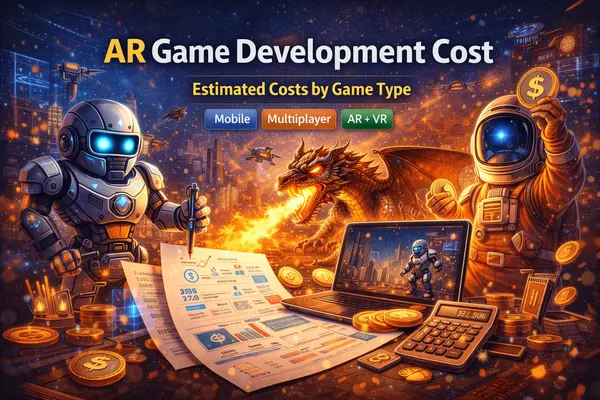
Quick answer: A simple AR game costs $15,000–$50,000. A mid-range AR game runs $50,000–$150,000. A large, feature-rich AR game costs $150,000–$500,000+. Keep reading to find out which bracket your project fits.
If you are planning an AR game, the first question is always: how much is this going to cost?
The answer depends on platform, game type, art quality, and team location. The ranges below cover each variable and explain what pushes a budget higher or lower. They are based on typical project scopes — not list prices.
What Makes AR Games Different From Regular Games
A regular game runs inside its own world. An AR game has to blend digital objects into the real world — in real time, on a moving phone camera, on thousands of different devices.
That extra challenge is what drives up the cost. Your team needs to:
- Track real surfaces accurately — floors, walls, tables
- Handle bad lighting and low-contrast environments
- Keep the game running smoothly on mid-range phones
- Make sure AR objects stay where they are placed and do not drift
These are not easy problems. They take specialist skills and more testing time than a normal mobile game.
AR Game Development Cost by Game Type
The type of game you want to build is the biggest factor in cost. Here is a simple breakdown:
| Game Type | Example | Typical Cost | Build Time |
|---|---|---|---|
| Simple AR game | Marker-based card game, basic AR puzzle | $15,000 – $50,000 | 2–4 months |
| Mid-range AR game | Location-based game, AR adventure on mobile | $50,000 – $150,000 | 4–8 months |
| Multiplayer AR game | Two players sharing the same AR space | $100,000 – $250,000 | 6–12 months |
| Large AR game | Open world, live service, complex mechanics | $250,000 – $500,000+ | 10–18 months |
| Branded AR experience | WebAR for a brand campaign | $30,000 – $120,000 | 3–7 months |
Main Cost Drivers in AR Game Development
Most AR budgets rise because of five variables. Understanding them before scoping helps avoid surprises mid-project:
1. The Number of Platforms
iOS only costs less than iOS + Android. Adding WebAR — so the game works in a browser without a download — adds another layer. Each platform uses different AR tools: ARKit for iPhone, ARCore for Android, 8thWall for web. Each needs separate work.
2. Multiplayer Features
Getting two players to see the same AR objects in the same real space at the same time is technically hard. You need a real-time server, spatial anchor syncing, and solid network code. This alone can add $30,000–$80,000 to a project.
3. 3D Art Quality
High-quality 3D characters and environments take a lot of time to build. A simple AR game with basic shapes costs far less than one with detailed animated characters and rich visual effects.
4. Location Features
If your game uses the player's GPS location — placing a game object at a real landmark, for example — you need map APIs, location services, and a lot of testing across different cities and environments.
5. Live Service After Launch
Many AR games need ongoing updates — new content, seasonal events, OS fixes as Apple and Google release new versions. This is a real ongoing cost that many budgets do not plan for.
AR Game Development Cost by Platform
Fastest to ship
Broader audience
Most common choice
No app download needed
Building iOS first and launching Android later is a smart way to manage budget. You test the game on iOS, get real player feedback, then invest in the Android build knowing the game already works.
AR Game Cost Estimator
Select your options — the estimate updates instantly.
1 — Game type
2 — Platform
3 — Multiplayer
4 — Location features
5 — 3D art quality
6 — Team location
Estimated budget range
$15k – $50k
Typical timeline: 2–4 months
Planning ranges based on typical project scopes. Does not include third-party API licensing, post-launch hosting, or content updates.
Get a scoped estimate for your project →What These Numbers Include
The cost ranges in this guide cover the standard scope of a full AR game build:
- Discovery — game design document, AR interaction model, scope definition
- AR engineering — SDK integration (ARKit, ARCore, 8thWall), surface tracking, spatial anchors
- 3D art and animation — characters, environments, UI, visual effects
- Game development — core gameplay loop, progression, scoring, physics
- QA and device testing — testing across multiple devices and lighting conditions
- Launch support — App Store submission, basic server setup, release prep
Not included in these ranges: third-party API licensing fees (map data, analytics), ongoing hosting costs after launch, post-launch content updates, platform-specific compliance audits, and marketing or ASO work. These vary too widely by project to give a useful generic figure.
Typical AR Game Budget Breakdown
Here is roughly how the budget splits on a $100,000 AR game project:
| Phase | What Happens | % of Budget |
|---|---|---|
| Discovery & Design | Game design document, AR interaction model, wireframes | 10–15% |
| AR Engineering | SDK integration, surface tracking, spatial anchors | 25–35% |
| 3D Art & Animation | Characters, environments, effects, UI | 20–30% |
| Game Development | Core gameplay, progression, scoring, loops | 15–25% |
| QA & Testing | Device testing, tracking accuracy, performance | 10–15% |
| Launch & Submission | App Store certification, server setup | 5% |
Team Size and Cost — Who You Need
A typical AR game team looks like this:
| Role | What They Do | Needed For |
|---|---|---|
| AR Engineer | ARKit, ARCore, 8thWall SDK integration | Every AR project |
| Unity Developer | Game logic, physics, player input | Every AR project |
| 3D Artist | Characters, objects, environments | Every AR project |
| Game Designer | Mechanics, progression, UX | Every AR project |
| Backend Developer | Servers, leaderboards, multiplayer | Multiplayer and live service |
| QA Tester | Device testing, bug reports | Every AR project |
| Producer | Milestones, client communication | Projects over $50k |
Freelancer vs Agency vs In-House — Which Is Cheaper?
This is a real question, so here is a straight answer:
| Option | Cost Level | What to Know |
|---|---|---|
| In-house team | Highest | Full control, but salaries, benefits, tools, and office space add up fast. Rarely makes sense for a first AR game. |
| US/UK agency | $150–$250/hr | High quality and easy communication. Best for brands with large budgets and strict deadlines. |
| India/Eastern Europe studio | $40–$90/hr | Strong quality at lower rates. Works best when you pick a studio with dedicated AR engineers, not a general dev shop. |
| Freelancers | Lowest upfront | Coordination risk is high. You manage multiple people across different time zones. One person leaving mid-project can stop the whole build. |
How to Keep AR Game Development Costs Under Control
Four things consistently keep budgets on track:
Start with a prototype
Build a basic playable version in 3–6 weeks before committing to full production. It costs $5,000–$20,000 and proves the core AR mechanic works on real devices before you spend the rest of the budget.
Lock the scope before development starts
Most budget overruns happen because features get added during development. Write down exactly what the game does before a single line of code is written. Adding multiplayer halfway through a solo game build costs 3x more than planning it from the start.
Pick one platform first
Launch iOS first, Android second. This cuts your initial build cost and lets you test the game with real players before doubling the engineering work for Android.
Plan for post-launch costs
Set aside 15–20% of your build budget per year for updates, new OS compatibility, and optional new content. An AR game with no updates after launch loses players fast.
Frequently Asked Questions
How much does a simple AR game cost?
A simple AR game — like a marker-based puzzle or basic mobile AR experience — costs between $15,000 and $50,000. Build time is roughly 2–4 months with a small, focused team.
How long does it take to build an AR game?
A simple AR game takes 2–4 months. A mid-range game takes 4–8 months. Large multiplayer AR games take 10–18 months. The timeline depends on complexity, art quality, and the number of platforms you target.
Is ARKit or ARCore more expensive to develop for?
Neither is significantly more expensive on its own. The cost goes up when you build for both — because ARKit (iOS) and ARCore (Android) have different APIs and each needs separate testing. Expect to add 30–50% to a single-platform budget when going cross-platform.
What is the cheapest way to build an AR game?
One platform (iOS first), simple 3D art, no multiplayer, no live service, a prototype before the full build. You can build a solid AR game experience for $20,000–$40,000 this way. An AR game development studio based in India or Eastern Europe with dedicated AR engineers gives you the best cost-to-quality ratio.
Does WebAR cost less than a native AR app?
Often yes. WebAR runs in a browser using tools like 8thWall, so users do not need to download an app. This removes the App Store submission process and reduces the audience barrier. WebAR typically costs $25,000–$90,000 for a branded experience, compared to $30,000–$130,000 for a full iOS + Android native build.
Summary — AR Game Cost at a Glance
| Game Size | Cost | Timeline | Best For |
|---|---|---|---|
| Simple / prototype | $15k – $50k | 2–4 months | Testing an idea, branded experiences |
| Mid-range | $50k – $150k | 4–8 months | Consumer apps, location games, B2B training |
| Multiplayer | $100k – $250k | 6–12 months | Social experiences, competitive games |
| Large / live service | $250k – $500k+ | 10–18 months | Flagship consumer game, enterprise platform |
Need a Realistic AR Game Budget?
Share your game type, target platforms, and feature list. We will give you a practical cost range and timeline based on your specific scope — not a generic bracket.
Get a Scoped Cost Estimate →