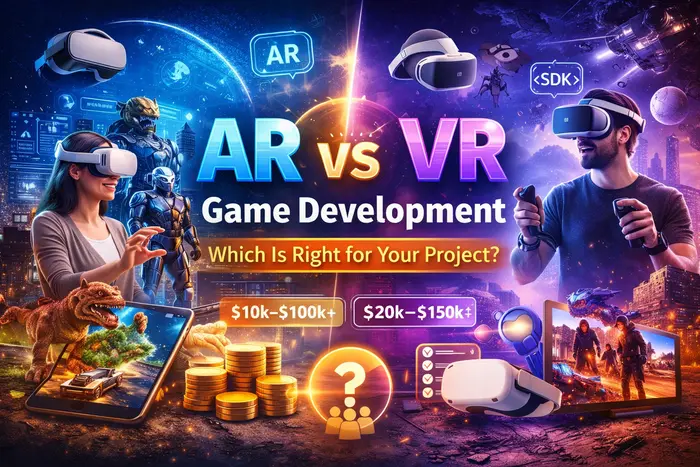
AR vs VR Game Development: Which Is Right for Your Project?
AR adds digital content to the real world. VR puts players inside a fully digital world. Each is right for different types of games, budgets, and audiences.
This guide covers cost, hardware, audience reach, tech stack, and which game types suit each technology.
Choose AR if you need…
- Players to use their own phone
- No headset requirement
- Real-world location or object interaction
- Branded or WebAR campaigns
- Wide reach on iOS and Android
- Lower entry cost for players
Choose VR if you need…
- Full immersion in a separate environment
- Players to feel physically present
- High-intensity training or simulation
- Seated or room-scale gameplay
- Meta Quest or PC VR platform
- High-quality, premium experience
AR vs VR Game Development — Side by Side
| Factor | AR (Augmented Reality) | VR (Virtual Reality) |
|---|---|---|
| What it does | Adds digital content to the real world — players see both at once | Replaces the real world with a fully digital environment |
| Hardware needed | Smartphone (iOS or Android) — no extra hardware required for most AR games | Headset required — Meta Quest, PlayStation VR2, or PC VR |
| Player audience | Very wide smartphone reach across iOS and Android | Smaller but growing headset audience |
| Player cost to play | Zero extra cost if they already own a phone | Headset adds an extra hardware cost for each player |
| Immersion level | Semi-immersive — real world is still visible | Fully immersive — real world is blocked out |
| Primary SDKs | ARKit (iOS), ARCore (Android), 8thWall (browser), AR Foundation (cross-platform) | OpenXR, Meta XR SDK, SteamVR, PlayStation VR SDK |
| Game engine | Unity (most common), Unreal Engine | Unity, Unreal Engine (both widely used) |
| Simple game cost | $15,000–$60,000 | $40,000–$150,000 |
| Mid-range game cost | $60,000–$180,000 | $150,000–$500,000 |
| Motion sickness risk | Low — real world provides stable visual anchor | Moderate to high — smooth movement design required |
| Browser delivery | Yes — WebAR via 8thWall, no app download needed | Limited — WebVR exists but is rarely used for games |
| Best game types | Location-based, branded experiences, casual games, training overlays | Simulation, action, adventure, training, social VR |
| Development complexity | Moderate — tracking and lighting conditions add complexity | High — full 3D environment, physics, comfort engineering |
What Each Technology Is Best For
AR works best for…
Location-based games
Games that use the player's real-world location as part of the gameplay — the Pokémon Go model. Players walk around their environment and interact with virtual objects placed at real-world locations. ARCore and ARKit both support this natively.
Branded experiences and WebAR
Campaigns that launch in a browser without an app download. A retail brand can put a WebAR experience on a product page using 8thWall — customers scan a QR code and see 3D content in their phone camera. No app, no friction, no headset.
Casual mobile AR games
Short-session games built for iOS and Android. AR works well for puzzle, strategy, and social games where the real-world environment is part of the experience — placing game boards on tables, building structures on floors.
Enterprise training overlays
AR is used in field service, manufacturing, and healthcare to overlay step-by-step instructions onto real equipment. The engineer still sees the real machine — the AR layer adds the guide on top. No room needed, no headset, just a phone or smart glasses.
VR works best for…
Action and simulation games
Games where the player needs to feel physically present — combat, sports, rhythm games like Beat Saber. VR's full immersion makes physical interaction feel real. The player's body movement drives the gameplay in a way that AR cannot replicate.
Training simulations
High-stakes training — aviation, military, medical, emergency response — where the environment must feel completely real and distractions must be eliminated. VR removes the real world entirely, which is the point. Players practise actions that would be dangerous or expensive in reality.
Social and multiplayer VR
Shared virtual spaces where multiple players are present as avatars. VR gives a sense of shared physical presence that flat-screen multiplayer does not. Platforms like VRChat and Rec Room built their entire model on this.
Narrative and adventure games
Story-driven games where the player needs to feel inside the world. Half-Life: Alyx is the best example. VR gives players a sense of being inside the world that no other format matches.
Cost Comparison: AR vs VR Game Development
VR usually costs more than AR. VR needs a full 3D world, more comfort testing, and more headset testing. AR can use the real world as the backdrop, which cuts a lot of that work.
| Project tier | AR development | VR development |
|---|---|---|
| Simple / prototype | $15,000–$60,000 | $40,000–$150,000 |
| Mid-range game | $60,000–$180,000 | $150,000–$500,000 |
| Full commercial title | $180,000–$500,000+ | $500,000–$1,000,000+ |
| Hourly rate (offshore) | $15–49/hr | $25–75/hr (VR specialists typically cost more) |
| Main cost drivers | AR tracking complexity, 3D asset quality, number of platforms | Full environment creation, comfort testing, physics engineering |
| Where you save money | Real-world environment is free — no need to build the world from scratch | Reusable assets across scenes; standalone headsets cut QA hardware costs |
SDK and Tech Stack: What Changes Between AR and VR
The game engine (Unity or Unreal) is the same for both. What changes is the SDK layer underneath — the tools that handle tracking, rendering, and device communication are completely different between AR and VR.
AR SDKs and tools
ARKit (Apple)
iOS only. Best tracking quality on iPhone and iPad. Required for App Store AR games targeting Apple users.
ARCore (Google)
Android only. Covers most Android phones. Works alongside ARKit via AR Foundation for cross-platform builds.
AR Foundation (Unity)
Cross-platform layer that works with both ARKit and ARCore. Lets you build once and deploy to iOS and Android without separate codebases.
8thWall
Browser-based AR without an app download. Used for WebAR campaigns by brands like Vans and Nike. Works across many modern mobile browsers.
Vuforia
Strong for image-triggered AR — games that start when the camera sees a specific image or object. Common in card games, toys, and packaging-based AR.
VR SDKs and tools
OpenXR
The industry standard cross-platform VR SDK. Works across Meta Quest, HTC Vive, PlayStation VR, and most other headsets. Most new VR games should target OpenXR.
Meta XR SDK
Meta Quest tools for hand tracking, mixed reality, and room setup. Required for Quest-specific features not covered by OpenXR.
SteamVR
PC VR games distributed via Steam. Covers HTC Vive, Valve Index, and PC-tethered headsets. Best for high-end VR with the full power of a gaming PC behind it.
PlayStation VR SDK
Required for PlayStation VR2 games. Console-exclusive — needs Sony licensing to publish on PlayStation VR.
XR Interaction Toolkit (Unity)
Unity's built-in VR interaction system for movement, grabbing, menus, and hand tracking. Works across OpenXR-compatible headsets.
How to Choose: Decision Table
Answer these questions about your project. Each answer points toward AR, VR, or either.
| Question | If the answer is… | Choose |
|---|---|---|
| Does the player need to be in their real environment? | Yes — the real world is part of the game | AR |
| Should the player feel fully transported to another world? | Yes — immersion is the core mechanic | VR |
| What device will players use? | Their own phone, no extra hardware | AR |
| What device will players use? | A headset they own or will buy | VR |
| Do you need the widest possible audience? | Yes — you want the widest phone audience | AR |
| Is this a branded campaign or marketing activation? | Yes — needs to run in a browser | AR (WebAR) |
| Is this a training or simulation product? | Needs real equipment visible — field service, surgery | AR |
| Is this a training or simulation product? | Needs full environment, no distractions — aviation, emergency response | VR |
| What is your development budget? | Under $80,000 | AR (lower base cost) |
| What is your development budget? | $150,000+ | Either — both are viable |
| Can you build both and decide later? | Prototype first with AR — if you need more immersion, move to VR with more budget | Start with AR |
AR vs VR Game Development: Common Questions
Is AR or VR cheaper to develop?
AR is generally cheaper at every tier. A simple AR game starts around $15,000–$60,000. A comparable VR game starts at $40,000–$150,000. The gap comes from world-building: AR uses the real world as the backdrop, so developers do not need to build environments from scratch. VR requires a complete 3D world, which adds art, engineering, and testing time. The full cost breakdown for each is in the AR cost guide and VR cost guide.
Can AR and VR use the same game engine?
Yes. Unity and Unreal Engine both support AR and VR. The game engine is the same — what changes is the SDK layer. For AR you use ARKit, ARCore, or 8thWall. For VR you use OpenXR, Meta XR SDK, or SteamVR. A studio experienced in both can switch between them, but AR and VR specialists develop different skills over time, so it is worth checking whether a studio has shipped games in the specific technology you need.
Which has a larger player audience — AR or VR?
AR reaches more players today. Most AR games run on smartphones, giving very wide reach. VR requires a headset. Meta Quest has sold well, but the headset audience is much smaller than the smartphone audience. For a game targeting maximum reach, AR is the stronger choice. For a game targeting players who already own a headset and will spend more time per session, VR is a better fit.
Can you build an AR game and then add VR later?
Technically yes, but the game design usually needs to change. AR and VR are not just different rendering modes — they are different interactions with the world. An AR game built around the player moving through their physical environment does not automatically translate to VR. If you want to build something that works in both, design for that from the start. If you want to prototype cheaply and decide later, AR is the lower-risk starting point because the core game mechanics are easier to test without expensive hardware.
What is WebAR and does VR have an equivalent?
WebAR is AR that runs in a mobile browser without an app download. Tools like 8thWall make it possible — the user scans a QR code and the AR experience opens in their browser camera. It is widely used for branded campaigns, product try-ons, and marketing activations. VR has a browser-based equivalent called WebXR, but it is rarely used for commercial games because browser-based VR performance is much weaker than native headset apps. For VR, a native Meta Quest or Steam app is almost always the right approach.
Ready to Build? Talk to the Right Team.
Share your game type, target platform, and budget. We will confirm whether AR or VR is the better fit and give you a realistic cost and timeline estimate.