

BSP E-Wallet Delinking in Philippines is a deposit-conversion shock for casino apps. When wallet “casino” links disappear, users hit dead ends, and deposit attempts drop or fail across the funnel.. In August 2025, Bangko Sentral ng Pilipinas issued Memorandum No. M-2025-029, ordering all BSP-supervised institutions to remove links that provide in-app gambling access from their mobile payment apps and websites within 48 hours. That single requirement breaks a lot of “old” casino deposit journeys. This guide explains what changed, why deposits fail, and how casino apps can fix the journey without trying to “work around” the rule.
What the BSP memo says about “in-app gambling access”
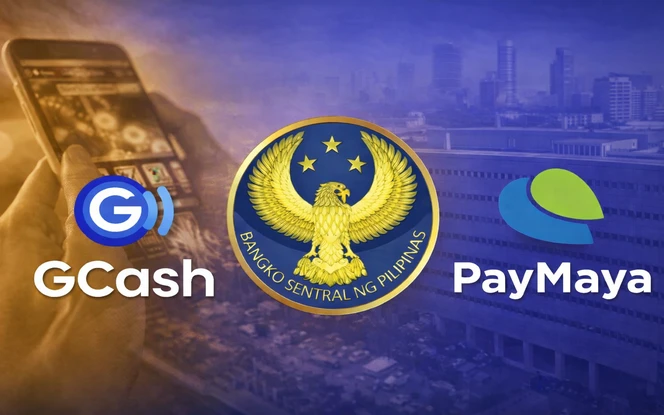
- The suspension was approved by the Monetary Board via Resolution No. 805 dated 14 August 2025.
- BSP approved the suspension of in-app gambling access from BSP-supervised institutions’ mobile payment apps and websites.
- The suspension is pending issuance and implementation of the policy that sets standards and expectations for BSP-supervised institutions in providing online gambling payment services.
- Therefore, all BSP-supervised institutions were instructed to remove links that provide in-app gambling access within 48 hours upon issuance of the memorandum.
- “In-app gambling access” includes any product/service that redirects an account holder to a gaming/gambling site.
What “BSP delinking” means in plain language
- It is about in-app access links inside payment apps and websites.
- It is not written as a blanket statement that “all e-wallet payments to gambling are banned.” Instead, it suspends in-app access and signals a broader policy is coming for online gambling payment services.
However, in practice, payment providers may tighten risk rules at the same time. So, even if the memo targets links, your deposit success rate can still drop due to policy enforcement across the funnel.
Why deposits fail after BSP E-Wallet Delinking
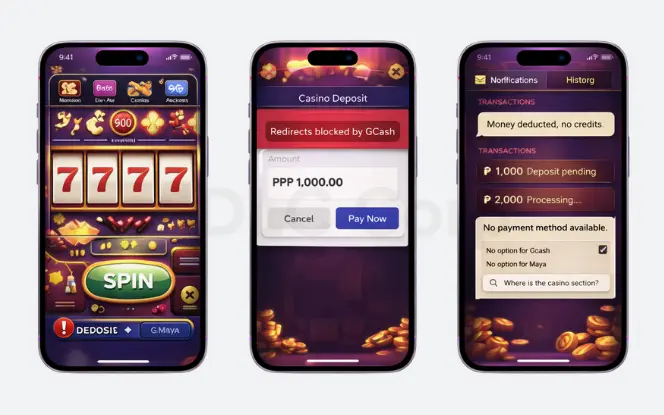
1) Entry points disappear when wallet casino tiles are removed
Many players used to start from the wallet:
- Wallet app → casino tile → operator page → deposit prefilled
If that tile/link is removed, the user never reaches your deposit screen. As a result, your conversion looks like “deposit failed,” but it’s actually a journey broken earlier.
2) Redirect-based cash-in flows get blocked or flagged
Some cash-in journeys rely on:
- embedded webviews
- deep links
- in-app redirects that resemble “wallet → gambling access”
Since the memo defines in-app gambling access as a redirect to a gambling site, those patterns become high-risk.
3) Trust drops when the wallet UI suddenly changes
When users don’t understand what changed, they assume:
- the operator is shady, or
- the wallet is “not safe,” or
- the deposit will get stuck
So, they stop trying.
4) Support tickets spike without clear statuses and logs
Then support tickets explode:
- “Money deducted but no credits”
- “Pending for hours”
- “No option for GCash/Maya anymore”
- “Where is the casino section?”
If you don’t have clean audit trails and status codes, disputes get expensive.
The fix after BSP E-Wallet Delinking in Philippines (compliant deposit playbook)
This section is written for product, payments, and engineering teams. Still, it stays practical.
Step 1: Map Your Current Deposit Journey End-To-End
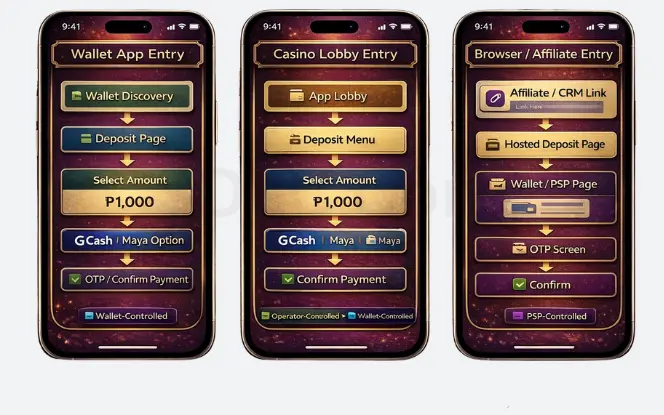
1.1 List every deposit entry path
Document every route a player uses to start a deposit:
From a wallet app (wallet menu / directory / tile → operator page → deposit)
From your app lobby (deposit button → cashier)
From a browser landing page (web → login → deposit)
From CRM links (SMS/email/push → deep link → deposit)
From affiliate links (affiliate → landing page → deposit)
1.2 Break each path into steps (happy path)
For each entry path, write the flow step-by-step so nothing is assumed:
Operator-controlled: your UI, your APIs, your backend logic
Wallet-controlled: wallet menus, wallet directories, wallet webviews/redirects
PSP-controlled: hosted pages, redirect handlers, OTP screens, callback
1.3 Tag every step by dependency (who controls it)
- Open deposit screen
- Pick method (e-wallet / bank / OTC)
- Enter amount
- Create deposit → generate reference ID
- Redirect / authorize (wallet or PSP)
- Return to app
- Confirm status (webhook or poll)
- Credit balance + show receipt
This makes the risk visible immediately: anything wallet-controlled can vanish or change quickly due to “link removal.”
1.4 Output: a “delinking-risk” view
At the end, you should be able to point to the exact breakpoints:
- Which paths depend on wallet-side casino links
- Which steps use webviews/deep links/redirect patterns that look like “in-app gambling access”
- Which PSP steps cause timeouts, pending states, or missing callbacks
Step 2: Remove wallet-dependent “access” assumptions
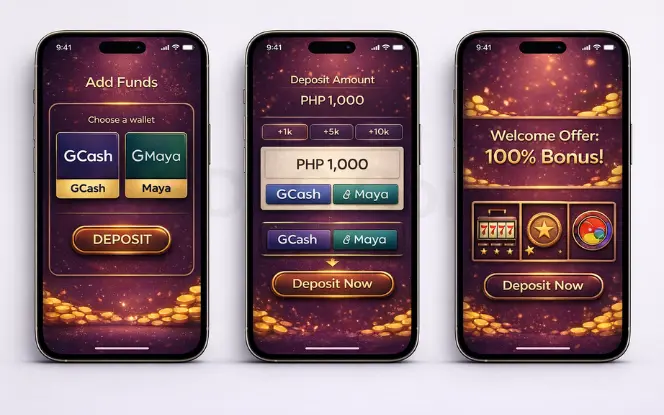
After BSP E-Wallet Delinking in Philippines, anything that depends on wallet-side “casino discovery” should be treated as unstable. If the wallet removes links, directories, or menus, your deposit path can break before the user reaches your cashier.
2.1 Identify wallet-dependent conversion assumptions
If your conversion relies on any of the following, mark it non-reliable:
- Wallet “casino” menu visibility
- Wallet-hosted operator directories or listings
- Wallet internal redirects that send users to gambling pages
- Wallet webviews or flows that look like “wallet → gambling access”
2.2 Move deposit initiation into channels you control
Shift the start of the deposit journey away from wallet discovery and into operator-controlled surfaces:
A clear Deposit button inside your app lobby (top nav + cashier entry)
Your own deposit landing page (web) that you can update quickly
Direct navigation + verified links (CRM links that open your deposit screen, not wallet directories)
2.3 Keep link behavior compliant and low-risk
Shift the start of the deposit journey away from wallet discovery and into operator-controlled surfaces:
- Avoid designing journeys that require “wallet → casino tile → operator redirect”
- Prefer “operator → wallet authorization → return to operator” patterns
- Make every entry path work even if wallet discovery disappears
Step 3: Rebuild deposit UX with clear user choices
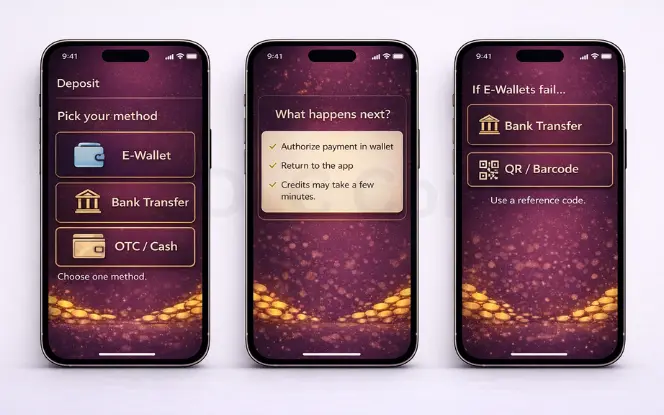
Once you control deposit initiation, the next goal is clarity. Users drop when they feel surprised, stuck, or uncertain. So design the cashier to set expectations and provide safe fallbacks.
3.1 Start with a “Pick your method” screen (simple tiles)
Use a clean first screen with 3–5 options max:
E-wallet
Bank transfer
Card (only if allowed)
OTC / Cash (if supported)
Keep labels simple and consistent. Avoid wallet-specific “casino” language.
3.2 Show a “What happens next” mini-flow (reduce surprise)
Immediately after method selection, show a short 2–3 line expectation card:
“You’ll be redirected to authorize the payment.”
“After approval, you’ll return to the app.”
“Credits may take up to X minutes.”
This small step reduces retries, rage-taps, and support tickets.
3.3 Add a fallback ladder (don’t trap users in one rail)
If an e-wallet option fails or disappears, offer a clear next best action:
Bank transfer with a generated reference code
OTC / cash with a barcode/reference (where supported)
Alternate provider rail (only where compliant)
Make fallbacks visible before users abandon the cashier.
3.4 Add “missing option” and “pending” guidance inside the UI
Two short helper messages prevent confusion:
- “If a wallet option is missing, choose another method on this screen.”
- “If you were charged but not credited, don’t retry immediately—use your reference ID.”
Step 4: Implement payment-safe engineering patterns
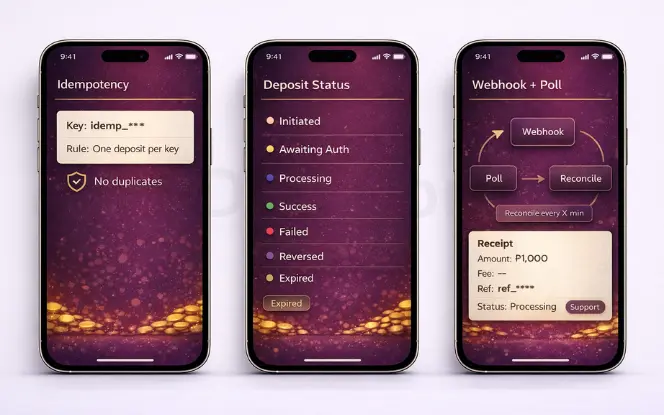
Policy may trigger the drop, but reliability decides whether you recover. These patterns prevent duplicate credits, reduce “stuck pending” cases, and give support the proof they need.
4.1 Idempotency keys for deposit creation
Use idempotency so retries and double taps don’t create duplicate deposits.
Generate an idempotency key per attempt
Enforce it on deposit creation APIs
Return the same reference ID if the same key repeats
4.2 Status codes that match reality (state machine)
Avoid vague “success/fail.” Use states that reflect what’s happening:
INITIATED (deposit created, reference ID issued)
AWAITING_AUTH (waiting for wallet/PSP authorization)
PROCESSING (provider accepted, confirmation pending)
SUCCESS / FAILED (terminal outcome)
REVERSED (refund/chargeback/void)
EXPIRED (authorization window ended)
4.3 Webhook + poll fallback (don’t rely on callbacks only)
Some providers miss callbacks, arrive late, or send duplicates. Therefore:
Accept and verify webhook events
Also poll by transaction reference for a short window after redirect/return
Deduplicate events so repeated callbacks don’t double-credit
4.4 Reconciliation job (scheduled safety net)
Run a reconciliation job every X minutes to catch:
- Money deducted but not credited
- Deposits stuck in PENDING beyond your SLA
- Provider reversals that your system didn’t reflect
4.5 User-visible receipt (dispute-proof evidence)
Show a receipt screen for every attempt, even if pending:
Amount
Fee (if any)
Reference ID
Timestamp
Status
Support CTA (pre-filled with reference ID)
That receipt reduces panic retries and gives disputes/support what they need immediately.
Step 5: Add “delinking-aware” monitoring
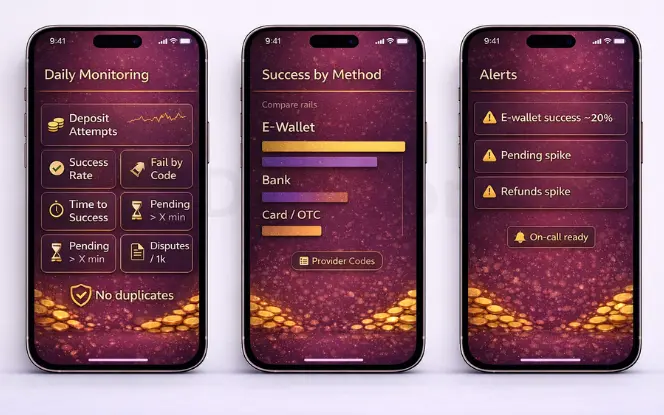
Treat delinking impacts like an incident class. Your job is to detect conversion drops early, understand where the break happens (entry vs authorization vs confirmation), and reduce dispute cost.
5.1 Track daily cashier health metrics
Set alerts for pattern changes that indicate policy or provider enforcement:
- Deposit attempt rate
- Success rate by method
- Fail rate by provider response code
- Average time to success
- Pending deposits > X minutes
- Dispute rate per 1,000 deposits
5.2 Alert on sudden shifts (catch problems within hours)
Set alerts for pattern changes that indicate policy or provider enforcement:
E-wallet success drops 20% day-over-day
Pending deposits spike above baseline
Refunds/reversals spike
Authorization drop-offs increase (AWAITING_AUTH not returning)
5.3 Make monitoring actionable (not just charts)
When an alert triggers, your dashboard should answer:
Did the break happen at entry (users not reaching cashier)?
At authorization (AWAITING_AUTH spikes)?
At confirmation (PROCESSING/PENDING grows, webhooks missing)?
That’s what turns monitoring into a real early-warning system.
What to Tell Users When Deposits Fail
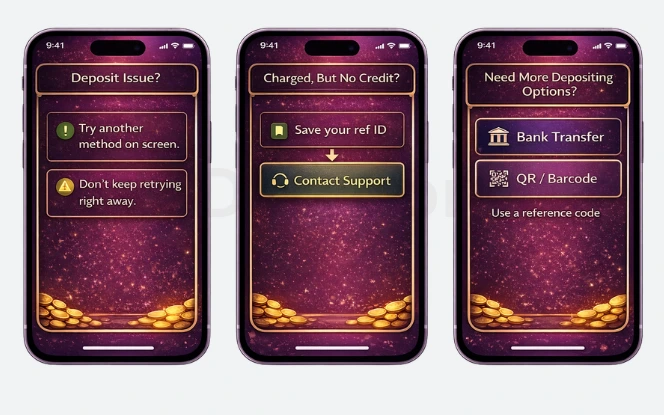
Players don’t care about policy language. They care about what to do next. So, add a short “Deposit help” section in-app:
- “If your wallet option is missing, choose another method on screen.”
- “If you were charged but not credited, don’t retry immediately.”
- “Instead, save your reference ID, contact support from this button.”
- “Most pending deposits resolve within X minutes.”
Keep it calm. Also, keep it specific.
Why GCash Removed Casino Links
If you notice casino links disappear inside GCash (or other wallets), the simplest explanation is compliance with BSP’s instruction to remove links that provide in-app gambling access within 48 hours. In other words, wallets may remove menus, tiles, or directories that redirect users to gambling sites because that redirect behavior is explicitly covered by the memo’s definition.
Operator Checklist: what “Good” Looks Like after Delinking
Your deposit flow is in a better place when:
- Users can start a deposit from your app in under 2 taps
- Every deposit has a reference ID visible to the user
- Pending deposits auto-reconcile without manual support work
- Failures show plain reasons and next actions
- Support can pull complete logs fast

Conclusion
BSP delinking has made wallet-dependent casino deposit flows unreliable by design. To recover conversion and stay compliant, operators must fully own their deposit journey, remove dependence on wallet-side casino links, and rebuild payments with clear UX, fallbacks, and strong reconciliation. SDLC Corp helps iGaming operators do exactly this by redesigning compliant deposit flows, integrating wallet-agnostic payment rails, hardening payment logic, and setting up monitoring that prevents silent revenue loss when policies shift.
FAQs
Are e-wallets ordered to unlink from online gambling?
BSP’s memo instructs BSP-supervised institutions to remove links that provide in-app gambling access in their mobile payment apps and websites.
So, it is specifically about in-app access/redirect links, as defined in the memo.
What is the BSP 48 hours?
It refers to the compliance window. BSP instructed BSP-supervised institutions to remove those in-app gambling access links within 48 hours upon issuance of the memorandum.
What is the BSP memo for gambling?
For this issue, it’s Memorandum No. M-2025-029, titled “Suspension of In-app Gambling Access in Mobile Payment Apps and Websites.”
It suspends in-app gambling access and orders removal of the relevant links.
Why did GCash remove online casinos?
Most likely, it’s to comply with BSP’s instruction to remove in-app links that redirect users to gambling sites, since that redirect behavior is included in the memo’s definition of “in-app gambling access.”
Does BSP delinking stop all casino deposits?
No. The BSP memo targets in-app gambling access links inside payment apps and websites. However, deposit success can still drop because payment providers may tighten rules and remove casino entry points at the same time.
What is “in-app gambling access” according to BSP?
It includes any product, service, or feature that redirects an account holder to a gaming/gambling site from inside a payment app or website. This definition is the core reason wallet casino links were removed.
How can casino apps reduce deposit drop-offs after delinking?
First, stop relying on wallet “casino” directories or tiles. Then add a fallback ladder inside your deposit flow, show clear error reasons with next steps, and log every attempt with a reference ID. As a result, users retry correctly and support resolves issues faster.
Until when will the suspension stay in place?
BSP said the suspension remains until it finalizes the policy standards for BSP-supervised institutions that provide online gambling payment services. So, operators should treat the current state as ongoing and design deposits to work without wallet-side gambling links.