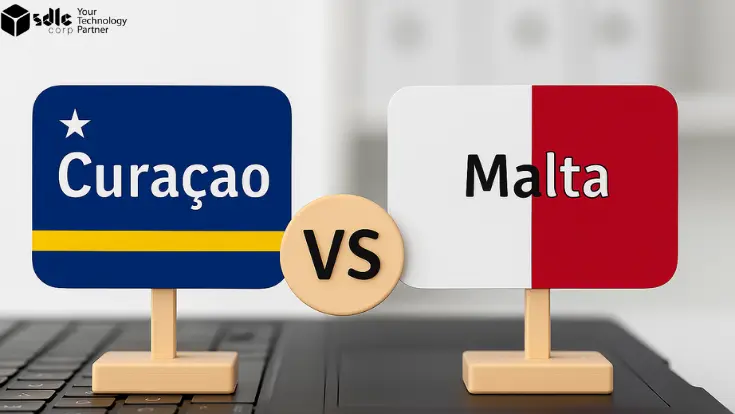
The Curaçao vs Malta iGaming licence decision is the most common jurisdiction choice new online casino and sports betting operators face. Both are legitimate, widely used licensing routes — but they solve very different problems. Curaçao (now regulated by the Gaming Control Board / GCB) is the faster, lower-cost offshore route for operators who need to launch quickly with a manageable compliance burden. Malta (the Malta Gaming Authority / MGA) is the credibility-first route for operators targeting regulated EU markets, tier-1 payment partners, and long-term commercial trust.
This guide gives you a direct side-by-side comparison of real costs, timelines, compliance requirements, banking access, player trust, and which type of operator each jurisdiction actually suits. For the full jurisdiction landscape including UK, USA, and Panama, see our gambling licence overview guide.
Quick verdict — Curaçao vs Malta iGaming licence
- You need to launch in 2–4 months
- Budget under $100k for Year 1 licensing
- Targeting emerging markets (LatAm, Africa, Asia)
- Testing product-market fit before heavy compliance investment
- Comfortable with Tier 2 payment processor relationships
- B2C operator without EU-regulated market ambitions initially
- Targeting EU-regulated markets (Germany, Netherlands, Sweden)
- Need Visa/Mastercard and tier-1 banking access
- B2B supplier serving MGA-licensed operators
- Building a brand that requires player trust signals
- Have the budget for €25k–€35k+ in fees plus compliance overhead
- Planning to seek additional regulated market licences later
Curaçao iGaming licence — what it is now in 2025
Curaçao underwent a major regulatory reform in 2023–2024. The old master licence / sub-licence model (where a single master licence holder sub-licensed to hundreds of operators) has been replaced by a direct licensing framework under the Gaming Control Board (GCB). Every operator now applies for their own licence directly with the GCB rather than through a master licence intermediary.
- Regulator: Gaming Control Board (GCB) — Curaçao. Replaced the old Curaçao eGaming (CEG) and other master licence systems.
- Licence type: Single B2C licence covering remote gambling products (casino, sports betting, poker). B2B supplier licences available separately.
- Application fee: Approximately ANG 6,000 (~$3,300 USD). Annual licence fee approximately ANG 34,000 (~$19,000 USD).
- Timeline: 2–4 months for a well-prepared application under the new GCB framework.
- Corporate requirement: A Curaçao-incorporated entity is required to hold the licence. A local registered agent and a local managing director are required.
- Technical requirements: RNG certification, responsible gambling tools (self-exclusion, deposit limits), AML/KYC programme, and a data protection policy. Less prescriptive than MGA but not absent.
- Player protection: Basic — self-exclusion and responsible gambling messaging required. No equivalent to GAMSTOP or MGA's detailed player protection codes.
2024 reform important: If you are reading advice about Curaçao licences that references "master licence sub-licences" or "CEG/CIL licences" — that information is outdated. The new GCB framework requires all operators to hold their own direct licence. Existing sub-licences were being transitioned. Apply directly to the GCB under the new framework. For the full Curaçao application process step by step, see our Curaçao iGaming licence guide.
Malta MGA licence — what it covers
The Malta Gaming Authority (MGA) is the EU's most respected iGaming regulator. An MGA licence is the gold standard for operators targeting European players and tier-1 commercial partnerships.
- Regulator: Malta Gaming Authority (MGA). EU regulatory body operating under EU law including GDPR and EU AML directives.
- Licence types: B2C Gaming Service Licence (for operators) and B2B Critical Gaming Supply Licence (for software/platform suppliers). A single Gaming Service Licence covers all remote product types — casino, sports betting, poker, virtual sports.
- Application fee: €5,000 non-refundable application fee. Annual compliance contribution: €25,000 (for most operators) rising with revenue tiers. Total Year 1 fees: approximately €30,000–€35,000 in MGA costs alone, before legal advisory and compliance infrastructure.
- Timeline: 4–6 months for a complete, well-prepared application. Complex ownership structures, overseas applicants, or weak compliance documentation extend this to 8–12 months.
- Corporate requirement: A Malta-incorporated company is recommended (not strictly required but strongly preferred). Physical office presence in Malta is required.
- Technical requirements: Comprehensive — RNG certification from an MGA-approved test house, technical audit of the platform, AML programme meeting EU standards, detailed player protection systems, GDPR compliance, and ongoing technical reporting.
- Player protection: High — detailed responsible gambling requirements, player verification, enhanced due diligence thresholds, mandatory self-exclusion tools, and MGA's player complaints process.
MGA as a EU passport: An MGA licence does not automatically allow you to serve players in all EU countries — many EU states have their own national licensing requirements (Germany, Netherlands, Sweden, Denmark all require separate national licences). However, an MGA licence significantly strengthens your application for these national licences and signals regulatory credibility to national regulators. For an EU market overview, see our Europe gambling licence guide.
Curaçao vs Malta iGaming licence — direct comparison
| Factor | Curaçao (GCB) | Malta (MGA) |
|---|---|---|
| Application fee | ~$3,300 (ANG 6,000) | €5,000 (non-refundable) |
| Annual licence fee | ~$19,000/yr (ANG 34,000) | €25,000/yr base (rises with GGR) |
| Total Year 1 cost (fees only) | ~$22,000–$30,000 | €30,000–€35,000+ (fees only; legal/compliance extra) |
| Timeline to approval | 2–4 months | 4–6 months (up to 12 for complex cases) |
| Corporate requirement | Curaçao entity + local managing director | Malta entity strongly preferred + physical office |
| Compliance burden | Moderate — AML, KYC, RNG, responsible gambling basics | High — EU AML directives, GDPR, detailed player protection, technical audit |
| Player protection standards | Basic — self-exclusion, deposit limits | High — comprehensive player protections, complaints process, EU standards |
| Banking / payment access | Tier 2–3 — crypto-friendly; mainstream processors limited | Tier 1 — Visa, Mastercard, PayPal, mainstream EU banking |
| Regulator reputation | Improving post-2024 reform; still viewed as offshore | Top tier — EU regulator, widely respected by players, partners, affiliates |
| Affiliate / partner acceptance | Many tier-2 affiliates; some tier-1 affiliates decline | Accepted by all major affiliates and sports media partnerships |
| EU market access | Not an EU licence — grey market status in most EU states | EU licence — credibility signal for national EU applications |
| B2B supplier licensing | Limited — most EU-licensed operators require MGA B2B | MGA B2B Critical Gaming Supply licence accepted globally |
| Crypto acceptance | Widely used for crypto casino operations | Possible but more regulated under EU crypto frameworks |
| Tax on gambling revenue | 0% gambling-specific tax in Curaçao | Gaming tax: 5% GGR (capped at €466,000/yr for most operators) |
| Ongoing reporting | Annual return, incident reporting, material change notifications | Quarterly/annual financial returns, monthly KPI reporting, technical compliance reporting |
Where each licence wins — the detail that matters
Banking and payment processing — MGA wins clearly
This is the most practically important difference for most operators. An MGA licence gives you access to Visa, Mastercard, PayPal, Trustly, and mainstream EU banking relationships. Curaçao-licensed operators are classified as high-risk merchants by most tier-1 payment processors — many simply will not onboard them. This means Curaçao operators often rely on cryptocurrency payments, alternative e-wallets, and tier-2/3 processors with higher fees and lower reliability. If your business model depends on mainstream card payments from EU players, the payment processing gap alone may justify the higher MGA cost.
Launch speed — Curaçao wins clearly
2–4 months vs 4–12 months is a meaningful difference in a fast-moving market. For operators entering a new vertical, testing a new market, or working to a competitive launch deadline, the Curaçao timeline advantage is real. Many operators launch on Curaçao first, validate their product with real players, and then transition to MGA once the business case justifies the higher compliance investment.
EU market access — MGA wins
A Curaçao licence does not give you legal access to serve players in EU-regulated markets. Germany, Netherlands, Sweden, Denmark, and others all require national licences — and operating in those markets without a national licence, regardless of your Curaçao approval, is illegal. An MGA licence strengthens your national licence applications in EU states and is the standard licence held by operators seeking to enter multiple EU regulated markets.
Crypto operations — Curaçao wins
Curaçao is the dominant licensing jurisdiction for crypto casino and blockchain gambling operations. The lighter compliance framework, crypto-friendly banking environment, and faster onboarding make it the practical choice for operators building on crypto infrastructure. MGA is possible for crypto operations but the EU's MiCA (Markets in Crypto-Assets) regulation adds additional complexity for crypto gambling under an EU licence.
B2B supplier licensing — MGA wins clearly
If you supply gambling software, games, or platforms to other operators, an MGA B2B Critical Gaming Supply licence is the industry standard. Most MGA-licensed operators require their software suppliers to hold MGA B2B status — a Curaçao B2B licence is not an adequate substitute for working with the major EU-facing operators.
Which iGaming licence is right for your business?
- You need to launch within 3 months
- Year 1 licence budget is under $50,000
- Primary markets are LatAm, Africa, Asia, or crypto-native
- You are testing a new product or entering gambling for the first time
- Your payment model is crypto-first or alternative payments
- You plan to transition to MGA once revenue justifies it
- You are running a B2C operation without EU white-list market ambitions
- You are targeting EU-regulated markets from day one
- You need Visa/Mastercard/PayPal payment access
- You are a B2B software supplier to EU-facing operators
- Your brand strategy requires top-tier regulatory credibility
- You are pursuing tier-1 sports sponsorships or media partnerships
- You plan to apply for national EU licences (DE, NL, SE) within 2 years
- Budget allows €50,000–€150,000 in Year 1 licensing and compliance costs
The two-stage approach: Many operators use both — launch on Curaçao to validate the product with real players while building the MGA application in parallel. Once MGA approval comes through (4–6 months later), transition the EU player base to the MGA-licensed entity. This is a legitimate and common strategy. The key risk is ensuring your Curaçao-era operations are compliant from day one — a regulatory action under the Curaçao licence can complicate your MGA suitability review.
Need help choosing the right licence for your iGaming product?
SDLC Corp builds iGaming platforms with compliance architecture for both Curaçao and MGA requirements — KYC/AML systems, responsible gambling tools, RNG-certifiable game architecture, and technical documentation for licence applications. See our iGaming software development services.
FAQ — Curaçao vs Malta iGaming licence
Is a Curaçao licence or Malta licence better?
Neither is objectively better — they suit different operators. Curaçao is better for operators who need speed (2–4 months), lower cost (~$22,000–$30,000 Year 1 fees), and flexibility to serve emerging markets. Malta is better for operators targeting EU-regulated markets, who need tier-1 payment processing (Visa/Mastercard), who are building brands requiring strong player trust signals, or who supply software to EU-facing operators. Many successful operators hold both — Curaçao for launch speed and emerging markets, MGA for EU expansion.
How much does a Malta MGA licence cost compared to Curaçao?
Curaçao: approximately $3,300 application fee plus ~$19,000 annual fee — total Year 1 licence cost around $22,000–$30,000. Malta MGA: €5,000 application fee plus €25,000 annual compliance contribution — total Year 1 MGA fees alone approximately €30,000–€35,000. On top of MGA fees, legal advisory, Malta company formation, physical office costs, and compliance infrastructure typically add €50,000–€150,000 in Year 1 total spend. Curaçao is significantly cheaper to establish and maintain at comparable GGR levels.
Can I use a Curaçao licence to serve EU players?
You can serve players in EU countries that do not have nationally regulated online gambling markets. However, in EU states with their own national licences (Germany, Netherlands, Sweden, Denmark, and others), operating without a national licence is illegal regardless of your Curaçao approval. A Curaçao licence does not give you EU market access — it is an offshore licence, not an EU licence. If EU-regulated market access is a priority, an MGA licence is the appropriate starting point followed by national licence applications.
Which licence do payment processors prefer?
Malta MGA — clearly and significantly. MGA-licensed operators access Visa, Mastercard, PayPal, Trustly, and mainstream EU banking relationships. Curaçao-licensed operators are classified as high-risk merchants by most tier-1 processors — many will not onboard them at all. Curaçao operations typically rely on cryptocurrency, alternative e-wallets, and tier-2/3 processors. If your business model requires mainstream card payment acceptance from EU players, the MGA licence's payment processing advantage alone can justify the higher cost.
How long does a Malta MGA licence take vs Curaçao?
Curaçao GCB: 2–4 months for a well-prepared direct application. Malta MGA: 4–6 months for a straightforward application, up to 8–12 months for complex ownership structures, overseas applicants, or applications requiring additional information rounds. The MGA timeline is longer because the review is more detailed — ownership, financial sustainability, compliance programme, technical systems, and key person suitability are all assessed in depth. The speed difference is real and relevant for operators with time-sensitive launch plans.