


Introduction
MVP vs full product development is one of the most important decisions a business can make at the start of a software project. It affects budget, launch speed, validation, delivery risk, and long-term growth. Choosing the right path early helps teams avoid wasted development effort and build with more confidence.MVP vs full product development is a common decision for businesses that want to launch the right product at the right stage.
The choice between MVP vs full product depends on your budget, launch speed, and how much validation you need before building more. Many teams do not fail because they build badly. They fail because they build too much before validating demand. A polished product with the wrong features is still the wrong product. On the other hand, a focused product that proves real demand gives you data, direction, and a better reason to invest further.
Businesses comparing MVP vs full product development often also review our custom software development services before choosing the right build approach.
When to Start with an MVP and When to Build the Full Product
Choose an MVP if your core market assumption is still unproven, your budget is limited, or you need fast user validation before committing to a larger build. Businesses at this stage often work with a startup product development company to validate ideas faster and reduce early product risk.
Businesses also evaluate related product decisions, such as choosing between a web app or a mobile app, before finalizing the right development path.
- Build an MVP when you need to learn first.
- Build a full product when the market is already validated.
What Is an MVP?
An MVP, or minimum viable product, is the simplest version of a product that helps you test a core business assumption with real users.

- one core use case
- a simple but usable experience
- a way to measure behavior
- clear success metrics before launch
- a small initial audience
- extra features added for future use
- dashboards no one needs yet
- complex role systems too early
- polished design without real validation
- long development cycles before user feedback
What Full Product Development Means
Full product development means building a broader, production-ready solution from the start. It usually includes a more complete feature set, stronger infrastructure, refined UX, testing coverage, security controls, and support for future scale.
This approach is common when the business already has strong evidence that the concept works, or when the product must meet technical, legal, or buyer expectations before launch.
A full product often includes:
- broader feature coverage
- stronger security and stability
- production-grade infrastructure
- complete onboarding and support flows
- higher quality assurance standards
- readiness for scale, integration, and maintenance
Key Differences: MVP vs Full Product
| Factor | MVP | Full Product |
|---|---|---|
| Main goal | Validate demand and learn fast | Launch a market-ready solution |
| Scope | Narrow and focused | Broader and more complete |
| Timeline | Faster | Longer |
| Cost | Lower upfront | Higher upfront |
| Risk | Lower validation risk | Higher if assumptions are wrong |
| Users | Early adopters | Broader market or enterprise buyers |
| Quality level | Functional and focused | More polished and scalable |
| Best for | New ideas, uncertain demand, limited runway | Validated demand, compliance-heavy, enterprise sales |
What the Data Says About Cost, Risk, and Product Validation
The case for building lean first is strong, especially in early-stage product development. Research often cited in startup and product strategy discussions shows that many businesses fail because they build products without strong market demand. Another common problem is feature overload. Teams build large parts of a product that users rarely use, while the truly important workflows receive less attention.
That pattern matters for one reason: early product decisions are expensive to reverse.
When teams start with an MVP, they gain:
- faster access to user feedback
- lower upfront investment
- easier product iteration
- clearer feature priorities
- better evidence for fundraising or expansion
When teams skip validation and move directly into full product development, they often face:
- longer time to first feedback
- more internal assumptions in roadmap decisions
- larger rework cost if user behavior differs from expectations
- delayed learning about pricing, onboarding, and retention
Real-World MVP Examples

Dropbox
Dropbox validated interest before building a full product experience. Instead of investing heavily upfront, the team used a simple demo video to show the concept. That helped prove demand before committing to a larger build.
Lesson: your MVP does not always need to be a large software product. It needs to test whether people care enough to act.
Airbnb
Airbnb started with a very small use case. The founders validated that people would pay for temporary accommodation in a personal space during a crowded event.
Lesson: a narrow use case can be enough to test a much larger business idea.
Uber
Uber started in one city with a limited service model. That reduced market complexity and helped the business validate the core experience before expanding.
Lesson: geography, audience, and feature constraints can improve learning.
When to Build an MVP First
In most cases, businesses should build an MVP first when In these cases, the market signal is still uncertain.
Your budget is limited
You need faster market feedback
You need the option to pivot
Your core assumption is still unproven
When Full Product Development Makes Sense
Compliance is non-negotiable
Enterprise buyers expect production readiness
- security reviews
- stable infrastructure
- documentation
- role controls
- service expectations
- integration readiness
The concept is already validated
Brand quality matters from day one
The product has deep technical dependencies
MVP Development Cost in 2026
Why the year should be used carefully
MVP vs full product also affects project cost because a smaller first release usually needs less time, fewer features, and lower initial investment.Adding a year like 2026 can help when the section includes current pricing, trends, or recent market context. However, if the year is added in too many headings or repeated across the article without need, it can look forced and make the content age faster. Use the year only where freshness matters, such as the SEO title, meta description, or cost section.
One of the biggest reasons businesses ask about MVP vs full product development is cost.If you are comparing MVP vs full product budgets, it also helps to understand what app development costs can look like in real build scenarios.

Typical MVP cost ranges
| Product Type | Estimated MVP Cost | Typical Timeline |
|---|---|---|
| Simple web app | $25,000–$60,000 | 2–4 months |
| Mobile app | $30,000–$80,000 | 3–5 months |
| Marketplace platform | $50,000–$150,000 | 4–6 months |
| AI-powered SaaS | $75,000–$200,000+ | 4–8 months |
| Compliance-heavy product | $75,000–$300,000+ | 6–12 months |
No-Code vs Custom MVP Development
When no-code MVP development makes sense
A no-code MVP is often the best option when:
- you need fast validation
- workflows are simple
- you are testing forms, dashboards, or basic automation
- you are a non-technical founder
- speed matters more than long-term scalability
When custom MVP development makes more sense
Choose custom development when:
- the product needs deeper integrations
- performance requirements are higher
- your logic is too complex for no-code tools
- data handling is sensitive
- compliance matters early
- mobile-native performance is important
No-code MVP vs custom MVP
| Factor | No-Code MVP | Custom MVP |
|---|---|---|
| Speed | Very fast | Moderate |
| Cost | Lower | Higher |
| Flexibility | Limited by platform | High |
| Scalability | Often limited | Better long-term |
| Compliance control | Lower | Stronger |
| Best for | Early validation | Complex or sensitive products |
MVP vs MLP vs MMP: What’s the Difference?
MVP: Minimum Viable Product
MLP: Minimum Lovable Product
MMP: Minimum Marketable Product
How they relate
- MVP proves the core assumption
- MLP improves emotional and user experience value
- MMP supports broader commercialization
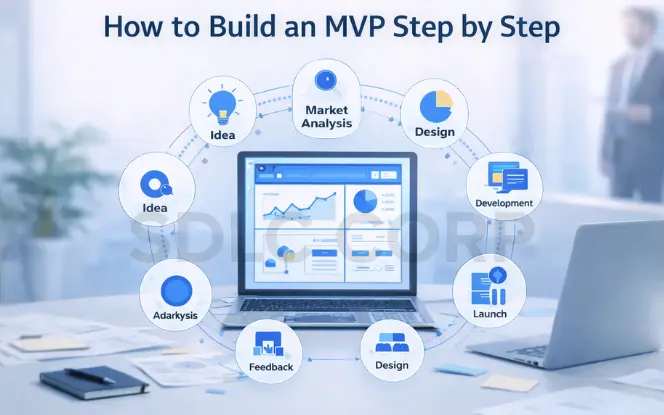
How to Build an MVP Step by Step
A strong MVP development process is focused, measurable, and tied to a real business question.
1. Define the one problem you are solving
2. Identify the riskiest assumption
3.Choose the right build approach
4. Define the minimum feature set
Use a strict prioritization method. Separate:
- must-have features
- useful but non-essential features
- nice-to-have ideas
- features you will not build yet
This step is where many MVPs go off track. Good MVP scoping removes more than it adds.
5. Set success metrics before launch
Define what success means before development begins. Useful metrics may include:
- sign-up conversion
- activation rate
- repeat usage
- retention
- paid conversion
- demo requests
- completed workflows
6. Build for speed and clarity
7. Launch to a defined audience
8. Gather quantitative and qualitative data
9. Decide what happens next
After launch, do not move straight into feature expansion. First decide whether the product shows enough evidence to:
- continue
- refine
- pivot
- pause
- rebuild with stronger direction
Common MVP Mistakes to Avoid
Building too much before launch
Confusing a prototype with an MVP
Skipping user discovery
Launching without success metrics
Treating launch as the finish line
Scaling before validation
Building for internal confidence instead of user need
How to Know When Your MVP Is Ready to Scale
An MVP is successful when it gives you evidence, not just activity.Here are signs your product may be ready to move beyond MVP stage:
Users return consistently
Users are willing to pay
Feedback becomes more specific
Growth becomes easier
Infrastructure starts limiting usage
What Happens After an MVP?
Once your MVP validates demand, the next step is not adding every requested feature. It is building a roadmap based on evidence.
That usually means prioritizing:
- retention improvements
- friction points in onboarding
- conversion bottlenecks
- repeated workflow requests
- infrastructure stability
- stronger reporting and user support
- security and scale improvements where needed

Conclusion
MVP vs full product is not a question of building less or building more. It is a question of building what your business actually needs at the current stage. An MVP is the right choice when you need to test demand, validate assumptions, reduce early risk, and learn from real users before making a bigger investment. A full product makes more sense when your concept is already validated, your buyers expect a complete solution, or your industry requires stronger compliance, stability, and deeper functionality from the start.
The best decision comes from understanding your market, your budget, your delivery risk, and your product goals. Businesses that choose the right path early usually avoid wasted development effort and move with more clarity. Instead of asking what sounds better, ask what helps you learn, launch, and grow in the smartest way. That is what makes the difference between a product that only gets built and a product that actually succeeds.


