Banks and financial institutions operate under a distinct set of constraints. Compliance requirements — KYC, AML, Basel III, local financial regulations — are non-negotiable and auditable. Transaction volumes are high. Data accuracy is a legal requirement, not just an operational preference. Customer expectations for speed and reliability are set by the most capable digital banks in the market. When the systems managing these demands are fragmented — separate tools for accounting, compliance, customer records, and reporting — the gaps between them create exactly the delays, errors, and audit risks that banks cannot afford.
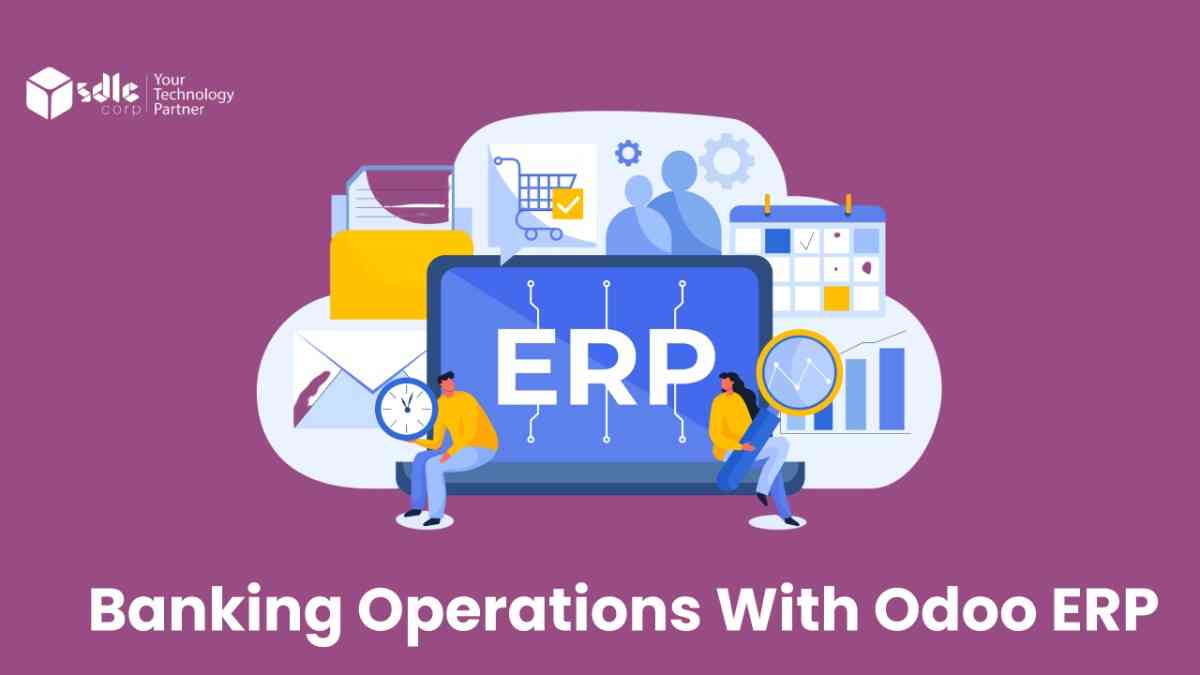
Odoo ERP for the banking sector brings financial management, compliance workflows, reporting, customer records, and operational automation into one integrated platform. This guide covers what Odoo addresses for banking operations and how SDLC Corp implements these solutions. See also our guide to banking operations with Odoo ERP.
Challenges Banks Face Without an Integrated ERP
The operational challenges that drive banking institutions to adopt integrated ERP solutions are consistent across institution types — retail banks, cooperative banks, financial services firms, and credit institutions. They stem from the same root cause: critical functions managed in disconnected systems whose data must be reconciled manually at every point of contact.
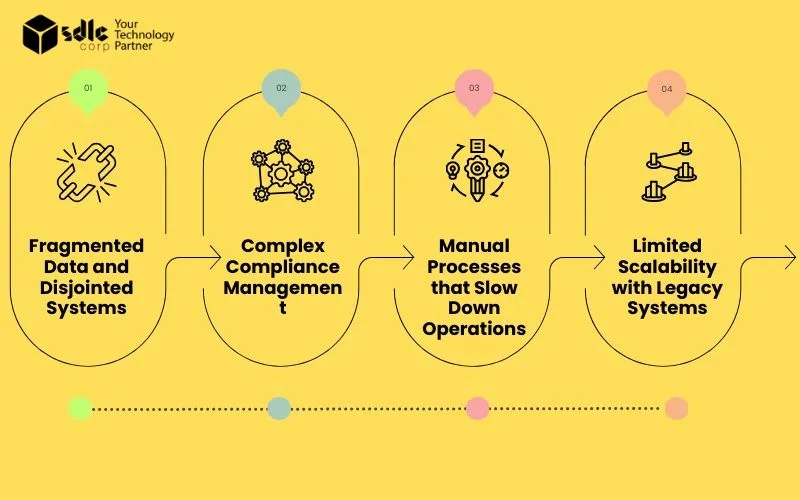
Fragmented data across disconnected systems
When accounting, customer records, compliance tracking, and reporting systems operate independently, reconciling them consumes significant staff time and introduces version-conflict errors. A transaction that should update customer balance, general ledger, and compliance log simultaneously requires manual entry in multiple systems — each an opportunity for inconsistency.
Compliance management without automation
KYC verification, AML transaction monitoring, Basel III capital ratio reporting, and regulatory deadline tracking require structured, documented workflows. Without automated systems, compliance teams rely on manual checklists and calendar reminders — increasing the risk of missed deadlines, incomplete documentation, and audit findings.
Manual processes slowing core operations
Loan approval workflows, payment authorisations, account opening procedures, and periodic regulatory reports that depend on manual input introduce delays and human error at predictable points. In a sector where processing speed is a competitive differentiator, manual workflows are a structural disadvantage.
Legacy systems that cannot scale
Core banking systems installed a decade or more ago were not designed for the transaction volumes, channel diversity, or regulatory complexity of contemporary banking. Extending them to support digital banking channels, new product lines, or regional expansion requires expensive custom development on architectures that resist change.
Limited real-time visibility for management
When financial performance, operational metrics, compliance status, and customer activity data live in separate systems, senior management cannot see a consolidated operational picture without manually assembling reports from multiple sources — which are already out of date by the time they are assembled.
Comprehensive Financial Management for Banking Operations
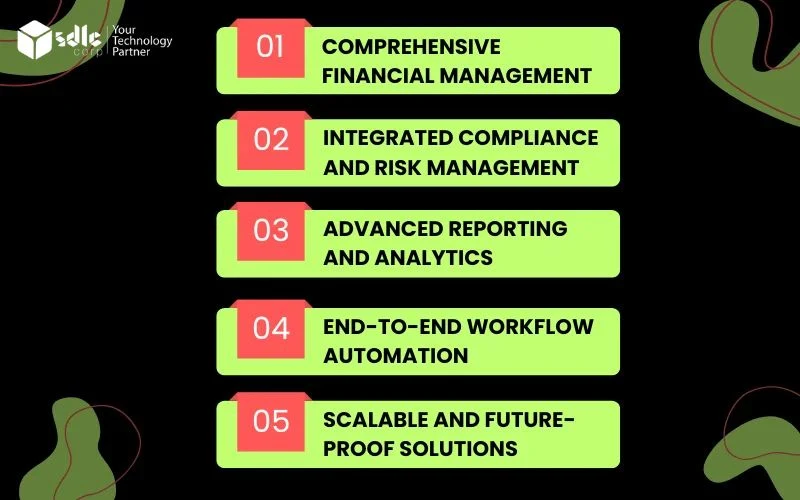
Odoo's accounting module provides the financial management foundation for banking operations — automated invoicing, payment processing, bank reconciliation, multi-currency and multi-entity support, and a full audit trail on every financial transaction. The integration of financial records with customer accounts, compliance logs, and operational data means financial reporting draws from a single consistent source.
Customer invoicing and billing
Automated invoice creation for fees, charges, and service billing with configurable payment terms. Collections tracked and followed up automatically. Reduces manual billing overhead and billing cycle delays. See our e-invoicing with Odoo guide.
Vendor bill management
Incoming vendor bills tracked with approval workflows, payment scheduling, and automatic reconciliation against purchase orders. Three-way matching reduces overpayment risk. Audit trail maintained automatically for every payment.
Payment processing
Customer and vendor payments handled within Odoo with full reconciliation against bank statements. Support for multiple payment methods — bank transfer, direct debit, online payments — with status tracking per transaction. See our guide to automating payments with Odoo accounting.
Bank reconciliation
Odoo matches imported bank statement lines against recorded transactions automatically, flagging unmatched items for manual review. Reconciliation that previously required dedicated staff time is largely automated — reducing errors and accelerating period-end close.
Multi-currency and multi-entity
Transactions in multiple currencies with automatic exchange rate application and realised/unrealised gain/loss tracking. Multi-company structure supports banks with subsidiaries or regional entities sharing consolidated reporting.
Fiscal localisation
Configurable tax rules and financial reporting formats for different jurisdictions. Banks operating across multiple regulatory environments apply the relevant local accounting rules without separate systems per region.
Compliance, Risk Management, and Data Security
Compliance in the banking sector is an operational function, not a periodic exercise. KYC processes run at account opening and are periodically refreshed. AML monitoring runs continuously against transaction activity. Regulatory reporting is filed on defined schedules. Audit trails must be available on demand. Odoo supports these requirements through structured workflows, automated record-keeping, and access controls — reducing the manual overhead while improving the reliability of the compliance record.
Comprehensive audit trails
Every transaction, approval, document change, and user action is logged automatically with timestamp, user identity, and the previous and new values. The audit trail is immutable — changes cannot be made without a corresponding log entry. Audit preparation moves from manual assembly to a reporting task against complete, structured records.
Role-based access controls and data security
Access to financial records, customer data, and compliance documentation is defined by user role. Sensitive operations require elevated permissions. Data encryption protects records at rest and in transit. Access logs provide visibility into who accessed or modified what, supporting both internal governance and regulatory examination.
Structured approval workflows
Credit decisions, large payment authorisations, account modifications, and compliance exceptions pass through defined multi-step approval chains with notification to each approver and a full decision log. Informal approvals — verbal sign-offs, email confirmations outside the system — are replaced with structured, auditable processes.
Automated compliance alerts and deadline tracking
Regulatory filing deadlines, KYC review dates, document expiry alerts, and transaction monitoring triggers are configured as automated reminders. Compliance staff receive proactive notifications rather than discovering missed deadlines during reviews.
Risk monitoring and reporting
Real-time dashboards consolidate risk indicators — overdue payments, unusual transaction patterns, concentration exposures, and operational exception rates — in a single view. Risk management becomes proactive rather than reactive when the relevant data is visible as it develops.
Implementation note: Odoo's standard accounting and compliance modules address core financial operations effectively. Specific banking-sector regulatory requirements — Basel III capital ratio calculations, MiFID II reporting, country-specific AML regulation — typically require custom configuration or module development aligned with the regulatory environment. SDLC Corp scopes these requirements before implementation begins.
Advanced Reporting, Analytics, and Workflow Automation
The operational intelligence and automation capabilities of Odoo address two distinct banking needs: decision support through real-time reporting, and operational efficiency through automated workflows. Both depend on the same underlying requirement — accurate, current data in one system rather than manually assembled from several.
Reporting and analytics
Real-time financial dashboards
Current P&L, balance sheet, cash position, and revenue trends visible without waiting for manual report assembly. Configurable by role — what a branch manager sees differs from what the CFO sees.
Customisable transaction reports
Reports for customer transactions, loan portfolios, fee income, overdue receivables, and payment velocity — configured to match the institution's specific KPI requirements rather than a fixed template.
Regulatory reporting support
Structured data export and reporting formats for regulatory submissions. When source data is accurate and complete, regulatory report generation is a formatting exercise rather than a data collection exercise.
Management information
Performance by product line, region, or customer segment — the views that support strategic decisions. Historical trend analysis and period comparisons available on demand.
Workflow automation
Automated transaction processing
Routine transactions meeting defined criteria — recurring payments, standard invoice approvals, account maintenance actions — processed automatically without manual intervention. Exception items routed to the appropriate team.
Approval flow automation
Multi-step approval chains for credit decisions, large payments, and compliance exceptions triggered automatically, with notifications to each approver and escalation if responses are not received within defined timeframes.
Notifications and alerts
Automated alerts for overdue payments, compliance deadlines, unusual transaction activity, and account events — delivered to the right staff member at the right time, not discovered during periodic manual reviews.
Document generation
Account statements, loan schedules, fee notices, and compliance documentation generated automatically from system data — reducing manual drafting effort and the errors that accompany it.
Why Odoo ERP Is the Right Choice for Banking
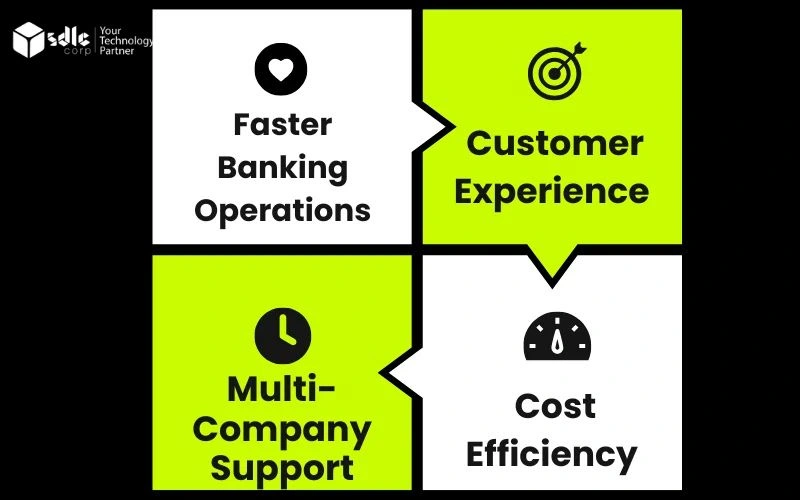
Odoo's advantages for the banking sector are practical rather than theoretical. They stem from its architecture — open-source, modular, and integration-first — rather than from marketing differentiation. The reasons banking institutions choose Odoo over proprietary alternatives consistently come down to four factors.
Operational speed and efficiency
Odoo's cloud-based architecture enables 24/7 access, faster transaction processing, and real-time data availability. Automated workflows reduce the bottlenecks that slow approvals and increase processing times in manual environments.
Improved customer experience
Faster approval processes, accurate account information, consistent communications, and accessible digital services — all downstream of better operational data and automated workflows. Customer-facing staff work with current information rather than outdated records.
Cost efficiency and ROI
Odoo's open-source foundation eliminates per-seat licensing costs common in proprietary ERP. Implementation is typically faster than alternatives, reducing deployment cost. Ongoing operational cost reductions from automation improve ROI consistently over time.
Multi-currency and multi-entity scalability
Multi-currency transaction support, multi-company consolidation, and fiscal localisation for multiple jurisdictions — making Odoo suitable for banks operating regionally or internationally without separate systems per market.
| Area | Without integrated ERP | With Odoo |
|---|---|---|
| Financial reporting | Manual assembly from multiple systems | Real-time dashboards from one source |
| Compliance tracking | Spreadsheets and manual reminders | Automated workflows and audit trails |
| Bank reconciliation | Manual matching, error-prone | Automated with exception flagging |
| Payment approvals | Email chains, unclear audit trail | Structured workflows with full log |
| Customer records | Separate systems, inconsistent data | Unified customer view across functions |
Ready to streamline your banking operations with Odoo ERP?
SDLC Corp configures Odoo for real banking processes — financial management, compliance workflows, reporting, and system integrations — aligned with your existing infrastructure and regulatory requirements.
Talk to an Odoo banking specialist
Technical Expertise and Services from SDLC Corp
SDLC Corp specialises in Odoo ERP implementation for financial institutions and banking organisations. Our approach starts with understanding the specific compliance requirements, system integration needs, and operational workflows of the institution — before any configuration or development work begins. Banking ERP implementations that fail usually do so because generic configurations were applied to sector-specific requirements. We address this by scoping the regulatory and operational requirements first.
Workflow and compliance mapping
We document your financial workflows, compliance requirements, approval structures, and reporting needs before configuring Odoo. This ensures the system reflects how your institution actually operates, not a generic banking template.
System integration
Connecting Odoo to existing core banking systems, payment gateways, CRM platforms, loan management software, and reporting tools. Our development team builds the integrations required to create a unified operational platform rather than adding another disconnected system. See our Odoo customisation services.
Custom module development
Where standard Odoo modules do not cover specific banking requirements — sector-specific regulatory reporting formats, custom compliance workflows, banking product management tools — our developers build the modules needed. See our Odoo development company page.
Ongoing support and optimisation
Post-implementation support covering system performance, regulatory changes that affect configuration, module updates, and user training. Our Odoo consulting team provides dedicated support to ensure the system keeps pace with evolving requirements. 24/7 expert support availability.
Training and change management
Role-specific training for finance teams, compliance officers, branch staff, and management. Change management support to ensure adoption across departments. The investment in implementation is only realised if staff are equipped to use the system effectively.
Conclusion: Odoo ERP as a Practical Banking Platform
Banks cannot continue to rely on fragmented systems and manual workflows. Compliance pressure keeps rising. Customer expectations keep moving. Data accuracy requirements only tighten. Small delays and reconciliation gaps accumulate into real cost and regulatory risk.
Odoo ERP for the banking sector addresses these challenges by consolidating financial management, compliance workflows, reporting, and operational automation in one platform. Teams work from the same current data. Approvals move through structured workflows. Audit trails are built automatically. Regulatory reporting draws from operational data rather than being assembled separately.
The practical value depends on implementation quality. Odoo configured around real banking processes and regulatory requirements produces better outcomes than a generic ERP deployment. SDLC Corp's Odoo implementation services are built around this principle — scope the requirements first, then configure the system to match.
What this guide covered
- Why fragmented systems create compliance and operational risks in banking
- Comprehensive financial management: invoicing, payments, reconciliation, multi-currency
- Compliance and risk management: audit trails, access controls, approval workflows
- Advanced reporting: real-time dashboards, regulatory reporting, management information
- Workflow automation: transaction processing, alerts, document generation
- Why Odoo: cost efficiency, scalability, integration-first architecture
- SDLC Corp's implementation approach for the banking sector
How does Odoo ERP integrate with existing banking systems?
Can Odoo automate bank reconciliation?
How does Odoo handle compliance requirements like KYC and AML?
How does Odoo ERP protect sensitive banking data?
How long does an Odoo ERP implementation take for a banking institution?