
Ecommerce website development cost 2026 typically ranges from $5,000 to $200,000+, depending on business size, platform, customization needs, and integrations.
Shopify and WooCommerce are cost-effective for small businesses. Magento and Adobe Commerce suit complex enterprise projects. This guide compares pricing, hidden costs, maintenance expenses, and budget tips so you can choose the right ecommerce solution.
Quick Answer
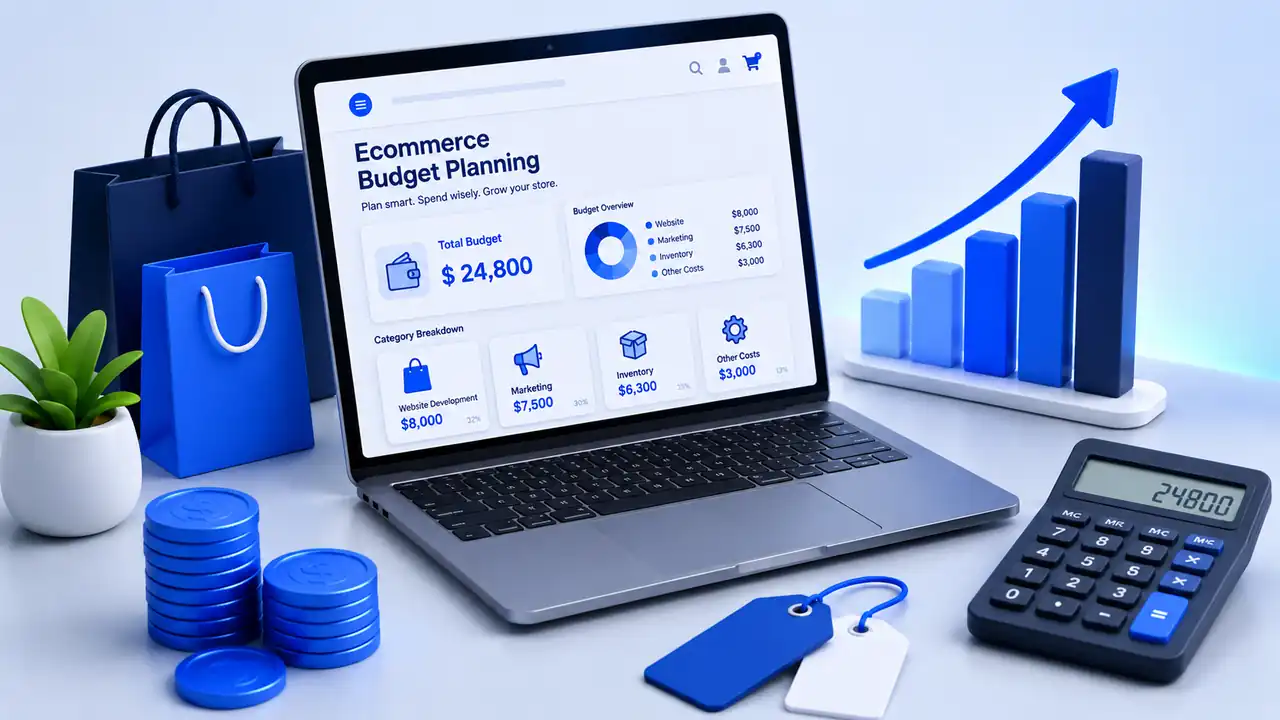
In 2026, ecommerce website development costs roughly $2,000 to $250,000+. Most small and mid-size businesses spend $5,000 to $40,000 for a professional store. A basic DIY shop can start as low as $30 a month, while a custom or enterprise build can pass $100,000.
| Store type | Typical cost (USD) | Best for |
|---|---|---|
| DIY website builder | $30–$60/month | Testing an idea, tiny catalogs |
| Freelancer build | $500–$5,000 | Simple stores on a tight budget |
| Template store (agency) | $3,000–$10,000 | Small brands launching clean |
| Semi-custom store | $10,000–$30,000 | Growing brands needing custom work |
| Fully custom store | $40,000–$150,000+ | Large catalogs, complex workflows |
| Enterprise / headless | $100,000–$250,000+ | High traffic, multi-channel selling |
These ranges cover the build only. Hosting, apps, and maintenance sit on top, and are broken out below.
Want a realistic cost range for your store?
Share your platform, product count, and feature list to get a clear ecommerce website development estimate.
Average Ecommerce Website Development Cost
For most businesses, a professional store costs $5,000 to $40,000 to build, covering design, development, product setup, testing, and launch. The range is wide because "store" covers everything from a templated shop to a fully custom platform.
Who builds it is one of the biggest swings in price:
DIY builder
$30–$60/month. Best for testing small catalogs with bundled hosting, checkout, and basic payments.Freelancer
$500–$5,000. Best for simple stores when budget matters more than long-term support.Small agency
$5,000–$25,000. Best for polished stores with clear process, design, testing, and launch help.Mid-to-large agency
$25,000–$150,000+. Best for custom stores, integrations, scaling needs, and ongoing support.
A clean Shopify shop with 40 products is a small job. By contrast, a custom platform with multi-warehouse stock, B2B pricing, and ERP links is a major one. The scope, not the product, sets the price.
Representative project profiles
Three typical builds show how scope changes the bill.
Small Shopify store around $6,000.
A skincare brand launches with 50 products on a premium theme, with light branding, standard payments, and a few apps for reviews and email. Most of the work is setup and design polish, so it ships in about four weeks.
Custom WooCommerce store around $18,000.
An apparel brand needs custom design, size filters, a loyalty program, and links to its shipping and inventory tools. That takes a small team a couple of months and produces a store shaped around the brand instead of a template.
Multi-vendor marketplace around $70,000.
A founder wants many sellers listing products, managing orders, and getting paid automatically, which means vendor dashboards, commission rules, and split payments. The build runs several months with a full team.
Each store could sell similar products, yet the cost differs by what the platform has to do.
What Affects Ecommerce Website Development Cost
Two stores can sell the same products and still cost very different amounts. These are the factors that move the price the most.
Platform choice
Shopify, WooCommerce, Magento, and custom builds vary by setup cost, flexibility, and control.Design and UX
Templates cost less, while custom layouts need more design time and stronger brand planning.Number of products
Small catalogs are faster, while large SKU sets need data cleanup, variants, and structure.Custom features
Filters, subscriptions, loyalty, B2B pricing, and dashboards add planning, coding, and testing time.Integrations
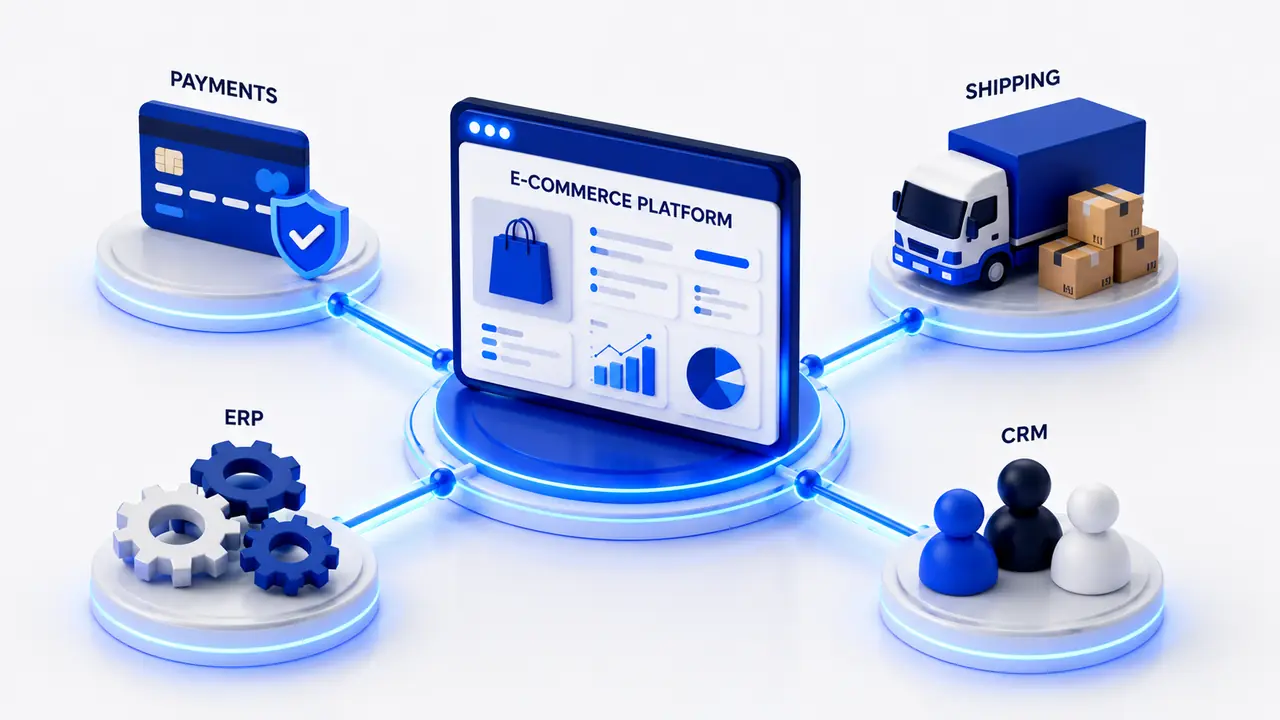
Payments, shipping, ERP, CRM, and inventory tools increase build effort and testing scope.Business model
D2C stores are lighter, while B2B portals and marketplaces need extra workflows.Development team
Freelancers, local agencies, and offshore teams price the same scope very differently.Team location
Regional rates vary widely, so India-based teams often reduce cost without cutting scope.Product content
Photos, descriptions, categories, and clean catalog data add time when created from scratch.Launch timeline
Faster deadlines can increase cost because more designers, developers, and testers work together.
The more of these your store needs at launch, the higher the price, so it's worth separating day-one essentials from what can wait.
Ecommerce Website Cost by Business Size
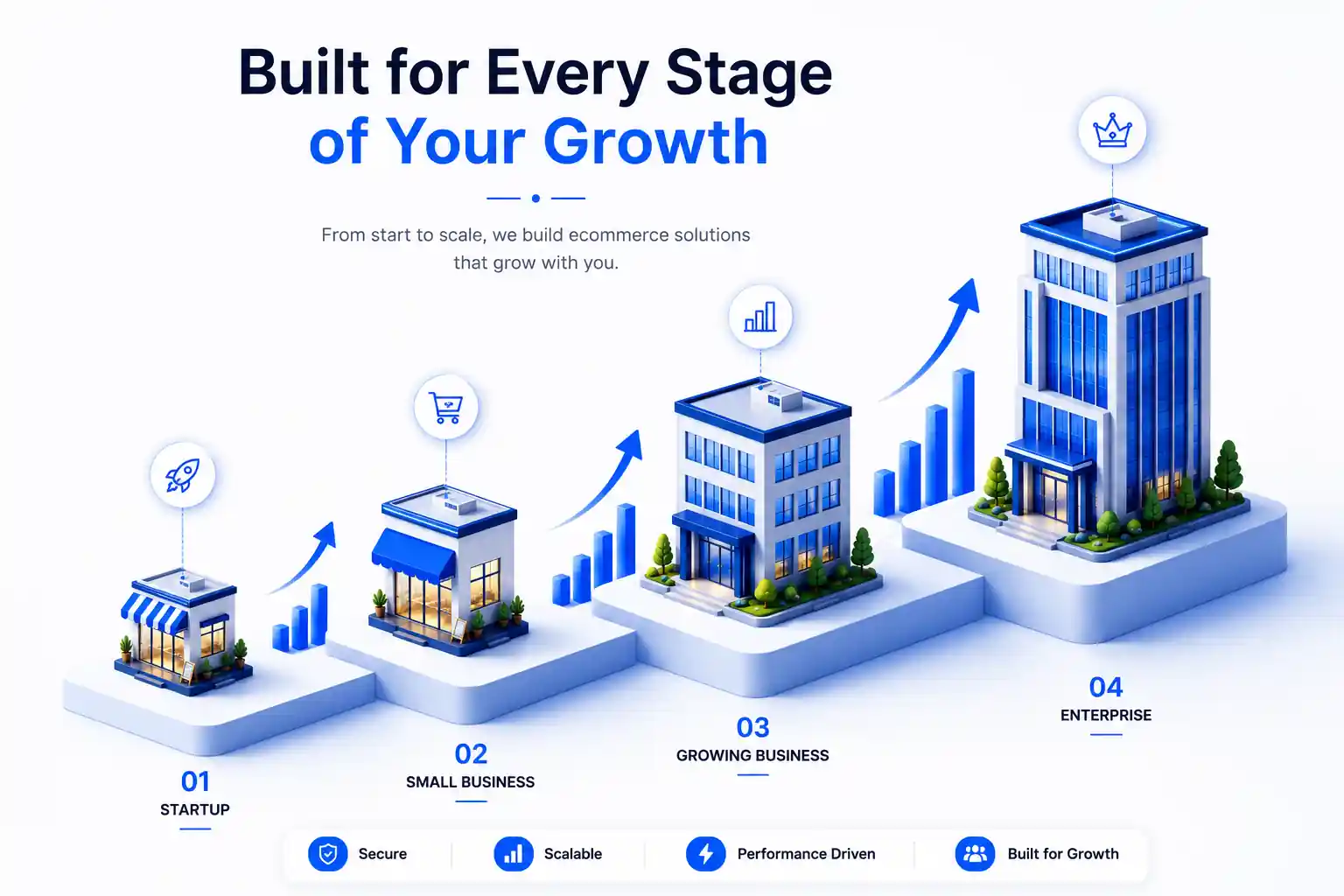
Your stage of business is one of the better ways to predict your budget. A startup testing demand has very different needs from an enterprise selling across countries.
| Business size | Cost (USD) | What it includes |
|---|---|---|
| Startup / small | $2,000–$10,000 | Template store, core features, up to 100 products |
| Growing business | $10,000–$40,000 | Custom design, integrations, stronger UX |
| Mid-market | $40,000–$100,000 | Custom build, advanced features, automation |
| Enterprise | $100,000–$250,000+ | Headless or custom platform, multi-channel, high traffic |
What each business stage spends
Startups and small businesses.
The goal is to launch fast and keep costs low. A Shopify or WooCommerce store with a good template, basic branding, and standard payments does the job. It isn't fully custom, but it sells, and it lets you test a market before investing more.
Growing businesses.
Sales are coming in and the template starts to limit you. Custom design, better UX, and a few integrations begin to pay off as you build for conversions and repeat buyers.
Mid-market brands.
At real volume, performance and automation matter. Custom features, ERP and CRM links, and a build that handles traffic spikes become worth the spend. This tier is about efficiency at scale.
Enterprise.
You sell across regions, channels, and sometimes physical stores. A custom or headless platform gives you speed, control, and room to grow. If you prefer a hosted enterprise-ready SaaS route, compare BigCommerce plan pricing before estimating development and app costs. The cost is high, but so is the cost of an outage or a slow site at this size.
Selling in physical stores as well as online? Retail ecommerce development connects both channels so stock, orders, and customers stay in sync.
Ecommerce Website Cost by Platform
Your platform shapes both the build cost and what you pay later. Choose the wrong one and you may hit a wall when you try to scale.
| Platform | Build cost (USD) | Good for |
|---|---|---|
| Shopify | $2,000–$20,000+ | Fast launch, small to mid stores |
| WooCommerce | $1,000–$15,000+ | Flexible WordPress stores |
| Magento / Adobe Commerce | $20,000–$100,000+ | Large catalogs, complex needs |
| BigCommerce | $5,000–$30,000+ | Growing stores that want SaaS |
| PrestaShop / OpenCart | $2,000–$15,000+ | Budget open-source stores |
| Custom / headless | $40,000–$250,000+ | Unique features, high traffic |
Platform-by-platform cost breakdown
Shopify.
The quickest path to launch. Hosting, checkout, and payments are built in. You can review the latest Shopify pricing plans before choosing a package, then budget for apps, themes, and custom work. Custom Shopify development usually runs $2,000 to $20,000 or more. A solid Shopify development partner can tailor the store without a full rebuild.
WooCommerce.
A WordPress store powered by WooCommerce gives you strong flexibility and code ownership. The plugin itself is open source, though you still pay for hosting, themes, plugins, and development. Builds usually run $1,000 to $15,000. It suits brands that want freedom on a fair budget.
Magento / Adobe Commerce.
Built for big catalogs and complex needs. Magento is powerful, but it needs skilled developers and a bigger budget, often $20,000 to $100,000+. Great for large retailers, overkill for a small shop.
BigCommerce.
A hosted SaaS platform with strong APIs. It reduces infrastructure work while still scaling well, which suits growing stores that want power without managing servers.
Custom / headless.
The front end is split from the back end, giving full design freedom across web, app, and other channels. It's the most flexible option and the most expensive, often $40,000 to $250,000+. For enterprise commerce, review Adobe Commerce pricing as part of the platform budget. Best for brands with unique needs and high traffic.
A useful rule: match the platform to the business you expect in two to three years, not just the one you have today.
Not sure which ecommerce platform fits?
Compare Shopify, WooCommerce, Magento, BigCommerce, and custom development before you spend.
Ecommerce Website Cost by Region (Including India)
Where your team is based affects the bill as much as what you build. For the same scope and quality, blended rates differ sharply by region.
| Region | Relative build cost | Notes |
|---|---|---|
| North America / UK | Highest | Strong talent pool, highest day rates |
| Western Europe / Australia | High | Comparable to US/UK in most markets |
| Eastern Europe / Latin America | Mid | Often 30–50% below US rates |
| India / South Asia | Lowest | Frequently 50–70% below US/UK for comparable work |
In India specifically, a basic store runs about ₹25,000–₹60,000, a mid-range store ₹60,000–₹1,50,000, and a custom store ₹1,50,000–₹6,00,000+. Indian rates typically sit 60% or more below US and UK prices for similar quality, which is why many global brands build there.
The trade-off to manage is communication and time-zone overlap. A partner whose working hours overlap yours keeps distance from slowing delivery.
Cost Breakdown by Features
Features are where budgets grow fastest. A basic store needs only a few; a rich store needs many, and each one adds development hours.
| Feature | Typical cost (USD) | Notes |
|---|---|---|
| Product catalog & pages | $500–$5,000 | Scales with product count and variants |
| Shopping cart & checkout | $1,000–$6,000 | Core of the store; keep it simple |
| Payment gateway setup | $500–$3,000 | Per gateway; some need extra work |
| User accounts & profiles | $500–$3,000 | Login, order history, saved details |
| Search & filters | $1,000–$5,000 | Smart search lifts conversions |
| Wishlist & favorites | $300–$1,500 | Useful for repeat shoppers |
| Reviews & ratings | $500–$2,500 | Builds trust and adds SEO content |
| Admin dashboard | $1,500–$8,000 | Manage orders, stock, and reports |
| Coupons & promotions | $500–$2,500 | Drives sales and loyalty |
| Multi-currency & language | $1,500–$8,000 | Needed for global selling |
| Subscriptions / recurring | $2,000–$10,000 | For D2C and membership models |
| Loyalty & rewards | $1,500–$7,000 | Keeps customers coming back |
| AI product recommendations | $3,000–$15,000 | Personalized upsells and cross-sells |
| Live chat / chatbot | $1,000–$8,000 | Faster support, fewer drop-offs |
| Analytics & reporting | $1,000–$6,000 | Tracks what's working |
Which features to prioritize
Must-have features
are the base you never cut corners on: a product catalog, a cart, secure checkout, and at least one payment gateway. A clunky checkout kills sales.
Growth features
like search, filters, reviews, wishlists, and coupons help shoppers buy and come back. They're worth adding once you have steady traffic.
Advanced features
such as subscriptions, loyalty programs, AI recommendations, and multi-currency support open new revenue but cost more. Add them when the numbers justify it.
A practical approach is to ship the core first, then add growth and advanced features in phases as revenue supports them.
Need help prioritizing ecommerce features?
Build the must-have features first, then add growth features without wasting budget.
Hidden Costs You Should Know
Many quotes list only the build. Then the real bill arrives, larger than expected. Budget for these up front and you avoid the surprises.
Domain and hosting
Domains are low cost, but hosting depends on traffic, platform, and support. Check the WooCommerce ecommerce platform when planning WordPress store costs.SSL certificate
Security certificates protect checkout data and are usually included with modern ecommerce hosting.Payment processing
Every order has transaction fees, which can become a major cost at higher sales volume.Gateway surcharges
Third-party gateways can add extra fees beyond normal card and platform processing charges.Security compliance
PCI needs, scans, monitoring, and audits can raise costs for custom or self-hosted stores.Apps and plugins
Email, reviews, SEO, analytics, and automation tools can quickly increase monthly spending.Theme updates
Premium themes, custom sections, and layout changes often need developer help after launch.Catalog content
Product photos, copy, tags, and categories become extra cost when produced by your agency.Marketing budget
SEO, ads, email, and social promotion are ongoing costs needed to generate store traffic.Returns and fulfillment
Shipping, packaging, refunds, and return handling affect your real ecommerce operating cost.
The sticker price is only the start. Plan around total cost of ownership over three to five years, not just launch day.
Website vs Marketplace Development Cost
A single-vendor store and a multi-vendor marketplace look similar to a shopper, but under the hood they're very different builds, and the price gap is large.
With a website, you sell your own products. You control the catalog, orders, and payments. It's simpler, faster, and cheaper to build.
A marketplace lets many sellers list and sell on one platform, like Amazon or Etsy. That adds vendor sign-ups, separate seller dashboards, commission rules, split payments, and dispute handling all heavy development work.
| Project type | Cost (USD) | Build time |
|---|---|---|
| Single-vendor website | $5,000–$40,000 | 3–10 weeks |
| Multi-vendor marketplace | $30,000–$150,000+ | 3–9 months |
Marketplace projects cost more because you build two experiences at once. Shoppers need to browse, search, and buy across many sellers. Vendors need to onboard, list products, track orders, and get paid.
As the owner, you also need tools to manage sellers, commissions, disputes, and approvals. Payments split across many parties, so the money flow has to be airtight. Trust features like ratings and verified sellers become essential.
If a marketplace is your goal, plan for a phased build and a larger budget. A multi-vendor ecommerce app development team can map the vendor and payment flows so the platform scales without breaking.
Planning a marketplace instead of a store?
Map vendor onboarding, commission rules, dashboards, and payment flows before development starts.
Ecommerce Website Maintenance Cost
A store isn't finished at launch. It needs care to stay fast, secure, and ready to sell. Skip upkeep and you risk slow pages, security holes, and lost sales, so build maintenance into your budget from day one.
A simple rule: plan for 15%–25% of the build cost each year for maintenance. For a $20,000 store, that works out to about $3,000–$5,000 a year to stay healthy.
| Maintenance item | Typical cost | What it's for |
|---|---|---|
| Hosting & security | $5–$300/month | Keeps the site live and protected |
| Updates & patches | 15–25% of build/year | Fixes bugs and security gaps |
| Plugin / app subscriptions | $0–$300+ each | Keeps tools running |
| Backups & monitoring | $20–$200/month | Protects your data |
| Small content & design edits | Varies | Banners, new products, tweaks |
| Performance tuning | Varies | Keeps load times fast |
On a hosted platform like Shopify, much of this is bundled into your monthly fee and app costs, so you spend less time on servers and more on running the shop. With a self-hosted platform like WooCommerce or Magento, the upkeep is yours: hosting, updates, and security fall to you or your dev team. For Magento projects, this Magento license cost breakdown is useful when planning licensing, hosting, and infrastructure costs.
A slow or unpatched store usually costs more than the maintenance would have. Even a small delay in load time can drop conversions, so steady upkeep protects the revenue the store makes.
What Return Can You Expect?
A store is an investment, so it helps to weigh the cost against the return rather than treating it as a flat expense. Two simple checks:
Payback period.
Divide the build cost by the extra monthly profit you expect the store to add. A $20,000 build that generates $4,000 a month in profit pays back in about five months.Cost as a share of revenue.
For many small and mid-size brands, a sensible build lands within a few months of target revenue. If a quote would take years of profit to recover, the scope is probably too large for your current stage.
These are planning rules of thumb, not guarantees. Actual return depends on traffic, margins, and execution. The aim is to size the build to the revenue it can realistically produce.
How to Reduce Ecommerce Website Development Cost
You can spend less without cutting quality. The trick is smart choices rather than cheap shortcuts.
Start with an MVP
Launch core selling features first, then add advanced tools after revenue proves demand.Pick the right platform
Choose Shopify, WooCommerce, or BigCommerce based on your stage. Check BigCommerce subscription costs before development.Use a quality theme
A strong template with light customization saves budget while keeping the store professional.Get itemized quotes
Compare design, features, integrations, testing, support, and launch tasks line by line.Consider offshore teams
India-based developers can reduce cost when communication, overlap, and project management are clear.Reuse proven tools
Use reliable plugins and components first, then custom-build only your true business differentiators.Plan scope clearly
Clear requirements reduce revisions, change requests, delays, and surprise development costs.Build SEO early
Plan URLs, speed, schema, and product structure before launch to avoid rework.
The cheapest quote is rarely the best value. A fragile site you have to replace within a year costs far more than a solid build that lasts.
Why Businesses Choose Custom Ecommerce Development
Templates are great for a fast start, but as a brand grows, many move to custom development. The reasons it makes sense for a lot of stores:
Better performance
Custom builds can remove bloat, improve speed, and support stronger conversion-focused experiences.Room to scale
Add products, channels, integrations, and traffic capacity without rebuilding the store repeatedly.Unique features
Build special pricing, workflows, dashboards, and buyer journeys that templates cannot support well.Stronger security
Add security controls, access rules, and compliance needs directly into the platform architecture.Real ownership
Own your source code, IP, and platform direction instead of depending on rented limitations.
The trade-off is cost and time. Custom development asks for a bigger budget and a longer timeline, so it fits brands with real volume, clear needs, and plans to grow. For a small shop just testing an idea, a template is still the smarter call. Custom isn't automatically better; it's better once your store has outgrown what a template can do.
Why Choose SDLC Corp
The right partner shapes both the price and the result. Here's what we bring to an ecommerce build, and why brands across the world work with us.
SDLC Corp is a software and ecommerce development company founded in 2015, headquartered in San Francisco, with delivery teams across the US, UK, UAE, India, and Australia. That setup gives clients strong engineering at fair rates, with support that fits their time zone.
Full platform coverage
Shopify, WooCommerce, Magento, BigCommerce, PrestaShop, custom, and headless builds under one team.End-to-end delivery
Discovery, UI/UX, development, QA, launch, support, and improvements handled by one team.More than a store
Add mobile apps, marketing, integrations, and automation without managing separate vendors.Proven track record
500+ projects across ecommerce, fintech, retail, logistics, SaaS, startups, and enterprise teams.You own everything
Keep full source code, IP, documentation, and platform access with no vendor lock-in.Flexible engagement
Choose fixed-scope delivery, turnkey builds, white-label work, or dedicated development teams.
The outcome is a store built to sell, ready to grow, and backed by a team you can reach after launch. Want a real number for your project? We'll scope it and give you a clear quote, with no guesswork.
Need an accurate ecommerce development quote?
Share your platform, product count, features, and launch goal. SDLC Corp can help you estimate a practical build budget with clear scope.
Request a Custom Ecommerce QuoteConclusion
There's no single price for an online store. What you pay depends on your goals, your platform, your features, and your team. A small shop can launch for a few thousand dollars; a custom platform or marketplace can run into six figures. Both can be the right call, depending on where your business stands.
The smart way to plan is simple. Define what you need now, not everything you may want later. Pick a platform that fits your stage. Budget for upkeep and marketing alongside the build, and choose a partner who is clear about scope and price from the start.
Ready to build a store that sells and scales? SDLC Corp can scope your project and give you a firm, no-surprise quote. Get a free consultation today, and let's turn your idea into a store that's ready to grow.
FAQs
Cost and budget questions
Most businesses spend $5,000 to $40,000 for a professional store. A basic DIY shop can cost as little as $30 a month, while a large custom build can pass $100,000. Your final price depends on the platform, features, and team you choose.
Yes. Shopify is faster and cheaper to launch because hosting, checkout, and payments are built in. A custom store costs more but gives you full control and room to scale. If you're starting out, Shopify is usually the smarter pick.
A basic store takes 2 to 4 weeks. Semi-custom builds usually take 6 to 12 weeks. A fully custom build or marketplace can run 3 to 9 months, depending on scope and features.
Plan for 15% to 25% of the build cost each year. That covers hosting, security, updates, and fixes. Marketing and new features sit on top of that.
A basic store runs about ₹25,000 to ₹60,000, a mid-range store ₹60,000 to ₹1,50,000, and a custom store ₹1,50,000 to ₹6,00,000 or more. Indian rates sit 60% or more below US and UK prices for similar quality, which is why many global brands build there.
Custom design, custom features, and deep integrations push the price highest. Marketplaces cost the most overall, since they need vendor and payment systems on top of the storefront.
Platform, build, and growth questions
Yes. Build on a scalable platform from the start and you can add features, products, and integrations as you grow. Planning for growth early saves a costly rebuild later.
Not at first. A mobile-friendly website covers most needs, though an app can lift repeat sales and loyalty over time. Expect $10,000 to $50,000+ for a solid ecommerce mobile app, so add it once the store proves itself.
Most brands spend 10% to 20% of revenue on marketing. SEO, ads, email, and social all help drive traffic, and strong digital marketing often returns more than the build itself.
It depends on scope and budget. Freelancers suit small, simple stores and tight budgets. Agencies suit builds that need design, integrations, testing, and support because you get a full team and less risk. For anything you plan to scale, an agency usually pays off in the long run.
Most stores support options like Stripe, PayPal, Razorpay, and major card networks. The right mix depends on where you sell and who your buyers are. Adding more gateways means a little extra setup, but it removes friction at checkout and can lift sales.


