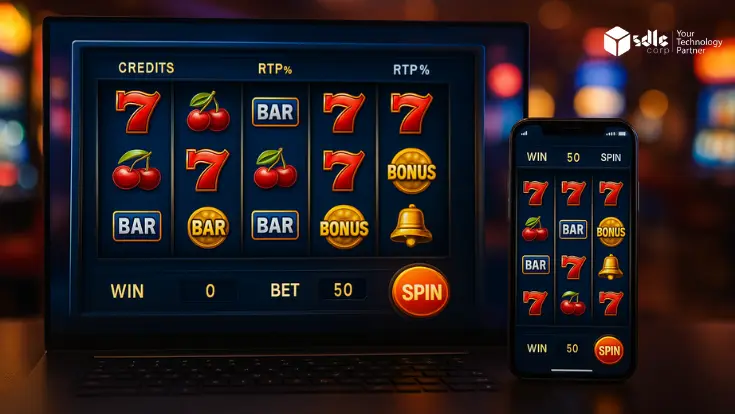
How Slot RNG Algorithms Work: From Random Numbers to Reel Stops

TABLE OF CONTENTS

Share on Media :

Online slot games look simple: you tap Spin, the reels move, and a result appears. But behind that animation is a controlled system designed to be unpredictable, testable, and tamper-resistant—especially in real-money environments.

This guide explains slot "algorithms" the way they actually work in modern online systems:

  • what the RNG does (and what it doesn't)
  • how random numbers become reel stops and symbols
  • how RTP fits into the picture without "controlling" randomness
  • and what fairness verification looks like in practice

Key point: A slot outcome is not "decided by the spinning reels." The result is determined by RNG output + reel mapping + evaluation rules, and then rendered as animation.

Building a Certified Slot Game?

From RNG implementation to regulatory compliance, we handle the complete technical stack for online slot development. Our certified solutions meet GLI, iTech Labs, and eCOGRA standards out of the box.

Get Started with Slot Development

What "slot algorithms" actually include (RNG + mapping + evaluation)

Most players hear "slot algorithms" and picture a single formula that controls everything. The reality is more structured: a slot game combines random number generation, mathematical mapping, and rule evaluation to produce outcomes that are both unpredictable and verifiable.

The Core Mechanism: RNG

The RNG is a secured software module (usually a PRNG) that generates unpredictable values used to determine outcomes. When a player initiates a spin, the system captures the current RNG output at that precise moment to determine the result.

The machine doesn't know 'you won last time.' True randomness has no memory.

Mapping Numbers to Virtual Stops

Once the RNG produces a number, the slot's software uses a mathematical mapping system to translate that number into a visual position on each reel. This means the visual spinning of the reels is merely a dramatic presentation of a result that was effectively randomized the instant you pressed the button. The "near misses" you sometimes see are not the machine teasing you with what might have been; they're simply the visual result of a number that the math had already decided.

Verifying Fairness: RTP and Audits

Licensed games are verified and their results guaranteed through Return to Player (RTP) percentages and rigorous audits. Independent testing agencies verify that the RNG is truly random and that the game pays out according to its mathematical design specifications.

RTP vs RNG: RTP represents the long-term statistical average of payouts, while RNG ensures each individual spin is unpredictable. For a detailed explanation, see our comprehensive RTP guide.

Now that you understand the overall system, let's dive into the core component: the RNG itself.

What is an RNG in slot games?

An RNG (Random Number Generator) is the component that generates unpredictable numbers used to determine outcomes. The RNG ensures that:

  • spins are independent (each spin stands on its own)
  • results are unpredictable (no reliable patterns)
  • and outcomes are statistically consistent with the game's configured probabilities

PRNG vs TRNG (in online slots)
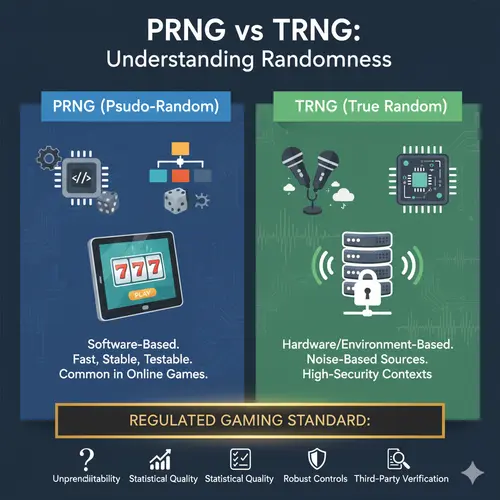
PRNG vs TRNG comparison showing pseudo-random and true random number generators in slot games

Figure 1: Comparison of PRNG and TRNG systems in slot game randomness generation

PRNG (Pseudo-Random Number Generator): software-based randomness. It's extremely common in online games because it's fast, stable, and testable.

TRNG (True Random Number Generator): hardware/environment-based randomness (noise-based sources). It may be used in some high-security contexts, but many slot stacks rely on properly implemented PRNG systems.

In regulated gaming, the "randomness" standard is about unpredictability and statistical quality, plus robust controls and third-party verification.

Building Your Own Slot Game?

Implementing a certified RNG system requires expertise in cryptographic randomness, mathematical modeling, and compliance standards. Our team specializes in building audit-ready slot games with provably fair RNG implementations.

Explore Slot Game Development Services

With the RNG explained, here's what happens step-by-step when you actually press the Spin button.

Spin lifecycle: what happens when you press Spin

In most modern online slot architectures, the outcome is determined immediately when the spin request is processed—long before the reels finish animating.

Here's the typical spin lifecycle:

1. Spin request is sent

The client sends bet details (stake, lines/ways, denomination) and session credentials.

2. RNG generates output

The backend (or secured game runtime) obtains one or more random values.

3. RNG output is mapped to reel stops

Random values are converted into stop positions for each reel (or into a pre-defined outcome model, depending on the game design).

4. Rules evaluate the outcome

The engine checks paylines/ways, wild/scatter rules, multipliers, and bonus triggers.

5. Bonuses are resolved (if triggered)

Free spins, pick bonuses, hold-and-win, jackpots—each has its own RNG calls and rule logic.

6. Result is returned and logged

The game returns the outcome to the client and stores key data for audits and dispute resolution.
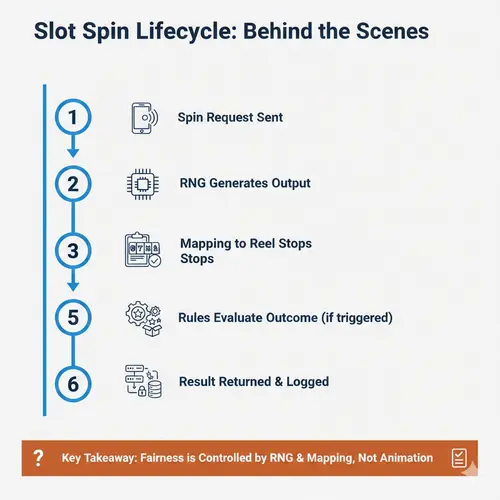
Slot spin lifecycle diagram showing the 6-step process from spin request to logged result

Figure 2: The complete spin lifecycle from request to result

Why this matters: The reel animation is presentation. Fairness is controlled by the RNG and mapping, and proven by verification and logging.

Next, let's separate randomness (RNG) from long-run payout design (RTP)—two concepts often confused.

How RNG differs from RTP (and why both matter)

RNG (Random Number Generator) is the engine that produces the outcome of every spin. It generates unpredictable values that are mapped into reel stops and evaluated by the game rules.

RTP (Return to Player) is the long-term mathematical average of outcomes. It doesn’t predict a single session’s results—rather, it describes the expected payout percentage over a very large number of spins.

RNG creates the unpredictability of the moment, while RTP defines the certainty of the long run.

To avoid confusion (and content overlap), this article keeps RTP discussion high-level and links to dedicated deep dives below.

RTP comes from design choices such as:

  • symbol distribution/weighting
  • paytable design
  • feature frequency and expected value distribution

For a detailed explanation, read:

And for payout modeling:

Now that you know what RNG outputs look like, here's how they become reel stops and symbols.

Reel mapping and virtual reels: how numbers become symbols
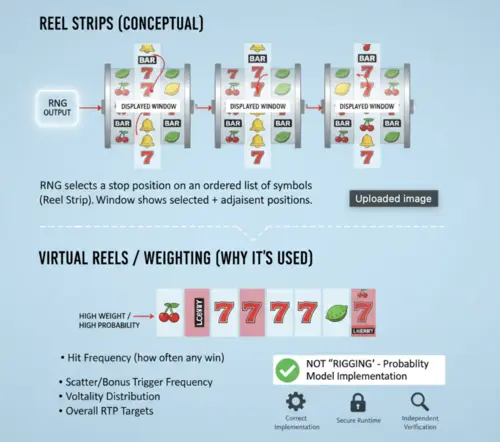
Reel mapping diagram showing how RNG outputs are mapped to reel stops in slot games

Figure 4: Reel mapping process in slot games

Most online slots use reel strips (lists of symbols) behind the scenes. The RNG doesn't "choose symbols directly" in a naive way. Instead, it typically selects stop positions on these strips.

Reel strips (conceptually)

  • Each reel has an ordered list of symbols (a reel strip).
  • Symbols appear multiple times on the strip.
  • The RNG output selects a stop index on that strip.
  • The displayed window (e.g., 3 symbols per reel) shows the selected stop and adjacent positions.

Virtual reels / weighting (why it's used)

Many games use virtual reels or weighted mapping to tune:

  • hit frequency (how often any win appears)
  • scatter/bonus trigger frequency
  • volatility distribution
  • and overall RTP targets

This is not "rigging"—it's how the probability model is implemented. Fairness depends on:

  • correct implementation
  • secure runtime/controls
  • and independent verification

Need Expert Math Modeling for Your Slot?

Virtual reel configuration, symbol weighting, and RTP tuning require precise mathematical modeling and extensive simulation testing. We deliver complete slot math packages with full documentation for regulatory approval.

Get Slot Development Quote

Bonuses and jackpots: how additional RNG events are used
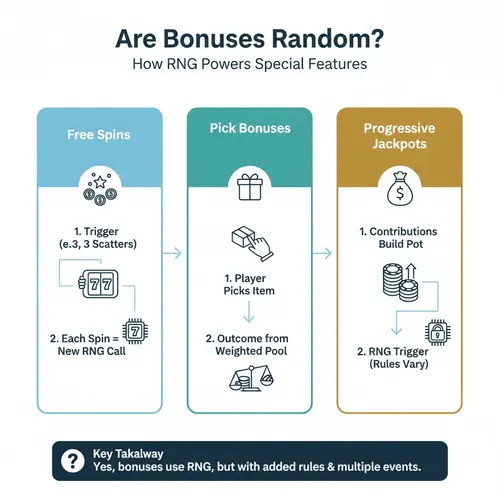
Infographic explaining how RNG powers free spins, pick bonuses, and progressive jackpots in slot games

Figure 5: How RNG powers bonuses and special features in slot games

Yes—bonuses typically use RNG as well, but they may involve multiple RNG events and stateful rules.

Examples:

  • Free spins: The trigger is rule-based (scatters), and each free spin outcome is generated like a normal spin.
  • Pick bonuses: Outcomes are often selected from weighted pools or pre-generated sequences based on RNG calls.
  • Progressive jackpots: Usually combine contribution logic with RNG-based triggers (rules vary by platform and jurisdiction).

For jackpots (without expanding this article into a jackpot guide), see:

How fairness is verified (testing, audits, traceability)

In compliant real-money setups, fairness is not just a claim—it's supported by process and evidence.

1) Independent testing

Third-party labs evaluate RNG quality via statistical testing and implementation review.

2) Configuration control

Fair systems separate:

  • RNG implementation
  • math configuration
  • deployment/change approvals

so outcomes can be audited and releases are reproducible.

3) Logging and dispute resolution

Typical logs include:

  • bet parameters
  • timestamps/session identifiers
  • outcomes and payout calculations
  • (implementation-dependent) trace IDs for RNG calls and outcome derivation

4) Security controls

Anti-tamper controls, secure authentication, and monitoring reduce manipulation risk and improve trust in the system.

For security/fraud prevention context, see:

And for integration concerns (payments/KYC/services), see:

Preparing for Regulatory Certification?

Independent testing lab submission requires comprehensive documentation: RNG implementation details, logging architecture, security controls, and full traceability. We help studios and operators pass audits on the first submission.

Learn About Certification Support

Common RNG myths (quick reality check)

Myth: “Slots pay more at night.”

Reality: Each spin is independent; time-of-day doesn’t “warm up” RNG.

Myth: “A slot is due after a losing streak.”

Reality: Random systems naturally produce streaks; prior spins don’t change future probability.

Myth: “You can spot patterns and predict wins.”

Reality: Proper RNG implementations are designed to be unpredictable and resist pattern prediction.

Myth: “Changing bet size changes RNG odds.”

Reality: In many slots, bet size changes payout scale, not randomness—unless the game has explicit bet-linked mechanics (a design rule, not RNG bias).

Operator checklist (launch validation)

If you operate, integrate, or QA slot content, validate these fundamentals:

RNG runs in a secure environment (avoid client-side manipulation risk).
Seeding/entropy handling is robust and controlled.
Math configuration is versioned and locked with approvals.
Outcomes and payouts are deterministic from logged inputs (traceability).
Logging supports audits and player dispute resolution.
Security controls cover authentication, anti-tamper, and monitoring.

Need help documenting RNG flow for audits?

Documenting RNG flow, logging, and configuration control is the fastest path to audit readiness. Contact us for guidance.

For a broader operations roadmap, read:

Are online slots truly random?

Yes, when properly implemented and audited. Licensed online slots use RNG systems that produce unpredictable outcomes for each spin.
Independent testing labs verify that the RNG implementation meets statistical randomness standards and that results cannot be predicted or manipulated.

The RNG generates a random number, which is then mapped to a specific position on virtual reel strips.
Each reel has an ordered list of symbols, and the RNG output determines which stop position is selected.
The visible symbols shown on screen are simply a presentation of this mathematically determined outcome.

RNG determines the unpredictable outcome of each individual spin, ensuring independence and randomness.
RTP is the long-term statistical average—the percentage of wagered money that the game is designed to pay back over millions of spins.
RNG creates moment-to-moment unpredictability, while RTP defines long-run mathematical expectations.

No. In regulated online gaming, each spin must be independent and determined by RNG output.
Time-based payout manipulation would violate licensing requirements and fail third-party audits.
Proper RNG systems ensure that outcomes are not influenced by time of day, previous results, or player history.

Fairness is verified through multiple layers: independent testing labs evaluate RNG implementation and statistical quality;
configuration controls ensure math models are locked and versioned; comprehensive logging enables audit trails and dispute resolution;
and security controls prevent tampering.

Virtual reels are weighted mapping systems that translate RNG outputs into reel positions. They allow designers to tune hit frequency,
bonus trigger rates, volatility, and RTP targets while maintaining randomness. Fairness depends on correct implementation, security controls,
and independent verification.

SDLC Corp supports end-to-end slot game consulting and development implementation—from concept and feature planning to math/RTP modeling, secure RNG + reel mapping implementation, full game build, QA, integrations, and certification/audit readiness (documentation, logging, and compliance controls).

Relevant links:

Subscribe Our Newsletter

Request A Proposal
Contact Us

Share a few details about your project, and we’ll get back to you soon.

Let's Talk About Your Project

Contact Us
For Sales Enquiry email us a
For Job email us at
United States Flag

United States:

5214f Diamond Heights Blvd,
San Francisco, California, United States. 94131

United Kingdom Flag

United Kingdom:

30 Charter Avenue, Coventry
CV4 8GE Post code: CV4 8GF United Kingdom

United Arab Emirates Flag

United Arab Emirates:

Unit No: 729, DMCC Business Centre Level No 1, Jewellery & Gemplex 3 Dubai, United Arab Emirates

India Flag

India:

715, Astralis, Supernova, Sector 94 Noida, Delhi NCR India. 201301

Qatar Flag

Qatar:

B-ring road zone 25, Bin Dirham Plaza building 113, Street 220, 5th floor office 510 Doha, Qatar

Tell Us What you Need ?
Share Your Idea, Get Expert Insights Instantly
20+
Years of Experience
100+
 Developers