A Curaçao iGaming license is one of the most commonly used offshore licensing routes for operators that want faster market entry, broad gaming coverage, and a workable balance between cost and compliance.
This guide explains how the Curaçao iGaming license works, including B2C and B2B license types, application steps, estimated costs, compliance obligations, crypto considerations, and which operators it suits best.
Is iGaming Legal in Curaçao?
Yes. iGaming is legally permitted in Curaçao for operators that obtain and maintain a valid Curaçao iGaming license. Licensed businesses may offer qualifying online gambling services internationally, subject to licensing conditions and restricted-market rules.
A valid Curaçao iGaming license is required to operate legally.
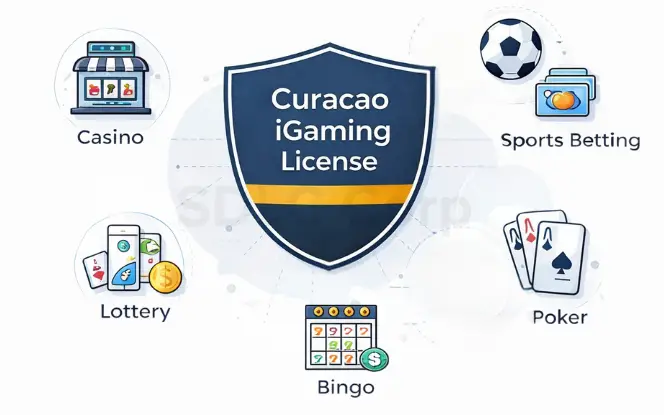
The license authorizes online casino games, sports betting, poker, and other remote gambling services.
Operations are permitted only in approved international markets.
Strict AML, KYC, and responsible gambling obligations must be followed.
Restricted jurisdictions must be excluded from operations.
Curaçao iGaming License Types: B2C vs B2B
Curaçao issues two primary license categories based on how your business operates within the iGaming ecosystem.
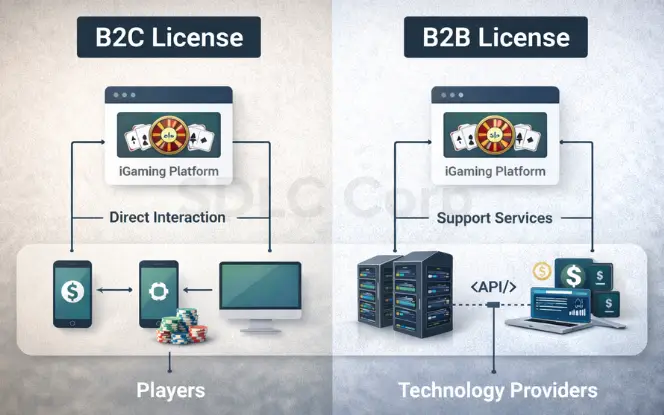
| Aspect | B2C License | B2B License |
|---|---|---|
| Purpose | Directly offers gambling services to players | Provides services to licensed operators |
| Player Interaction | Yes | No |
| Typical Businesses | Online casinos, sportsbooks, poker rooms, bingo platforms | Software providers, platform vendors, payment services, backend providers |
| AML / KYC Responsibility | Full player-level AML and KYC obligations | Operational / technical compliance support, depending on service scope |
| Regulatory Burden | Higher due to consumer-facing obligations | Usually lower than B2C |
| When Required | If players can register, deposit, bet, or withdraw | If you provide iGaming technology or backend services to operators |
Why Curaçao Is a Preferred iGaming Jurisdiction
Curaçao is commonly chosen by operators that want one offshore framework covering multiple gaming verticals, faster approval, and lower regulatory overhead than stricter local-license jurisdictions.
Key reasons operators choose Curaçao include:
- One license covering multiple gambling verticals
- Faster approval compared to Tier-1 regulators
- Lower licensing and compliance costs
- International operational scope with defined restricted markets
- Support for cryptocurrency payments alongside fiat options
Step-by-Step Process to Obtain a Curaçao iGaming License
While Curaçao is often more accessible than higher-regulation jurisdictions, the licensing process still requires structured legal, technical, and compliance preparation before approval.
The current CGA process is divided into two phases: first an integrity and financial-stability review, then a broader LOK compliance review. Once all required documents are submitted, each phase is targeted at up to eight weeks, with an extension of up to four weeks if needed.
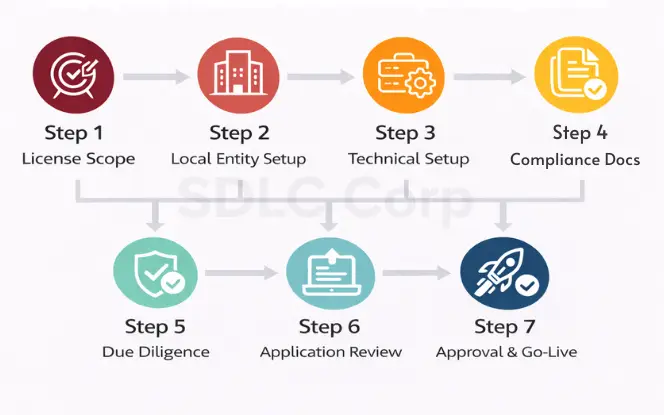
Step 1: Define Your License Scope
Decide whether a B2C or B2B license is required
Define the types of games and services offered
Identify target markets and restricted jurisdictions
Confirm supported payment methods, including fiat and crypto
Step 2: Incorporate a Curaçao Legal Entity
Register a Curaçao legal entity with its statutory seat in Curaçao
Appoint directors and shareholders
Establish a registered local business address
Ensure the entity has at least one resident managing director or a qualifying Curaçao corporate director structure
Step 3: Establish Technical and Operational Infrastructure
Set up secure hosting and server architecture
Implement platform security and data-protection controls
Define game logic and payout mechanisms
Establish backup and disaster-recovery systems
Step 4: Prepare Compliance Documentation
Draft KYC policies
Prepare AML and counter-terrorist financing procedures
Implement responsible gambling controls
Finalize terms and conditions
Prepare privacy and data-protection policies
Step 5: Due Diligence (Fit-and-Proper Checks)
Submit KYC documents for owners, directors, and UBOs
Provide source of funds and source of wealth evidence
Disclose full corporate ownership structure
Respond to regulator verification or clarification requests
Step 6: Submission and Application Review
Upload all corporate, compliance, and technical documents via the portal
Pay application and due diligence fees
Undergo review of business plan, AML/KYC framework, and operational readiness
Step 7: Technical Assessment and Approval
Submit detailed technical platform information
Provide hosting, security, RNG, backup, and data-protection details
Complete required audits or third-party certifications
Receive license issuance and proceed to go-live under ongoing compliance obligations
Estimated Curaçao iGaming License Costs
Core Curaçao regulatory costs differ materially between B2C and B2B licenses, so this section should show the fee structure by license type rather than a blended estimate.
| Cost Item | B2C License | B2B License |
|---|---|---|
| Application Fee | €4,592 | €4,592 |
| UBO Due Diligence | €150 per person | €150 per person |
| Qualified Interest Holder Due Diligence | €150 per person | €128 per person |
| Listed UBO Addition | €2,551 per entity | €2,551 per entity |
| Annual Government License Fee | €24,490 | €0 |
| Annual CGA Supervisory Fee | €22,960 | €24,490 |
| Annual Core Regulatory Total | €47,450 | €24,490 |
Initial annual fees are calculated pro rata in the year of issuance. Full annual fees apply for subsequent years.
These figures cover core regulatory and due-diligence fees only. They do not include company formation, local director costs, legal support, hosting, certifications, AML tooling, payments, or broader operational setup.
Ongoing Compliance Requirements
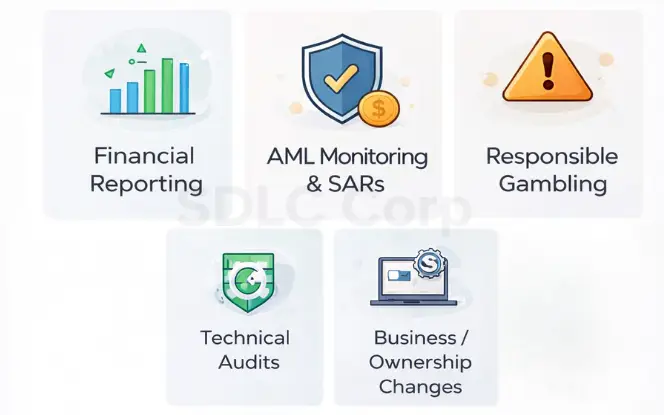
Holding a Curaçao license requires continuous operational compliance after approval, including:
- Reporting: Maintain financial and operational reporting as required.
- AML monitoring: Monitor transactions and report suspicious activity where required.
- Responsible gambling: Keep player-protection controls active.
- Technical upkeep: Maintain system integrity, updates, certifications, and required audits.
- Business-change disclosure: Notify the regulator of material ownership or operational changes.
Failure to meet these obligations can result in penalties, suspension, or revocation.
Cryptocurrency Support Under a Curaçao License

Curaçao is widely regarded as one of the more crypto-friendly iGaming jurisdictions.
Licensed operators may:
Accept cryptocurrencies such as Bitcoin, Ethereum, and stablecoins for digital asset–based transactions
Offer crypto deposits and withdrawals alongside traditional payment methods
Operate hybrid fiat-crypto platforms to support both conventional and crypto-native users
Crypto acceptance still requires strong AML, KYC, and transaction-monitoring controls. Curaçao may be attractive for crypto-friendly operators, but it does not remove the need for full compliance design and ongoing monitoring.
Who Should Choose (and Who Should Avoid)
A quick comparison to determine whether this licensing framework fits your business model, target markets, and regulatory expectations.
| Good Fit for Curaçao | Poor Fit for Curaçao |
|---|---|
| Startups seeking faster market entry | Operators targeting tightly regulated markets such as the UK or USA |
| Crypto-friendly casinos and sportsbooks | Brands that require Tier-1 regulatory signaling from launch |
| International or emerging-market operators | Businesses unwilling to maintain strong AML / KYC controls |
| Multi-vertical gaming platforms | Operators seeking only country-specific local licenses |
| Teams validating a business model before expanding | Businesses focused only on strict local-market authorizations |
If reputation signaling and expansion into stricter jurisdictions are central to the decision, review our Curacao vs Malta comparison.
Is a Curaçao License Enough for Long-Term Growth?
For many operators, a Curaçao license works best as an early-stage or growth-stage operating framework rather than a final long-term regulatory endpoint.
- Launch jurisdiction: Useful for faster entry and early operational validation.
- International base: Supports activity across permitted markets, subject to jurisdictional restrictions.
- Stepping stone: Many operators later pursue stricter local licenses once the business matures and target-market requirements narrow.
Conclusion
A Curaçao iGaming license is often the strongest fit for operators that need faster entry, lower upfront cost, and broader offshore flexibility without immediately targeting stricter local-license markets.
The operators who succeed with this route are the ones that pair speed with real compliance discipline, especially around AML, KYC, payments, and restricted-market controls. For the broader licensing framework first, use our
global gambling license guide.
FAQ's
What is a Curaçao iGaming license?
A Curaçao iGaming license is a legal authorization that allows approved operators to run qualifying online gambling products such as casinos,
sportsbooks, poker rooms, and similar remote-gaming services.
Does Curaçao still use the old master-license and sublicense model?
No. The legacy master-license and sublicense structure has been replaced by direct licensing under the current framework.
What is the difference between B2C and B2B licenses?
A B2C license applies to businesses that interact directly with players.
A B2B license applies to businesses that provide technology, software, or operational services to licensed operators.
How long does it usually take to obtain a Curaçao license?
Timing depends on documentation quality and regulator queries. Once all required documents are submitted, the CGA process is targeted in two phases, each up to eight weeks, with an extension of up to four weeks if needed.
How much does a Curaçao iGaming license cost?
Core regulatory fees differ by license type. Current fee schedules show a €4,592 application fee for both B2C and B2B, annual core fees of €47,450 for B2C, and €24,490 for B2B, excluding company setup and broader operational compliance costs.
Does the Curaçao license support cryptocurrency payments?
Yes, crypto-friendly models are commonly associated with Curaçao, but operators still need strong AML, KYC, and transaction-monitoring controls.
Is a Curaçao license valid worldwide?
No. It can support international operations, but operators must avoid restricted jurisdictions and still comply with local laws in target markets.
Is a Curaçao license indefinite or does it expire?
A definitive Curaçao gaming license is issued for an indefinite duration, but ongoing fees, reporting, and compliance obligations still apply, and the license can be suspended or revoked.