


Choosing a custom software development company is a high-impact decision. Unlike packaged tools, custom software becomes part of daily operations, internal workflows, and long-term business strategy. Once development begins, switching vendors often leads to delays, additional cost, and technical complications. This guide explains how to evaluate a software development company objectively, avoid common mistakes, and make a decision that remains reliable over time—especially when working with global or distributed teams.
The Risk Behind Choosing a Software Development Company
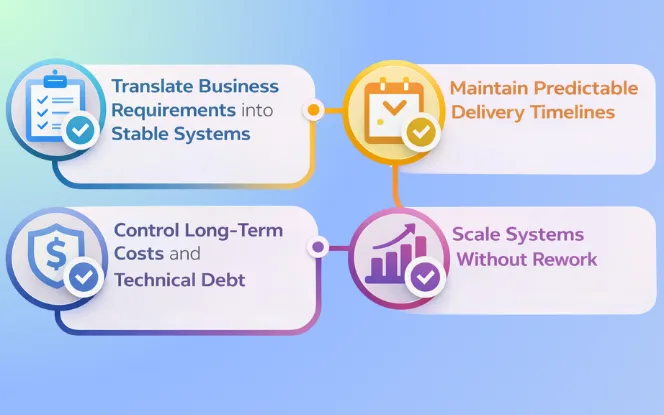
- Translate business requirements into stable systems
- Maintain predictable delivery timelines
- Control long-term costs and technical debt
- Scale systems without rework
For teams unfamiliar with professional delivery structures, reviewing custom software development services can clarify what a mature engagement model looks like:
Consequences of Choosing the Wrong Development Partner

The impact of selecting the wrong software development company usually appears gradually.
Common consequences include:
- Budget overruns caused by unclear scope and frequent revisions
- Codebases that are difficult or risky to maintain
- Dependency on a single vendor due to missing documentation
- Delayed launches that reduce market opportunity
Requirement Clarity Before Vendor Comparison
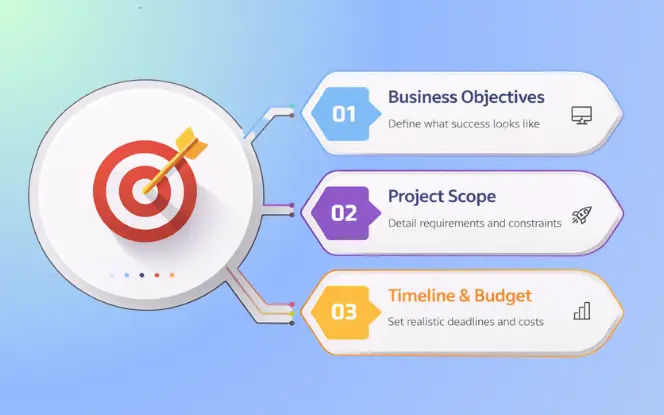
Aligning Business Objectives
Key points to define:
- Core business problems the software must solve
- Measurable outcomes expected from the system
- Internal processes the software will replace or improve
- Stakeholders who will rely on the system for decisions
Identifying Target Users
Key points to define:
- Primary and secondary user groups
- Expected number of active users
- Usage frequency and peak load scenarios
- Access roles and permission levels
Defining MVP Scope Versus Long-Term Roadmap
- Features required for initial launch
- Features planned for later phases
- Dependencies between MVP and future enhancements
- Criteria for moving from MVP to full product development
Integrations & Data
Clear integration and data requirements prevent rework and estimation errors. They also influence system architecture and security decisions.
- Third-party systems to integrate
- Data sources and storage needs
- API and reporting requirements
Compliance Needs
Compliance considerations affect system design and documentation. Addressing them early reduces legal and operational risk.
- Applicable regulations or standards
- Data privacy and residency rules
- Audit and security requirements
Budget & Timeline
Defining budget and delivery expectations helps vendors propose realistic plans. It also sets clear boundaries for scope and resourcing.
- Budget range for development
- Target delivery timelines
- Flexibility for phased rollout
Evaluating Technical Expertise Beyond Surface Claims
- Review how architectural decisions are explained
- Confirm experience with scalable systems
- Look for understanding of performance and security trade-offs
- Evaluate problem-solving depth rather than framework familiarity
For long-term development, understanding how dedicated development teams operate is especially important:
Hire Software Developers
Development Process and Delivery Transparency
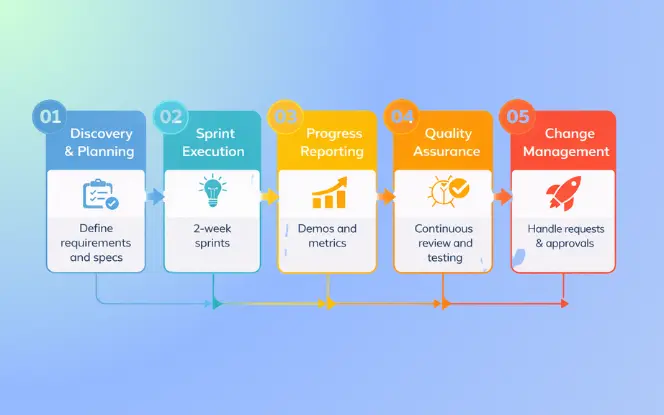
Discovery & Planning
A structured discovery phase helps clarify requirements, technical constraints, and delivery scope before development begins. This reduces rework and improves estimation accuracy.
- Requirement validation and prioritization
- Technical feasibility assessment
- Delivery scope alignment
Sprint Execution
Defined sprint cycles provide regular checkpoints and measurable progress. They help teams identify risks early and adjust delivery plans when needed.
- Sprint planning and backlog management
- Milestone-based progress tracking
- Review and retrospective practices
Progress Reporting
Regular updates improve visibility and accountability during development. They also help stakeholders make timely decisions.
- Status reports and demos
- Risk and dependency tracking
- Stakeholder communication cadence
Quality Assurance
Consistent testing standards help detect issues early and reduce post-launch defects. Quality checks should be integrated throughout development.
- Functional and regression testing
- Performance and security validation
- Pre-release quality reviews
Change Management
Clear change management procedures prevent uncontrolled scope growth. They ensure that changes are evaluated for impact on cost, timeline, and quality.
- Change request evaluation
- Impact analysis and approvals
- Scope and timeline adjustments
Documentation & Handover
Comprehensive documentation ensures long-term maintainability and knowledge transfer. It reduces dependency on individual team members.
- Technical and system documentation
- Deployment and support guides
- Knowledge transfer and handover plans
Delivery Models Across Regions and Teams
| Delivery Model | Best For | Pros | Watch-outs |
|---|---|---|---|
| Onshore | Regulated, high-collaboration projects | Easy communication, regulatory familiarity | Higher cost, limited scalability |
| Offshore | Cost-efficient, long-term development | Large talent pool, scalable teams | Requires strong governance |
| Nearshore | Agile teams, time-zone overlap | Faster feedback, balanced cost | Smaller talent pool |
| Hybrid | Complex, enterprise systems | Balance of control and scale | Clear ownership needed |
Hybrid delivery models often provide the best balance. When offshore delivery is part of the plan, reviewing established offshore software development practices helps set realistic expectations:
Security, Compliance, and Intellectual Property Protection
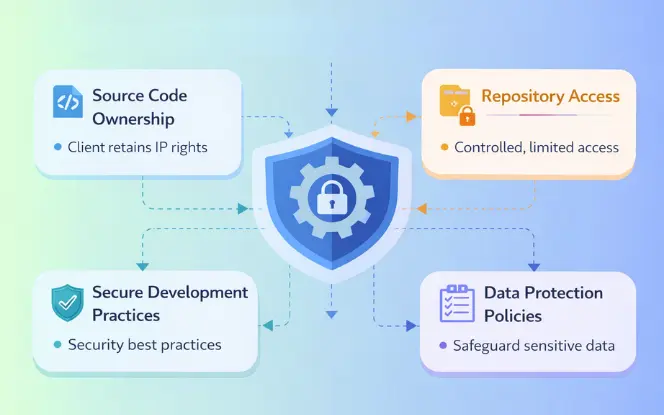
Source Code Ownership
Ownership terms should be defined before development begins. Clients should retain full rights to the source code and related assets created for the project.
- Ownership clauses in contracts
- Rights to reuse and modify code
- Restrictions, if any, on usage
Source Code Ownership
Ownership terms should be defined before development begins. Clients should retain full rights to the source code and related assets created for the project.
- Ownership clauses in contracts
- Rights to reuse and modify code
- Restrictions, if any, on usage
Repository Access
Direct access to code repositories ensures transparency and continuity. It also reduces dependency on individual vendors or team members.
- Client-controlled repository access
- Version history visibility
- Backup and recovery access
Secure Development Practices
Security should be integrated throughout development, not added at the end. Vendors should follow defined standards to reduce vulnerabilities.
- Secure coding guidelines
- Access control and permissions
- Regular security reviews
Data Protection Policies
Handling of sensitive data must comply with relevant privacy requirements. Clear policies reduce legal and reputational risk.
- Data storage and encryption practices
- Access and retention rules
- Data handling responsibilities
Structured Vendor Evaluation Using a Scorecard
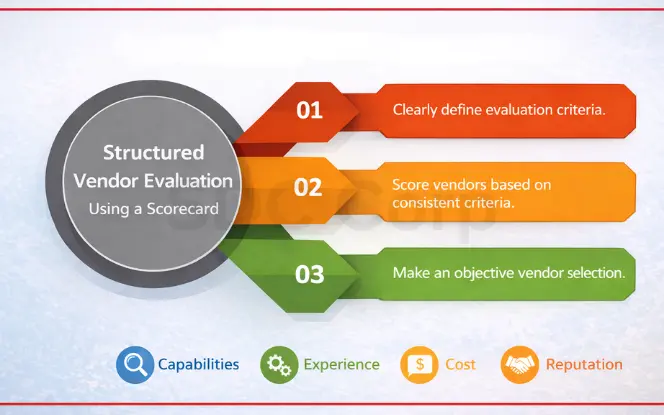
Using a scorecard helps teams compare vendors objectively.
Evaluation criteria typically include:
- Technical capability
- Process maturity
- Communication clarity
- Documentation standards
- Security practices
- Post-launch support
Contract Review and Pre-Signing Validation
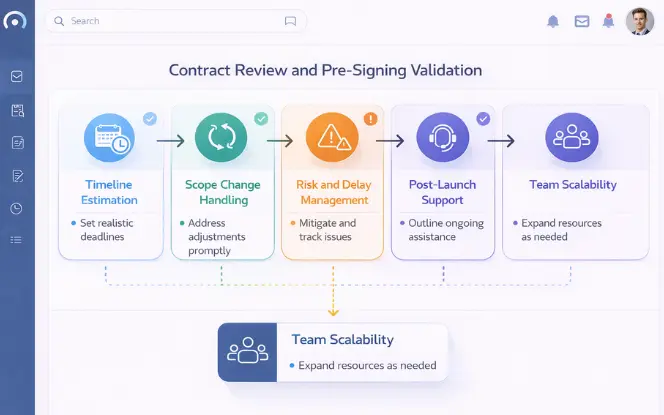
Timeline Estimation
Delivery timelines should be based on realistic planning rather than assumptions. Clear tracking methods help teams monitor progress and address delays early.
- Milestones and delivery phases
- Progress tracking approach
- Reporting frequency
Scope Change Handling
Contracts should define how changes are evaluated and approved. This prevents uncontrolled scope growth and budget overruns.
- Change request process
- Impact assessment on cost and timeline
- Approval responsibilities
Risk and Delay Management
Potential risks should be identified upfront along with mitigation plans. Clear responsibility reduces disruption when issues arise.
- Risk identification procedures
- Delay escalation paths
- Contingency planning
Post-Launch Support
Support responsibilities after delivery should be clearly outlined. This ensures stability once the system goes live.
- Bug fixes and maintenance scope
- Support timelines and response levels
- Warranty or support periods
Team Scalability
The contract should explain how the team can scale up or down as needs change. This helps manage cost and delivery flexibility.
- Resource scaling options
- Replacement and onboarding processes
- Continuity planning
Read Our Blog On Enterprise Software Development
Common Errors in Software Development Partner Selection
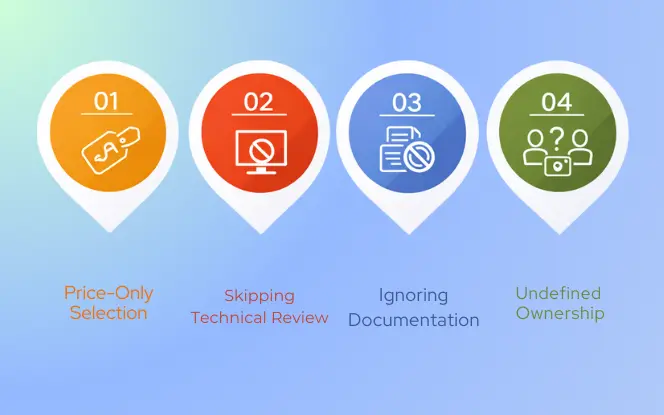
Price-Only Selection
Choosing a vendor based solely on the lowest price often leads to quality and delivery issues. Initial savings are frequently offset by rework, delays, and higher long-term costs.
- Hidden costs emerge later
- Quality and stability may suffer
- Limited accountability for outcomes
Skipping Technical Review
Failing to assess technical capability increases delivery risk. Without due diligence, teams may overlook gaps in architecture, scalability, or security experience.
- Weak system design choices
- Limited scalability planning
- Increased maintenance challenges
Ignoring Documentation
Poor documentation creates long-term dependency on the vendor. It also makes future updates and transitions difficult.
- Limited system understanding
- Higher onboarding effort later
- Increased vendor reliance
Undefined Ownership
Not defining ownership early can lead to disputes over code, data, and access. These issues are difficult to resolve once development is underway.
- Unclear source code rights
- Restricted repository access
- Complications during handover
Pricing Models and Total Cost Considerations
| Pricing Model | Description | Typical Cost Range |
|---|---|---|
| Fixed-Price | Best when scope is well defined and unlikely to change. | $15,000 – $50,000+ per project |
| Time & Material | Flexible model where you pay for actual effort & hours. | $50 – $150 / hr (avg. dev rate) |
| Dedicated Team | Long-term development with a committed engineering team. | $8,000 – $40,000+ / month |
| Maintenance & Support | Ongoing post-launch support and updates. | ~$500 – $3,000 / month |
| Future Enhancements | Budget for adding features & scaling over time. | $5,000 – $25,000+ per phase |
Conclusion
FAQs
How should a business choose a custom software development company?
What factors matter most when selecting a software development company?
How much does it cost to hire a custom software development company?
The cost depends on project scope, complexity, delivery model, and region. Long-term cost of ownership—including maintenance, scalability, and vendor dependency—matters more than initial pricing.
Is offshore software development a reliable option?
Offshore software development can be reliable when supported by strong communication, clear documentation, defined ownership, and consistent oversight. It is less suitable for projects with heavy regulatory or real-time collaboration needs.
What questions should be asked before signing a software development contract?
Key questions should cover delivery timelines, scope change handling, post-launch support, team continuity, security practices, and knowledge transfer in case the partnership ends.
Who owns the source code in custom software development projects?
How does SDLC Corp approach custom software development projects?
SDLC Corp follows a structured SDLC-driven approach that emphasizes clear requirements, scalable system design, documented development processes, and security-first delivery. This helps organizations maintain long-term stability and scalability in their software systems.


