






















Enterprise software partner

Enterprise Software Development Company

SDLC Corp is an enterprise software development company that builds secure business platforms, modernizes legacy systems, and connects ERP, CRM, cloud, and data tools. We plan each solution around workflows, compliance needs, integration dependencies, and long-term ownership.

Reviewed on
SDLC Corp GoodFirms review badge SDLC Corp AppFutura review badge SDLC Corp Clutch review badge
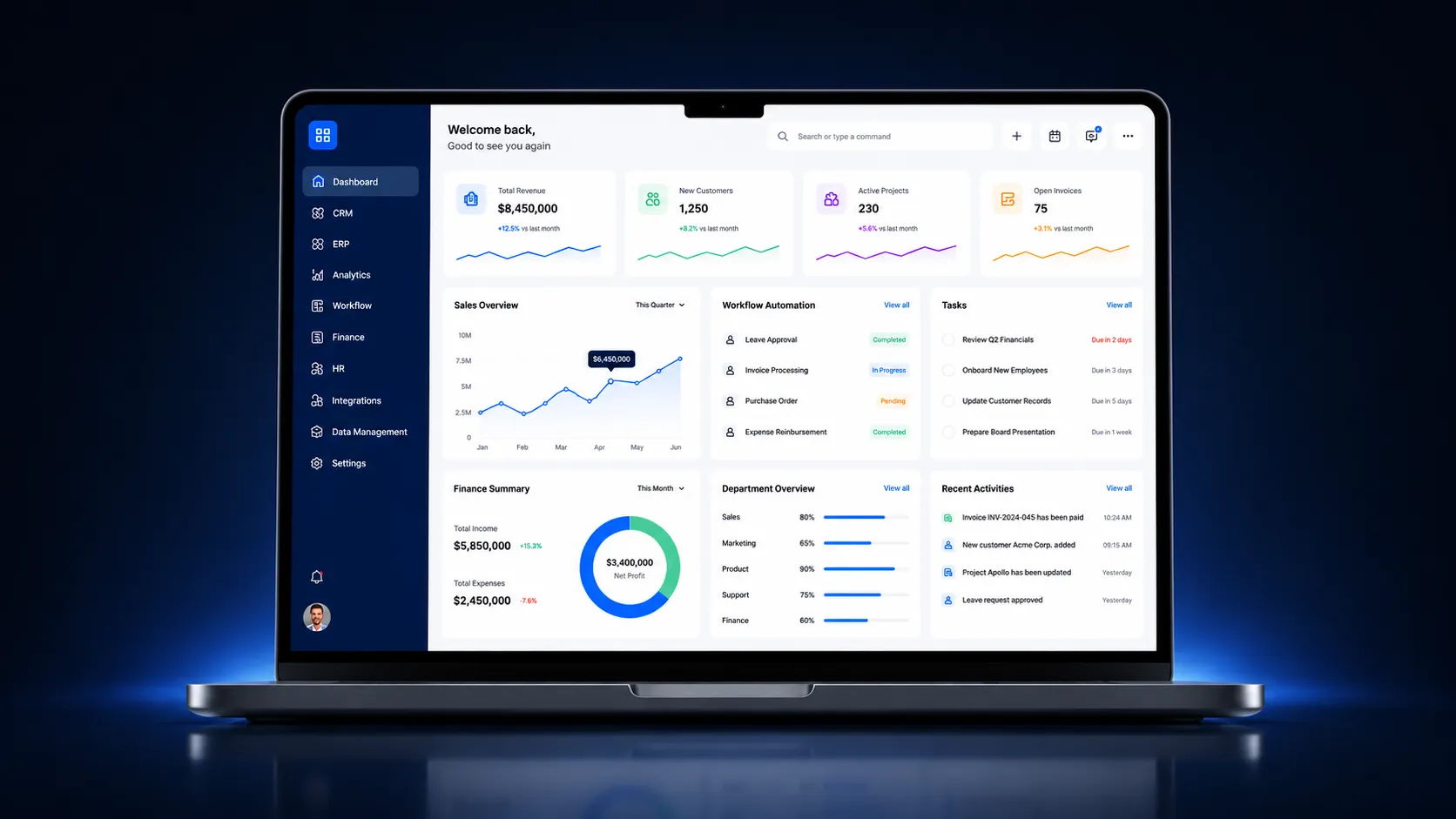
Enterprise software dashboard on a laptop for business platform planning
20+ Years of software development experience
200+ Software projects delivered
150+ Integration workflows supported
4 Flexible engagement models
Enterprise software capabilities

Enterprise Software Development Services

SDLC Corp provides enterprise software development services for secure business platforms, legacy modernization, system integration, data workflows, practical AI features, and long-term application support.

Enterprise Software Consulting

Review current systems, software risks, architecture gaps, integration needs, and delivery priorities before development begins.

Discuss consulting needs

Custom Enterprise Software Development

Build secure business platforms for approvals, user roles, reporting, and operational processes that packaged tools cannot fully support.

Explore custom software

Legacy Software Modernization

Modernize aging applications through phased migration, code refactoring, cloud readiness, database upgrades, and rollback planning.

Explore modernization

Enterprise System Integration

Connect ERP, CRM, finance, inventory, HR, and operations systems through APIs, middleware, data sync, and secure access layers.

Talk about integration

Enterprise Data and AI Solutions

Design data pipelines, analytics layers, automation flows, and AI features that fit existing business systems and governance rules.

Explore enterprise AI

Enterprise Software Maintenance and Support

Keep enterprise applications stable after launch with issue fixes, version updates, performance checks, security patches, and planned improvements.

Explore maintenance support
Industries we serve

Industry-Focused Enterprise Software Solutions

SDLC Corp maps industry workflows, data rules, user roles, and integration needs before planning enterprise software solutions for complex business environments.

Banking finance and insurance software workflows for enterprise operations

Banking, Finance and Insurance

Secure finance systems can support approval routing, risk checks, reconciliation, reporting, and audit-ready transaction workflows.

Healthcare software platform for patient data and clinical workflows

Healthcare and Life Sciences

Healthcare platforms can manage patient records, staff workflows, appointment systems, clinical access, and operational reporting.

Manufacturing software for production planning and shop floor operations

Manufacturing and Industrial Operations

Manufacturing systems can support ERP integration, production planning, inventory control, equipment visibility, and quality workflows.

Retail and ecommerce software for inventory orders and customer data

Retail and eCommerce

Retail platforms can connect inventory, orders, warehouse operations, loyalty programs, customer data, and sales reporting.

Logistics and supply chain software for shipment fleet and warehouse workflows

Logistics and Supply Chain

Logistics platforms can improve shipment visibility, fleet workflows, warehouse integrations, carrier data, and exception handling.

Education and EdTech software for LMS workflows and learning portals

Education and EdTech

EdTech systems can support LMS workflows, student management, staff access, course operations, learning portals, and reporting.

How we deliver

Enterprise Software Delivery Framework

Our delivery process keeps business goals, system dependencies, security requirements, and compliance checkpoints visible from discovery to post-launch support.

01

Discovery and Scoping

During discovery, we review workflows, existing systems, user roles, integration dependencies, and compliance needs to define a practical roadmap.

02

Architecture Planning

The architecture phase defines system boundaries, data flows, access controls, infrastructure needs, and security inputs before development starts.

03

Agile Development

Development runs in planned sprints with backlog visibility, progress reviews, release priorities, and checkpoints aligned to the approved scope.

04

QA and Security Review

At this stage, functional testing, integration checks, performance reviews, code quality checks, and security validation are handled based on project needs.

05

Controlled Launch

Before release, the team prepares deployment steps, rollback paths, go-live support, monitoring setup, and handover documentation.

06

Maintenance and Support

After launch, enterprise applications can be supported with issue fixes, version updates, performance checks, monitoring, and planned improvements.

Why SDLC Corp

Enterprise Software Delivery Built Around Your Constraints

Complex business platforms need more than development capacity. SDLC Corp plans architecture, integrations, security, delivery governance, and post-launch support together from the start.

01

Architecture before code

System boundaries, integration flows, access policies, and deployment needs are defined before implementation begins.

02

Connected technical capability

Engineering, cloud, data, CRM integration, QA, and support teams can stay aligned under one project structure.

03

Support planned upfront

Monitoring, release support, issue handling, and improvement planning are scoped before go-live, based on project needs.

What sets our approach apart

Each program is structured around governance, technical coverage, security planning, and cross-industry delivery context.

Delivery model

Governance for complex software programs

Clear ownership, sprint reporting, release planning, risk tracking, and stakeholder review points keep progress visible.

Full-stack technical coverage

Cloud, CRM, backend systems, data pipelines, QA, and managed support can be coordinated through one team.

Security as an architecture input

Access control, identity integration, audit trails, and data protection needs are planned during architecture design.

Cross-industry software experience

Teams support software programs across BFSI, healthcare, manufacturing, logistics, retail, and education use cases.

Integration map
Access planning
Cloud readiness
Release planning
Support scope
Security planning

Enterprise Software Security Planned at the Architecture Stage

Enterprise software security works best when access control, data protection, audit logging, and deployment policies are planned before development starts.

Based on project scope, SDLC Corp maps controls against relevant frameworks such as SOC 2, ISO 27001, HIPAA, PCI DSS, SOX, and GDPR before key architecture decisions are finalized.

Enterprise security architecture visual Shield connected to identity access, data protection, audit logging, secure development, cloud security, and control mapping. Identity Access control Data Protection Audit Logging Controls Mapping Secure SDLC Cloud Security Control Map Audit Trail Risk Review

Identity and Access Management

Plan SSO, role-based permissions, MFA, session controls, and access logs around user roles, approval paths, and internal policies.

SSO SAML / OIDC RBAC MFA

Data Security and Privacy

Define encryption needs, retention rules, sensitive-field handling, backup requirements, and data residency controls before the build phase.

Encryption TLS 1.2 / 1.3 Key Management Data Residency

Secure SDLC and DevSecOps

Release pipelines can include code quality checks, dependency scanning, secrets handling, vulnerability review, and environment validation based on project risk.

SAST DAST SCA Secrets Management
How we engage

Enterprise Software Engagement Models

Choose a project structure based on scope clarity, governance needs, procurement process, and the level of flexibility your build requires.

Ongoing platforms

Dedicated Delivery Team

A structured engineering group works on your roadmap with defined roles, sprint rhythm, technical oversight, and release planning.

Best for: Long-term platforms, product evolution, and continuous improvement
Evolving scope

Time and Materials

This model suits projects where requirements, integrations, user feedback, or architecture decisions may change during execution.

Best for: Complex integrations, modernization work, and discovery-led builds
Defined deliverables

Fixed Scope Delivery

A documented scope, milestone plan, acceptance criteria, and change control process help keep defined work predictable.

Best for: Clearly defined modules, MVPs, and scoped business features
Specialist support

Specialist Delivery Support

Focused engineering, QA, cloud, integration, or data support can help an active program move through specific technical blockers.

Best for: Technical gaps, integration work, cloud tasks, and active platform programs
Technology stack

Technology Stack for Enterprise Software Development

SDLC Corp selects production-ready technologies based on integration needs, maintainability, security requirements, cloud fit, and long-term product ownership.

Frontend
React icon React
Angular icon Angular
Vue.js icon Vue.js
TypeScript icon TypeScript
Flutter icon Flutter
Backend
Node.js icon Node.js
Java icon Java
Python icon Python
.NET Core icon .NET Core
Laravel icon Laravel
Data and Cloud
PostgreSQL icon PostgreSQL
MongoDB icon MongoDB
Redis icon Redis
AWS icon AWS
Microsoft Azure icon Azure
Google Cloud icon GCP
Docker icon Docker
Kubernetes icon Kubernetes
Business Platforms, Integrations and AI
Salesforce
Odoo ERP
SAP
Microsoft Dynamics 365
ServiceNow
OpenAI API
LangChain
MuleSoft / iPaaS

Technology choices are documented for handover. Source code access, platform ownership, integration needs, and vendor dependencies are reviewed based on the agreed project scope.

Business outcomes

What Enterprises Can Improve with Custom Software

Custom software outcomes depend on the workflow, data model, integration landscape, and operating process. SDLC Corp focuses on improvements that can be defined during project scoping.

Digital transformation

Better release control

Modern architecture, release planning, and deployment controls can help teams review, approve, and ship platform updates with more clarity.

Release planning
Process automation

Reduced manual handoffs

Workflow automation can reduce repeated data entry, manual approvals, spreadsheet tracking, and disconnected team handoffs.

Workflow automation
Data visibility

Clearer operational reporting

Connected data flows can help teams view business activity, exceptions, approvals, and performance indicators from one reporting layer.

Connected data
Control readiness

Stronger access controls

Role-based access, audit logging, secure data handling, and deployment rules can be planned into the architecture early.

Access planning
Cloud readiness

Improved scalability planning

Cloud-ready architecture can support changing user demand, new modules, integration growth, and future platform improvements.

Cloud architecture
Long-term operations

Simpler maintenance planning

Documented code, modular architecture, release notes, and support planning can help teams manage platforms after launch.

Support readiness
Plan software outcomes before development starts. Define workflows, connected systems, access controls, and reporting needs before selecting the delivery approach.
Discuss your project
FAQ

Common Questions

Answers on enterprise software planning, timelines, integrations, modernization, security, and post-launch support.

Ask us directly

What is enterprise software development?

Enterprise software development is the process of designing, building, integrating, and maintaining software for complex business operations. It can include internal workflow platforms, ERP and CRM integrations, reporting systems, customer portals, automation tools, and secure data platforms.

Unlike basic software builds, enterprise systems are planned around user roles, approval flows, system dependencies, data rules, security controls, and long-term operating needs.

Why choose an enterprise software development company?

An enterprise software development company plans software around system dependencies, user roles, security controls, integrations, compliance needs, and long-term support.

This matters when the platform must connect with ERP, CRM, finance, cloud, data, and operational systems without creating maintenance or ownership gaps.

How much does an enterprise software project cost?

Cost depends on scope, features, integrations, security requirements, compliance needs, data migration, infrastructure, and support expectations.

A focused module or integration usually costs less than a full business platform. SDLC Corp defines the estimate after discovery, architecture planning, and dependency mapping, so the proposal reflects the actual delivery scope.

How long does an enterprise software project take?

Timelines vary by project size and complexity. A small workflow module or integration can move faster, while a full platform with multiple systems, user roles, and compliance requirements needs a phased delivery plan.

During discovery, SDLC Corp maps milestones, release phases, dependencies, testing needs, and launch steps before confirming the timeline.

Can you modernize legacy enterprise systems?

Yes. SDLC Corp can modernize legacy systems through phased migration, code refactoring, database upgrades, API enablement, cloud readiness, and controlled release planning.

For complex production systems, the work may include parallel runs, rollback paths, regression testing, and performance checks before each cutover.

How do you handle security and compliance?

Security and compliance are reviewed during discovery and architecture planning. Based on the project scope, SDLC Corp maps controls for access management, audit logging, encryption, data retention, backup, deployment, and user permissions.

Project requirements may be mapped against frameworks such as SOC 2, ISO 27001, HIPAA, PCI DSS, SOX, or GDPR where relevant to the business and operating region.

Do you provide support after launch?

Yes. Post-launch support can include issue fixes, version updates, monitoring, performance checks, security patches, release management, and planned feature improvements.

The support model is defined based on scope, operating needs, release frequency, monitoring needs, and planned improvement cycles.

Start your project

Ready to Build Secure Enterprise Software?

Share your enterprise software requirements, integration needs, and delivery goals. Our team can review the scope and suggest a practical development approach.