Industry 4.0 & Smart Factory Software

Manufacturing Software Development Company

As a manufacturing software development company, we build custom ERP, MES, IIoT, QMS, and production planning systems for real shop floor operations. These solutions connect production, inventory, quality, and maintenance in one reliable system.

Recognized on GoodFirms company profile badge AppFutura software development profile badge Clutch company review badge
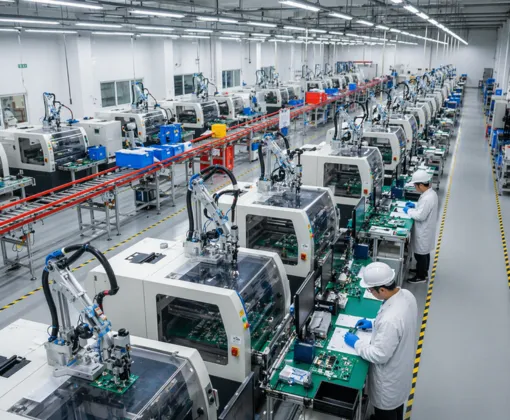
electronics manufacturing production line with automated assembly machines
OEE Visibility SupportDesigned for production tracking
Quality Workflow Support Built for audit-friendly processes
20+

Years of Software
Development Experience

200+

Software Projects
Delivered

150+

Integration Workflows
Supported

4

Flexible Engagement
Models

Manufacturing Software Challenges

Why Manufacturers Struggle With
Off-the-Shelf Software

Generic ERP and MES platforms often work for standard processes. However, custom workflows, multiple plant locations, and strict compliance needs can make standard tools harder to manage.

Disconnected Shop Floor Data

ERP may show one figure, while the shop floor shows another. As a result, teams spend extra time reconciling data and making decisions with outdated numbers.

Unplanned Machine Downtime

Equipment issues can appear without early warning. Without usage-based maintenance data, teams may struggle to spot risks before they affect production.

Manual Quality Tracking

Teams may log inspections on paper and track CAPA actions in spreadsheets. This can slow audit preparation and make traceability harder to manage.

Inventory Inaccuracies

Stock counts may not match actual inventory. This can lead to over-ordering, shortages, or poor traceability across multiple warehouse locations.

Production Scheduling Gaps

Production plans can change quickly when a machine stops or a rush order arrives. Manual rescheduling may slow teams down and affect downstream operations.

Hard-to-Maintain Legacy Systems

Aging ERP and MES tools often need workarounds and may not connect easily with modern IoT systems. They can also create dependency on a few internal experts.

What We Build

Manufacturing Software
Solutions We Build

Our manufacturing software solutions support production execution, scheduling, inventory control, quality assurance, and connected operations. Each solution is built around factory workflows instead of generic enterprise templates.

Manufacturing ERP Software

Connect procurement, MRP, inventory, reporting, and production planning in one manufacturing-focused system. This helps teams improve visibility across plants and departments.

MES Software Development

Track work orders, capture operator and machine inputs, monitor WIP, and support shop floor traceability across production lines and work centers.

Industrial IoT & Factory Automation Software

Connect machines and sensors for OEE monitoring, equipment status tracking, downtime alerts, and predictive signals. As a result, teams can identify downtime risks earlier.

Manufacturing Inventory & Supply Chain Software

Improve stock accuracy, material availability, warehouse movement, and supplier coordination across locations. This supports better traceability from purchase orders to production.

Quality Management Software for Manufacturing

Manage inspections, non-conformance records, CAPA workflows, traceability logs, and corrective actions. These workflows can support ISO 9001, IATF 16949, and FDA 21 CFR needs.

Production Planning & Scheduling Software

Plan schedules, balance capacity, manage bottlenecks, and improve production sequencing. In addition, dynamic rescheduling can help teams respond when priorities change.

Predictive Maintenance Software

Use sensor data and analytics to identify possible equipment risks, plan maintenance around production windows, and support more proactive asset management.

Digital Twin & Factory Simulation Software

Model production environments digitally to test layout changes, review throughput bottlenecks, and compare floor configuration options before physical changes.

PLM Software for Manufacturing

Manage BOM structures, engineering change workflows, and design revisions from concept through production. These workflows can connect with ERP and MES systems.

Manufacturing Software Development Process

How We Deliver
Manufacturing Software

Our manufacturing software development process maps factory workflows, integrations, and delivery risks before development starts. This helps teams move with a clearer plan.

  1. 01

    Discovery & Scoping

    We map production workflows, system dependencies, integration points, and compliance needs. This helps define a clear project scope before development starts.

  2. 02

    Architecture Design

    We design the data model, module structure, API layer, and system connection plan. Then, we map ERP, MES, IIoT, and shop floor touchpoints in sequence.

  3. 03

    Agile Development

    We build in planned sprints with review points during development. This helps your team review progress, share feedback, and adjust priorities before deployment.

  4. 04

    Integration & Testing

    We test key connections such as ERP to MES, sensors to dashboards, and warehouse systems to planning tools. Testing can also cover edge cases and backup scenarios.

  5. 05

    Deployment, Training & Support

    We deploy the system, train users, and support a parallel run where needed. After launch, support can help with fixes and workflow updates.

Manufacturing Software Services

Custom Manufacturing
Software Development Services

Our custom manufacturing software development services cover application development, legacy upgrades, system integration, automation, and cloud deployment. Each service is mapped to factory workflows, production data, and operational needs.

Custom Manufacturing Software Development

Build software around factory workflows, BOM structures, routing logic, approvals, and traceability needs instead of generic templates.

AI Automation for Manufacturing

Use forecasting, anomaly detection, process automation, and exception alerts to support production, quality, and planning teams.

Cloud Manufacturing Software

Deploy cloud, on-premise, or hybrid systems for multi-site access, easier maintenance, and connected manufacturing workflows.

Legacy System Modernization

Upgrade aging manufacturing applications, replace disconnected tools, and improve reporting workflows with less disruption.

Manufacturing System Integration

Connect ERP, CRM, IoT devices, warehouse systems, scheduling tools, and legacy factory systems for smoother data flow.

Manufacturing Compliance Software Readiness

Build workflows that can support ISO 9001, ISO 27001, FDA 21 CFR Part 11, IATF 16949, and GDPR requirements.

Why SDLC Corp

Why Choose SDLC Corp as Your
Manufacturing Software Development Company

SDLC Corp supports manufacturers with software built around production, inventory, quality, and plant operations. Our approach focuses on clear workflows, practical integrations, and flexible delivery.

Manufacturing Workflow Understanding

We map work orders, BOMs, routing, shifts, inventory, and quality checks before planning the software structure.

ERP, MES & IoT Integration Knowledge

We plan connections across ERP, MES, WMS, IoT devices, dashboards, and legacy factory systems.

Practical Delivery Approach

We keep delivery structured with discovery, scoped milestones, review points, testing, and handoff support.

Support After Launch

Post-launch support can help teams manage fixes, workflow updates, integrations, and system improvements.

Benefits of Manufacturing Software

Business Benefits of
Manufacturing Software

Manufacturing software can help teams improve production visibility, quality tracking, inventory control, and daily decision-making across factory operations.
  • Better Downtime Visibility IIoT monitoring and predictive maintenance alerts can help teams spot equipment risks before they affect production.
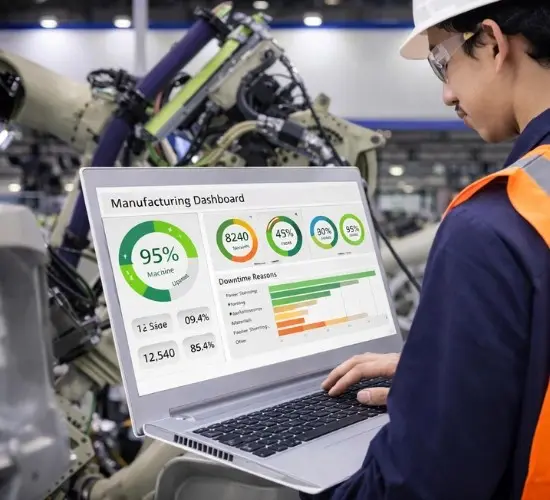
  • Clearer OEE Monitoring Track availability, performance, and quality data across machines, shifts, and production lines with less manual reporting.
  • Smoother Order Fulfillment Scheduling tools and WIP visibility can help teams manage priorities, capacity, and order movement more clearly.
  • Improved Quality Tracking Inline checks, CAPA workflows, and traceability logs can support faster issue review and better production control.
  • Better Supply Chain Traceability Track materials, batches, work orders, and delivery records across the production lifecycle.
  • Connected Operational Data Connect planning, production, warehouse, and finance data so teams can review operations from one place.
manufacturing software dashboard for production visibility and OEE monitoring
Industries We Serve

Manufacturing Verticals
We Support

We support manufacturing software needs across production-heavy industries, including sectors with traceability, compliance, inventory, and integration requirements.

Automotive & Tier Suppliers Aerospace Manufacturing Pharmaceuticals & Life Sciences Food & Beverage Electronics & Semiconductors Heavy Equipment & Machinery Chemical Processing Textile & Apparel Metal Fabrication Building Materials Consumer Goods & FMCG Medical Devices
ERP, MES, QMS & IIoT Guide

ERP vs MES vs QMS vs IIoT:
What Each System Does

ERP supports planning, MES supports shop floor execution, QMS supports quality control, and IIoT supports machine monitoring. Use this guide to compare where each system fits.

AttributeERP for ManufacturingMESQMSIIoT Platform
Primary RoleBusiness planning, procurement, inventory, and financeShop floor execution and work order trackingQuality checks, inspections, and corrective actionsMachine, sensor, and equipment monitoring
Data LayerOrders, inventory, purchasing, finance, and HRWIP, operator inputs, routing, scrap, and production recordsInspections, NCRs, CAPA, audit trails, and quality recordsMachine telemetry, OEE, downtime events, and sensor data
Key UsersOperations, finance, procurement, and management teamsProduction supervisors, operators, and plant teamsQuality engineers, compliance teams, and auditorsMaintenance teams, plant managers, and operations teams
Common Use CasesMRP, purchasing, inventory, costing, and reportingProduction tracking, scheduling, WIP control, and traceabilityInspections, CAPA, non-conformance, and audit supportCondition monitoring, downtime tracking, alerts, and analytics
Integrates WithCRM, WMS, EDI, finance, HR, and reporting toolsERP, IIoT, scheduling, QMS, and PLM systemsMES, ERP, supplier portals, and lab systemsMES, SCADA, PLCs, sensors, and analytics tools
Real-Time FitUsually near real-time or scheduled updates✓ Strong fit for live executionOften event-based quality updates✓ Strong fit for live machine data
When to PrioritizeWhen business planning and inventory control need structureWhen shop floor visibility and execution control are neededWhen quality tracking and audit preparation need improvementWhen machine visibility, downtime tracking, or sensor data is needed
Technology Stack

Technology Stack for
Manufacturing Software

We select technologies based on factory connectivity, system performance, data flow, security, and maintenance needs.

React
Angular
Vue.js
Next.js
TypeScript
JavaScript
Tailwind CSS
Bootstrap
Node.js
NestJS
Express
Python
Django
Java
Laravel
GraphQL
MySQL
PostgreSQL
MongoDB
Redis
Elastic
AWS
Azure
Google Cloud
Docker
Kubernetes
Nginx
Cypress
Selenium
Jest
JUnit
BrowserStack
Verified B2B Profiles

Public Ratings & Manufacturing Project Feedback

The rating cards below reflect SDLC Corp’s public company profiles. The feedback cards should only be used if these testimonials are approved for publishing.

4.9
★★★★★
GoodFirms
Public company profile
Verified Rating
4.8
★★★★★
SelectedFirms
Public company profile
Verified Rating
4.9
★★★★★
Sortlist
Public company profile
Verified Rating
★★★★★

“My manufacturing system built on Odoo needed technical improvements to keep up with growing operations. SDLC Corp reviewed the setup in detail and fixed slow database queries, broken module links, and delays in report generation. Performance improved noticeably after deployment.”

— Daniel Carter, Manufacturing Systems Manager · CoreAxis Manufacturing
★★★★★

“We needed better coordination between inventory, production planning, and reporting in our manufacturing setup. SDLC Corp reviewed the workflow, improved system connections, and streamlined several manual steps. The platform became easier for our team to manage day to day.”

— Michael Turner, Operations Director · NorthPeak Industrial
★★★★★

“Our manufacturing operations had started to outgrow the existing software setup. SDLC Corp analyzed the pain points, resolved module-level issues, and improved overall system stability. The updated solution supported smoother reporting and better process visibility across teams.”

— Ryan Mitchell, ERP & Process Lead · Vertex Components
FAQ

Everything You
Need to Know

Common questions about manufacturing software cost, timelines, ERP/MES integration, customization, deployment, and support.

What does a manufacturing software development company do?

A manufacturing software development company builds software for production, inventory, quality, maintenance, reporting, and shop floor operations. These systems may include ERP, MES, QMS, IIoT, scheduling, and predictive maintenance tools.

How much does custom manufacturing software development cost?

Cost depends on scope, modules, users, integrations, deployment type, data complexity, and compliance needs. A single module usually costs less than a multi-site ERP, MES, or IIoT-connected platform.

How long does manufacturing software development take?

Timelines depend on solution size, integration needs, and rollout approach. A focused module may take a few weeks, while larger systems with ERP, MES, or IoT integrations usually need phased delivery.

Can you integrate with ERP, IoT devices, and legacy systems?

Yes. We can support integrations with ERP, CRM, WMS, IoT devices, PLCs, SCADA platforms, and legacy factory tools. The process starts with reviewing APIs, data flow, and system dependencies.

What compliance standards can manufacturing software support?

Manufacturing software can support standards such as ISO 9001, ISO 27001, FDA 21 CFR Part 11, IATF 16949, GDPR, and GMP, depending on your sector and workflow requirements.

What is the difference between MES and ERP for manufacturing?

ERP supports business planning, procurement, inventory, finance, and reporting. MES supports shop floor execution, work orders, WIP, operator inputs, and production tracking.

Do you provide post-launch support and maintenance?

Yes. Post-launch support can include maintenance, issue fixes, performance checks, system updates, integration support, and new module improvements as production needs change.

What deployment model is right: cloud, on-premise, or hybrid?

The right model depends on infrastructure, security, data residency, and plant operations. Cloud supports easier access, on-premise gives more local control, and hybrid can support both needs.

Build Your Manufacturing Software System

Connect production, inventory, quality, maintenance, and ERP/MES workflows with custom manufacturing software built around your factory operations.

What happens after you submit?