
Technical support is not a secondary service in a bitcoin casino platform. It is a core part of platform performance, transaction reliability, and player trust. When support fails, deposits can stall, withdrawals can slow down, and risk alerts can be missed. As a result, even a short incident can damage operations and user confidence.
Bitcoin casino platforms carry higher support complexity than standard software. They depend on wallet systems, transaction tracking, balance logic, fraud controls, bonus rules, APIs, and third-party services at the same time. Therefore, one fault can spread across multiple systems very quickly. That is why buyers must evaluate how a provider detects, escalates, resolves, and prevents incidents before signing. This guide helps operators and decision-makers assess that support with more confidence.
Key Takeaways
- “24/7 support” is not a support model. Ask for severity tiers, response targets, escalation ownership, and written scope.
- Bitcoin-specific support — wallet reconciliation, tx hash tracing, node failover, confirmation logic — must be owned by the provider, not passed to third-party vendors.
- A strong SLA defines uptime targets, first response time, target resolution time, escalation rules, and communication frequency during incidents — not just availability.
- Mature support teams run post-incident reviews, update runbooks, and prevent repeat failures. Reactive teams only restore service.
- Test every support promise with scenario-based questions before signing. Strong providers answer with a sequence. Weak providers answer with a promise.
Why Technical Support Is a Core Product in Bitcoin Casino Software

How Support Failures Affect Live Financial Operations
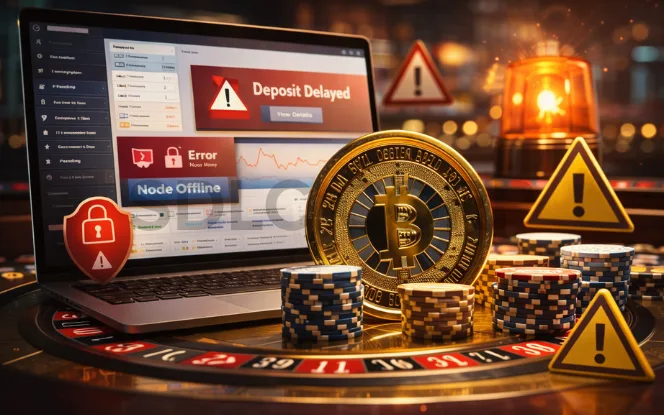
A bitcoin casino platform processes high-trust financial activity in real time. If a deposit appears on-chain but does not credit in the user account, player confidence drops immediately. If withdrawals remain queued too long, the issue becomes both a support problem and a brand problem.
In most cases, the visible failure is not the root failure. A missing credit may trace back to delayed confirmations, node lag, wallet sync failure, internal ledger mismatch, fee estimation errors, or a release change that broke payment logic. A capable support team knows how to separate one failure type from another within minutes. A weak team routes the ticket in circles.
Why Bitcoin Casino Platforms Have Higher Support Complexity
Bitcoin casino software is a multi-layer system — not a single application. Wallet services, payment processors, game integrations, KYC checks, fraud controls, bonus logic, admin tools, and reporting services all run interdependently. A fault in one layer rarely stays contained.
Consider how quickly misrouting happens in practice:
- A node delay can present as a failed deposit
- A release bug can present as a fraud block
- A third-party payment outage can present as a balance mismatch
- A hot wallet threshold breach can present as a withdrawal queue backup
Mature support teams isolate the failure path quickly because they have monitoring, runbooks, and ownership. Weak teams pass the ticket between departments while the clock runs.
What Weak Security Support Costs in Production
Security support in a bitcoin casino platform extends far beyond server patching. It includes vulnerability response, emergency fix deployment, access control incidents, suspicious transaction investigation, and coordinated response between product, DevOps, wallet, and infrastructure teams.
If a provider cannot explain how a critical security issue moves from detection to remediation — with named ownership and a defined timeline at each stage — the security support promise is not operational. In a live iGaming environment, vague security handling creates direct business and regulatory risk.
What Technical Support From Bitcoin Casino Software Providers Must Include
A Written Support Scope That Goes Beyond “24/7”
A mature provider defines support scope in a document — not a sales call. That scope should cover:
- Bug triage and issue intake
- Uptime monitoring and alerting
- Incident detection, ownership, and communication
- Deployment support and post-release validation
- Rollback support with defined approval criteria
- Wallet and payment issue investigation
- API support and dependency coordination
- Security patching and emergency fix procedures
- Post-incident review and corrective action
If a provider cannot produce this list in writing before you sign, you cannot hold them to it after.
Defined Support Tiers With Clear Ownership
Ask how the support team is structured across L1, L2, and L3 functions:
- L1 — First-line intake: Receives reports, logs tickets, assigns severity, and opens communication
- L2 — Technical investigation: Reproduces issues, isolates failure paths, and coordinates escalation
- L3 — Engineering and infrastructure action: Changes code, infrastructure configuration, or wallet settings
This distinction matters in practice. Many providers show strong L1 coverage in a demo — fast acknowledgment, polished ticket systems — while L2 and L3 escalation is slow, undocumented, or shared across too many clients. A provider can have a 15-minute first response time and a 48-hour resolution time. Both numbers should appear in any SLA you review.
Bitcoin-Specific Wallet and Payment Support Capabilities
General software support is not sufficient for a bitcoin casino platform. Confirm that the provider’s support team can handle:
- Confirmation threshold logic and adjustment by asset or risk policy
- Deposit reconciliation when on-chain status and internal ledger diverge
- Withdrawal queue investigation, including fee-estimation delay analysis
- Wallet balance mismatch checks across hot wallet and cold wallet states
- Address monitoring and refund workflow handling
- Transaction hash (tx hash) tracing from blockchain event to internal ledger entry to player balance state
- Stuck transaction investigation and recovery
- Node provider failover handling
- Third-party wallet, custody, or payment coordination during live incidents
This point is critical. If the provider relies on external wallet, node, or payment services, their support team must still own the incident end-to-end. Your team should not become the coordination bridge between multiple vendors during a live production failure.
Support Metrics That Measure Resolution, Not Just Response
First response time is one metric. It is not the only one that matters. A provider should track and report:
| Metric | What It Measures |
|---|---|
| First response time | Speed of acknowledgment |
| Time to technical investigation | How quickly L2 engages |
| Time to engineering involvement | How quickly L3 engages |
| Time to workaround | How quickly operators can resume operations |
| Time to full resolution | End-to-end incident duration |
| Update frequency during incidents | Communication discipline |
| Time to post-incident report | Organizational learning speed |
Industry benchmarks vary by severity. For a P1 incident (platform-level service failure), a reasonable target is: first response within 15 minutes, engineering involvement within 60 minutes, and a post-incident report within 48 hours. Providers unable to commit to documented P1 benchmarks are not operationally mature.
Post-Incident Review and Prevention Discipline
Restoring service is only the first half of incident resolution. Ask whether the provider performs:
- Written incident summaries with root-cause analysis
- Corrective actions with named ownership and deadlines
- Runbook updates following each significant failure
- Monitoring threshold adjustments after missed alerts
- Preventive changes to reduce repeat occurrence
If support ends when the service is restored, that is reactive maintenance — not mature operational support.
What Evidence to Request From a Bitcoin Casino Software Provider Before Signing
Support claims made during a sales process cannot be verified in a sales process. Before signing, request documents that reflect how the provider actually operates:
- Sample SLA — with severity definitions, response targets, resolution targets, and uptime commitments
- Escalation matrix — showing L1, L2, and L3 contacts with coverage hours per severity level
- Onboarding checklist — mapping environments, runbooks, contacts, and escalation paths before launch
- Incident update format — the actual template used to communicate during a live production incident
- Post-incident report sample — a real or anonymized report showing root-cause analysis and corrective actions
- Runbook excerpt — showing how one common failure type (e.g. failed deposit, withdrawal queue backup) is handled
- Monthly service review format — showing how the provider reports on support performance
- Wallet or payment incident summary — showing how a bitcoin-specific failure was investigated and resolved
Providers that rely on verbal reassurance during vendor review tend to rely on verbal reassurance during production incidents. Documentation is the earliest test of operational discipline.
How to Evaluate a Provider’s Support Model Step by Step

Step 1: Evaluate the Support Structure and Coverage Model
Start by asking whether support is shared across all clients or dedicated to your platform. Then ask:
- Is there a named technical account contact or on-call escalation owner?
- Is L2 and L3 support available outside business hours for P1 severity incidents?
- What is the difference between “support available” and “engineering available” at 2am on a Sunday?
Many providers advertise 24/7 support that, in practice, means after-hours acknowledgment only. Outside business hours, L2 and L3 resolution may require waiting until the next working day. That gap matters on a live platform processing deposits and withdrawals continuously.
Step 2: Review the SLA for Completeness
A strong SLA from a bitcoin casino software provider defines more than an uptime percentage. Review each of the following:
- Uptime commitment — 99.9% uptime allows roughly 8.7 hours of downtime per year. Understand what is excluded (maintenance windows, third-party failures).
- Severity tier definitions — P1 through P4 should map to specific operational conditions, not vague descriptions.
- Response and resolution targets — First response time and target resolution time should be defined separately for each severity level.
- Escalation rules — What triggers automatic escalation from L1 to L2, and L2 to L3?
- Maintenance window terms — When can the provider perform planned downtime? How much notice is required?
- Communication frequency — How often are updates provided during a P1 incident?
- SLA breach remedies — What happens when the provider misses their own SLA? Service credits, remediation plans, and escalation rights should all be documented.
Without those terms, an SLA is a marketing document. It defines what the provider hopes to deliver — not what they are contractually committed to.
Step 3: Test the Incident Response Process
Ask the provider to walk you through the first thirty minutes of a live production outage. They should be able to answer:
- How is the incident detected — by monitoring, or by a player complaint?
- Who opens the incident record and assigns severity?
- Who leads the response?
- Who communicates with your team, and through which channel?
- When does L3 engineering join?
- How often are updates shared?
- Who owns communication until full resolution?
If a provider cannot walk through the early stage of incident handling with specific answers, their incident process is not operational. It is theoretical.
Step 4: Assess Onboarding and Knowledge Transfer Quality
Onboarding quality is consistently underweighted during vendor evaluation. If the provider does not fully map your environments, escalation flows, runbooks, and wallet dependencies before launch, they will be learning your platform during your first live incident
Before launch, a capable provider should deliver:
- Full environment documentation (staging, UAT, production)
- Release ownership and deployment calendar
- Named support contacts with hours and escalation paths
- Runbooks for common failure scenarios
- Monitoring coverage map
- Wallet and payment dependency documentation
- Third-party coordination contacts and escalation procedures
A provider that skips this or calls it “onboarding lite” will cost you time during the incidents that matter most.
Technical Questions to Ask Bitcoin Casino Software Providers Before You Sign

The best way to evaluate support quality is to ask questions that require process detail. A strong provider answers with a sequence of actions, named owners, and defined thresholds. A weak provider answers with a general promise.
Questions About Deposits and Confirmation Logic
- After how many confirmations is a deposit credited — and can that threshold change by asset, risk profile, or transaction value?
- How are delayed confirmations surfaced to the support team?
- How does the team investigate a deposit that shows confirmed on-chain but has not credited in the user account?
- Can support trace a tx hash from blockchain status through internal ledger state to player wallet balance?
Questions About Platform Monitoring
- What alerts exist for failed deposits and delayed withdrawals?
- How is wallet latency distinguished from application-layer failure?
- How are node issues separated from platform issues in monitoring?
- How are third-party game or payment outages identified before players report them?
A provider that learns about platform failures from player complaints is not monitoring the platform — they are reacting to it.
Questions About Releases and Rollback
- Are payment and wallet flows tested in staging before every production release?
- Is rollback supported for all release types?
- Who validates production state after deployment?
- If a withdrawal queue backs up after a release, who owns the investigation and who approves rollback?
Live production failures disproportionately follow release events. Release support is not a separate topic from production support — they are the same capability
Questions About Wallet and Vendor Dependency Handling
- If the node provider becomes unstable, how is failover handled and how quickly?
- If the custody or wallet vendor is unresponsive during a live incident, who owns the resolution?
- How are fee-estimation failures handled when withdrawals are delayed?
- Does your team coordinate across all vendors during a live incident, or does responsibility transfer to the operator?
This set of questions separates genuine operational ownership from basic helpdesk coverage. A provider that says “that part belongs to another vendor” during a live support conversation has already handed you the incident.
Questions About Security Incident Response
- How quickly are critical vulnerabilities patched after discovery?
- Who approves emergency fixes, and what is the minimum approval path during an active security incident?
- How are patch windows communicated and scheduled?
- How are access control incidents — compromised credentials, unauthorized wallet access, suspicious withdrawals — handled?
- What is the RTO (Recovery Time Objective) and RPO (Recovery Point Objective) for a critical platform security event?
Red Flags That Signal Weak Technical Support

These warning signs appear during vendor evaluation — not during a live outage. Identifying them early is the entire point.
A vague “24/7 support” promise with no severity detail
On its own, this phrase proves nothing. Availability without defined response targets, severity tiers, and named ownership is not a support commitment.
No clear escalation path from L1 to engineering
If a first-line support contact cannot explain when and how engineering joins a P1 incident, serious failures will drag past the point where a workaround was possible. This gap becomes critical during live financial events.
No wallet or payment specialist in the escalation path
Bitcoin-specific failures — confirmation tracking errors, wallet balance mismatches, stuck transactions — require specialists. If the escalation path runs only through general technical support, those issues will bounce.
Weak or missing documentation
A provider that cannot produce a sample SLA, escalation matrix, onboarding plan, or incident format during vendor review is not operating at a documented level. What is undocumented in sales is unavailable in production.
Feature-heavy sales language with no failure-handling detail
If a provider speaks at length about game integrations, bonus logic, and platform modules but cannot explain what happens when a deposit fails or a release breaks production, the demo is showing you the parts they built — not the parts they operate.
Deflected ownership of third-party incidents
If the provider says “that part belongs to another vendor” during a support discussion, they are signaling that incident ownership transfers to you when a third-party dependency fails. In a live bitcoin casino environment, that transfer is not acceptable.
How to Verify Support Claims With Scenario Testing

Do not accept support claims from bitcoin casino software providers at face value. Test every one before signing.
First — request the support documents. Review the SLA, escalation matrix, onboarding plan, incident communication policy, maintenance terms, support metrics, and security remediation workflow. Gaps in documentation reflect gaps in operations.
Second — speak with customer references specifically about support. Ask whether the team responds quickly, communicates clearly during incidents, involves engineering early, and prevents repeat failures. Do not ask general satisfaction questions.
Third — run scenario questions during vendor review. Ask each question and evaluate whether the answer is a sequence of actions or a general assurance:
- A player deposit shows as confirmed on-chain but has not credited in the account. What happens in the next thirty minutes?
- A withdrawal queue backs up immediately after a production release. Who joins first, and who owns the rollback decision?
- A wallet balance mismatch appears across multiple accounts in production. How is ownership assigned and how is the scope determined?
- A third-party payment service degrades during peak traffic. How are updates shared with your team and when does engineering join?
- A stuck transaction creates withdrawal delays for multiple players. How is the issue traced and who owns recovery?
Strong providers answer with a sequence of actions. Weak providers answer with a promise.
Provider Support Evaluation Scorecard
Use this scorecard to compare providers on operational capability — not presentation quality or sales confidence.
Rate each provider from 1 (poor) to 5 (strong) across the ten criteria below. Multiply each score by the assigned weight and sum the results for a weighted total out of 5.
| Criterion | Weight |
|---|---|
| Support scope defined in writing | 15% |
| SLA completeness (severity, response, resolution, escalation, breach remedies) | 15% |
| Wallet and payment support depth | 15% |
| Incident response maturity (detection, ownership, engineering involvement, communication) | 15% |
| Security remediation process | 10% |
| Communication quality and update discipline during incidents | 10% |
| Onboarding and knowledge transfer quality | 5% |
| Post-incident review and prevention discipline | 5% |
| Support tooling and monitoring visibility | 5% |
| Third-party incident ownership | 5% |
| TOTAL | 100% |
Scoring interpretation
- Below 2.5: The provider’s support model is immature. Do not proceed without substantial contractual protections and independent monitoring.
- 2.5 – 3.5: Acceptable, but gaps exist. Identify the weakest criteria before signing and address them contractually.
- 3.5 – 4.5: Operationally capable. Verify with references and scenario testing before final decision.
- Above 4.5: Strong support model. Confirm documentation matches the verbal score before signing.
A strong sales team can create confidence during meetings while a weak support model stays hidden. This scorecard makes that gap visible.
Conclusion
Technical support from bitcoin casino software providers should be judged by proof, not promises. Buyers should verify support scope, SLA terms, escalation paths, payment expertise, and incident ownership before signing. In addition, real support quality shows up in metrics, onboarding, communication, and post-incident discipline. The safer provider is not the one that claims 24/7 support, but the one that can prove how it handles real production issues. That is how operators reduce risk, protect player trust, and choose a more reliable platform partner.
FAQs
What should technical support from a bitcoin casino software provider include?
A complete support scope covers bug triage, uptime monitoring, incident detection and handling, wallet and payment issue investigation, API support, deployment and rollback support, security patching, post-incident review, and defined support metrics. If any of these are missing from the written scope, the provider cannot be held to them operationally.
Why is technical support more complex in bitcoin casino software than in standard platforms?
Bitcoin casino platforms run multiple interdependent systems — wallet services, payment processors, game integrations, KYC checks, fraud controls, and reporting services — simultaneously. A failure in one layer can cascade across others and present as a different problem entirely. This complexity requires support teams with bitcoin-specific knowledge, not general software helpdesk capability.
Is “24/7 support” enough when evaluating providers?
No. “24/7 support” describes availability — not capability. Buyers should confirm that 24/7 coverage includes L2 technical investigation and L3 engineering access for P1 incidents, not just first-line acknowledgment. After-hours acknowledgment with business-hours resolution is not 24/7 support for a live financial platform.
What should a bitcoin casino software SLA include?
A complete SLA defines uptime targets (typically 99.9% or higher), severity tier definitions, first response times, target resolution times, escalation rules by severity, maintenance window terms, communication frequency during incidents, and SLA breach remedies. Without breach remedies, an SLA has no enforcement mechanism.
What is a reasonable P1 response time for a bitcoin casino platform?
For a P1 incident — platform-level service failure affecting deposits, withdrawals, or account access — industry-standard targets are: first response within 15 minutes, L2 technical investigation within 30 minutes, L3 engineering involvement within 60 minutes, and a written post-incident report within 48 hours of resolution. Providers unable to commit to these benchmarks in writing are not operationally mature for a live financial environment.
How can buyers test support quality before signing?
Review all support documents (SLA, escalation matrix, onboarding plan, incident format), speak with customer references specifically about support quality during live incidents, and run scenario-based questions covering failed deposits, delayed withdrawals, wallet mismatches, release failures, and stuck transaction handling. The quality of scenario answers — sequence versus promise — is the most reliable pre-contract test of actual support maturity.
What proof should a provider show before you trust their support promises?
At minimum: a current SLA with breach remedies, an escalation matrix with named roles and coverage hours, an onboarding checklist, a sample incident update, a post-incident report from a real or anonymized event, and at least one customer reference who can speak specifically to live incident handling. Providers that cannot produce these documents are not operating at a documented level.