
Introduction
Brazil’s regulated market for fixed-odds sports betting is live. Online betting in Brazil now operates under a formal framework, which means a sportsbook launch starts with SPA authorization, a compliant operating structure, and controls you can prove in audits. The regulator is the Secretariat of Prizes and Betting (SPA) under the Ministry of Finance (Brazil).
This guide explains how the licensing path works for online betting in Brazil, what requirements you must prepare, what it costs, and what ongoing obligations you must run after go-live. It is written for operators and international groups planning to enter online betting in Brazil through the regulated route.
If speed matters most, review Sportsbook Software For Sale for white-label, turnkey, and ownership-led launch paths. If you need a custom build, explore Sports Betting App Development Company.
1. Brazil’s Online Betting Market Overview
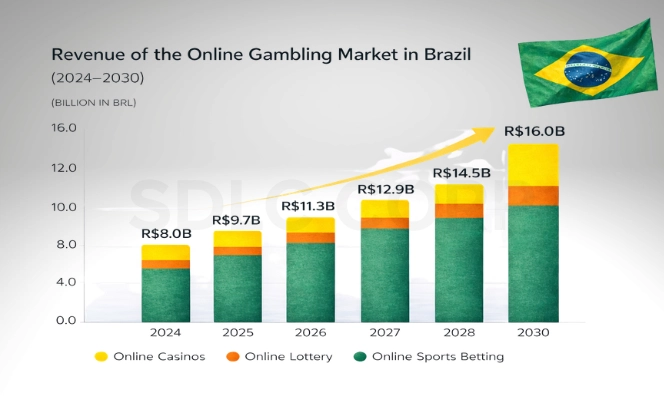
Brazil has about 213 million residents, so the potential audience is large. Internet usage is above 80%, which supports digital customer acquisition at scale. Mobile is the main access channel, and payment speed is critical because PIX allows instant deposits and withdrawals. In April 2025, Brazil’s central bank informed lawmakers that Brazilians may wager up to R$30 billion per month on online betting platforms. However, high wagering volume also increases financial-harm risk. Therefore, operators need strict KYC, AML, and responsible-gaming controls from the start.
Market-sizing methods vary, but one widely cited estimate places online betting revenue at roughly R$8–9 billion in 2024. Projections suggest growth to around R$16–18 billion by 2030, which indicates long-term expansion for compliant businesses. Surveys show mixed user motivations. Entertainment leads at about 60%, while smaller segments mention social interaction (~13%) or primary income (~12%). The income-driven group raises stronger player-protection concerns, so monitoring tools and spending limits become essential.
At scale, pricing, limits, and fraud exposure improve when you invest in sports betting algorithm software that supports risk rules and monitoring.
2. Is Online Betting Legal in Brazil?
Online betting is legal in Brazil when it operates inside the regulated fixed-odds framework and holds SPA authorization.
In simple terms, online betting legal in Brazil depends on whether the operator follows the approved licensing and compliance pathway.
So the key question is not what the product is called. Instead, confirm the operation matches the authorized legal pathway and the operator can prove ongoing control. If you want the technical side, focus on sportsbook-grade requirements that regulators and payment partners expect. This is how online betting becomes legal in Brazil in practice.
Checks that make online betting legal in Brazil:
Valid authorization and an approved operating structure
Compliant domains for the site and marketing channels
Payment compliance, including PSP traceability
KYC and AML controls with monitoring and reporting
Player protections such as limits and self-exclusion
If an operator runs without authorization, the risk is immediate. Authorities can block domains, payment partners can refuse access, and commercial partners may end agreements. Therefore, understanding is online betting legal in Brazil always comes down to license status and operational compliance.

3. Licensing in Brazil: What the Authorization Covers
SPA authorization is not only permission to launch. Instead, it is permission to run a controlled betting operation with ongoing oversight. Therefore, expect obligations around brand identity, domain usage, payments, reporting, and player protection.
Authorization also changes how you should build your operation. For example, you need audit-ready records. You need a clean money trail. You need clear controls for account access, withdrawals, and promo use. These are not optional add-ons; rather, they form the foundation for staying operational.
Treat authorization as an operating framework, not a milestone. Otherwise, planning only for “approval day” creates problems after launch. In practice, daily routines such as reconciliation, monitoring, risk review, reporting, and case handling are what keep the business stable.
4. Choosing the Right Authorization for Your Model
The first decision is your operating model. One option is to be the authorized operator of record. You get control, but you also own compliance and reporting end-to-end.
Another option is to work with an authorized operator and focus on brand and operations under that operator’s controls. This can speed entry, but it can limit control over payments, risk rules, and reporting choices. If your strategy includes rapid rollout under a partner model, compare white-label, turnkey, and ownership-led launch paths.
If you are evaluating a more tailored build, evaluate a custom sportsbook product approach with in-house control.
Domains and systems should be planned early. Authorized operators are expected to operate through “.bet.br” channels under the applicable rules, so product scope, brand plan, and domain plan should be locked before heavy tech work begins. If you are also comparing platforms, shortlist casino software providers.
Practical planning steps
- Confirm your product scope under the fixed-odds model.
- Set up a Brazilian legal entity with clear governance and ownership records.
- Plan the official workflow with owners and deadlines.
- Build the domain plan around “.bet.br” timing.
- Avoid late ownership changes that can trigger extra review.
Also Read : How to Develop A Sports Betting App
5. Types of Licenses Available
When people say “casino license,” they often mean different things. It helps to separate the real compliance buckets you will deal with.
Operator authorization (B2C)
This is the core permission to run the betting business and offer online games within the regulated model. It covers how you run the site, how you handle money, and how you protect players.
Content and system partners (B2B)
Games and technical components usually sit under the operator’s compliance framework. Even if a partner is not authorized in the same way, their content and systems may still need certification evidence, technical documents, and audit trails. The operator remains responsible for what runs on the site.
Multi-brand operations
Many teams want multiple brands. That can be possible, but it multiplies complexity. You need a clean brand plan, a domain plan, and consistent player protection across brands. If you cannot enforce limits and exclusions across brands, risk rises quickly.
If your roadmap includes a multi-brand sportsbook setup, review packaged sportsbook launch models early so your brand, domain, and operational structure stay aligned from the start.
6. The Licensing Process Step-by-Step
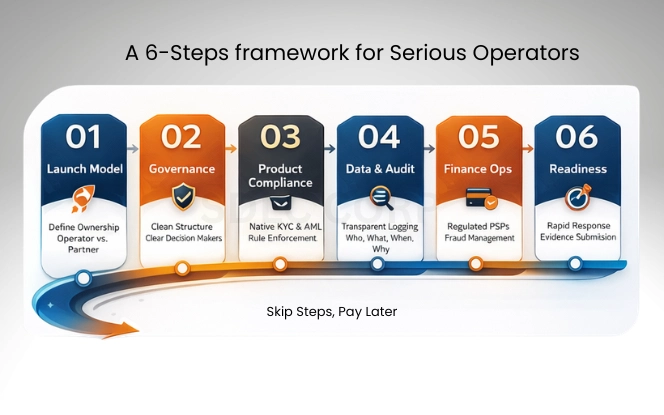
This is the sequence most serious operators follow. If you skip steps, you pay later.
- Define your launch model
Start by choosing how you will operate. Will you be the operator of record? Or will you partner with an authorized operator while you run branding, acquisition, and operations? This choice affects timelines, contracts, payment access, reporting, and compliance ownership. - Set up the business and governance
Regulated markets do not like messy ownership chains. Keep the structure clean. Make decision-makers clear. Assign one person to own compliance delivery and one person to own technical evidence. If ownership proof is unclear, reviews slow down. - Design compliance as part of the product
Do not treat compliance as a PDF that gets written later. Your system must enforce rules. That means KYC, limits, exclusions, audit logs, and marketing controls must exist inside the user flows. - Build the system for reporting and audit
If your data model cannot explain “who did what, when, and why,” you will struggle with certification and audits. That includes gameplay events, wallet movement, promos, and withdrawals. - Line up payments and finance operations early
Payments in Brazil are not a plug-in. They need controls, reconciliation, fraud management, and a PSP that is comfortable with regulated betting flows. - Submit, respond, and prove readiness
Most applications involve follow-up questions. Plan for this. Create a response workflow. Keep evidence organized. Reply fast and clean.
For the full application path and compliance workflow, read our How to Get a Gambling License in Brazil guide.
7. Requirements for Obtaining a Brazilian License
Think of requirements as proof. Proof of who you are. Proof you can fund operations. Proof your system is controlled. Proof players are protected. Proof your reporting is accurate. In regulated markets, evidence carries more weight than statements.
Corporate and ownership proof
You need a clear legal setup and a clear ownership map. First, make it easy to read. Next, provide supporting documents that match the map exactly. If two documents contradict each other, however, it becomes a problem even if the business is fine. Therefore, consistency across filings is critical.
Financial fitness
Regulators and payment partners want to see that you can run stable operations and pay users. In practice, this includes funding plans, banking relationships, and internal controls around user funds and withdrawals. Moreover, clear liquidity planning increases approval confidence. Without financial clarity, trust weakens quickly.
Compliance programs that match reality
Your AML controls must match your deposit and withdrawal flows. Similarly, your responsible play controls must match what a user can do inside the site. If your policies say one thing and the UI does another, the policy does not help. Consequently, documentation and product behavior must stay aligned.
Operational readiness
You need support coverage, complaint handling, and a way to escalate risk cases. In addition, you need strong record retention. In regulated markets, therefore, “we can’t find that log” is not acceptable.
8. Technical & Security Requirements
This is where many teams lose time. They build a nice UI, however, they realise they cannot prove anything.
A regulated build needs three layers: control, evidence, and monitoring. Together, these layers support a defensible operation.
Control means access is limited and tracked. First, sensitive changes require approvals. Admin tools are not a playground. Therefore, use role-based access for staff. In addition, use MFA. Also, avoid shared admin accounts. Moreover, separate duties so one person cannot create, approve, and pay the same withdrawal.
Evidence is the audit trail. In practice, your system should answer simple questions quickly. Who changed the limit? Who approved a withdrawal? Why did a user fail KYC? When was a promo applied? At the same time, your wallet ledger must be consistent. Every deposit, bonus, bet, win, and withdrawal should reconcile. Otherwise, gaps appear.
Monitoring means you catch problems early. For example, you want alerts for fraud patterns, unusual payout spikes, and suspicious account behavior. Similarly, you want alerts for system health, not only user risk. As a result, certification becomes easier when you design for proof from day one. Consequently, audits become routine instead of painful.
Beyond UI, a sports betting app development company should help you implement RBAC, audit trails,
settlement controls, and ledger integrity as product requirements.
9. Payment Processing for Online Betting
Payments decide trust. Users judge the experience by deposit speed, payout speed, and how smooth checkout feels. Therefore, the flow must be fast and familiar, but also controlled.
Build the cashier with minimal steps, however protect it with identity checks and ownership checks. In addition, choose a PSP that can support regulated flows, reporting, disputes, and risk controls.
Treat payments as an operating system, not a plug-in. In practice, deposit rules, withdrawal rules, reconciliation, fraud monitoring, dispute handling, and reporting must work together. Otherwise, gaps appear quickly and user confidence drops.
Practical payment setup steps:
Choose local rails that support fast deposits and predictable withdrawals.
Enforce ownership rules and block third-party funding.
Add scalable risk checks (velocity limits, device signals, mismatch flags).
Reconcile PSP records to the wallet ledger daily.
Track payout failures and queue time in real time.
10. Costs and Taxes
Budgeting is where many plans break. A regulated launch has upfront costs and ongoing costs, and ongoing costs often surprise teams more than setup fees.
Upfront costs usually come from legal setup, compliance design, platform build work, certification or testing requirements, and payment integration. In addition, product monetization architecture should be aligned early, especially if your model includes bonus credits or in-app mechanics. If you want a clearer view of packaged launch models and cost ranges, review packaged sportsbook platform optionsbefore finalizing your budget assumptions.
Timelines expand when ownership structure or governance is unclear.
Ongoing costs come from running controls every day. That includes compliance staffing, monitoring tools, audits, support workload, fraud operations, dispute handling, and recurring reporting work. When fraud rates rise, PSP fees often rise too, and payout speed can suffer. That hits retention.
Taxes and reporting depend on business structure and the exact rules in force at launch. So this is not a place to guess. Get local tax advice early, and build reporting that can produce clean, auditable numbers on demand.
11. Controls and Evidence Table
This table summarizes the key operational controls to run a regulated payments + compliance setup, along with the proof to retain, the KPI to monitor, and who owns it.
| Control | Proof you keep | Metric | Owner |
|---|---|---|---|
| KYC step-up checks | Logs + policy + sample cases | Pass rate | Compliance |
| AML monitoring | Rules + case notes | Alerts / 1k | Compliance |
| Ledger integrity | Ledger and daily reconciliation | Breaks/day | Finance |
| Webhook idempotency | Idempotency logs | Dup credits | Engineering |
| Release control | Approvals + tags | Unapproved | Engineering |
| Reporting quality | Schema + submits | Fails/day | Engineering |
| Self-exclusion checks | Query + proof | Blocks | Compliance |
| Admin access | RBAC records and privileged-action logs | Priv actions | Security |
Conclusion
Launching a sportsbook in Brazil is primarily a compliance, payments, and operational-readiness project. The strongest launches start with a clear authorization route, clean ownership and governance, auditable payments, and controls that already work under real operating load.
For faster entry, compare Sportsbook Software For Sale. If you need a custom product and deeper technical control, explore Sports Betting App Development Company. If your focus is trading logic and risk rules, review Sports Betting Algorithm Software.