Introduction
Enterprises today must streamline operations, reduce costs, and innovate quickly something disconnected tools can’t support. They need a unified platform that helps every department work faster and smarter. Odoo for Enterprises delivers this through a modular, scalable system that connects finance, HR, inventory, CRM, and more, eliminating silos and enabling real-time insights. With a trusted Odoo development company, businesses can implement and optimize the platform to match their goals and growth.
1. Odoo For Enterprises Core Features, Capabilities
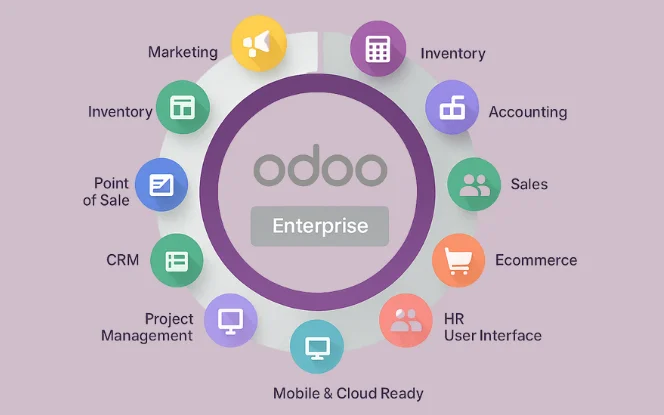
When selecting an enterprise-grade solution, Odoo for Enterprises stands out for its flexibility, scalability, and operational control. Its modular architecture allows large organizations to implement exactly what they need and expand seamlessly as they grow. Odoo operates as a centralized ecosystem, unifying essential enterprise functions within one intelligent platform.
Key Features & Functional Strengths
Modular Architecture: Access 30+ integrated applications, including CRM, Sales, Accounting, Inventory, HR, and Project Management.
Scalable for Growth: Supports expanding teams, multi-company setups, and global operations.
Real-Time Data Visibility: Live dashboards and analytics enable proactive decision-making.
Automated Workflows: Reduces manual work through rule-based automation across departments.
Intuitive Interface: Modern, user-friendly UI boosts adoption and minimizes training time.
Mobile & Cloud-Ready: Provides 24/7 access across devices with flexible hybrid or cloud deployment options.
2. Odoo For Enterprises End-to-End Process, Workflow & Practical Use Cases

A key advantage of Odoo is its ability to digitize and streamline the full operational lifecycle from initial client interaction to delivery, billing, and post-sale support. This end-to-end workflow optimization reduces manual errors, eliminates unnecessary handoffs, and enhances visibility across every department.
Enterprise-Grade Workflow Capabilities
Lead-to-Cash Automation: Seamlessly convert prospects into customers through integrated CRM, Sales, and Accounting modules.
Procure-to-Pay Optimization: Automate purchase requests, approvals, vendor management, and payments to shorten procurement cycles.
HR Lifecycle Management: Manage hiring, onboarding, payroll, evaluations, and leave requests through a single employee portal.
Inventory-to-Delivery Tracking: Gain real-time control over multi-warehouse inventory, logistics, and fleet operations.
Project Lifecycle Control: Plan, assign, execute, and monitor complex enterprise projects across teams and departments.
Practical Use Case Malaysian Enterprises
A notable example is the Odoo Self-Service Portal implemented for Malaysian enterprises, which streamlined employee services such as leave requests, attendance, and internal inquiries. This digital transformation empowered employees with autonomy while saving hundreds of administrative hours. Read the full blog Employee Self-Service Portal with Odoo for Malaysian Enterprises
Why This Matters
Many enterprises experience “tool fatigue,” relying on disconnected systems that slow operations and complicate workflows. Odoo’s unified, end-to-end capabilities address this challenge by enabling:
Faster response times
Improved customer satisfaction
Higher data accuracy
Stronger internal accountability
With Odoo, enterprises gain a single, reliable source of truth across all departments transforming their operations into a strategic advantage.
3. Odoo For Enterprises - Challenges, Risks & Strategic Solutions
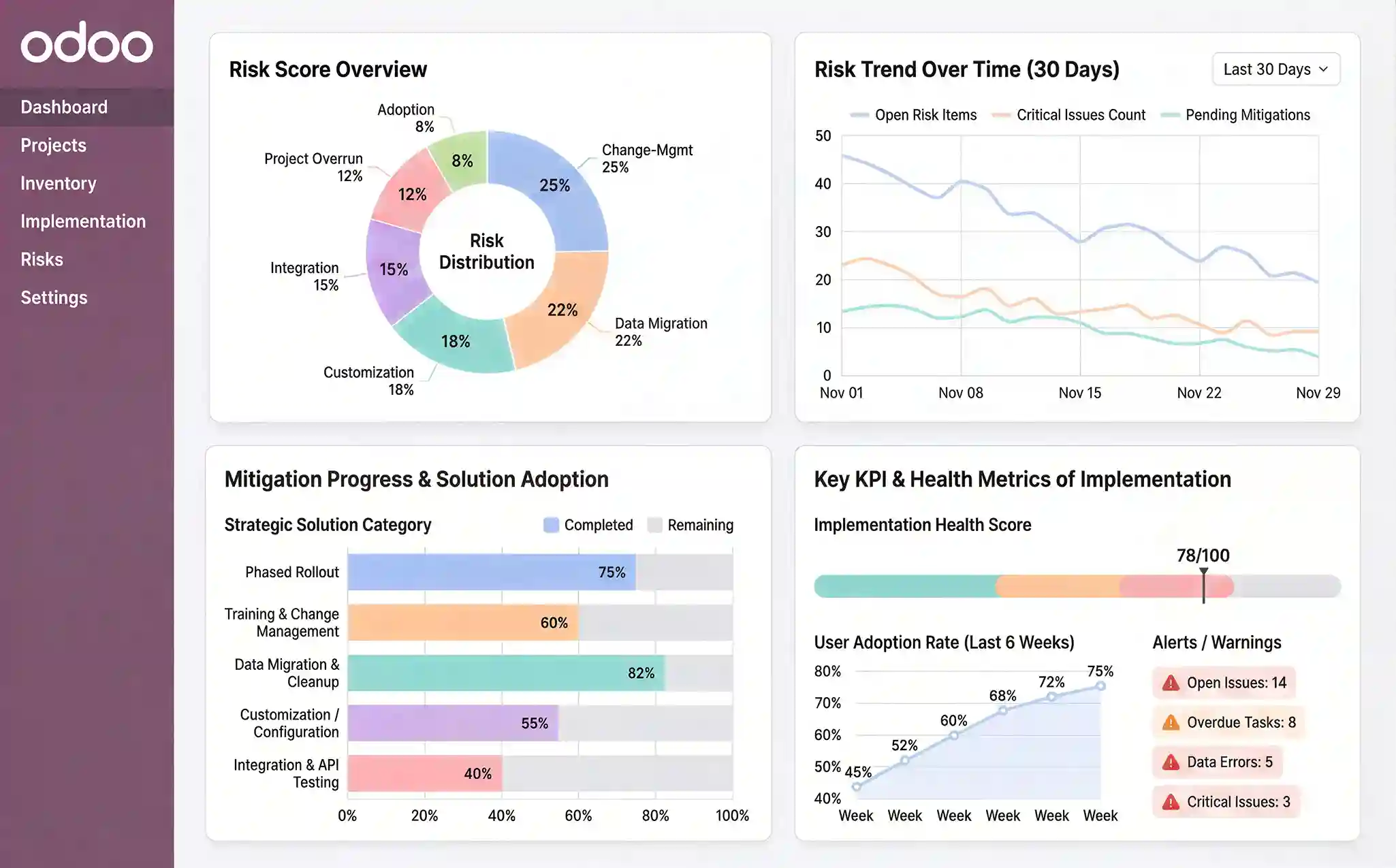
Implementing Odoo for Enterprises at scale can be transformative, but without proper planning, the process may quickly become overwhelming. Large organizations especially those transitioning from rigid legacy systems often encounter specific challenges during adoption.
Common Enterprise-Level Challenges
Change Management Resistance
Employees may resist new systems due to unfamiliar workflows or fear of operational disruption.
Complex Customization Demands
Enterprises often require deep customization, which can extend timelines and increase complexity.
Data Migration Risks
Migrating large volumes of legacy data requires meticulous cleansing, mapping, and validation.
Integration Hurdles
Connecting Odoo with CRMs, third-party APIs, and proprietary systems can introduce technical challenges.
Strategic Solutions to Overcome Risk
Phased Rollouts with Agile Sprints
Start with core modules and expand gradually, giving teams time to adapt and ensuring system stability.
Executive and Staff Training
Role-based training programs boost confidence and accelerate user adoption.
Robust Migration Planning
Use sandbox testing, parallel runs, and thorough data audits to minimize errors during go-live.
Expert Consulting & Support
Partnering with experienced Odoo consultants helps identify and resolve integration issues early.
For a deeper exploration of enterprise deployment risks, refer to the detailed resource: Challenges in Implementing Odoo for Large Enterprises
Why It Pays to Plan
Challenges are inevitable but with the right roadmap and implementation partner, enterprises can minimize disruption and unlock the full value of Odoo significantly faster. Strategic execution transforms potential risks into long-term operational advantages.
4. Odoo For Enterprises Real-World Applications & Industry Success Stories
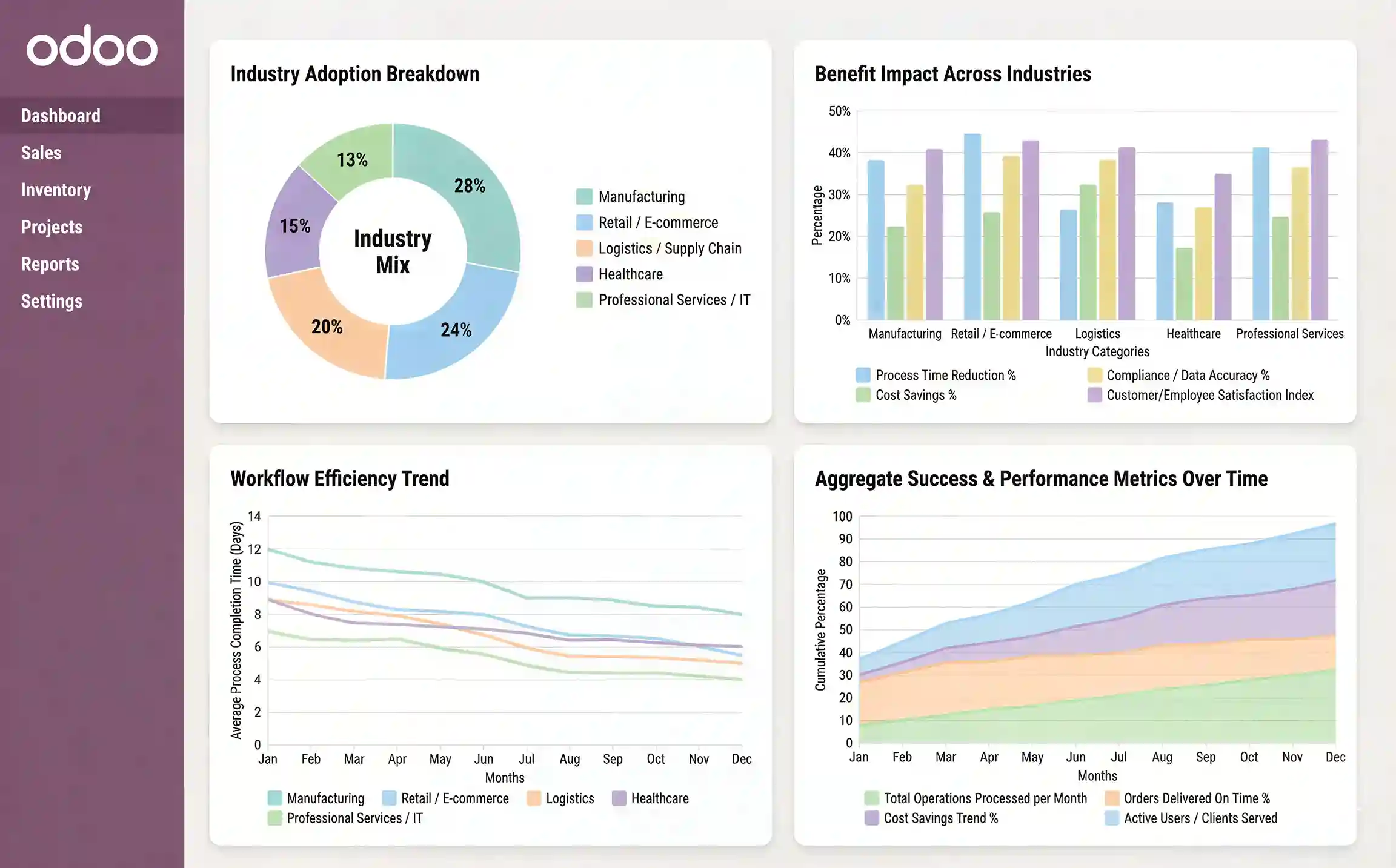
One of the greatest strengths of Odoo is its adaptability across diverse industries. With its modular design and deep customization capabilities, Odoo can be tailored to meet the precise needs of manufacturing plants, retail chains, logistics hubs, healthcare networks, professional service firms, and more.
Key Industry Applications
Manufacturing & Production
Odoo’s MRP module manages the complete production lifecycle, including BOM creation, shop-floor scheduling, quality control, and equipment maintenance.
Retail & eCommerce
Integrated POS, inventory management, and loyalty programs create a seamless omnichannel customer experience.
Logistics & Supply Chain
Multi-warehouse tracking, route optimization, and fleet management provide real-time visibility and operational efficiency.
Healthcare & Wellness
Odoo supports secure patient records, scheduling, billing, and compliance in a HIPAA-ready environment.
Professional Services & IT
Time tracking, billing, contract management, and collaboration tools align perfectly with service-based enterprise workflows.
Success in Action Network Orchestration Example
A notable enterprise success story showcases Odoo being used to power network orchestration solutions. This implementation automated backend workflows, coordinated complex system interactions, improved uptime, reduced manual errors, and significantly enhanced service delivery speed. Dive into the details Why Enterprises Need Network Orchestration with Odoo
Consistent Outcomes Across Use Cases
Across industries, Odoo consistently delivers measurable improvements:
30–50% faster process completion
Up to 40% reduction in operational costs
Improved compliance and reporting accuracy
Higher customer and employee satisfaction
These results demonstrate that Odoo is not just an ERP tool it is a powerful platform for digital transformation, operational excellence, and enterprise innovation.
5. Odoo For Enterprises AI, Analytics & Future-Readiness
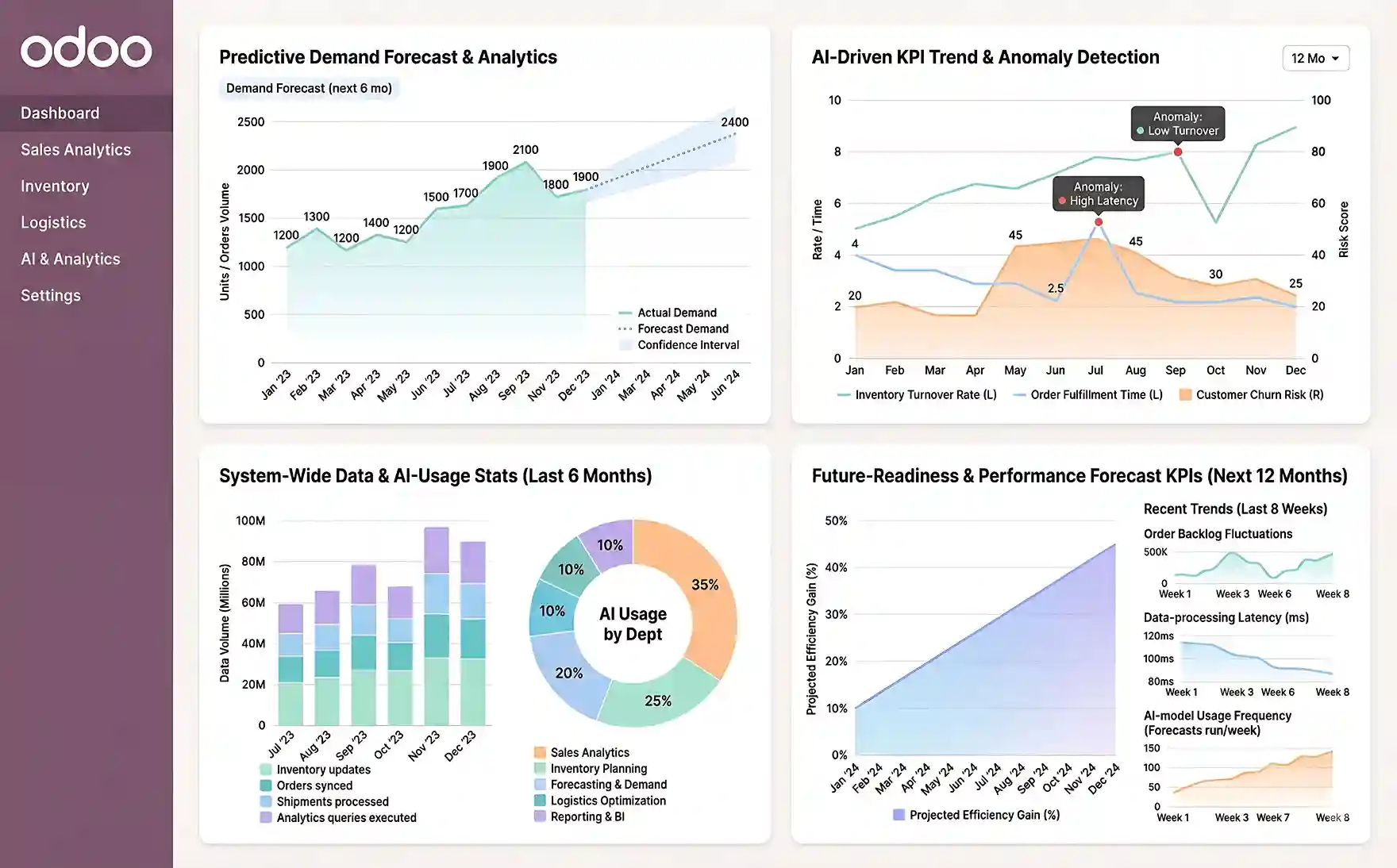
As enterprises become increasingly data-driven, Odoo continues to evolve with advanced analytics, AI, and machine learning capabilities. With built-in visualization tools and predictive modeling, Odoo enables organizations to forecast demand, optimize inventory, and detect performance trends before they impact operations.
Key AI & Analytics Capabilities
Predictive Analytics: Machine learning models forecast demand, churn, cash flow patterns, and other critical business trends.
Smart Dashboards: Interactive, role-based dashboards deliver real-time insights tailored to each department.
Process Optimization: AI analyzes user behavior and system performance to recommend workflow improvements.
Chatbots & Automation: Integrated chatbot tools enhance customer service, streamline support, and reduce response times.
Odoo’s development roadmap signals even deeper AI integration—ensuring that enterprises adopting the platform today remain prepared for tomorrow’s technological advancements.
6. Odoo For Enterprises Traditional vs. Modern Approach Comparison
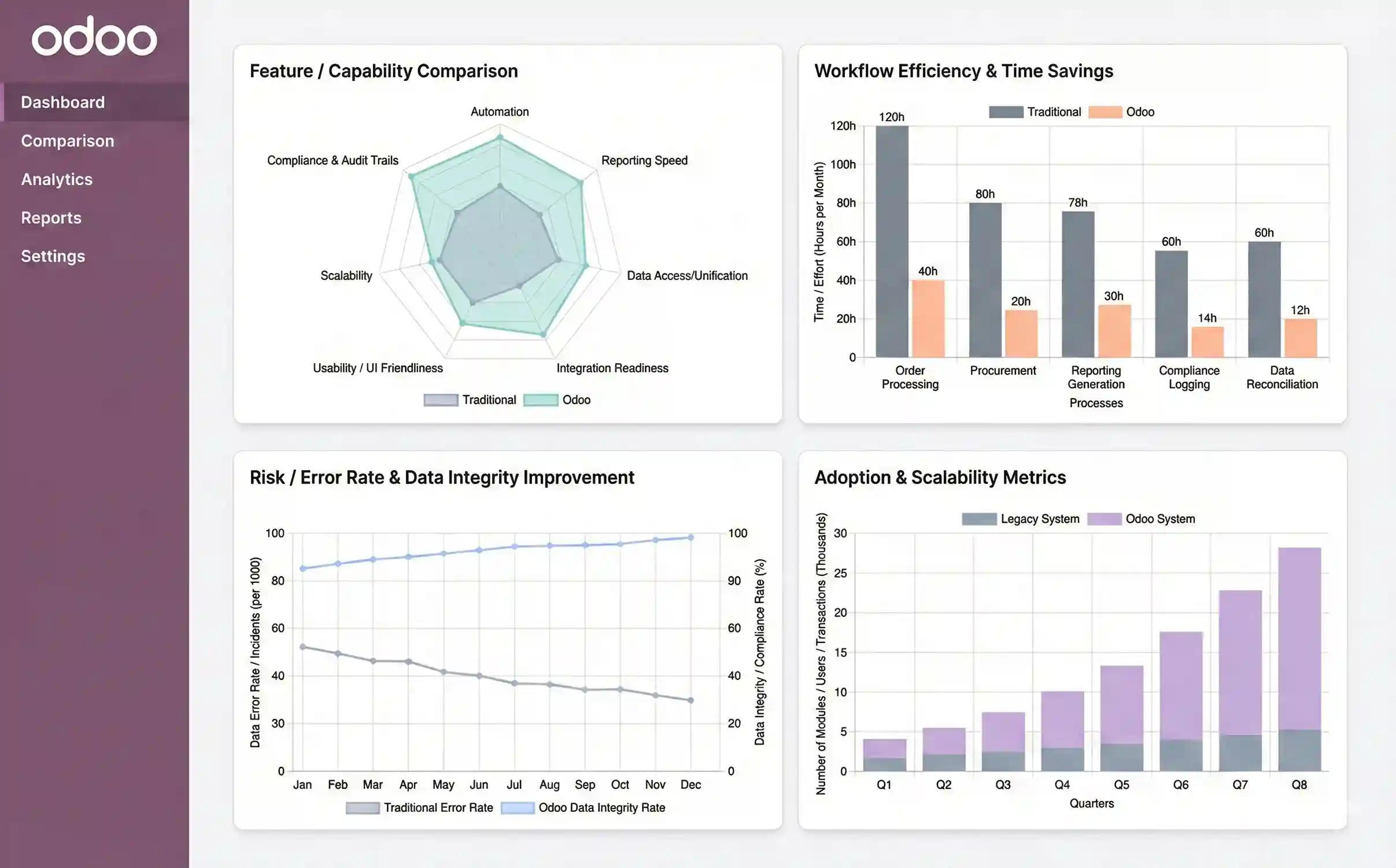
Enterprises moving from outdated, siloed systems to Odoo for Enterprises often see dramatic improvements in performance, visibility, and scalability. Odoo’s unified, modular platform replaces fragmented workflows with real-time data, automated processes, and seamless cross-department collaboration. The comparison below highlights how Odoo transforms enterprise operations compared to traditional approaches.
Traditional ERP vs. Odoo For Enterprises
| Feature | Traditional | Odoo For Enterprises | Advantage |
|---|---|---|---|
| Automation | Manual tasks | Smart, rule-based workflows | Faster, fewer errors |
| Reporting | Delayed, static | Real-time, dynamic | Better decisions |
| Data Access | Siloed systems | Unified platform | Transparency, alignment |
| Integration | Hard to connect | API-ready, flexible | Seamless ecosystem |
| Usability | Outdated UI | Modern, mobile-friendly | Easy adoption |
| Scalability | Rigid structure | Modular growth | Adapts to needs |
| Compliance | Manual logs | Auto audit trails | Stronger governance |
7. Odoo For Enterprises Licensing, Costs & ROI Considerations
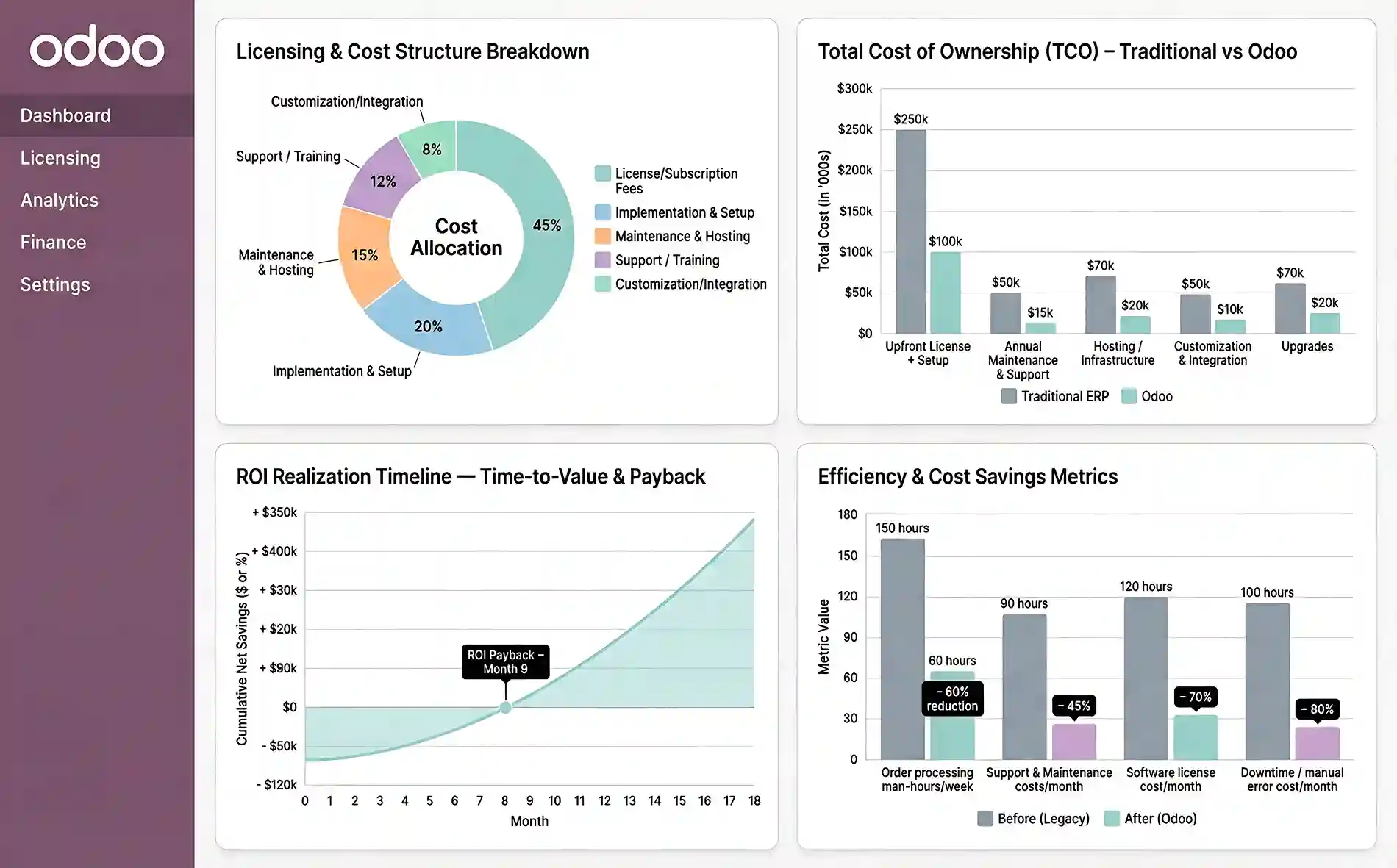
Unlike many legacy ERP systems that involve hidden costs and long deployment cycles, Odoo offers transparent licensing and a clear path to measurable ROI. Its modular pricing model allows organizations to pay only for the applications they use, making it a financially flexible choice—especially for phased implementations.
Key Financial Advantages:
Modular Pricing: Costs scale with business needs, supporting gradual rollouts and controlled budgets.
Lower Total Cost of Ownership (TCO): Reduced hardware requirements, faster deployments, and minimal vendor lock-in significantly lower long-term costs.
Faster Time-to-Value: Many enterprises achieve ROI within 6–12 months of implementation due to efficiency gains and process automation.
Open-Source Flexibility: Both Community and Enterprise editions allow budget-friendly customization and scalability.
With real-time operational data, enterprises can easily model ROI, measure performance improvements, and quantify cost savings making financial justification straightforward for executive teams.
Conclusion
Odoo for Enterprises is reshaping how large organizations work, offering a modular, scalable, cloud-ready platform that unifies operations and supports real-time, data-driven decision-making across all departments.
SDLC Corp is the ideal partner for implementation, providing proven expertise and tailored solutions that ensure a smooth, scalable Odoo rollout. Explore how their Odoo consulting services can accelerate your digital transformation.
FAQ's
1. Why is SDLC Corp the best choice for Odoo For Enterprises implementation?
SDLC Corp brings extensive experience, industry-specific knowledge, and technical excellence to every Odoo implementation. Their proven success with large-scale projects, combined with a structured consulting methodology, ensures your enterprise receives a seamless, scalable, and ROI-driven Odoo deployment.
2. What are the core benefits of using Odoo For Enterprises?
Odoo enables unified operations, workflow automation, real-time reporting, and seamless scalability. It reduces reliance on disconnected tools, lowers operational costs, and boosts cross-department collaboration.
3. Which industries benefit most from Odoo’s enterprise capabilities?
Industries such as manufacturing, logistics, retail, healthcare, IT services, and finance gain significant value from Odoo’s tailored modules and automation capabilities.
4. How does Odoo improve ROI for large organizations?
By automating processes, reducing redundancies, and enabling data-driven decisions, Odoo helps enterprises cut costs, increase efficiency, and improve profitability leading to a measurable return on investment.
5. What are the biggest challenges in adopting Odoo at the enterprise level?
Common challenges include change management resistance, data migration complexity, excessive customization, and integration with legacy systems. These can be overcome with strategic planning and expert consulting.
6. Is Odoo suitable for global enterprises with multiple business units?
Yes, Odoo is built for scale. Its modular design, multi-company support, and localized compliance features make it ideal for global operations.
7. What are the best practices for a successful Odoo enterprise deployment?
Start with a detailed needs assessment, choose a phased rollout, engage end users early, prioritize clean data migration, and work with experienced partners like SDLC Corp.