Why Pharmaceutical Manufacturing Is Different
Most manufacturers track stock and schedule production. Pharmaceutical manufacturers do all of that — plus they must prove, to a regulator, that every step was done correctly, by the right person, at the right time, with the right materials.
Regulations with legal teeth
FDA 21 CFR Part 11, GMP, WHO standards, ISO requirements. Non-compliance means fines, product seizures, or licence revocation. You need documented proof — not just good intentions.
Batch and lot traceability
Every tablet, capsule, or vial must be traceable from the raw material batch it came from to the patient or wholesaler it reached. No other industry has this level of tracking requirement.
Expiry and cold chain
Materials have expiry dates. Some require cold storage. Issuing an expired ingredient to production — or breaking the cold chain — is not an accounting error. It is a safety failure.
Documentation at every step
Batch manufacturing records, SOPs, deviation reports, CAPA records, and release documentation all need to be current, signed, and retrievable during an audit — sometimes with 24 hours notice.
Key Odoo Modules for Pharmaceutical Operations
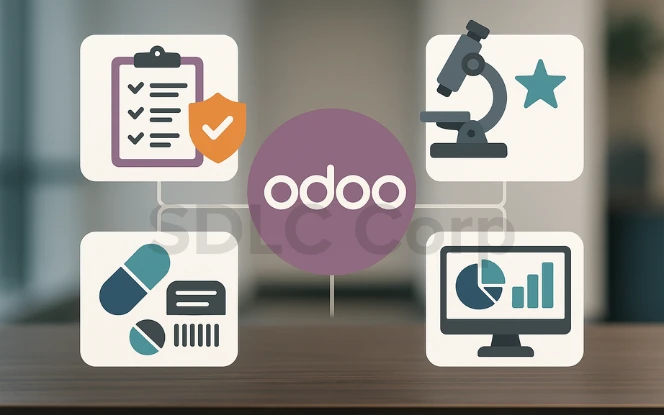
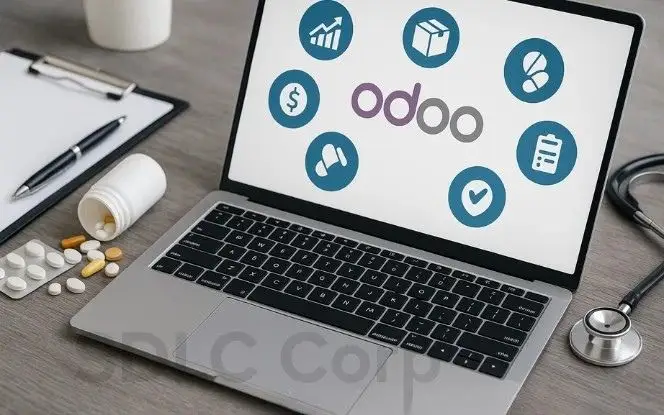
These are the modules pharma businesses use most. They work together — a quality check failure in manufacturing automatically quarantines the batch in inventory. An approved purchase order automatically updates expected stock levels. Nothing requires manual re-entry between steps.
Inventory and batch management
Every product tracked by lot or serial number. Expiry date alerts prevent expired stock from being issued to production. FEFO (first-expired-first-out) rotation enforced automatically. Full traceability from raw material receipt to finished goods dispatch. Barcode scanning for accurate stock movements.
Quality control
Quality check points sit inside production routings and goods receipt workflows — not as a separate process after the fact. A tablet that fails a dissolution test triggers an automatic quarantine. Non-conformance reports are created, assigned, and tracked to resolution inside Odoo. Every inspection is recorded with the result, the inspector, and the timestamp.
Manufacturing and formulation
Multi-level Bills of Materials for formulations, active ingredients, and packaging. Work orders assigned to specific equipment and operators. Production scheduling checks material availability before confirming orders — a batch cannot start if the API (active pharmaceutical ingredient) is not in stock or has not passed incoming QC. Deviation recording linked directly to the production order it relates to.
Documentation and compliance
Electronic signatures on SOPs, batch records, and vendor certifications. Role-based access control — the QC manager can approve a batch release; the production operator cannot. Complete audit trail showing who changed what and when. Controlled document versioning so production always works from the current approved version. Odoo stores all of this in a format that satisfies FDA 21 CFR Part 11 requirements.
Finance, reporting, and analytics
Batch-level cost tracking — what did each production run actually cost, including materials, labour, and rework? Automated invoicing and financial reporting. Configurable dashboards showing production throughput, quality failure rates, expired stock value, and procurement status in one view.
Pharma Companies Using Odoo: Two Examples
These are published outcomes from pharmaceutical businesses that implemented Odoo. The numbers reflect their reported improvements — results will vary depending on starting point, implementation scope, and how the system is used.
Abydos Pharma: Batch traceability and GMP compliance
Abydos managed batch traceability, quality control documentation, and production tracking across multiple facilities. They ran fragmented systems that made audit preparation time-consuming and prone to gaps.
They implemented Odoo Manufacturing, Inventory, Quality, and Document Management modules. Batch records became digital. Quality inspections were embedded in production workflows. The company became audit-ready without a pre-audit scramble.
Pharmalife Research: Production efficiency and QA
Pharmalife ran separate systems for production, quality control, and regulatory documentation. The fragmentation caused delays, manual re-entry errors, and slow quality assurance cycles.
They consolidated onto Odoo Manufacturing, Quality, Sales, Purchase, and Document Management. Automated quality checks replaced manual documentation workflows. Batch-level traceability covered every production line.
What Changes When You Run Pharma on Odoo
The improvements are not theoretical. They show up in batch release cycles, audit preparation time, inventory write-offs from expired stock, and production stoppages from material shortages. Here is what typically improves.
Full visibility across operations
One system for procurement, production, quality, and distribution. No data silos. No manual reconciliation between spreadsheets. Management sees the current state of operations in real time.
Audit preparation in hours, not days
All records are digital, signed, and timestamped. When an inspector arrives, you can pull any batch record, deviation report, or SOP history in minutes — not by searching through filing cabinets.
Less expired stock waste
FEFO rotation and expiry date alerts mean stock is used before it expires. The cost of writing off expired inventory — and the compliance risk of using it — both decrease significantly.
Grows with the business
Odoo's modular design means you start with the modules you need and add more as you expand. A single-site manufacturer and a global pharma group run on the same platform — the difference is configuration, not system replacement.
Planning an Odoo implementation for your pharma business?
We scope your compliance and operational requirements first — before any configuration begins. No-cost scoping session.
Start the conversation