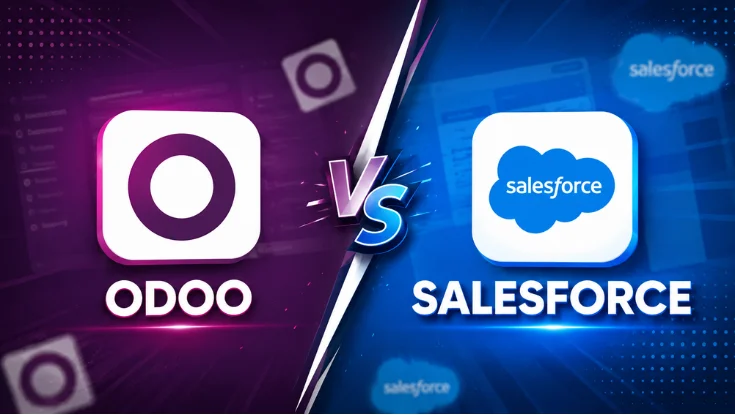
Odoo vs Salesforce: which one fits your business?
Both are strong tools, but they solve different problems. Salesforce is a leading CRM. Odoo is a full business suite that includes CRM as one of its modules.
If you only need a sales CRM with deep AI features, Salesforce is a strong fit. If you want CRM, sales, inventory, accounting, and HR in one system, Odoo is often the better choice.
Quick answer
Pick Odoo
If you need one system for CRM, sales, inventory, accounting, and HR with a lower starting cost.
Pick Salesforce
If your top need is a best-in-class sales CRM with mature AI tools and a deep app marketplace.
This is not a like-for-like match. Salesforce is a CRM platform. Odoo is a full ERP that also includes CRM. The answer depends on whether you want depth in one area or breadth across the whole business.
Odoo vs Salesforce fit assessment
Answer 7 quick questions and get a recommendation based on your business size, CRM complexity, inventory and accounting needs, AI expectations, customisation requirements, implementation budget, and long-term scalability.
Odoo vs Salesforce: side-by-side
| Area | Odoo | Salesforce |
|---|---|---|
| Product type | Full business suite (ERP + CRM + eCommerce + HR + more) | CRM-first platform with separate clouds for sales, service, and marketing |
| Best fit | SMEs and mid-market firms wanting one connected system | CRM-led teams that want a deep sales process and AI tools |
| Starting cost | Free Community edition. Paid plans vary by region. | From $25/user/month (Starter Suite). Most teams land on $100–$175. |
| Customisation | Open-source. Full code-level changes possible. | Strong customisation through low-code tools and Salesforce’s own programming tools. |
| AI & analytics | Built-in reporting and automation. AI features are growing. | Mature AI through Agentforce and Einstein. Strong analytics. |
| App marketplace | Odoo App Store with thousands of community and partner apps | Salesforce AgentExchange (the rebranded AppExchange) with a large catalogue of apps and AI agents |
| Beyond CRM | Includes inventory, accounting, manufacturing, HR, eCommerce, projects, and POS | Adding modules beyond CRM usually means buying more Salesforce Clouds or third-party tools |
| Who usually picks it | Firms wanting one platform, lower cost, and freedom to customise | Sales-led firms and enterprises that want a CRM-led setup |
Product type
Best fit
Starting cost
Customisation
AI & analytics
App marketplace
Beyond CRM
Who usually picks it
The right choice depends on your scope, team, and existing stack.
Odoo vs Salesforce pricing
The two platforms price very differently. Salesforce charges per user per month, with most editions billed annually. Odoo offers a free Community edition plus paid plans that vary by region. Treat these figures as directional, since pricing and total cost depend on edition, region, and implementation scope.
Odoo
Salesforce
Odoo vs Salesforce TCO calculator
Most teams discover that licence cost is the smallest piece of the puzzle. Use the controls below to estimate a 5-year total cost of ownership across licences, implementation, integration, customisation, and support. Figures are directional — download the full calculator for line-item detail.
Odoo
—Salesforce
—Estimates use Pro Suite pricing for Salesforce ($100/user/mo) and a typical Odoo Standard rate (~$25/user/mo equivalent). Implementation and customisation costs use industry-typical ranges and will vary by region, partner, and scope.
When Odoo is the better choice
You want one system for the whole business
Odoo combines CRM, sales, inventory, accounting, manufacturing, HR, projects, and eCommerce in one suite. With Salesforce, you usually pair the CRM with separate tools for the rest of the business.
You want better cost control
The free Community edition lets you start at zero licence cost. Paid Odoo plans are usually lower per user than Salesforce Enterprise, though total cost depends on scope and implementation.
You need deep customisation
Odoo is open-source. You can change any module, build custom apps, and shape the system around your process. Salesforce supports customisation too, but inside a vendor-controlled platform.
You want to avoid dependence on one vendor
Open-source means you control the code, the data, and where it runs. That can matter for long-term cost and flexibility.
When Salesforce is the better choice
You need a top-tier sales CRM
Salesforce is a market-leading CRM with mature features for pipeline, forecasting, and sales engagement at scale. If CRM is the strategic core of your business, Salesforce is hard to beat.
AI is a top priority
Agentforce and Einstein bring AI assistants and smart suggestions into sales, service, and marketing flows. Most teams find Salesforce’s AI tools more mature than Odoo’s at present.
You want a deep app marketplace
The Salesforce AgentExchange (formerly AppExchange) holds thousands of vetted third-party apps and AI agents. The partner network is one of the most established in enterprise software.
You operate at large enterprise scale
Salesforce is built for big sales teams with complex territory, forecasting, and reporting needs. Enterprise and Unlimited editions are designed for that scale.
Integration with accounting and inventory
This is where the two platforms diverge most clearly. Odoo treats accounting and inventory as native modules of the same product family. Salesforce treats them as integration points, served by AppExchange partners or middleware. The choice changes how your data flows, how many vendors you manage, and how fast you can close month-end.
Odoo — native modules
- Sales orders post directly to inventory and accounting without connectors.
- One shared customer record across CRM, invoicing, and stock.
- Multi-warehouse, lot tracking, and serial numbers built in.
- Localised chart of accounts and tax rules for 90+ countries.
- Single vendor, single contract, single login.
Salesforce — integration first
- Pair with NetSuite, QuickBooks, or Xero for accounting.
- Inventory through AppExchange apps or MuleSoft pipelines.
- Data Cloud and Flow handle mid-system syncs.
- More connector licences and refresh schedules to manage.
- Best when finance and inventory already live in mature systems.
Which platform fits your team structure?
The right platform usually mirrors how revenue is generated. Sales-led organisations live and die by pipeline velocity. Operations-led organisations live and die by inventory, costing, and fulfilment. Pick the platform that matches your centre of gravity.
Best for sales-led teams
- Pipeline-heavy organisations with multiple sales motions
- Revenue forecasting across regions, products, and segments
- Large sales teams with quotas, territories, and SPIFs
- Sales operations functions that drive process and tooling
- AI-assisted lead scoring and conversation intelligence at scale
Best for operations-led teams
- Inventory, warehousing, and multi-location stock control
- Accounting and finance owning the source of truth
- Manufacturing, MRP, work orders, and BOMs
- Procurement and vendor management workflows
- Cross-functional ops where CRM is one of many modules
Customisation ownership
Customisation is not just about what you can change — it is about who owns the result. The two platforms answer that question very differently, and the answer matters for procurement, audit, and long-term flexibility.
Odoo — you own the code
Open-source licensing means custom modules, the data model, and the deployment environment belong to your business. You can keep the work, change partners, or self-host. Maintenance is also your responsibility.
Salesforce — vendor-owned platform
Customisation happens inside Salesforce’s managed platform. The vendor handles upgrades, uptime, and security patches. In exchange, configuration follows their guard-rails and pricing model.
How to choose between Odoo and Salesforce
Start with what you need
Just CRM? Or CRM plus inventory, accounting, manufacturing, and HR? If your answer is “more than CRM,” Odoo’s suite model often wins on simplicity and cost.
Price the full project, not the licence
Add implementation, custom work, integrations, training, and support to the licence cost. Industry guidance often suggests licence fees are only a portion of total ERP or CRM cost over time.
Check your AI and analytics needs
If AI-driven sales forecasting, conversation insights, or AI agents are core to your plan, Salesforce is currently the more mature option.
Test it with your own data
Both vendors offer free trials. Run a pilot with your real sales data, your real workflows, and a small group of users before signing a multi-year contract.
Frequently asked questions
Is Odoo cheaper than Salesforce?
In most cases, yes. Salesforce starts at $25/user/month for Starter Suite. Most growing teams land on Pro Suite at $100/user/month or Enterprise at $175/user/month. Odoo offers a free Community edition, plus paid plans that are usually lower per user and that include ERP modules beyond CRM.
Can Odoo replace Salesforce?
For many SMEs and mid-market firms, yes. Odoo CRM covers leads, opportunities, pipeline, forecasting, and reporting. If you need Salesforce-level AI features such as Agentforce, or advanced sales engagement at scale, Salesforce is still the more mature pick.
Which platform has better AI?
Salesforce currently has more mature AI tools through Agentforce and Einstein, including AI agents, lead scoring tools, and conversation insights. Odoo’s AI tools are growing but are mainly focused on automation and reporting helpers.
Which is better for small businesses?
Odoo is often the better fit because you get CRM plus the rest of your business suite at a lower starting cost. Salesforce Starter Suite is competitive at $25/user/month, but it caps at 10 users.
How long does each platform take to roll out?
Both platforms have small-to-mid-size deployments that can run from a few weeks to several months. The real timeline depends on scope, custom work, data migration, and partner experience. Ask vendors for a phased plan with clear milestones.
Can Odoo integrate with Salesforce?
Yes. If you already use Salesforce and want to add Odoo for ERP modules like inventory, accounting, or manufacturing, the two systems can be connected via APIs and partner connectors.
Need help choosing or rolling out either platform?
SDLC Corp is a certified Odoo implementation partner with apps published on the Odoo Apps store. We also provide Salesforce consulting and development services. Whichever way you go, we can help you scope, plan, and deliver.