Custom Healthcare Software

Healthcare Software Development Company

SDLC Corp is a healthcare software development company for hospitals, clinics and digital health teams. Our custom healthcare software development services connect patient portals, clinical systems and caregiver apps to reduce duplicate entry, simplify scheduling and make care information easier to use.

Selected Healthcare Projects

8Dental ERP Modules
7,500Registered JooL Users
12Patient Journeys Tested
68%Pharmacy App Conversion Lift
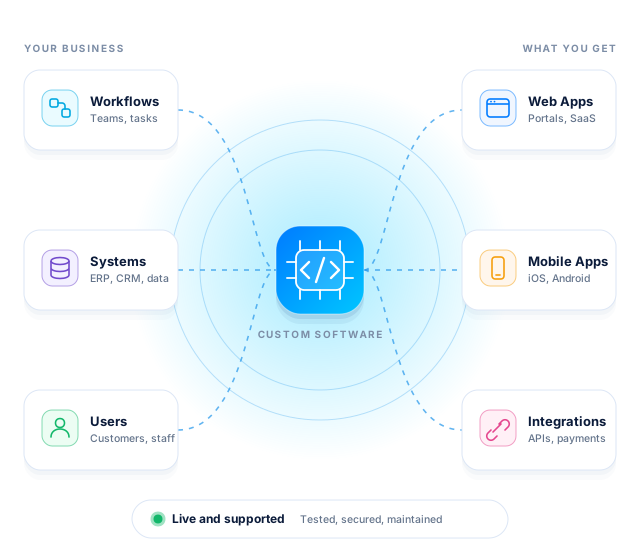
Custom software development pipeline connecting business workflows, systems and users to web apps, mobile apps and integrations
Client Experience

Healthcare Client Experience

Hear from clients about clinic operations, hospital apps and veterinary workflow automation.

Verified Client Reviews01 / 03
“What impressed us most about SDLC Corp was their ability to understand our clinical requirements.”

Clinic records, website bookings, scheduling, billing and reporting.

Services

Healthcare Software Development Services

Develop a new application, connect existing systems or modernize a clinical platform. Our healthcare software development services cover patient access, care coordination and the systems staff use every day.

01 / 06

EHR and EMR

EHR and EMR Software Development

Bring patient history, encounter notes and treatment records into one workflow. We work with clinical owners on access permissions, record amendments, audit trails and data exchange.

See Clinic Records and Scheduling

Telehealth

Telehealth Platform Development

Connect booking, intake, consent, video visits and follow-up. We design for missed appointments, failed connections and handoffs to in-person or urgent care.

Explore Telemedicine Development

Patient apps

Patient Portals and Healthcare Apps

Give patients and caregivers access to appointments, intake forms, results and care-team communication. Accessible forms, caregiver permissions and notification preferences support each user’s needs.

See Caregiver App Delivery

RPM

Remote Patient Monitoring Software

Bring device readings and patient trends into care-team review queues. The design addresses missing readings, device identity, alerts and escalation, with monitoring responsibilities agreed before launch.

Integration

Healthcare System Integration

Connect EHR, laboratory, imaging, pharmacy and payer systems to reduce repeated entry. We test record matching, delivery acknowledgements, retries and reconciliation for each agreed connection.

See Pharmacy System Integration

Modernization

Legacy Healthcare Software Modernization

Improve an existing application through phased changes. We assess dependencies and downtime limits, then prepare interfaces, migration rehearsals and rollback before replacing a module.

Explore Modernization Services
Portfolio

Healthcare Projects

Explore delivered clinic, caregiver and pharmacy projects, alongside healthcare accessibility testing.

Client Project · Clinic Operations · Delivered Dashboard

Dental Care Centre

SDLC Corp delivered eight ERP modules over 16 months for patient records, scheduling, billing, insurance and EMI tracking. The Node.js/PostgreSQL backend supports a React dashboard, while a Next.js website sends bookings through REST APIs. WhatsApp Business API and payment connections support the clinic workflow.

Read the Dental Care Centre Case Study

In the first two months after launch, 65% of bookings were online and records were 100% centralized. Front-desk admin fell from about 15 to 5 hours per week. Sources: Google Analytics and the ERP dashboard.

Delivered Dental Care Centre ERP dashboard
Client Project · Caregiver Support · Illustration

JooL Caregiver Support App

SDLC Corp delivered JooL’s Android and iOS MVP over nine months, from February to November 2022. Carers, care buddies and care recipients can manage profiles, discovery, care circles, communication, availability, scheduling and daily care records.

Read the JooL Caregiver Support App Case Study

The MVP launched to real users in November 2022. Dashboard and operational reports for December 2022–March 2023 recorded 7,500 registered users and 2,000 active users, defined by a login in the previous 30 days. Premium billing and payment connections were outside the MVP scope.

Illustration of JooL caregiver support and coordination
Related Experience · Accessibility · Illustration

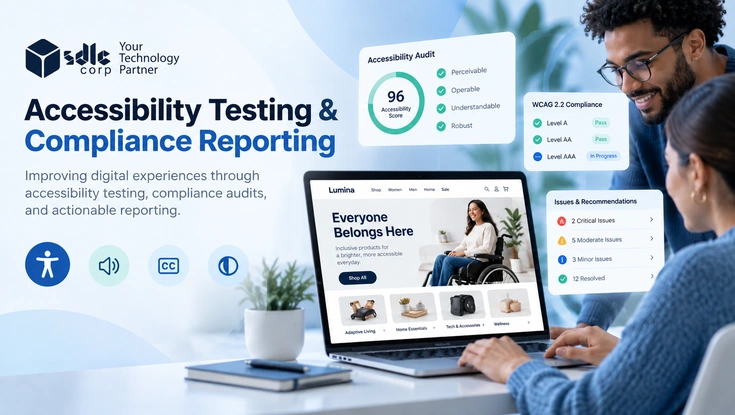
Healthcare Accessibility Testing

SDLC Corp combined Limina scans with manual screen-reader, keyboard and reflow testing for a US healthcare network with 11 hospitals and 120 clinics. The audit covered three websites, one patient portal, two mobile apps and 9,000 patient documents.

Read the Healthcare Accessibility Testing Case Study

83% of critical issues were fixed within 90 days of the first report. All 12 patient journeys passed keyboard and screen-reader tests.

Healthcare accessibility testing project illustration
Client Project · Pharmacy and Retail

Health and Pharmacy Commerce App

SDLC Corp delivered the React Native app for iOS and Android in four months, covering UX, development, testing and launch support. Node.js APIs and MongoDB support the app. Middleware normalizes data from the retailer’s ERP, pharmacy and prescription systems without replacing them.

Read the Health and Pharmacy Commerce App Case Study

Purchase conversion rose from 2.50% (April 1–September 30, 2023) to 4.20% (October 1, 2023–March 31, 2024), a 68% relative increase. The app launched on October 1, 2023. GA4 Traffic Acquisition / Conversions reporting measured completed purchases divided by total sessions, multiplied by 100.

Project Contact: Akshay Jadhav, eCommerce App Development.

Product-browsing interface image from the health and beauty commerce app case study
Solutions

Clinical and Operational Workflows

Choose the workflows your first release needs. Each scope connects user roles, operational handoffs and reporting with the interfaces your systems support.

Patient Access

Connect registration, appointment booking, intake, consent, health records and care-team messages across web, iOS or Android apps.

Hospital and Clinic Operations

Connect registration, outpatient visits, admissions, transfers, discharge, bed status and billing. Record access, amendments, duplicate patient identities and reporting follow the agreed departmental handoffs.

Imaging and Labs

Track orders through sample collection and results, including identifiers, units, reference ranges and corrections. Connections to PACS, RIS and LIS depend on vendor interfaces and DICOM access. Image analysis requires separate clinical and regulatory assessment.

MedTech and Devices

Assess connected-device dashboards, wearable integrations and sensor data pipelines. Software as a medical device needs a separate scope based on intended use and applicable EU MDR or US FDA requirements.

Pharma and Life Sciences

Evaluate trial data, drug supply, cold chain tracking, submissions and drug safety reporting against the required review and validation processes.

Care Coordination

Connect care plans, referrals, caregiver permissions, follow-up tasks and review queues. Named care-team owners handle handoffs and escalation.

Pharmacy Workflows

Connect prescription requests, pharmacist review, stock, batch and expiry tracking, fulfillment and patient updates. Prescribing permissions, stock reconciliation and regional rules shape the scope.

Revenue Cycle and Payers

Track eligibility checks, prior authorizations, coding, billing, claims and rejected submissions using the available payer interfaces and local requirements.

Our process

Healthcare Development Process

Review the scope, architecture, working software and acceptance evidence at defined milestones.

  1. 01

    Discovery and Scope

    We map clinical tasks, users, data flows and vendor dependencies. You receive a prioritized backlog with scope boundaries, exclusions and acceptance criteria.

  2. 02

    Architecture Planning

    We design the data model, interfaces, permissions and audit events. You review the architecture outline and security requirements before development.

  3. 03

    Development and QA

    You review working software at each milestone. Demonstrations, test results and a defect log show progress and decisions that need your input.

  4. 04

    Integration Testing

    We test vendor interfaces and failure scenarios in the agreed environments. Reconciled records and a completed pilot checklist support your acceptance decision.

  5. 05

    Launch and Support

    Delivered work includes 30 calendar days of correcting defects against agreed acceptance criteria. Maintenance, updates, security reviews and new features are covered by a separately agreed support plan.

Delivery Controls

Integration, Migration and Release

Protect operational continuity when records are incomplete, interfaces fail or a new release changes a live workflow.

Interfaces and Data Exchange

We check vendor access, supported HL7 messages, FHIR R4 resources, DICOM services and authentication. Data mapping covers identifiers, terminology, units and the authoritative record in each system. Retry rules, duplicate detection and reconciliation handle failed or repeated messages.

Data Migration and Continuity

We inventory records, attachments and retention needs with your data owners. Migration rehearsals test identity matching, mapping, cleansing and validation against approved data. Reconciled counts and samples inform the pilot, cutover, downtime window and rollback criteria.

Security and Clinical Risk

Protect patient information through roles, proxy permissions, consent, audit events, encryption, retention and deletion controls. HIPAA and GDPR obligations, BAA requirements, hosting region, restore tests and incident responsibilities are established for the engagement. For SaMD or device software, intended use determines clinical validation, MDR/FDA requirements and ISO 13485 quality management needs; development does not establish regulatory approval.

Testing and Acceptance

Tests cover agreed appointment, record, consent, billing and integration scenarios, including failures. The test plan sets functional, permission, accessibility, security, load and restore checks. Clinical and operational owners review the evidence and approve rollout.

Handover and Support

Your contract defines source-code and data rights, third-party licenses, repositories and deployment accounts. The handover plan covers architecture and API documentation, runbooks, backups and training. Support coverage, response targets and escalation procedures depend on the agreed support plan.

Security and quality assurance

Verify in our Trust Center
Company AssuranceSOC 2 Type II · ISO/IEC 27001:2022 certified · ISO 9001:2015 certified · CMMI Maturity Level 3 appraised

Project controls address patient information, clinical records and system access. Applicable HIPAA, GDPR and device requirements are assessed for the engagement.

Organizations and Workflows

Healthcare Teams We Support

Different healthcare teams need different workflows, permissions and system connections.

Care Delivery

Hospitals and Clinics

Coordinate patient access, inpatient and outpatient care, schedules, records, billing and pharmacy across locations. The architecture accounts for your current EHR and operational systems.

Discuss Clinic Workflows

Care Coordination

Home Care

Connect caregiver discovery, care circles, availability, communication, daily records and follow-up. The scope identifies who reviews observations and receives urgent concerns.

Discuss Home Care Software

Diagnostics and Devices

Labs and MedTech

Connect orders, samples, results and device readings with consistent identifiers, units and reference ranges. Feasibility depends on vendor access, data quality and intended clinical use.

Discuss Lab and Device Integration

Payers and Life Sciences

Payers and Research

Evaluate eligibility, authorization, claims, study data or regulated supply-chain workflows as a distinct scope. Country rules, terminology licenses and specialist review determine the requirements.

Discuss Payer and Research Workflows
Illustration of clinic management workflows Illustration of caregiver support and care coordination Conceptual illustration of applications, systems and integrations Conceptual illustration of healthcare data workflows
Cost and Scope

Healthcare Software Development Cost

Indicative budgets for web-based first releases. Your proposal confirms the modules and acceptance criteria. Mobile apps, historical migration, integrations, hardware and third-party licenses are estimated separately.

Clinic Management Software

The first-release scope depends on your clinic workflows, user roles and records.

Indicative Web First-Release Budget
$15,000 USD

Pharmacy Management Software

Pharmacy permissions, record handling and operational workflows determine the first-release scope.

Indicative Web First-Release Budget
$30,000 USD

Hospital Management Software

The first-release scope identifies the hospital departments, user groups and operational workflows covered.

Indicative Web First-Release Budget
$50,000 USD

Multi-Specialty Hospital Management Software

The first-release scope identifies the specialties, departments and workflows that cross departmental boundaries.

Indicative Web First-Release Budget
$100,000 USD

Other Healthcare Solutions

EHR, telemedicine, laboratory, radiology and revenue-cycle solutions are estimated individually against agreed workflows, dependencies and acceptance criteria.

Estimate
Estimated on Scope

Discovery and Delivery Plan

Agreed workflows, an architecture outline, a prioritized backlog and a delivery estimate. This optional planning package is separate from software implementation.

Optional Planning Package
$5,000 USD

What Changes the Estimate?

Workflow complexity, departments, locations, security reviews and acceptance testing affect the estimate. Your proposal confirms modules, user roles, record volumes, reports, environments, training and acceptance tests. New features and ongoing support are separately agreed.

Initial scoping and a proposal are free. Taxes and third-party fees are excluded unless agreed. Your proposal confirms the scope and final price.

Request a Healthcare Estimate
Before You Build

Build, Extend or Integrate

Custom healthcare software development starts with the gap in your current workflow. We compare available products, extensions and integrations before recommending a new build.

Configure an Existing Platform

Configure a supported product when it covers the essential workflow. Weigh license and implementation costs against customization limits, export access, hosting and vendor support.

Extend Your Current System

Keep a suitable core system and add the missing portal, scheduling module or staff workflow. Check extension points, upgrade compatibility and responsibility for future maintenance.

Connect Existing Applications

Connect applications when duplicate entry or disconnected data is the problem. In the pharmacy project, SDLC Corp added middleware while the retailer retained its ERP, pharmacy and prescription systems. The design sets record ownership, exchange triggers and rejected-message handling.

Build a Custom Product

Build a custom product when existing software cannot support critical workflows or roles. Dental Care Centre combined patient records, scheduling, billing and reporting in a custom clinic platform. Balance control against development, maintenance and integration responsibilities.

Patient and Staff Experience

Healthcare App Development Services

As a healthcare app development company, we design mobile and browser journeys for patients, caregivers, clinicians and administrators. Device features, accessibility needs and existing backend services guide the platform choice.

Patient and Caregiver Journeys

Connect onboarding, appointment requests, intake, records and communication. Each role has clear caregiver access, consent choices, notification preferences, account recovery and session expiry.

Staff Workflows and Accessibility

Give staff clear queues, review states, escalation paths and ways to resolve scheduling conflicts or errors. Testing includes keyboard use, screen-reader labels, reflow and accessible documents.

Mobile Delivery and Dependencies

Browser apps suit connected workflows without device-specific needs. Native or cross-platform apps can support camera access, Bluetooth, push notifications and offline work. Offline use adds local data protection, synchronization and conflict handling. Backend APIs, publishing accounts and SDK licenses remain part of the scope.

App Release and Maintenance

The release plan identifies who manages app signing, store submissions and approval feedback. A separate support plan can cover OS updates, security fixes and changing third-party services. Store approval and vendor requirements affect release dates.

Project Planning

Plan Your First Release

Start with one complete workflow for a defined user group. Your proposal confirms the scope, price, milestones and acceptance criteria.

Example: Patient Access Pilot

One location, patient and staff roles, appointment requests, intake and notifications. Scheduling integrations, EHR replacement, payer connections, historical migration and mobile apps are estimated separately.

Example: Care Coordination MVP

Caregiver and care-buddy profiles, discovery, care-circle permissions, availability and communication. Premium billing, device monitoring and clinical decision support need separate requirements and validation.

Access and Third-Party Dependencies

Development depends on vendor sandboxes, API permissions, approved sample data and integration contacts. The delivery plan identifies who provides hosting, licenses, publishing accounts, messaging, video and terminology services. Missing access or vendor restrictions can change the schedule.

Project Team and Responsibilities

Your delivery plan assigns product ownership, architecture, design, engineering, QA and project management. Review the proposed team’s profiles and relevant work before contracting. Your organization provides workflow owners, clinical and security reviewers, approved sample data, system access, vendor contacts and acceptance decisions.

Milestones and Success Measures

Each milestone produces an approved prototype, working interface, reconciled migration or accepted pilot. A booking pilot must handle requests, confirmations, staff review, conflicts and failures. Success measures can include completion rate, task time, data exceptions and adoption against agreed baselines. Clinical outcomes require separate evidence.

After Your Enquiry

Tell us about your organization, systems, priority workflow and users without sending patient records. We review feasibility and dependencies, then prepare a proposal with a suggested first release, assumptions, exclusions and an indicative estimate. Initial scoping and the proposal are free; detailed discovery is optional. An NDA can be signed before detailed discovery begins.

Working Together

Choose Your Engagement Model

Choose a model based on how clearly the requirements are defined, who sets priorities and how the work will be funded.

Fixed Price

Use fixed pricing for a release, module or integration with agreed requirements and acceptance criteria. The scope and milestone prices are confirmed before work starts. SDLC Corp manages delivery; scope changes follow the agreed change-request process.

Time and Materials

Use time and materials for evolving requirements, uncertain interfaces or phased modernization. Your product owner reprioritizes the backlog with SDLC Corp. Billing reflects time used, with regular reviews of spending and scope.

Dedicated Team

Use a dedicated team for an ongoing roadmap. Your organization sets backlog priorities, while SDLC Corp provides and manages the agreed delivery team. The proposal defines the recurring cost.

Get Started

Discuss Your Healthcare Project

Tell us which workflow needs to improve, who uses it and which systems are involved. We will review feasibility and the next step. Please do not send patient records.

  1. Discovery
  2. Architecture
  3. Development and QA
  4. Launch and Support
FAQ

Healthcare Development FAQs

Answers about scope, costs, delivery, data access, integrations and support.

Start with one workflow, a defined user group and the systems it must connect to. The proposal sets acceptance criteria, security controls and operational responsibilities. Custom healthcare software development can begin with patient access, caregiver coordination or one integration before a wider rollout.

Applicable obligations are established with your privacy, security and clinical owners. The scope covers access, consent, audit logging, encryption, retention and processing responsibilities, including BAA requirements where applicable. Device-related work needs a separate assessment of intended use and relevant regulatory and quality requirements.

We estimate the work after reviewing interfaces, data quality and approval needs. Your delivery plan sets milestones for prototypes, integration readiness, pilot acceptance and launch. Vendor access, migration rehearsals and clinical reviews can affect those dates.

We assess connections to EHR, EMR, laboratory, imaging, pharmacy and payer systems using their available HL7, FHIR R4, DICOM, CDA or API interfaces. Vendor permissions, licenses, sandboxes and supported data determine feasibility. Testing covers record mapping, failures and reconciliation.

The contract defines source-code rights, data rights and third-party license restrictions. Your delivery plan identifies who owns cloud and app-store accounts, repositories and deployment access. The handover scope includes the agreed documentation, runbooks, configuration and training.

Use synthetic or appropriately de-identified data for early design and development where feasible. Before any production data access, agree the purpose, permissions, processing terms, environment and safeguards with your data and security owners.

Delivered work includes 30 calendar days of correcting defects against agreed acceptance criteria. A separately agreed support plan can cover maintenance, security updates, performance reviews, feature updates and integration checks.

Indicative budgets for a web-based first release are $15,000 USD for clinic management, $30,000 USD for pharmacy management, $50,000 USD for hospital management and $100,000 USD for multi-specialty hospital management. The proposal confirms modules, user roles and acceptance criteria. Mobile apps, historical migration, integrations, hardware and third-party licenses are estimated separately. Other healthcare software development services are estimated on scope. Initial scoping and a proposal are free. The optional Discovery and Delivery Plan is $5,000 USD, separate from the software implementation budget. New features and ongoing support are separately agreed. Taxes and third-party fees are excluded unless agreed.

Let’s Talk About Your Project

Get expert guidance on scope, architecture, timelines, and delivery approach so you can move forward with confidence.

What happens next?