AI as a Service
(AIaaS)
Use production-ready AI capabilities without building and operating the entire model infrastructure yourself.
Our AI as a Service offering helps teams deploy managed model endpoints, scalable inference services, private AI environments and API-based AI capabilities that can be integrated into existing products and enterprise applications.
Proven AI Delivery
Trusted by Fortune Global 500 leaders, governments & top universities across 30+ countries











Powered by leading cloud & AI platforms
Awards & industry recognition


What Is
AI as a Service?
AI as a Service gives organizations access to managed AI capabilities through APIs or controlled application services. Instead of building every hosting, scaling, deployment and monitoring component internally, teams can use a managed AI layer around the models and workloads they need.
Inference
Managed AI Inference
Run approved models behind managed endpoints that applications can call when required.
Hosting
AI Model Hosting
Host suitable commercial, open or custom models within the infrastructure required by the workload.
APIs
AI API Services
Expose AI capabilities through secure APIs for integration into websites, applications and enterprise systems.
Private
Private AI Deployment
Run suitable AI workloads in controlled cloud, customer-managed or supported private environments.
Routing
Model Routing
Route requests to appropriate models according to workload, performance and operating requirements.
Operations
AI Operations
Monitor service availability, latency, usage, failures and model behavior after deployment.
Need a completely custom AI application rather than managed AI access? Explore AI Development Services.
What AIaaS
Can Provide
The operational pieces a managed AI layer takes off your team.
Endpoints
Model Endpoints
Provide applications with stable endpoints for supported AI workloads.
Inference
Managed Inference
Operate the infrastructure required to execute AI requests reliably.
APIs
Application APIs
Connect AI capabilities with software through REST APIs and application services.
Scale
Scaling
Adjust infrastructure according to production demand rather than maintaining fixed capacity for every workload.
Visibility
Monitoring
Track the operational health of AI services.
Control
Private Environments
Support workloads that require greater infrastructure or deployment control.
AIaaS
Use Cases
Where a managed AI layer usually earns its place first.
Product
Product AI Features
Add AI capabilities to SaaS products without building a separate model-serving environment for every feature.
Enterprise
Enterprise Applications
Expose reusable AI services to internal business applications.
Documents
Document Processing
Run document extraction or classification services behind reusable application endpoints.
Language
Language Applications
Provide managed inference for approved language-model workloads.
Predict
Predictive Models
Serve machine-learning predictions to business applications through production APIs.
Vision
Visual AI
Expose supported image-analysis models through application services.
Specialist development of these capabilities remains on the relevant AI service pages.
Managed AI
Architecture
A managed AI service separates the application from the underlying model infrastructure.
Layer 01
Application
Your website, product or enterprise system sends an approved request.
Layer 02
Secure API
Authentication and access controls determine who can use the service.
Layer 03
AI Service Layer
The service manages routing, request handling and application-level controls.
Layer 04
Model Runtime
The selected model performs the required inference.
Layer 05
Validation
Application rules verify important outputs before downstream use.
Layer 06
Response
The service returns structured results to the calling application.
Layer 07
Monitoring
Operational telemetry tracks performance, failures and usage.
Managed
Model Endpoints
A model endpoint provides applications with a stable interface while the underlying infrastructure can evolve independently.
Commercial
Commercial Models
Use managed model APIs from approved providers where appropriate.
Open
Open Models
Host suitable open models when greater infrastructure control is required.
Custom
Custom Models
Deploy trained or adapted models behind controlled production endpoints.
Multiple
Multiple Models
Use different models for different workloads rather than forcing every application onto one model.
Versions
Version Control
Introduce model changes through a managed deployment process.
Private AI
as a Service
Some organizations need more control over where AI runs and how data reaches models.
Cloud
Private Cloud
Deploy suitable AI services inside controlled cloud environments.
Customer
Customer-Managed Infrastructure
Run supported model-serving components within infrastructure operated by the customer.
Hybrid
Hybrid Architecture
Use managed external models for some workloads and private models for others.
Network
Network Controls
Place AI services within appropriate enterprise network boundaries.
Data
Data Controls
Define which applications and information sources may access each AI service.
For deeper private LLM architecture, explore LLM Development Services.
AI API
Integration
AIaaS becomes useful when the API fits naturally into the application workflow.
REST
REST APIs
Expose supported AI capabilities through standard application interfaces.
Input
Structured Inputs
Define predictable request formats for applications.
Output
Structured Outputs
Return JSON or other application-ready results.
Auth
Authentication
Protect endpoints using appropriate service credentials and identity controls.
Limits
Rate Controls
Manage workload volume according to service requirements.
Errors
Error Handling
Return predictable failures so calling applications can retry, queue or escalate safely.
For complex enterprise-system integration, explore AI Integration & Implementation Services.
AI Service
Monitoring
Production AI services need operational visibility.
Uptime
Availability
Track whether endpoints are reachable and operational.
Speed
Latency
Measure how long requests take from application call to response.
Failures
Error Rate
Monitor failed requests and infrastructure issues.
Usage
Model Usage
Understand which models and endpoints are handling workload.
Volume
Throughput
Track request volume over time.
Cost
Cost Visibility
Measure infrastructure and model usage associated with production services.
Quality
Quality Signals
Monitor application-specific indicators where model quality can change over time.
AIaaS
Security
Security should cover both the API and the underlying model environment.
Identity
Authentication
Require approved identities or service credentials.
Access
Authorization
Restrict access according to application and business requirements.
Crypto
Encryption
Protect information in transit and at rest where appropriate.
Secrets
Secrets Management
Keep model credentials and API keys outside client-side code.
Network
Network Controls
Use appropriate network boundaries for private workloads.
Audit
Audit Logging
Record relevant access, configuration and operational activity.
Security, Privacy and Responsible AI
Applicability depends on geography, industry, the data processed, the deployment model, the use case and your own legal and regulatory obligations.
AIaaS
Deployment Options
Where the service actually runs.
Managed
Managed Cloud
Run AI services using managed cloud infrastructure.
Private
Private Cloud
Deploy within a dedicated cloud environment where greater control is required.
Hybrid
Hybrid
Combine managed and private AI services according to workload requirements.
Customer
Customer Infrastructure
Deploy supported model-serving components within customer-managed infrastructure.
The appropriate deployment model depends on data sensitivity, workload volume, latency, model requirements and operating responsibilities.
AIaaS
Technology Stack
Chosen for the workload and the deployment environment.
What the service serves
How inference runs
How capability becomes an API
What the service reads and remembers
Where it runs
AIaaS vs
Custom AI Development
Two different jobs that are often confused.
Use AIaaS when you need:
Use AI Development Services when you need:
An application can use both. Custom software can consume AI capabilities delivered through an AIaaS layer.
AIaaS vs
AI Integration
Where the capability ends and the connection begins.
Provides the AI capability as a managed service or endpoint.
Connects that capability into CRM, ERP, business applications and operational workflows.
Example: AIaaS provides a managed inference endpoint. AI Integration connects that endpoint with the enterprise process that needs it.
AIaaS vs
MLOps
Related, but not the same discipline.
Focuses on providing usable AI capabilities to applications.
Focuses on the lifecycle of machine-learning models, including deployment pipelines, versioning, monitoring and retraining.
MLOps can support the infrastructure behind an AIaaS environment but should remain a separate specialist capability.
AIaaS
Across Industries
Where a shared AI service layer tends to pay off.
Finance
Financial Services
Provide controlled AI endpoints for analytical and operational applications. Payment workflows can be designed around applicable PCI DSS requirements.
Commerce
Retail and E-Commerce
Power recommendations, classification and intelligent product experiences.
Industry
Manufacturing
Serve predictive models and AI services to operational applications.
Supply
Logistics
Provide reusable AI capabilities for document, forecasting and operational workflows.

Product
SaaS Products
Embed AI inside customer-facing products without operating a separate AI stack for every feature.
Operations
Enterprise Operations
Expose shared AI services to multiple internal applications.

Managed AI
in Practice
The engineering behind the managed service.
AI Product Portfolio
SDLC Corp's AI product portfolio includes agent platforms, retrieval assistants and document-intelligence systems designed for production operation.

The same engineering experience supports managed model serving, application APIs and reusable AI infrastructure.
Model→Service Layer→Application API→Production Monitoring
- Agent platforms
- Retrieval assistants
- Document intelligence
- Managed model serving
- Application APIs
- Production operation
What Clients Say
About SDLC Corp
Founders, CEOs, and operating leaders share what it's like to build with SDLC Corp.
Eric Leist
CEO, Edgerton Strategies

Doug Schmidt
CEO, Roofaid USA

Reyzal Razmi
All Star Influencers


They approached our Salesforce discovery with real technical depth, uncovered structural gaps others missed, and delivered a solution that worked exactly as promised.
SDLC CORP built a mobile application that met our strategic requirements with strong technical execution. The solution performs reliably and has become an important operational asset.
They saw inefficiencies in our Salesforce workflow and redesigned our entire quote-to-cash system. We now operate faster, cleaner, and with better accuracy.
From planning to post-launch, SDLC Corp guided us every step of the way. Their support makes them more than a vendor. They're a trusted partner.
The SDLC Corp team scaled our platform with impressive technical expertise, ensuring it's secure, robust, and ready for future growth.


The SDLC Corp team scaled our platform with impressive technical expertise, ensuring it's secure, robust, and ready for future growth.
From planning to post-launch, SDLC Corp guided us every step of the way. Their support makes them more than a vendor. They're a trusted partner.
They saw inefficiencies in our Salesforce workflow and redesigned our entire quote-to-cash system. We now operate faster, cleaner, and with better accuracy.
SDLC CORP built a mobile application that met our strategic requirements with strong technical execution. The solution performs reliably and has become an important operational asset.
They approached our Salesforce discovery with real technical depth, uncovered structural gaps others missed, and delivered a solution that worked exactly as promised.
Our AIaaS
Delivery Process
From capability definition to an operated service.
Define
Identify the AI capability, workload, users, deployment requirements and expected request volume.
Select
Choose the appropriate model and serving approach.
Configure
Set up model runtime, APIs, authentication and required application controls.
Integrate
Connect the AI service with the calling application.
Validate
Test quality, performance, failure behavior and security requirements.
Deploy
Release the service into the agreed environment.
Operate
Monitor availability, latency, usage and model behavior.
Why Choose SDLC Corp
for AI as a Service
How we run managed AI services.
Experience
AI Engineering Experience
Build and operate AI across language, machine learning, document intelligence, agents and enterprise applications.
Choice
Model Flexibility
Use suitable managed or open models according to the workload.
Control
Private Deployment Options
Support workloads requiring greater infrastructure control.
Connect
Enterprise Integration
Connect managed AI services with real applications and workflows.
Operate
Production Operations
Design around monitoring, failures, scaling and ongoing service management.
Services Related to
AI as a Service
Where managed AI work usually connects next.
Build
AI Development Services
Build complete custom AI applications.
Explore AI Development ServicesConnect
AI Integration & Implementation
Connect managed AI capabilities with enterprise systems.
Explore AI Integration ServicesLanguage
LLM Development Services
Build advanced language-model applications and private LLM environments.
Explore LLM DevelopmentPredict
Machine Learning Development
Build custom predictive and analytical models.
Explore Machine Learning DevelopmentScale
Enterprise AI Development
Build and scale AI capabilities across multiple enterprise teams and systems.
Explore Enterprise AI DevelopmentAI as a Service
Resources
Background reading on running managed AI services once they are live.
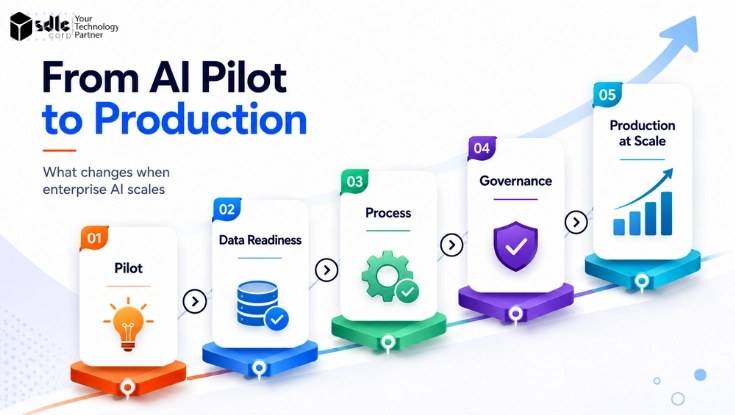
ProductionHow to Move AI Pilots into Production
A practical sequence for taking a working pilot through to a system that runs reliably in production.
Read Article
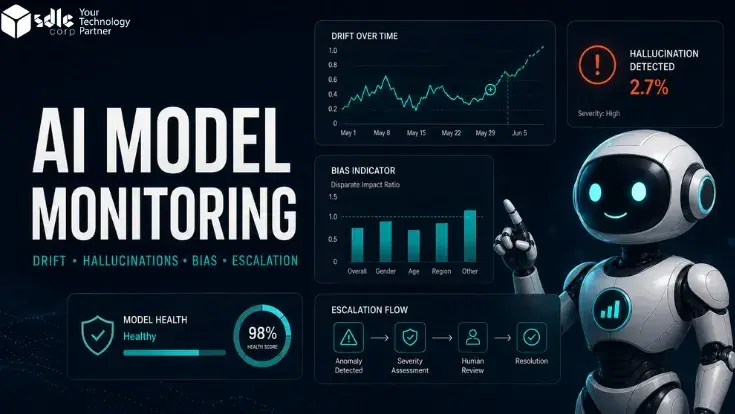
MonitoringAI Model Monitoring in Production: Drift, Bias & Alerts
What to watch once a model is serving real traffic, from drift and bias to alerting thresholds.
Read Article
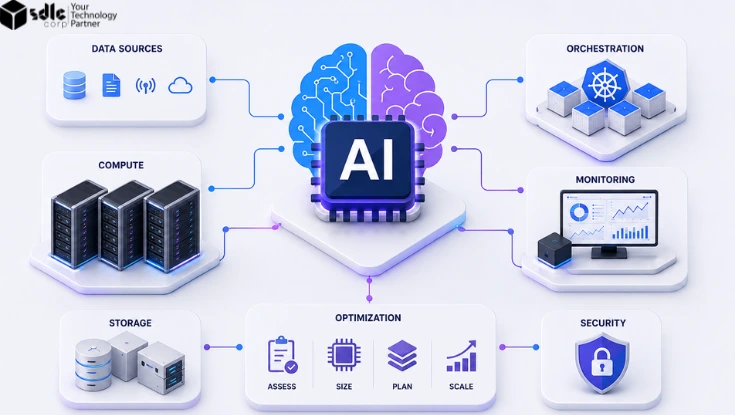
InfrastructureAI Infrastructure Planning: GPUs, Kubernetes & Cost
Sizing GPUs, choosing orchestration and keeping the running cost of AI workloads predictable.
Read ArticleUse AI Without
Operating Everything Yourself
Give your applications access to managed AI capabilities while reducing the infrastructure your internal teams need to build and operate.
From model endpoints and scalable inference to private deployments and production monitoring, our AIaaS team can help turn AI models into reliable application services.
Contact Us
Share a few details about your project, and we’ll get back to you soon.
Let's Talk About Your Project
- Free Consultation
- 24/7 Experts Support
- On-Time Delivery
- sales@sdlccorp.com
- +1(510-630-6507)