Language Engineering Enterprise Ready

Natural Language Processing
Services

Turn unstructured language into structured information your applications and teams can use.

Our NLP development services help organizations classify text, detect intent, extract entities and business fields, analyze sentiment, process multilingual content and automate language-heavy workflows.

Proven AI Delivery

50+Enterprise Clients
400+AI Specialists
98%On Time Delivery
10+ Yearsof Experience

Trusted by Fortune Global 500 leaders, governments & top universities across 30+ countries

Powered by leading cloud & AI platforms

AWS
Google Cloud
Microsoft Azure
NVIDIA
OpenAI
Anthropic
Gemini
Grok
Perplexity
Google AI
AWS
Google Cloud
Microsoft Azure
NVIDIA
OpenAI
Anthropic
Gemini
Grok
Perplexity
Google AI

Recognized by leading industry reviewers

Awards & industry recognition

Top AI Development Company by Selected FirmsTop IT Consulting, SI & Managed Services Company by ITRateTop Web Development Company by Selected FirmsTop Service Provider 2025 by RightFirmsTop App Development Company by AppDevelopmentCompaniesTop Software Development Company by Selected FirmsBest Support Company 2025 by SoftwareSuggestTop AI App Developers by C2C Reviews
Recognition

Recognized for
AI Delivery

AI engineering experience across language processing, machine learning, document intelligence and enterprise applications.

Top AI Solutions Provider for Enterprises — 2025 Read the announcement

Top AI Development Company by Selected FirmsTop AI Development Company by Selected Firms
Top AI App Developers by C2C ReviewsTop AI App Developers by C2C Reviews
Top IT Consulting, SI & Managed Services Company by ITRateTop IT Consulting, SI & Managed Services Company by ITRate
Top Software Development Company by Selected FirmsTop Software Development Company by Selected Firms

Reviewed on Clutch, GoodFirms, Selected Firms and DesignRush.

Services

Natural Language Processing
Services We Deliver

Build NLP systems that understand, classify and extract useful information from human language.

Categorize

Text Classification

Automatically classify emails, documents, support requests and other text into defined business categories.

Common applications include email routing, ticket categorization, document classification, issue detection and content tagging.

Purpose

Intent Classification

Identify what a customer, employee or user is trying to accomplish from written or transcribed language.

Intent classification can support enquiries, service requests, call intake, support triage and workflow routing.

Entities

Named Entity Recognition

Identify and extract meaningful entities such as people, organizations, locations, dates, products, reference numbers and domain-specific terms.

Fields

Information Extraction

Transform unstructured language into structured fields that downstream applications can process.

Opinion

Sentiment Analysis

Analyze reviews, feedback, surveys and support interactions to identify sentiment and recurring opinion patterns.

Languages

Multilingual NLP

Process classification, extraction and language-understanding tasks across supported languages.

For generative language applications, model integration and fine tuning, explore our LLM Development Services.

Solutions

NLP Solutions
We Build

The systems organizations most often need when language volume outgrows the people reading it.

Inbox

Email Classification Systems

Interpret incoming emails and classify them by intent, department, urgency or topic before routing them into the appropriate workflow.

Service

Support Ticket Routing

Analyze requests and automatically assign them to the correct support queue, workflow or business function.

Documents

Document Classification

Identify document types before extraction, validation or downstream processing begins.

Extraction

Entity Extraction Systems

Extract names, dates, references, products, codes and business-specific information from free-form text.

Insight

Feedback Analytics

Analyze large volumes of reviews, surveys, complaints and open-ended customer feedback.

Policy

Content Moderation

Classify text according to predefined moderation categories and business policies.

Outcomes

What NLP
Can Improve

Where language processing changes how work actually moves through the business.

Volume

Faster Text Processing

Reduce the manual effort required to read, classify and process large volumes of written information.

Routing

Better Request Routing

Route messages and requests according to meaning instead of relying only on fixed keywords.

Structure

Structured Information

Turn free-form text into categories, entities and fields that business systems can use.

Consistency

Consistent Classification

Apply the same classification logic across high-volume workflows.

Insight

Customer Insight

Identify patterns across reviews, complaints, surveys and support interactions.

Global

Multilingual Operations

Support language-heavy workflows across international users and markets.

Architecture

NLP
Architecture

A production NLP system turns raw language into structured information that business applications can use.

Stage 01

Text Input

Process information from sources such as:

emailsdocumentscontact formssupport ticketstranscriptsAPIs

Stage 02

Language Processing

Apply the appropriate model for classification, extraction or language understanding.

Stage 03

Structured Output

Return useful results such as:

categoriesintentsentitiesextracted fieldssentimentconfidence scores

Stage 04

Validation

Apply business rules and confidence thresholds before information moves downstream.

Stage 05

Application Integration

Send approved NLP results to CRM, ERP, support, document or custom business applications.

Approach

NLP Models
and Technology

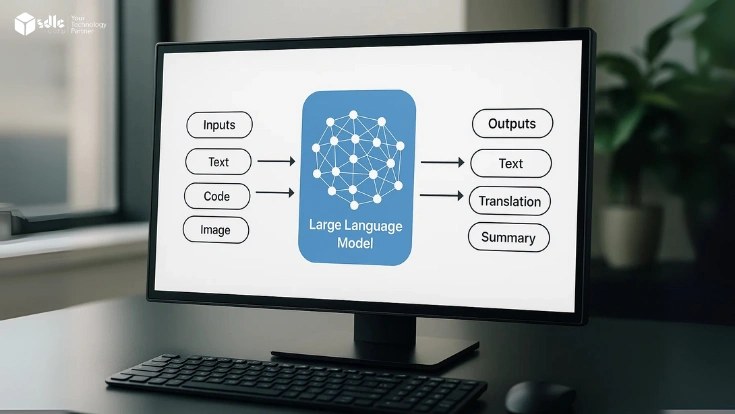
Not every language problem requires a large language model. We select the approach according to the task, available data and required level of accuracy.

Deterministic

Rule-Based NLP

Useful for workflows with highly deterministic terminology and well-defined language patterns.

Supervised

Machine Learning Models

Suitable for many classification and extraction tasks when representative labeled data is available.

Contextual

Transformer Models

Use contextual transformer models for more complex language-understanding requirements.

Adapted

Pretrained NLP Models

Adapt established models for classification, entity recognition and domain-specific tasks.

Generative

LLM-Assisted NLP

Use language models when they provide a measurable advantage for the specific language-processing task.

For deeper model engineering, explore our LLM Development Services.

Measurement

NLP
Evaluation

NLP systems should be measured against the task they actually perform.

Accuracy

Classification Accuracy

Measure whether text is assigned to the correct category.

Balance

Precision and Recall

Track false positives and missed examples for important classes.

Combined

F1 Score

Balance precision and recall when both are important.

Entities

Entity Accuracy

Measure whether required entities are identified correctly.

Fields

Field Accuracy

Validate extracted business values against expected results.

Per Language

Multilingual Performance

Evaluate supported languages individually instead of relying on one overall score.

Thresholds

Confidence Thresholds

Use model confidence to determine when automatic processing is appropriate and when human review is required.

Industries

NLP Solutions
by Industry

Where language volume and language complexity are highest.

Finance

Financial Services

Classify correspondence, extract structured information and analyze customer communications.

Health

Healthcare

Process administrative text, forms and operational language workflows.

Legal

Legal

Classify documents and extract entities, references and structured information from legal text.

Logistics

Logistics

Extract shipment references, dates, parties and operational details from documents and correspondence.

Commerce

Retail and E-Commerce

Analyze customer enquiries, reviews, product feedback and support messages.

Service

Customer Service

Classify requests, detect intent and improve support routing.

Stack

NLP
Technology Stack

Chosen for the language task, not for the largest available model.

NLP Frameworks

Where the language work happens

spaCyHugging Face TransformersNLTK
Machine Learning

Training and inference

PyTorchTensorFlowscikit-learn
Models

Matched to the task

BERT-family modelsTransformer modelsTask-specific classifiersCustom NLP models
Engineering

How the capability is exposed

PythonFastAPINode.jsREST APIs
Infrastructure

Where it runs

AWSMicrosoft AzureGoogle CloudDockerKubernetes
Portfolio

NLP Systems
in Production

Real implementations showing language understanding, classification and information extraction inside operational workflows.

3 entries · scroll to reveal
01 / 03 Case Study
Natural Language Intent Classification SDLC Corp

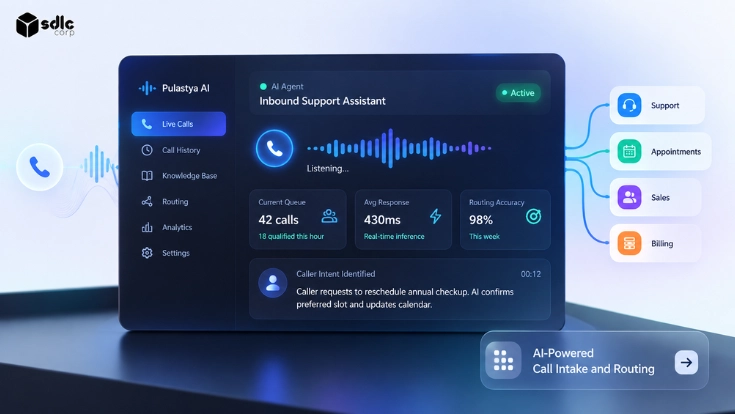
Pulastya AI Call Intake

A service business needed incoming calls understood according to what callers actually said instead of forcing people through fixed phone menus.

Pulastya interprets natural conversation and maps each call to a defined business intent before routing logic determines the appropriate workflow.

Typical intents can include booking requests, support enquiries, pricing questions, service requests and department-specific enquiries.

  • Natural-language understanding
  • Intent classification
  • Structured request capture
  • Transcript processing
  • Caller-context extraction
  • Defined intent taxonomy
View Full Case Study
Pulastya AI call intake showing the detected intent and the matched queue before routing

Pulastya uses NLP to identify caller intent before routing each request into the appropriate workflow.

02 / 03 Case Study
Document Classification and Extraction SDLC Corp

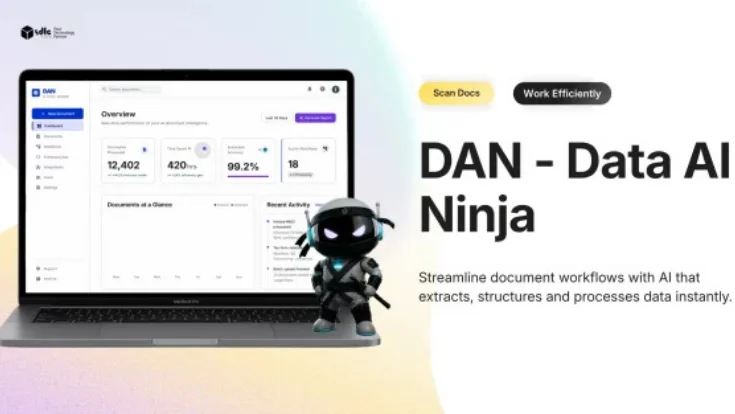
Data AI Ninja

Data AI Ninja converts uploaded business documents into structured information.

The system identifies the document type, applies the appropriate extraction workflow and returns structured fields with confidence information for review.

Supported workflows can include invoices, receipts, contracts, statements and other business documents.

  • Document classification
  • Information extraction
  • Field detection
  • Confidence scoring
  • Reviewer validation
  • Structured JSON output
View Full Case Study
Data AI Ninja document extraction console showing document type, detected language and per-field confidence

Document types and confidence scoring are published on the Data AI Ninja product page.

60%Faster Document Processing
80%Fewer Manual Entry Errors
18+Supported Document Types
03 / 03 Case Study
Unstructured Document Extraction SDLC Corp

Global Logistics

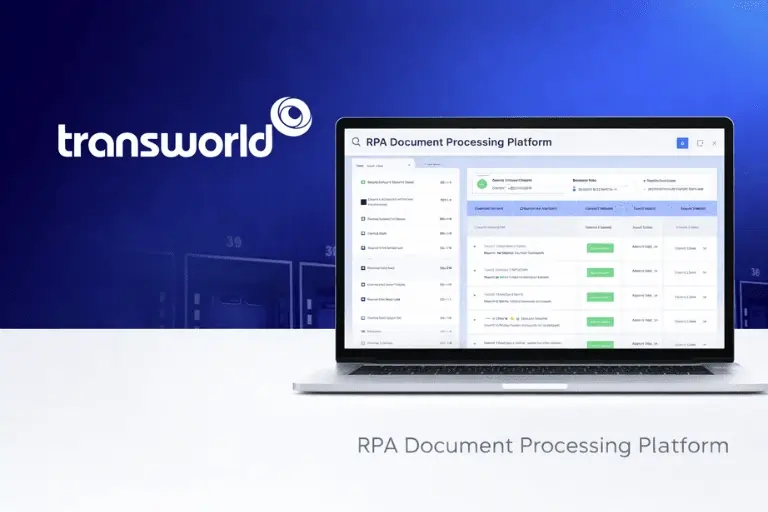
A logistics operation needed to extract important information from invoices and bills of lading arriving in different formats.

The document-processing layer identifies required business fields and converts unstructured document content into structured information for validation and downstream processing.

Depending on the document, extracted information can include invoice details, shipment references, vendor information, dates, amounts and operational fields.

  • Invoice details
  • Shipment references
  • Vendor information
  • Dates
  • Amounts
  • Operational fields
View Full Case Study
Transworld Logistics document processing platform extracting fields from unstructured invoice PDFs

Featured image from the Transworld document-processing case study.

2,000+Invoices Per Day
48 Hours → 4 HoursProcessing Time
4-5% → 0.1%Published Error Rate
Client Stories

What Clients Say
About SDLC Corp

Founders, CEOs, and operating leaders share what it's like to build with SDLC Corp.

Client story

Eric Leist

CEO, Edgerton Strategies

Client story

Doug Schmidt

CEO, Roofaid USA

Client story

Reyzal Razmi

All Star Influencers

What clients say
01 / 05
They approached our Salesforce discovery with real technical depth, uncovered structural gaps others missed, and delivered a solution that worked exactly as promised.
SDLC CORP built a mobile application that met our strategic requirements with strong technical execution. The solution performs reliably and has become an important operational asset.
They saw inefficiencies in our Salesforce workflow and redesigned our entire quote-to-cash system. We now operate faster, cleaner, and with better accuracy.
From planning to post-launch, SDLC Corp guided us every step of the way. Their support makes them more than a vendor. They're a trusted partner.
The SDLC Corp team scaled our platform with impressive technical expertise, ensuring it's secure, robust, and ready for future growth.
What clients say
01 / 05
The SDLC Corp team scaled our platform with impressive technical expertise, ensuring it's secure, robust, and ready for future growth.
From planning to post-launch, SDLC Corp guided us every step of the way. Their support makes them more than a vendor. They're a trusted partner.
They saw inefficiencies in our Salesforce workflow and redesigned our entire quote-to-cash system. We now operate faster, cleaner, and with better accuracy.
SDLC CORP built a mobile application that met our strategic requirements with strong technical execution. The solution performs reliably and has become an important operational asset.
They approached our Salesforce discovery with real technical depth, uncovered structural gaps others missed, and delivered a solution that worked exactly as promised.
By the Numbers

AI Engineering
at Scale.

Language systems built by teams that also build the applications they feed.

Drag to spin
3,400+
Projects Delivered
across 12 industries
400+
AI Specialists
Top 1% global talent
1,200+
Global Engineers
across 6 continents
30+
Countries Served
global regulatory regimes
50+
Enterprise Clients
Fortune 500 to challengers
10+ Years
of Experience
in AI and software
Process

Our NLP
Development Process

Six stages, from defining the categories to watching the language change.

01

Discover

Define the language sources, business task, required categories or entities, supported languages, downstream workflow and success criteria.

02

Prepare

Organize representative language data and create labels where supervised learning is required.

03

Build

Develop or adapt the NLP model and processing pipeline.

04

Evaluate

Test performance against representative unseen examples.

05

Integrate

Connect NLP capabilities to applications and workflows through APIs or application services.


06

Deploy

Release the NLP system into the required production environment and monitor performance.

Why SDLC Corp

Why Choose SDLC Corp
for NLP

NLP judged by the task it performs, not by how impressive the model sounds.

Right-Sized

Language and ML Engineering

Use the appropriate NLP and machine-learning approach for the problem rather than applying the same model architecture everywhere.

Connected

Enterprise Workflow Experience

Connect NLP output with real operational systems and business processes.

Usable

Structured Business Outputs

Turn language into categories, entities and fields that applications can act on.

Oversight

Human Review Where Needed

Use confidence thresholds and exception handling when language is ambiguous or business impact is higher.

Per Language

Multilingual Design

Evaluate target languages individually for production use.

Measured

Production Evaluation

Measure NLP quality against representative business scenarios.

Get Started

Build Your
NLP Solution

Turn emails, documents, feedback, messages and other unstructured language into structured information your software and teams can use.

From text classification and intent recognition to entity extraction, sentiment analysis and multilingual NLP, our team can take your project from data preparation through production deployment.

Contact

Contact Our
NLP Team

Tell us what language data you need to process, which categories or entities matter, which languages are involved and where the results need to go.

Contact Us

Share a few details about your project, and we’ll get back to you soon.

Let's Talk About Your Project

FAQ

NLP Services
FAQs

Straight answers on classification, entities, extraction, multilingual work and how NLP relates to language models.

Natural Language Processing services involve building software that analyzes and understands human language.

Common applications include text classification, intent recognition, sentiment analysis, named entity recognition and information extraction.

Text classification assigns predefined categories to written content.

It can be used for support tickets, emails, documents, customer feedback and other business text.

Intent classification identifies what a user is trying to accomplish from their language.

Different phrases can therefore map to the same underlying business request.

Named Entity Recognition identifies entities such as people, organizations, locations, dates, products and business-specific references inside text.

Information extraction converts unstructured language into structured information such as fields, entities, attributes or relationships.

Sentiment analysis identifies patterns of opinion or sentiment expressed in text.

It can be applied to reviews, surveys, support interactions and customer feedback.

Yes. Emails can be classified according to intent, department, urgency, topic or another defined business category.

Yes. Document classification can identify the type of document before extraction or downstream processing.

No. Many NLP problems can be solved with traditional machine learning, transformer models or rule-based methods.

The appropriate approach depends on the task, available data and required performance.

Natural Language Processing is the broader field concerned with computational understanding and processing of language.

Large language models are one family of models capable of performing many language tasks. For model engineering work, see our LLM Development Services.

NLP analyzes, classifies or extracts information from language.

RAG retrieves information from external knowledge sources before a language model generates an answer. See our RAG Development Services.

Yes. Multilingual NLP can support classification, entity extraction and other language-processing tasks across supported languages.

Each production language should be tested independently.

Common evaluation measures include accuracy, precision, recall, F1 score, entity accuracy and field-level extraction accuracy.

The appropriate metrics depend on the business task.

Yes. NLP services can integrate with CRM, ERP, ticketing systems, document workflows and custom business applications through APIs and application services. See our AI Integration & Implementation Services.

Yes. We can review training data, label quality, preprocessing, model selection, class balance, confidence thresholds, multilingual performance and production errors to identify where accuracy is being lost.