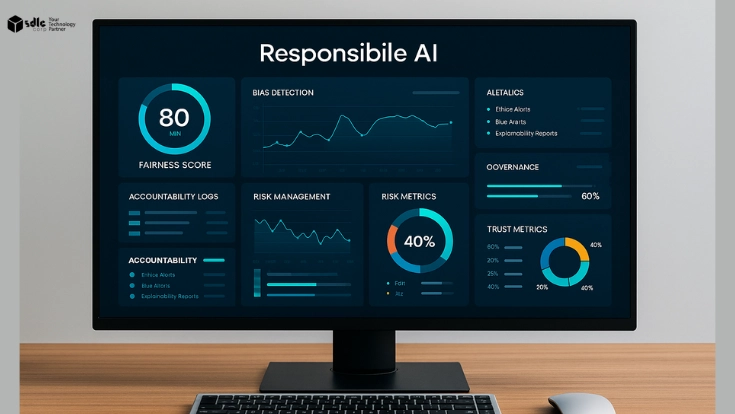
Responsible AI development is the practice of designing, building, evaluating and operating AI systems with fairness, transparency, privacy, security, human oversight and lifecycle accountability.
It is not a policy statement written once and filed away. It is a set of engineering and operating habits that shape how a use case is chosen, how data is prepared, how a model or agent is tested, who can approve its release and what happens when it behaves unexpectedly in production.
This guide explains how responsible AI works across the full lifecycle: principles, risk classification, fairness testing, explainability, human oversight, privacy, security, red teaming, generative AI and RAG risks, agentic actions, monitoring and change control. It closes with a practical checklist and a clear distinction between responsible AI practice and enterprise AI governance.
Key Takeaways
- Responsible AI covers the whole lifecycle, from use case design to retirement.
- Controls should scale with risk; not every AI system needs the same scrutiny.
- Fairness needs several measures and a human review, not a single metric.
- Explanations should match the decision and the audience receiving them.
- Human oversight works only when approval gates, thresholds and owners are defined.
- Privacy law, security controls and abuse prevention apply to AI like any other system.
- Red teaming and regression testing belong before release and after every change.
- Generative AI, RAG and agents add hallucination, leakage and unsafe-action risks.
- Model, provider, prompt and retriever changes should trigger re-validation.
- Frameworks structure the work; they do not guarantee compliance on their own.
What Responsible AI Means
Responsible AI is the discipline of making sure an AI system does what it is supposed to do, for the people it is supposed to serve, without creating unacceptable harm along the way. It treats the AI system as a product with users, consequences and owners rather than as a model score on a benchmark.
In practice it touches eight areas that are often handled by different teams:
Design
Whether AI is the right tool, what it may decide and where its authority ends.
Data
Where training and grounding data comes from, whether it is representative and lawful to use.
Model behavior
Accuracy, robustness, fairness and failure modes across realistic inputs.
User impact
Who is affected by outputs and what an error costs them.
Human oversight
When people review, approve, override or take over from the system.
Deployment
Access, permissions, rollout strategy and fallback paths.
Monitoring
Quality, drift, misuse and business signals once the system is live.
Incident response
How issues are contained, fixed, communicated and learned from.
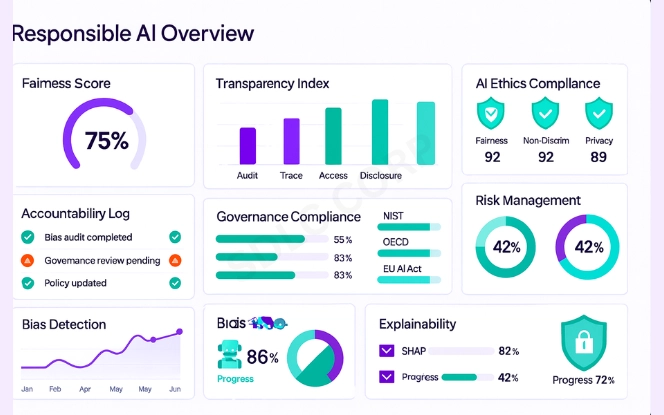
Responsible AI Principles
Most responsible AI programs converge on a similar set of principles. The value is not in listing them but in turning each one into something a team can test or evidence.
| Principle | What it means in practice |
|---|---|
| Fairness | Outcomes are evaluated across relevant user groups and unjustified disparities are investigated and reduced. |
| Transparency | Users know when they are interacting with AI and understand what the system is for. |
| Explainability | Decisions can be explained at a level suited to the decision, the user and any reviewer. |
| Accountability | Every AI system has a named owner who is responsible for its behavior and its changes. |
| Privacy | Personal data is collected, used and retained lawfully, minimally and securely. |
| Security | The system, its data and its tools are protected from misuse, leakage and attack. |
| Human oversight | People can review, approve, override or stop the system where the impact requires it. |
| Robustness | The system behaves acceptably on unusual, noisy or adversarial inputs and fails safely. |
| Traceability | Data sources, model versions, prompts, approvals and decisions can be reconstructed later. |
Risk Classification: Matching Controls to Impact
Not every AI system carries the same risk. A tool that drafts internal meeting notes does not need the same review as a model that influences credit, hiring, clinical or safety decisions. Classifying risk early lets teams apply strong controls where they matter and avoid slowing low-impact work.
| Category | Typical examples | Typical control emphasis |
|---|---|---|
| Low-risk assistance | Drafting, summarizing, internal search | Usage guidance, basic logging, user feedback |
| Decision support | Recommendations a person reviews before acting | Evaluation, explanation of outputs, reviewer training |
| High-impact decisions | Credit, employment, insurance, healthcare, public services | Fairness testing, documented approval, human review, audit trail |
| Autonomous actions | Agents that send, change, pay or delete | Tool permissions, approval gates, reversibility, action logs |
| Sensitive data | Health, financial, biometric or child data | Privacy review, minimization, access control, retention limits |
| Regulated domains | Sectors with specific AI or data rules | Legal review, sector requirements, evidence for regulators |
These categories are illustrative, not a universal taxonomy. Organizations should define tiers that reflect their own context, regulators and risk appetite.
Classification should consider intended use, affected people, consequence of error, data sensitivity, degree of autonomy, scale and reversibility. Designing the enterprise-wide tiering model, decision rights and review boards is covered by our AI governance consulting services.
Fairness and Bias
Bias can enter an AI system long before a model is trained. Historical data may reflect past decisions that were themselves unfair. Some groups may be under-represented, labeled inconsistently or described through proxies such as postal code or device type.
Where bias comes from
- Training-data bias: historical outcomes, skewed sampling or inconsistent labels.
- Representation gaps: too few examples for some groups, languages, accents or document types.
- Proxy variables: features that correlate strongly with protected characteristics.
- Deployment mismatch: the live population differs from the population the model was tested on.
How to evaluate fairness
Fairness cannot be reduced to one number. Different metrics, such as parity of selection rates, equal error rates or calibration across groups, can conflict with each other, and the right choice depends on the decision being made.
- Evaluate performance separately for relevant user groups, not only in aggregate.
- Check for disparate impact in outcomes as well as differences in error rates.
- Agree acceptable thresholds before testing, and record who approved them.
- Review decision thresholds, because a single cut-off can affect groups differently.
- Hold a fairness review with domain experts when results are close to or beyond thresholds.
- Repeat the evaluation after retraining, data changes and at regular intervals in production.
Transparency and Explainability
Transparency is about honesty with users: telling them when AI is involved, what it is designed to do and what it cannot do. Explainability is about being able to show why a particular output was produced.
Fit the explanation to the decision
A product recommendation needs little explanation. A declined application or a clinical flag needs reasons a reviewer can act on.
State the limits
Document known weaknesses, unsupported inputs and conditions where outputs should not be trusted.
Disclose AI use
Tell users when they are interacting with an AI system or receiving AI-generated content.
Show confidence
Surface confidence or uncertainty where it helps a person decide whether to rely on the output.
Provide evidence
For generative and RAG systems, cite the sources that support an answer.
Keep decision records
Record inputs, model version, output, explanation and any human action for later review.
Human Oversight
Human oversight is one of the most frequently cited principles and one of the most often left undefined. Saying that a human is in the loop means little unless the team has decided when that person is involved, what information they see and what authority they have.
When a human should review
- Before any high-impact decision about a person takes effect.
- When model confidence falls below an agreed threshold.
- When inputs fall outside the conditions the system was tested for.
- When an agent proposes an action that is irreversible, costly or externally visible.
- When a user disputes or appeals an AI-assisted outcome.
Designing effective oversight
Approval gates
Define which outputs or actions require explicit human approval before they proceed.
Escalation paths
Route uncertain, sensitive or disputed cases to people with the right expertise.
Override and stop
Give reviewers the ability to change an outcome or pause the system, and log when they do.
Confidence thresholds
Use calibrated thresholds to decide what is automated, reviewed or rejected.
High-impact decisions
Keep a meaningful human decision for outcomes with legal or similarly significant effects.
Accountable owners
Name who owns the system, who reviews cases and who approves changes.
Oversight must be real rather than rubber-stamping. Reviewers need enough time, context and training to disagree with the system, and teams should monitor override rates: a reviewer who never overrides may not be reviewing. For operating-model design, review boards and control libraries, see our AI governance consulting service.
Privacy and Data Protection
AI systems are subject to the same data protection laws as any other system that processes personal data, and they add new questions about training data, inference and retention. Which laws apply depends on where people are located, where data is processed and the sector involved.
| Law | Where it typically applies | What it means for AI |
|---|---|---|
| GDPR | Personal data of people in the EU, and the UK GDPR in the UK | Lawful basis, purpose limitation, data subject rights and safeguards for solely automated decisions with significant effects |
| CCPA / CPRA | Personal information of California residents | Notice, rights to know, delete, correct and opt out, and limits on sensitive personal information |
| India DPDP Act | Digital personal data processed in India, or linked to offering goods or services to people in India | Consent or legitimate use, purpose limitation, data principal rights and grievance handling |
| UAE PDPL | Personal data processed in the UAE outside free zones with their own regimes | Lawful processing, data subject rights and cross-border transfer conditions |
| DIFC Data Protection Law | Processing within the Dubai International Financial Centre | Accountability, rights and specific provisions on autonomous and semi-autonomous systems |
Applicability depends on the organization, jurisdiction, data and use case. Legal teams should confirm which obligations apply.
Privacy practices for AI teams
- Data minimization: use only the personal data the use case needs, and remove identifiers where possible.
- Retention: set limits for training data, prompts, logs and outputs, and enforce deletion.
- Consent and lawful basis: confirm that existing data can be reused for training or grounding.
- Access: restrict who and what, including AI agents, can read personal and sensitive data.
- Sensitive data: apply stronger controls to health, financial, biometric and child data.
- Rights handling: make sure access, correction and deletion requests can be honored across AI data stores.
Security and Abuse Prevention
AI introduces new attack surfaces alongside familiar ones. Inputs can be crafted to change the behavior of a model, retrieved documents can carry hidden instructions and tools connected to an agent can turn a bad output into a real-world action.
Access controls
Role-based access to models, data, prompts, logs and administration.
Prompt and input abuse
Defenses against prompt injection, jailbreaks and malicious documents.
Data leakage
Prevent models from exposing training data, data belonging to other users or confidential context.
Secrets management
Keep API keys and credentials out of prompts, code and logs.
Adversarial use
Test for manipulation, evasion and misuse by determined users.
Unsafe actions
Block or require approval for actions outside the intended scope of an agent.
Tool permissions
Give each tool the least privilege it needs, scoped per user and task.
Model and provider risk
Review third-party model terms, data handling, residency and availability.
Where a solution runs on SDLC Corp delivery infrastructure, it sits within our company assurance:
SOC 2 Type II · ISO 27001 Certified · ISO 9001 Certified
Company assurance does not replace system-level security testing. Each AI system still needs its own threat model, access review and abuse testing.
Evaluation and Red Teaming
Evaluation is where responsible AI principles become evidence. A system should not reach production because a demo looked good. It should reach production because it passed tests that reflect real users, real data and realistic misuse.
| Activity | Purpose |
|---|---|
| Pre-production evaluation | Measure accuracy, quality, fairness and safety against agreed acceptance criteria before release. |
| Representative test sets | Cover real user groups, languages, edge cases and the input distribution expected in production. |
| Failure-case analysis | Study where and why the system fails, not only its average score. |
| Adversarial testing | Probe with manipulated, noisy or malicious inputs to test robustness. |
| Abuse testing | Attempt misuse scenarios such as extracting data, generating harmful content or bypassing controls. |
| Red teaming | Give a dedicated team the goal of breaking the system and record every finding and fix. |
| Safety evaluation | Check outputs against content, domain and policy rules for the use case. |
| Regression testing | Re-run the evaluation suite after every model, prompt, data or code change. |
Findings from red teaming and production incidents should be added to the evaluation suite so the same failure is caught automatically next time. Evaluation results, thresholds and sign-off should be stored as part of the release record.
Generative AI and RAG Risks
Generative models and retrieval-augmented generation (RAG) systems create risks that classic predictive models do not. The output is open-ended text, code or media, and its quality depends on both the model and the information it retrieves.
- Hallucination: fluent answers that are not supported by any source.
- Groundedness: whether each claim in an answer is supported by the retrieved context.
- Retrieval quality: whether the right documents are found, ranked and passed to the model.
- Context leakage: answers that expose documents the user is not permitted to see.
- Outdated knowledge: stale documents or model knowledge presented as current.
- Source attribution: citations that let users verify answers and reviewers audit them.
- Sensitive document access: permission-aware retrieval that respects existing access rights.
Measure retrieval and generation separately, because a strong model cannot fix poor retrieval. Our RAG evaluation framework explains the metrics in detail, and our RAG development services and LLM development services apply these controls in production systems.
Agentic AI and Autonomous Actions
AI agents do more than answer questions. They plan, call tools, update records and trigger workflows. That shifts the main risk from a wrong answer to a wrong action.
Tool permissions
Each agent gets only the tools and data scopes its task requires.
Reversible actions
Prefer actions that can be undone, and treat irreversible ones as high risk.
Approvals
Require human approval for payments, external messages, deletions and similar actions.
Sandboxing
Test agents in isolated environments before they touch live systems.
Audit logs
Record every plan, tool call, input, output and approval.
Action boundaries
Set limits on spend, volume, recipients and systems an agent may affect.
Agents should also know when to stop: when confidence is low, instructions conflict or a request falls outside policy, the correct behavior is escalation to a person. Our agentic AI development team designs these boundaries into the architecture, and enterprise-level agent controls are part of AI governance programs.
Monitoring and Incident Response
Responsible AI does not end at launch. Data changes, users change and the world the model describes changes. Production monitoring is how teams notice.
- Production monitoring: track quality, latency, cost and business outcomes together.
- Drift: watch for changes in input data, predictions and the relationship between them.
- Quality signals: groundedness, user feedback, reviewer overrides and complaint rates.
- Misuse: detect abuse patterns, repeated jailbreak attempts and unusual tool use.
- Incidents: define severity levels, owners and response times before they are needed.
- Rollback: keep the ability to revert to a previous model, prompt or index quickly.
- Re-evaluation: re-run evaluations when monitoring shows sustained change.
- Post-incident learning: add failures to test sets and update controls.
Our guides to AI model monitoring in production and AI observability cover signals and architecture in depth, and our MLOps services put monitoring, versioning and rollback into the delivery pipeline.
Model and Provider Changes
An AI system that passed every test at launch can behave differently six months later without anyone changing its code. Many of the most important responsible AI controls are about change.
| Change | Why it matters | Expected response |
|---|---|---|
| Model upgrade | New versions can change tone, accuracy, refusals and bias | Re-run evaluation and fairness tests before switching |
| Provider change | Different data handling, residency, terms and behavior | Security, privacy and contract review plus full re-evaluation |
| Prompt change | Small wording changes can shift outputs significantly | Version prompts and run regression tests |
| Retriever or index change | Retrieval quality drives answer quality in RAG | Re-test retrieval and groundedness metrics |
| Dataset change | New or cleaned data can introduce new bias or leakage | Data review and targeted re-evaluation |
Each material change should be re-validated against the original acceptance criteria and, for higher-risk systems, re-approved by the accountable owner. Silent upgrades from a third-party model provider are a common blind spot, so pin versions where possible and monitor closely when they change.
Responsible AI Frameworks
Several regulations, standards and principles help organizations structure responsible AI work. They differ in legal force and purpose.
| Framework | Type | How it is used |
|---|---|---|
| EU AI Act | Regulation | A risk-based legal framework that sets obligations according to AI system risk, where it applies. |
| NIST AI RMF | Voluntary framework | A risk-management framework organized around govern, map, measure and manage functions. |
| ISO/IEC 42001 | Management-system standard | Requirements for an AI management system covering policy, roles, risk and continual improvement. |
| ISO/IEC 23894 | Guidance | Guidance on applying risk management to AI across the lifecycle. |
| OECD AI Principles | Intergovernmental principles | High-level principles for trustworthy AI that inform many national policies. |
These frameworks help structure governance, risk management and responsible AI practices. Applicability depends on the organization, jurisdiction and use case, and following a framework does not by itself establish compliance with any law.
The Responsible AI Lifecycle
Responsible AI works best as a repeatable lifecycle with clear checkpoints rather than a one-time review.
- DefineDocument the purpose, users, owner and success criteria.
- AssessClassify risk and identify legal, data and user-impact concerns.
- DesignChoose architecture, oversight model, data sources and controls.
- BuildDevelop with versioned data, prompts, models and code.
- EvaluateTest quality, fairness, safety and abuse against agreed thresholds.
- ApproveObtain sign-off from the accountable owner with evidence attached.
- DeployRelease gradually with access controls, logging and rollback ready.
- MonitorTrack quality, drift, misuse and incidents in production.
- Re-reviewRe-validate after changes and at scheduled intervals.
- RetireDecommission safely, archive records and remove data as required.
Practical Responsible AI Checklist
Before production
- Owner assigned
- Use case and limits documented
- Data sources reviewed
- Risk classified
- Evaluation and fairness testing complete
- Human oversight defined
- Access controls defined
- Logging enabled
- Escalation path defined
- Rollback path defined
After production
- Monitoring active and alerts owned
- Incidents reviewed and closed
- Changes re-evaluated before release
- Reviewer overrides analyzed
- Controls periodically reviewed
- Retirement criteria agreed
Responsible AI vs AI Governance
The two terms are related but not interchangeable.
| Dimension | Responsible AI | AI Governance |
|---|---|---|
| Focus | Principles and engineering practices used to build and operate AI safely and responsibly | Organizational policies, decision rights, lifecycle controls and oversight used to manage AI across the enterprise |
| Scope | An individual system or product team | The full AI portfolio, including third-party AI |
| Typical outputs | Evaluation suites, fairness tests, oversight design, monitoring | AI inventory, risk tiers, review boards, policies, evidence requirements |
| Owners | Product, engineering and data science teams | Leadership, risk, legal, compliance and technology functions |
Responsible AI practice makes each system trustworthy. Governance makes sure every system is held to the same standard. Organizations building an enterprise program can work with our AI governance consulting services team.
Responsible AI Development FAQs
What is responsible AI?
Responsible AI is the practice of designing, building, evaluating and operating AI systems with fairness, transparency, privacy, security, human oversight and lifecycle accountability. It turns ethical principles into testable engineering and operating practices.
Why is responsible AI important?
AI systems can affect decisions about people, money, health and safety at scale. Responsible AI reduces the risk of unfair outcomes, privacy breaches, security incidents and unreliable behavior, and it builds the trust that users, customers and regulators expect.
What is the difference between responsible AI and AI governance?
Responsible AI covers the principles and engineering practices used to build and run individual AI systems safely. AI governance is the organizational layer of policies, decision rights, lifecycle controls and oversight that applies those standards across every AI system in the enterprise.
How do you test AI for bias?
Teams evaluate model performance and outcomes separately for relevant user groups, check for disparate impact and differences in error rates, review decision thresholds and hold a fairness review against thresholds agreed in advance. Testing is repeated after retraining and in production.
What is human oversight in AI?
Human oversight means people can review, approve, override or stop an AI system where the impact requires it. Effective oversight defines approval gates, confidence thresholds, escalation paths and accountable owners rather than simply stating that a human is in the loop.
How do GDPR and privacy laws affect AI?
Privacy laws such as GDPR, CCPA and CPRA, India DPDP, UAE PDPL and the DIFC Data Protection Law apply to AI when it processes personal data. They affect the lawful basis for training and inference, data minimization, retention, individual rights and safeguards for automated decisions. Which laws apply depends on location, data and use case.
What is AI red teaming?
AI red teaming is structured adversarial testing in which a dedicated team tries to make an AI system fail, leak data, produce harmful content or take unsafe actions. Findings are fixed and added to the evaluation suite so they are caught automatically in future releases.
How do you monitor responsible AI after deployment?
Teams monitor quality, drift, fairness, misuse, reviewer overrides and business outcomes in production, with owned alerts and incident procedures. Model, prompt, provider, retriever and data changes trigger re-evaluation before release.
What frameworks support responsible AI?
Common references include the EU AI Act, the voluntary NIST AI Risk Management Framework, the ISO/IEC 42001 AI management-system standard, ISO/IEC 23894 risk-management guidance and the OECD AI Principles. Applicability depends on the organization, jurisdiction and use case.
How does responsible AI apply to generative AI and agents?
Generative AI adds risks such as hallucination, weak grounding, context leakage and outdated knowledge, so teams measure groundedness and retrieval quality and cite sources. Agents add the risk of unsafe actions, so they need scoped tool permissions, approval gates, reversible actions, sandboxing and audit logs.