AI call distribution decides which person picks up a call after an AI voice agent hands it off.
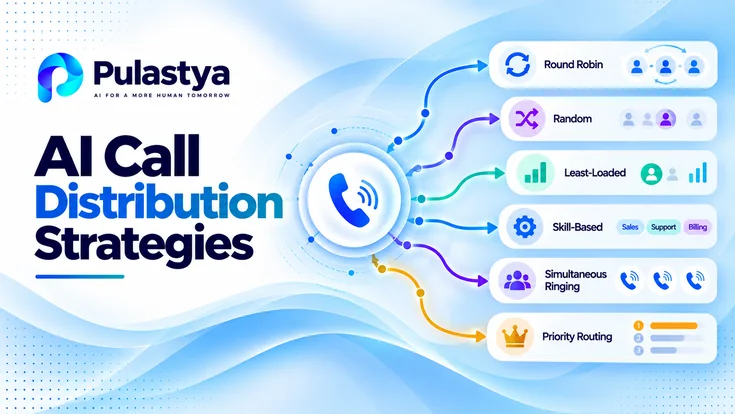
Once the AI has established why the caller needs a human and which team can help, a strategy such as round robin, random, least-loaded, skill-based or simultaneous ringing chooses the agent, balancing connect time, fair workload and transfer success. A dealership shows why that ordering matters, because one published number splits into sales, service and parts .
- Purpose Distribute eligible transferred calls to available agents while minimizing delay, avoiding overload, and preserving transfer context.
- Primary strategies Round robin, random, least-loaded, and skill-based each prioritize fairness, unpredictability, load balancing, or capability alignment respectively.
- Design boundary Treat distribution as the delivery layer after intent routing and team selection; integrate via a compact handoff payload and eligibility filters.
These strategies apply to one moment: an AI voice agent has decided a caller needs a person, and the system must pick which available agent takes the live call. The same choice exists whether the AI answered an inbound call or placed an outbound one.
Distribution does not pace outbound dialing, interpret caller intent or choose the team; it starts once those decisions are made. Its objectives are predictable wait times, fair work allocation, and fast handoffs that preserve the context the AI captured.
Design distribution to be observable and adjustable: instrument per-policy SLA metrics, expose agent availability signals, and provide a fallback path. Keep distribution rules narrowly scoped so they don't duplicate intent routing or team assignment logic.
What Call Distribution Means After an AI Transfer
When an AI voice agent reaches the point where a human transfer is required, distribution decides which eligible agent receives the live call. The system must respect agent availability, preserve conversation context, and fail gracefully if no suitable agent accepts the handoff within configured time.
Distribution does not choose teams or resolve caller intent. Instead it consumes the output of intent routing and team selection-an eligibility set and contextual metadata-and applies a delivery policy to allocate the live call to a single agent or a subset of agents for ringing.
Design goals are measurable: time-to-connect, transfer success rate, agent occupancy, and distribution fairness. Implement observability hooks to track each metric at policy level so operators can compare performance across strategies and adjust thresholds without redeploying routing logic.
- Inputs from routing: eligible agent list, required skills, priority flags, and call context token.
- Outputs: candidate agent identifier, ringing instructions, and handoff completion or fallback code.
- Failure modes to handle: no agents available, simultaneous accept conflicts, and context mismatch on pickup.
Distribution is the delivery mechanism for eligible transferred calls and should be observable, configurable, and decoupled from intent routing.
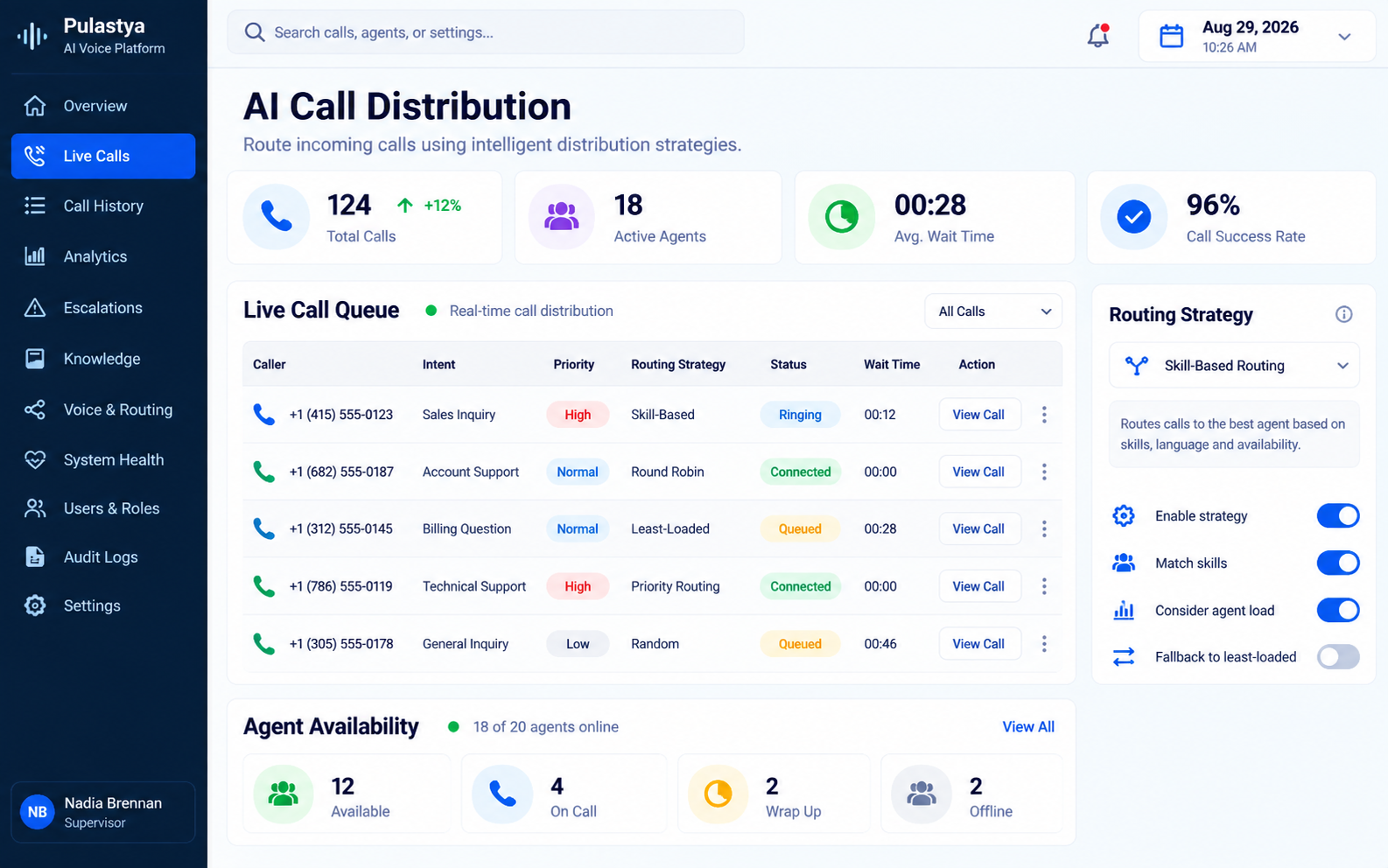
Comparing Round Robin, Random, Least-Loaded and Skill-Based Options
Round robin cycles through a stable list of eligible agents to distribute work evenly over time. It reduces fairness complaints but may send calls to agents with current high transient load unless coupled with live availability checks.
Random routing picks an eligible agent at random, offering unpredictability that can protect against gaming but provides no load guarantee. Random is simple to implement and useful in low-acuity scenarios where speed matters more than skill matching.
Least-loaded routing selects the agent with the lowest active load metric. It optimizes utilization and reduces queue times but requires accurate, low-latency occupancy telemetry to avoid oscillation and thrashing between agents.
Skill-based distribution prioritizes agents who meet required competencies or certifications. It improves first-contact resolution but can create hotspots; combine with fallback rules to avoid long waits when skill supply is limited.
- Round robin: fair long-term distribution, moderate implementation complexity when excluding busy agents.
- Random: minimal coordination, risk of sending work to temporarily unavailable agents if telemetry is stale.
- Least-loaded: best for utilization but sensitive to how load is calculated (calls, wrap-up, capacity score).
- Skill-based: improves outcomes for complex transfers but needs dynamic fallback and overflow rules.
Match policy to operational priorities: fairness favors round robin, utilization favors least-loaded, unpredictability favors random, and outcome quality favors skill-aware distribution.
After the AI hands off
Which Strategy Should Deliver a Call the AI Transfers?
| Strategy | Best when | Watch out |
|---|---|---|
| Round robin | Long-term fairness matters and live load signals are noisy | Can ring a busy agent unless live availability is checked first |
| Random | Low-acuity transfers where simple, fast delivery matters most | No load guarantee; stale telemetry can pick an unavailable agent |
| Least-loaded | Occupancy data is accurate and updates with low latency | Laggy or poorly defined load scores make calls bounce between agents |
| Skill-based | Complex transfers need specific skills or certifications | Creates hotspots and long waits without overflow and fallback rules |
| Simultaneous ringing | Time-critical transfers need the fastest possible connect | Interrupt fatigue and duplicate work; cap how many agents ring |
Each strategy trades fairness, speed or skill match against a specific failure mode, so pair the choice with the telemetry and fallback rules it needs.
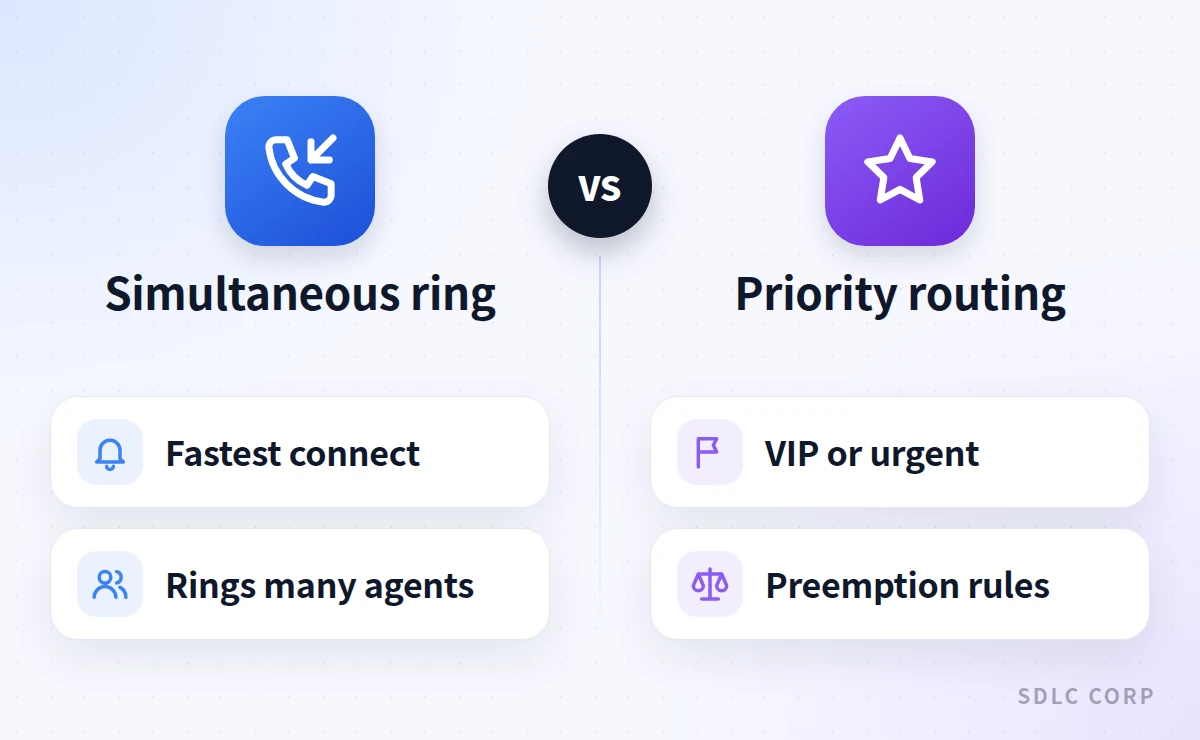
When Simultaneous Ringing or Priority Routing May Fit
Simultaneous ringing offers the fastest connect time by alerting multiple agents at once until one accepts. Use it for time-critical transfers where customer experience demands immediate human engagement, but limit concurrency to avoid interrupt fatigue and duplicate work.
Priority routing elevates certain transfers-VIPs, escalations, or time-sensitive offers-above ordinary calls. Implement priority buckets with clear preemption rules and safeguards so high-priority work does not starve regular queues or breach SLAs.
Trade-offs: simultaneous ringing increases agent interruptions and potential coordination overhead; priority routing improves SLA compliance for critical cohorts but requires monitoring to avoid systemic unfairness. Both need throttles, maximum concurrent rings, and measurable impact analysis.
- Use simultaneous ringing sparingly and with a cap on how many agents get alerted.
- Define priority tiers and set explicit preemption behavior and timeout windows.
- Monitor interrupt rate, abandonment after pickup errors, and agent satisfaction post-deployment.
Simultaneous and priority mechanisms accelerate connects but require throttles and monitoring to prevent degraded agent experience or SLA leakage.
Keeping Distribution Separate From Intent Routing and Team Selection
Maintain a clear boundary: intent routing and team selection determine why a call needs a human and which teams can handle it. Distribution consumes those decisions to execute delivery. Separate concerns reduce coupling and make each system easier to tune independently.
Implement a compact handoff contract containing eligibility, required skills, priority, and a context token. The distribution layer must treat that payload as authoritative and apply only delivery rules; avoid embedding intent logic inside distribution policies.
Integration patterns that work: synchronous handoff APIs for low-latency routing, event-driven queues for large-scale transfers, and a policy engine that evaluates agent eligibility against live availability signals. Log every handoff with audit fields for troubleshooting and compliance.
- Handoff payload should include agent filters, priority tier, caller context token, and timeout parameters.
- Distribution decisions must reference live availability metrics and not re-evaluate caller intent.
- Provide administrative controls to override distribution rules for emergencies or campaign experiments.
Treat distribution as the delivery tier: accept an eligibility set and deliver the call according to configurable policies, keeping intent logic upstream.
The upstream decision is explained in how AI voice agents route calls to the right team , which produces the eligibility set that distribution consumes.
Every strategy also depends on trustworthy agent states. Live-agent management covers how availability, skills and capacity signals are defined and kept current.
Frequently Asked Questions
Simultaneous ringing typically minimizes connect time by alerting multiple agents at once. If simultaneous ringing is not acceptable, least-loaded routing can reduce queue delays when accurate, low-latency agent occupancy metrics exist. Choose based on acceptable interrupt rate and available telemetry quality.
Select round robin when long-term fairness and predictability matter and load signals are noisy. Choose least-loaded when you can trust real-time occupancy and want to maximize throughput and shorten waits. Consider hybrid rules to exclude agents in wrap-up or high-occupancy states.
Priority routing can starve regular queues if unchecked. Prevent abuse with fixed priority budgets, automatic decay of priority over time, and monitoring that triggers rebalancing when priority work exceeds a configured share of total calls.
No. Keep distribution focused on delivery. Intent evaluation and team selection should run upstream and supply a compact eligibility set. Distribution should apply delivery policies against that set and report outcomes for analytics and audit.