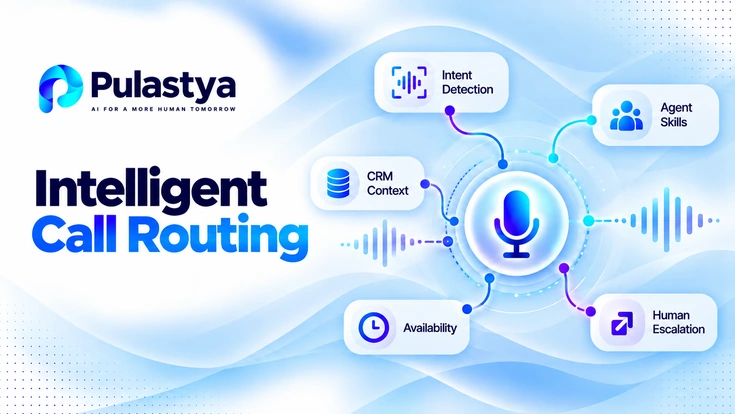
Intelligent call routing routes voice traffic by matching incoming caller intent, context, and agent capacity to a precise destination. The goal is fewer transfers, faster resolution, and measurable business outcomes tied to service level and cost per contact.
Effective implementations depend on operational inputs, selection logic, transfer avoidance techniques, measurement, and policies that use confidence as an actionable signal.
- Actionable Inputs Routing must combine caller intent, context, agent capability, and availability signals to produce deterministic and probabilistic matches.
- Confidence as Control Treat model or classifier confidence as a policy input that can trigger clarification prompts, reclassification attempts, or escalation to a human specialist.
- Measure What Matters Use transfer rate, handoff cause taxonomy, short-call loops, and outcome-aligned KPIs to quantify routing quality and prioritize tuning.
Enterprises operating contact centers must balance speed, specialist accuracy, and cost. Intelligent call routing replaces static trees and simple skill-based queues with real-time intent detection, historical context, agent state, and rule-driven escalation.
The routing engine must ingest voice-channel signals, CRM context, workforce availability, and configured service rules to return a destination that reduces repeat handoffs and improves first-contact resolution.
Getting routing right means deciding what inputs to collect, how selection logic combines deterministic and probabilistic signals, which tradeoffs appear on real voice calls, and how to measure routing quality.
Confidence scores should drive clarification prompts, reclassification, or escalation according to policy. These decisions matter to technical operations, contact center architects, and procurement teams evaluating routing platforms.
What Inputs Intelligent Routing Uses
Routing decisions depend on a curated set of inputs that span the moment of the call and historical context.
Primary inputs include the real-time speech or DTMF intent classification, ANI and account identifiers, CRM flags such as open cases or VIP status, and workforce state from the workforce management system. Each input must be normalized and timestamped so the routing engine can rank freshness and relevancy.
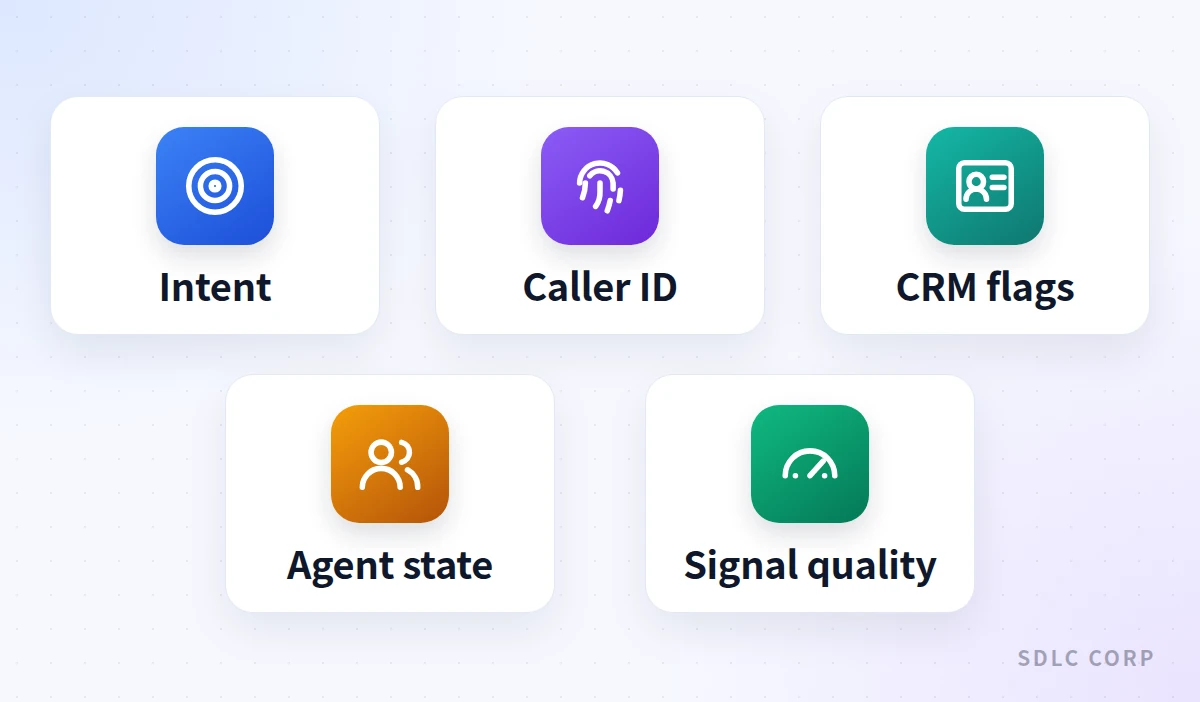
Secondary inputs improve precision: call channel metadata (call type, origination country, IVR path), recent contact history across channels, active offers or campaigns, and compliance flags such as recording consent or do-not-contact status for callbacks, plus language requirements.
Architect the data pipeline to surface these attributes in sub-second queries; slow or stale inputs produce poor matches and increase transfers.
Operational teams must also capture signal quality indicators: speech-to-text confidence, noise metrics, and DTMF recognition success.
These indicators feed policy decisions: low speech transcription confidence can prompt a clarification step, while high confidence combined with matching CRM context supports immediate routing to a specialist. Store these signals for post-call analysis to refine classifier thresholds and policy rules.
- Real-time intent from voice or IVR with confidence score and top intents.
- Caller identifiers: ANI, account number, loyalty tier, and recent interactions.
- Workforce state: agent skills, wrap time, current occupancy, and predicted availability.
- Channel metadata: inbound trunk, recorded IVR path, time of day, and language.
- Signal quality: transcription confidence, noise level, and DTMF detection status.
Combine freshness-ranked context and real-time signal quality to prevent routing on stale or unreliable inputs.
How the System Selects a Destination
Destination selection is a layered decision: deterministic filters reduce the choice set, probabilistic scoring ranks candidates, and policy engines apply business rules. Deterministic filters remove mismatches, for example a language mismatch or a regulatory block.
The remaining candidates receive composite scores derived from intent fit, agent expertise, predicted wait time, and business priority. The final selection can be the highest-scoring candidate or subject to additional rules like round-robin fairness.
Scoring models should be transparent and auditable. Use weighted factors where business teams can adjust weights for cost, speed, or specialist accuracy.
For example, increase the weight on agent expertise for complex technical issues, or prioritize speed for billing inquiries tied to revenue at risk. Record the contributing factors and weights for every routed call to enable retrospective analysis and dispute resolution.
Policy layers handle edge cases and escalation. Confidence thresholds determine when to accept the top prediction, when to ask a clarification question via IVR or bot, and when to route to a generalist for human triage.
Policies also enforce compliance and SLAs: VIP callers may skip normal queues, while high-risk compliance calls follow a stricter escalation path. Implement policy as configuration objects so business users can iterate without code changes.
- Deterministic filtering removes incompatible destinations before scoring.
- Composite scoring combines intent match, agent fit, predicted wait, and business priority.
- Transparent weights allow tuning between cost, speed, and accuracy.
- Confidence thresholds trigger clarification, reclassification, or escalation.
- Policy objects enforce SLAs, compliance, and VIP routing paths.
Make scoring transparent and policies configurable to align routing with business priorities.
Destination selection
How Intelligent Routing Picks a Destination for Each Call
- Collect inputsIntent with confidence, caller and CRM context, workforce state, signal quality
- Filter out mismatchesRemove destinations blocked by language, skill or regulatory rules
- Score the remaining candidatesWeigh intent fit, agent expertise, predicted wait and business priority
- Apply confidence and policyThresholds and risk rules decide whether to route, clarify or escalate
Possible outcomes
- Route directlyHigh confidence: top-scoring destination, with a structured context packet
- Clarify, then routeMedium confidence: one targeted question, then rescore
- Triage or specialistLow confidence to a generalist; high-risk calls to a specialist queue
Notice that filters and scoring narrow the options first, and confidence and risk policy make the final call on routing, clarifying or escalating.
Confidence-Driven Clarification and Escalation
Confidence scores are essential control signals. Treat them as policy inputs rather than binary accept/reject flags.
Define three bands: high confidence where the system routes directly, medium confidence where an automated clarification is triggered, and low confidence where the call should be routed to a human generalist for triage. Explicit thresholds should be based on monitored precision-recall tradeoffs and business tolerance for incorrect routing.
Clarification flows must be minimal and measurable. For voice channels, use a single targeted question that disambiguates the top intents; for example, ask whether the call concerns billing, technical help, or cancellations.
Log whether clarifications change the predicted intent and whether that change improved routing outcomes. Overuse of clarifications frustrates callers, so measure conversion of clarifications to correct routing as a tuning metric.
Escalation policies depend on confidence and risk. For high-risk calls or compliance categories, route to supervisors or a specialized compliance queue regardless of confidence. For low-confidence but low-risk calls, route to a generalist who can collect more information. Ensure escalation preserves the raw inputs and clarification attempts so specialists can see the decision history and avoid repeating steps.
- Define high, medium, and low confidence bands with explicit thresholds.
- Use single-question clarifications to disambiguate medium-confidence calls.
- Route low-confidence, high-risk calls directly to specialists for compliance.
- Log clarification outcomes to measure their effectiveness and tune thresholds.
- Avoid clarification fatigue by capping clarifications per session and measuring dropoffs.
Use confidence bands to drive minimal clarifications and risk-aware escalation.
Reducing Avoidable Transfers
Avoidable transfers often result from insufficient front-line information, poor intent extraction, or mismatch of skills. Reduce them by enriching the initial handoff packet: include top detected intents, confidence, relevant CRM notes, recent tickets, and suggested quick-reference scripts.
When agents receive a clear context snapshot, they resolve more calls without needing to transfer, lowering handle time and improving customer satisfaction.
Use proactive clarification as an alternative to direct transfer. If the intent classifier reports moderate confidence, an IVR or conversational bot can ask one targeted question to improve classification. For example, if an insurance caller is ambiguous between claims or billing, a single clarification prompt that asks why they called can increase first-contact resolution without adding a human handoff.
Design escalation channels that preserve context. When a transfer is necessary, pass a structured context object rather than free text. Include the original intent hypotheses, confidence scores, agent notes, and any steps already taken.
This reduces the need for repeat explanation by the caller and accelerates specialist resolution. Track transfer causes to identify repeat patterns that require process, training, or model improvements.
- Enrich agent handoffs with top intents, confidence, and recent CRM interactions.
- Use targeted clarification prompts when classifier confidence is borderline.
- Pass structured context objects during transfers to avoid caller repetition.
- Train front-line agents on when to escalate versus resolve with available context.
- Analyze transfer taxonomy to identify systemic drivers of avoidable handoffs.
Enriched context and targeted clarification reduce the need for costly transfers.
Operational Design and Policies
Operationalize routing with clear policy artifacts: routing matrices, escalation flows, and SLA mappings. Routing matrices map intents to destination groups under normal, degraded, and peak conditions.
Escalation flows describe who gets the call, which context is preserved, and the maximum number of transfers allowed. SLA mappings tie intent categories to service targets and routing priorities so the engine can balance speed versus specialist accuracy.
Governance must include change controls for routing weight adjustments and confidence threshold changes. Maintain a staging environment to simulate traffic and replay real calls to validate updates. Require a cross-functional sign-off for changes that affect more than a small percent of traffic, and document rollback plans. Maintain an audit log of configuration changes for compliance and root cause analysis.
Staffing and skills management integrate with routing logic. Define skill sets at a granular level and map them to routing destinations.
Use predicted arrival and shrinkage inputs from workforce management to adjust routing behavior during peaks: widen destination eligibility during overloads or prioritize top-tier agents for VIPs. Regularly update skill definitions to reflect retraining and role changes.
- Create routing matrices and escalation flows for normal and peak states.
- Map intents to SLAs and routing priorities to align with business goals.
- Use staging and call replay to validate configuration changes safely.
- Enforce cross-functional change approvals and maintain audit logs.
- Integrate workforce predictions to adjust routing during overloads.
Policies, change control, and workforce integration prevent routing regressions and align operations with SLAs.
Skills, Language, and Availability
Skill-based routing extends intent mapping by matching required competencies to agent profiles. For voice, key skills include product expertise, compliance certifications, and language fluency.
For instance, a caller requesting technical setup of network equipment should be routed to agents with a 'network-config' skill rather than a generic technical support pool. Maintain skill granularity that aligns with real-world agent training to avoid overfitting the routing model.
Language detection must operate early in the call flow. Use short initial prompts or a single-turn language selection step along with automatic language identification to decide whether to route to a bilingual agent or initiate a language-specific self-service path.
For multilingual enterprises, include fallback agents who can handle common cross-language handoffs and surface interpreted transcripts to the receiving agent.
Availability is the real-time constraint that converts ideal matches into practical assignments. Integrate occupancy and presence from the ACD or workforce system so the routing engine considers both skill match and current agent load.
If no perfect match is available, have configured fallback strategies: nearest-skill, cross-trained agents, or scheduled callback to minimize wait time while preserving resolution likelihood.
- Define a small set of core skills per team and tie them to skill proficiency levels to improve match accuracy.
- Use language detection within the first two speaker turns to avoid long misrouted interactions.
- Prioritize both skill match and agent occupancy to balance resolution probability and wait time.
- Support cross-skill fallbacks with required handoff context to reduce time lost during transfers.
- Expose agent skill and language attributes in the agent desktop for clearer handoff context.
Match intent requirements to agent skills and language early to reduce transfers and speed resolution.
Business Hours, Priority, and Exceptions
Routing must respect business hours and service level objectives. Configure time-aware rules so calls received outside support windows follow predefined paths: limited self-service, recorded guidance, or urgent escalation routes. For example, a billing dispute outside hours can be queued with a low SLA or forwarded to an on-call team when criteria indicate a revenue impact.
Priority routing applies to VIP customers, regulatory incidents, and safety-critical calls. Tag callers with priority markers from CRM or monitoring systems and have rules that preempt standard routing. Design these overrides explicitly and limit their use because unchecked preemption can starve regular queues and degrade overall service.
Exceptions are operational must-haves: system outages, campaign spikes, or region-specific holidays require temporary rule changes. Automate exception modes where possible and require human approval for high-impact exceptions. Maintain a log of exception conditions and outcomes to refine future automation and to provide post-incident reports for compliance and capacity planning.
- Set explicit business-hour flows that return contextual guidance and capture caller intent for next-business-day callbacks.
- Implement priority overrides tied to CRM attributes like enterprise account status or contract clauses.
- Use temporary exception flags for campaign-driven spikes with automatic rollback after a defined window.
- Establish on-call escalation paths for safety or legal issues that bypass normal queues.
- Require approval and postmortem for any exception that materially changes SLA behavior.
Time-aware and priority-aware routing prevents misassignment and preserves SLA integrity.
Measuring Routing Quality
Quantify routing quality with outcome-focused metrics. Core measures include transfer rate, first contact resolution rate, short-call loops (calls transferred back within a short time window), average handle time by route, and post-call resolution status.
Tie these measures to business KPIs such as revenue retention, churn reduction, or compliance incident counts to prioritize improvements that matter to the organization.
Create a cause-coded transfer taxonomy for operational insight. Categorize transfers as intent misclassification, missing skill, temporary unavailability, or policy-driven escalation.
This allows teams to resolve root causes: misclassifications point to model and prompt tuning, missing skills point to workforce training or hiring, and policy-driven transfers ask for policy refinement. Regularly review the top transfer causes in operations standups.
Use A/B tests and holdout cohorts to validate routing changes. Test new scoring weights, clarification scripts, or routing policies against a control group and measure statistical impact on transfers and resolution.
Collect sample recordings and annotated transcripts for failures to accelerate iteration. Maintain dashboards that show routing precision by intent and by time window to spot regressions after platform updates.
- Track transfer rate, first contact resolution, and short-call loops as primary KPIs.
- Use cause-coded transfer taxonomy to prioritize fixes.
- Run controlled experiments for routing policy and weight changes.
- Monitor routing precision per intent and agent group over time.
- Retain call recordings and context snapshots for failure analysis.
Measure routing outcomes, not just system uptime, to align with business impact.
Voice-Call Examples and Flows
Example 1: A caller with an open claim calls in. The system detects intent as claim inquiry with 0.86 confidence, attaches the claim ID from CRM via ANI, and routes directly to claims specialists who have the matching skill and are available within SLA.
The handoff packet contains the top 3 predicted intents, confidence scores, recent ticket notes, and last agent action to avoid repetition and speed resolution.
Example 2: A caller speaks a phrase that maps to billing or plan change with confidence 0.55.
The system asks a single clarifying question: "Are you calling about billing, technical help, or changing your plan?" The caller answers, the classifier updates to 0.92 on plan change, and the call routes to the right sales specialist. This avoids an unnecessary transfer from generalist to sales.
Example 3: A caller presents ambiguous language with low confidence and a regulatory flag (suspected fraud). Policy routes the call to a fraud specialist regardless of confidence, preserving raw audio and IVR details.
The specialist reviews the context and either resolves the call or escalates to legal. This flow prioritizes risk mitigation over speed and exemplifies how confidence and compliance intersect.
- Direct claims routing when high-confidence intent matches CRM open case.
- Single-question clarification moves medium-confidence calls to correct specialists.
- Policy-mandated routing for compliance or fraud regardless of confidence.
- Structured handoff packets eliminate caller repetition after transfers.
- Example-based flows should be captured as templates for operational playbooks.
Concrete call flows show how confidence, context, and policy combine to reduce transfers.
Routing quality matters most when it is part of a complete inbound design. See how inbound AI voice agents for business calls bring intent, knowledge, routing and escalation together.
Implementation, Integration, and Monitoring
Integrate the AI routing layer with core contact center systems: automatic call distributor, CRM, workforce management, and quality monitoring tools. At minimum, the routing engine should accept call metadata and classifier outputs and return queue assignments plus a routing rationale token. Provide synchronous APIs for call placement and asynchronous event streams for logging and analytics.
Design the handoff payload carefully so agents receive essential context: extracted intent, confidence score, entities, recent transcript, and which rules fired. This reduces the cognitive load during transfer and improves resolution time. Also ensure the agent desktop exposes the routing rationale so supervisors and auditors can trace why a call arrived in a given queue.
Operational monitoring must include both technical telemetry and business KPIs. Instrument latency of routing decisions, API errors, and classifier degradation signals. Correlate these with business metrics like abandonment rate and SLA breaches. Implement automated alerts for anomalous patterns such as sudden spikes in low-confidence classifications or unexpected queue overflow to enable fast remediation.
- Expose both sync routing APIs and async event streams for observability and analytics.
- Include routing rationale and classifier scores in the agent handoff payload for traceability.
- Monitor classifier drift and set alerts for sudden changes in confidence distributions.
- Correlate technical errors with business KPIs to prioritize operational responses.
- Ensure integrations respect data protection rules and log access for compliance audits.
Tight integrations and end-to-end monitoring make routing decisions auditable and operationally safe.
For smaller teams, routing often starts at the front desk. The guide to an AI receptionist covers how routing rules combine with FAQ answers, message capture and transfers on everyday business calls.
Conclusion
Intelligent call routing works best when every destination decision combines caller intent, reliable CRM context, agent skills and availability, and clear operational rules. Filtering incompatible queues before scoring candidates improves matching, while confidence-based clarification and risk-aware escalation help prevent avoidable transfers without overlooking service-level and compliance requirements.
For lasting improvements, preserve the context and reasoning behind each handoff, then track transfer causes, first-contact resolution, short-call loops, and routing performance. Validate changes to confidence thresholds, scoring weights, and fallback policies through controlled testing. This keeps routing decisions accurate, auditable, and responsive to the needs of both callers and contact center teams.
Frequently Asked Questions
Start with conservative thresholds based on intent-specific precision targets: a high-confidence band for direct routing, a middle band for a single clarification prompt, and a low band for human triage. Calibrate thresholds using historical data and A/B tests, and adjust per intent based on observed misroute costs and customer experience metrics.
Always pass a structured context packet that includes top predicted intents with confidence, caller identifiers, relevant CRM notes or ticket IDs, steps already taken, and any compliance flags. This reduces repeat explanation and accelerates specialist resolution while providing an audit trail for root cause analysis.
Use outcome metrics tied to business goals: first contact resolution, transfer rate, short-call loops, handle time by route, and downstream outcomes like conversion or churn. Run controlled experiments and track intent-level precision to ensure changes reduce avoidable transfers without increasing misroutes for high-risk categories.
Yes. Limit clarifications to a single, targeted question for medium-confidence calls and cap the total clarifications per session. Monitor clarification conversion rates and abandonment. If clarifications rarely change routing or increase abandonment, raise the threshold or improve the classifier instead of adding more prompts.
Use staging and call replay for validation, require cross-functional approvals for significant changes, maintain rollback plans, and keep audit logs of configuration updates. Monitor routing precision and key KPIs immediately after deployment and run quick rollbacks if negative regressions appear.