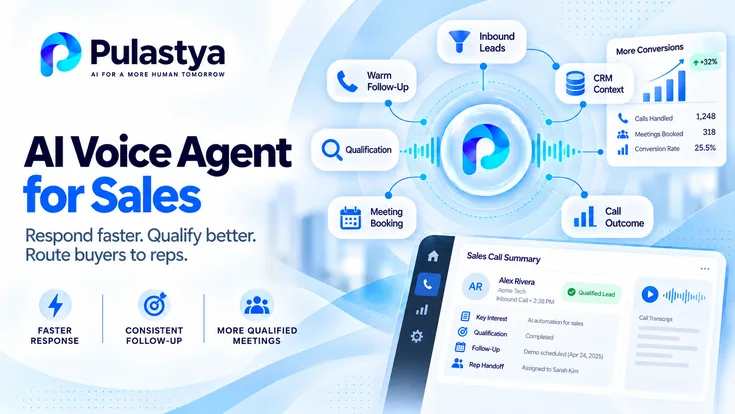
An AI voice agent for sales is a voice agent that handles repeatable sales calls: answering new lead calls immediately, following up with warm leads, gathering qualifying details, booking meetings and passing buying conversations to reps.
It is for sales teams that lose leads to slow first response and inconsistent follow-up.
- Faster first response New leads get a real conversation while their interest is current, not after a queue clears.
- Follow-up on schedule Warm leads receive follow-up calls under defined cadence and stop rules, with opt-outs honored.
- Logged dispositions Every call ends with a recorded outcome that triggers one owned next action.
The business outcome is a pipeline where new leads do not wait hours for a first conversation and follow-up happens on schedule rather than when a rep finds time. Every call ends with a logged outcome and an owner for the next step.
Reps stay responsible for conversations that need judgment: negotiation, custom pricing, objections beyond approved answers and relationship calls. The agent keeps leads moving and delivers them to reps with context.
Where an AI Voice Agent Fits in a Sales Call Program
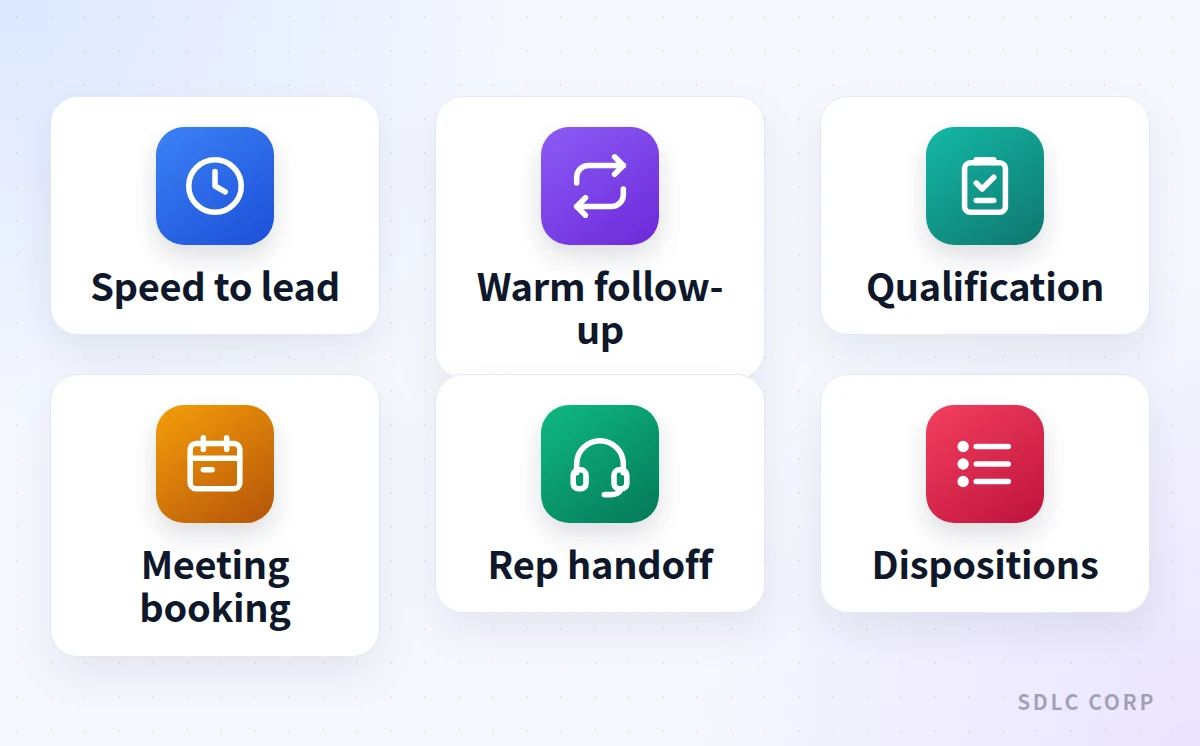
An AI voice agent fits the sales calls that are time-sensitive, repeatable and rules-based: first response to new leads, scheduled follow-up, basic qualification, meeting booking and outcome logging. Calls that require negotiation, commercial judgment or relationship history belong with reps. Drawing that line before launch keeps the agent from overreaching.
| Sales moment | AI voice agent role | Sales rep role |
|---|---|---|
| New inbound lead call | Answer, understand the need, answer approved questions | Take transferred buying conversations |
| Warm lead follow-up | Reconnect, confirm interest, capture updates | Work leads who re-engage seriously |
| Qualification | Ask agreed questions and record answers | Set criteria and review results |
| Meeting or demo booking | Book or capture preferred times | Run the meeting |
| Pricing and terms | Share approved published information only | Negotiate and approve exceptions |
The first two rows are where voice automation earns its place, because both are volume-driven and time-sensitive: inbound lead calls that arrive when no rep is free, and outbound follow-ups that slip whenever reps are busy selling.
A platform that handles only one direction leaves half of the speed problem untouched, so establish that inbound answering and outbound calling are both supported before scoping a program around either.
The same division of work applies across industries, and AI voice agents for real estate lead response shows how it adapts to property enquiries.
Speed-To-Lead: Responding While Interest Is Current
Speed-to-lead is the time between a prospect showing interest and their first real conversation with your business. Interest fades and prospects contact other vendors while they wait, so shortening that gap is one of the clearest reasons to deploy a sales voice agent. It removes the dependency on a rep being free.
How it works
How a Sales Lead Moves Through Calls
- New leadInbound call, form or quote request
- First responseAnswer now or call back promptly
- Understand and qualifyNeed, timeline and fit captured
- Decide next stepTransfer, book or follow up
- Log dispositionOutcome and owner recorded
Possible outcomes
- Rep conversationLive transfer with context
- Meeting bookedRep receives preparation notes
- Follow-up sequenceScheduled calls until a stop rule
Each lead gets a prompt first conversation and a logged outcome, so follow-up never depends on memory.
Inbound Sales Calls
When a prospect calls, the agent answers at once, including during busy periods, evenings and weekends. It identifies what the caller wants, answers product and pricing questions from approved material, and then qualifies, books or transfers. A prospect who calls on a Saturday gets a useful conversation instead of voicemail.
Form Fills and Other Digital Leads
For web forms, quote requests and chat leads, a common pattern is an automated callback shortly after submission, placed only within permitted calling hours and consent rules. The call opens by referencing the request, which gives the prospect an immediate reason to stay on the line.
Whatever the agent says on these calls has to be grounded in the company's own approved material, such as current pricing sheets, policies and service descriptions, rather than in model recall. Just as important, it has to be willing to say that it does not have enough context and offer a transfer instead of guessing.
On sales calls that distinction is commercial rather than cosmetic: an invented price or feature claim becomes the problem of the rep who inherits the lead, and occasionally a commitment the business is expected to honor.
Following up With Warm Leads Before They Go Cold
Follow-up calls reconnect with prospects who showed interest but did not convert: quote requests without a reply, missed meetings, stalled opportunities and leads who asked to be called later. An AI voice agent makes these calls consistently under defined rules, which is where manual follow-up most often breaks down.
- Trigger: a clear event, such as a quote sent, a meeting missed or a requested callback date reached.
- Purpose: one reason for each call, such as confirming interest or offering a new meeting time.
- Cadence: a defined number of attempts spaced over days, within calling-hour rules.
- Exit: stop the sequence when the lead converts, declines, stops responding or asks not to be called.
Outbound follow-up needs calling software with lead lists, schedules and attempt controls. The overview of AI outbound calling software for sales and service teams covers what to evaluate, and attempt limits and stop rules explains how to avoid calling loops.
Two things have to be true before any of this is more than a schedule on paper. The agent has to dial out rather than only pick up, and each attempt has to leave a transcript and a summary behind, so the third call opens where the second one stopped rather than starting the story again.
Campaign controls sit on top of that foundation and vary widely between tools, so establish which of them a platform provides before designing a sequence that assumes lead list imports, calling windows, attempt limits, suppression lists and pacing all exist. The principles for triggers, cadence and exits apply whichever platform places the calls.
Qualification and Meeting Booking Inside Sales Calls
Two workflows sit inside most of these calls, and both have enough design depth to plan on their own rather than improvise inside a call script. Treat them as components the program calls, not as things the script does.
Enough structure that whoever picks the lead up can act without replaying the call. The AI lead qualification agent page covers how that structure is designed.
Live booking through a scheduling integration, or preferred times captured for staff to confirm. The breakdown of AI appointment scheduling on business calls explains both models.
At the program level the decision that matters is sequencing, and it is a calendar question more than a call question. Whether a ready buyer is put straight through, offered a time, or offered both should match how your team actually protects its selling hours.
Using CRM Context on Sales Calls
CRM context is what lets a sales voice agent recognize who it is talking to and continue the relationship rather than restart it. The lead source, record owner, last interaction and open opportunity each change how the call should open and where it should end up.
This is about the live conversation, not about filing. A prospect who requested a quote last week should hear that quote referenced in the first sentence, not be asked what brings them here. A prospect with an open opportunity should reach the person already working it rather than a general queue.
- Opening: reference the prospect's request or last contact instead of a generic introduction.
- Continuity: pick the conversation up where the previous call stopped instead of starting the story again.
- Ownership: send transfers and meetings to the assigned rep when one exists.
- Restraint: use only the record data the call needs, and never read back sensitive details.
Context also decays. A record that was accurate when the lead arrived may be stale by the third follow-up attempt, so treat what the agent reads as something to confirm in conversation rather than as settled fact it can assert back to the prospect.
CRM read and write access depends on the systems and integration involved, so confirm both with any vendor. The article on personalizing voice calls with CRM data covers what to use and what to leave out.
Handing Buying Conversations to Sales Reps
The trigger for reaching a person is something the agent hears, not something it calculates. Buying intent that needs a human answer, an explicit request for a person, or a question the approved material does not cover should all end the automated part of the conversation there and then.
- Buying signals: questions about contracts, custom pricing, implementation timelines or procurement steps.
- Objections or concerns that go beyond approved responses.
- Explicit requests to speak with a person.
- Existing customers or open opportunities owned by a named rep.
A signal heard mid-call is a different thing from a lead that has already been scored, and the two pick their destination differently. Where a tier has been assigned, sending a qualified lead to a rep or a booked meeting sets out the tier-to-destination map, the availability check and what happens when nobody is free.
Whichever way the call arrives, what the agent has already promised has to travel with it. A price quoted, a date mentioned, a commitment implied: what lead context a rep should receive sets out what belongs in that briefing and what does not.
The one program-level rule worth writing down is what happens when the handoff fails. A prospect who has just said they are ready to buy should be offered a booked callback rather than left to try again later, because the intent that triggered the transfer is the thing you lose.
Call Disposition and Follow-Up Automation
A disposition records how a sales call ended, and follow-up automation turns that disposition into the next action. Without consistent dispositions, follow-up depends on memory, and pipeline reports cannot separate a lead who declined from one nobody reached.
| Disposition | Follow-up action | Owner |
|---|---|---|
| Meeting booked | Send confirmation and rep preparation notes | Assigned rep |
| Transferred to rep | Rep logs the outcome of the live conversation | Receiving rep |
| Callback requested | Call at the requested time | Agent or rep, by rule |
| No answer | Next attempt within calling rules | Calling system |
| Not interested | End the sequence and record the reason | Sales operations |
| Do-not-call request | Suppress the number immediately | Sales operations |
Keep follow-up automation conservative. Each disposition should trigger one next action, reps should be able to override it, and an opt-out must stop all further calls regardless of which sequence the lead was in. Spot-check labels regularly, because a call mislabeled as not interested quietly ends follow-up for a live prospect.
A disposition is only as trustworthy as the record behind it. A transcript and a summary for every call, inbound and outbound alike, let a manager test a not-interested label against what the prospect actually said, and a call dashboard showing status, duration and outcome turns those labels into something a pipeline report can stand on.
Whether outcome codes are written automatically, chosen by a rule or entered by a person differs from platform to platform, so settle that question before building follow-up automation that depends on the answer.
Sales Call Guardrails: Consent, Calling Rules and Honest Answers
Sales voice agents need guardrails that protect prospects and the business: permission to call, calling-hour limits, immediate opt-out handling, honest answers about being an AI and no commitments beyond approved information. Treat these as launch requirements, not refinements for later.
- Consent: confirm you hold the permission your jurisdiction requires before placing automated or AI-voiced calls.
- Calling hours: respect local time windows and holidays for each lead's location.
- Opt-outs: honor a stop request during the call and apply it across every campaign.
- Recording: follow notice and consent requirements for recorded calls.
- Claims: limit pricing, discounts and product promises to approved content, and transfer anything else.
Calling rules differ by country and state, so confirm consent, disclosure and calling-hour rules for your program with legal counsel before launch. The article on consent, opt-out and do-not-call controls outlines the controls to discuss. Your business remains responsible for call consent and local recording requirements.
Decision guide
Sales Call Guardrails by Situation
| Situation | Agent behavior | Reason |
|---|---|---|
| Lead asks to stop calls | Confirm, record the opt-out, end the call | Honor the request everywhere |
| Outside permitted calling hours | Do not call; queue for next window | Local calling rules |
| Question about discounts or terms | Share approved information, offer a rep | Avoid unapproved commitments |
| Prospect asks if it is an AI | Answer honestly | Trust and disclosure rules |
| Call is recorded | Follow the approved notice and consent policy | Recording rules vary by location |
Writing down the agent's behavior for sensitive sales moments before launch keeps follow-up programs within consent and calling rules.
How to Start an AI Sales Call Program
Start with the sales moment where delay costs you most, usually new inbound leads or unworked follow-up, and build that workflow end to end before adding another. One lead source that responds, hands off and logs outcomes cleanly teaches more than a broad launch.
- Pick one lead sourceChoose a source with steady volume and a clear owner, such as inbound sales calls or quote requests.
- Define the handoff lineWrite down which conversations the agent handles and which go straight to reps.
- Prepare approved sales contentUpload the pricing sheets, product information and policies the agent may use, each with an owner.
- Set dispositions and follow-up rulesAgree on outcome codes, next actions, attempt limits and opt-out handling.
- Review calls with repsListen back weekly, and change the approved content, the handoff trigger or the cadence wherever a call went somewhere the program did not intend.
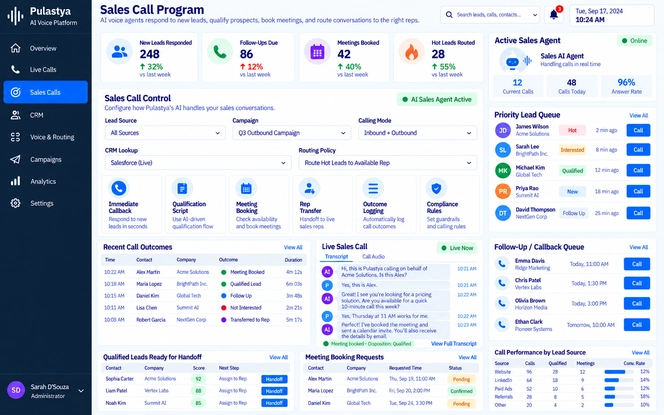
An outbound AI calling platform such as Pulastya is worth measuring against the program it has to run rather than a feature list. Does it both answer the line and place the follow-up, so neither direction stays manual. Does every attempt leave a record a manager can hold an outcome label up against.
Hearing it beats specifying it. A browser test call before launch puts you on the other end of the first thirty seconds, which is the part a caller actually judges.
Conclusion
An AI voice agent for sales helps teams respond to new leads promptly and follow up consistently without taking sales reps away from high-value conversations. It can qualify prospects, arrange meetings and record outcomes, while reps retain ownership of negotiations, complex objections and buying decisions. Clear handoff rules and CRM context keep each conversation connected to the next step.
Start with one sales call workflow and measure first-response time, follow-up completion, meeting bookings and the quality of rep handoffs. Before expanding, set approved answers, consent and calling-hour controls, opt-out rules and reliable call dispositions. Review transcripts and rep feedback regularly so automation improves response speed and pipeline continuity without sacrificing accuracy or prospect trust.
Frequently Asked Questions
It suits time-sensitive, repeatable calls: answering new lead calls, following up with warm leads, asking agreed qualifying questions, booking or capturing meeting requests and logging outcomes. Negotiation, custom pricing, complex objections and relationship conversations should stay with reps, and the agent should transfer those calls with context.
Automated follow-up is a common sales pattern, triggered by events such as a quote sent or a callback date reached. It requires calling software with schedules, attempt limits and opt-out handling, plus the consent your jurisdiction requires. Check that your chosen platform supports outbound calls before designing the sequence.
Disclosure rules vary by jurisdiction, and some require it. Even where they do not, answering honestly when a prospect asks protects trust and avoids complaints. Configure a clear, approved response for that question and review your disclosure approach with legal counsel before launch.
Organizations may track time to first conversation for new leads, follow-up attempts completed within rules, meetings booked, transfers accepted by reps, opt-out handling and disposition accuracy checked against transcripts. Compare results by lead source, and weigh rep feedback on lead quality alongside the numbers.