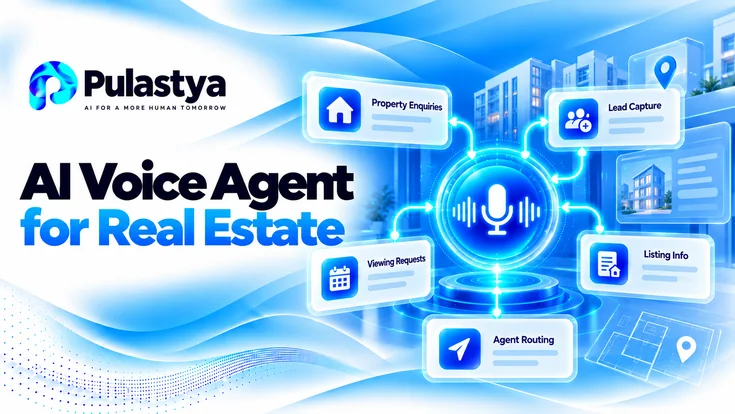
An AI voice agent for real estate is software that answers calls about listings, captures buyer and seller details, answers property questions from approved listing information, takes viewing requests and routes serious enquiries to the right agent.
It is for brokerages, agencies and property teams that miss enquiries while agents are showing homes, driving or off duty.
- Current listing data Answers about price, status and features should come from approved listing information with a named owner.
- Capture and qualify Buyer and seller details are captured in consistent fields and passed to the agent who should follow up.
- Scripts with review Approved scripts and regular transcript review help keep calls within fair housing and advertising rules.
The business outcome is faster, consistent lead response: every caller gets an answer or a clear next step, each enquiry is captured with property and contact details, and agents receive qualified conversations with context instead of a list of missed calls.
The value depends on accuracy. A listing that sold yesterday, a price that changed or an off-script comment about a neighborhood can do more harm than a missed call, so approved information and human review belong at the center of every workflow.
What an AI Voice Agent Does on Real Estate Calls
An AI voice agent handles the first response on real estate calls. It answers questions about a listing, captures the caller's details and intent, takes viewing or valuation requests, and routes the call to an agent when a person should take over. It acts as an always-available front line for sign calls, portal enquiries and office lines.
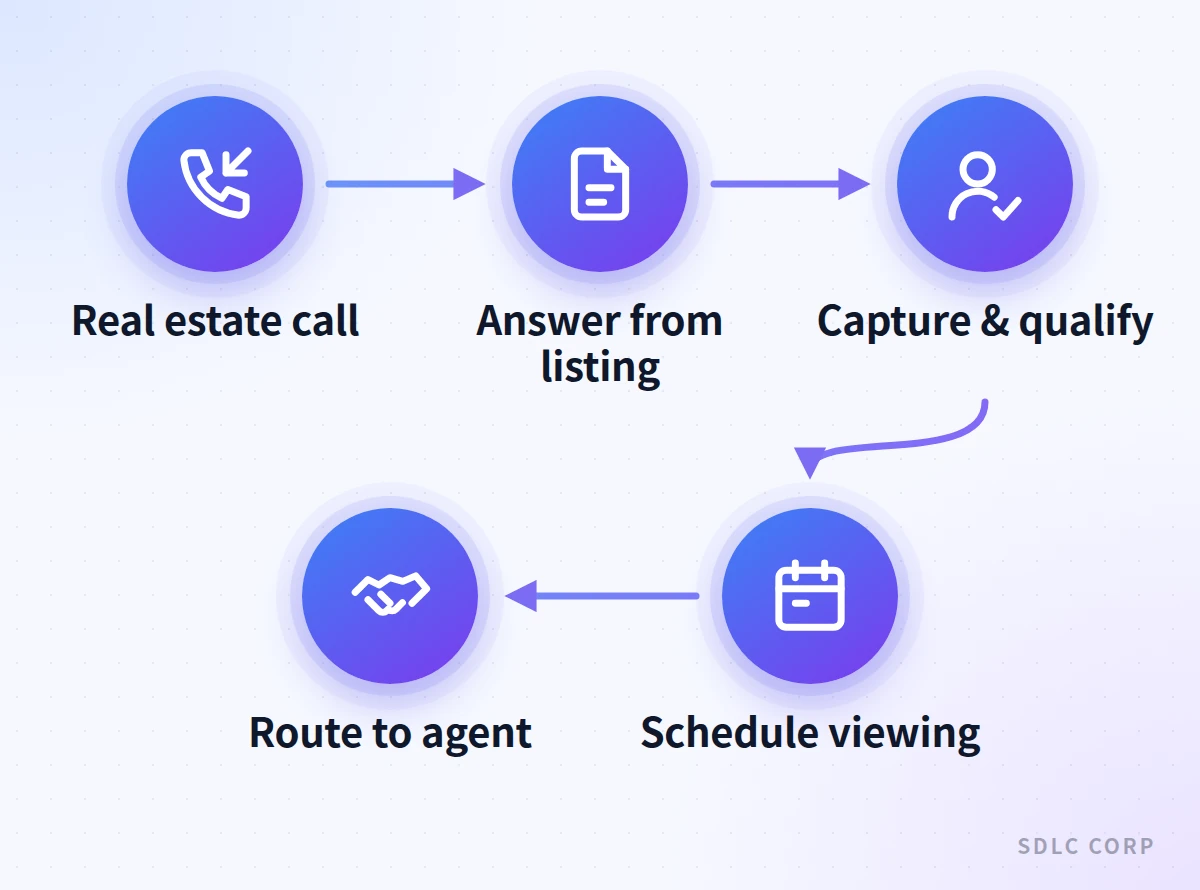
Greetings, messages and basic transfers follow the same pattern as an AI receptionist for business calls. Real estate adds listing-specific questions, buyer and seller qualification, and a higher cost when an answer is out of date.
The trade-off between answering fast and answering accurately is the constant, and where this pattern repeats outside property covers the sectors that meet it in a different vocabulary.
| Caller | Typical request | AI voice agent action |
|---|---|---|
| Buyer | Is the house on Oak Lane still available? | Answer from current listing data and capture details |
| Seller | What could my home sell for? | Capture property details and route to an agent |
| Renter | Can I see the apartment this weekend? | Capture the viewing request and contact details |
| Existing client | Is there any update on my offer? | Transfer to the assigned agent |
| Another agent or vendor | I am calling about a showing or inspection | Route to the listing agent or office |
How it works
How a Property Enquiry Call Flows
- Property enquiry callSign, portal or office line
- Identify caller typeBuyer, seller, renter or client
- Check listing informationApproved, current listing documents only
- Capture and qualifyProperty, timeline and contact details
- Record next stepSummary and lead details for follow-up
Possible outcomes
- Answer listing questionFrom approved listing data
- Viewing requestCaptured for agent confirmation
- Transfer to agentListing or on-duty agent, with context
Each property call ends with a grounded answer, a captured viewing request or a warm transfer, and a record the agent can act on.
Answering Property Enquiries From Approved Listing Information
A real estate AI voice agent should answer listing questions only from approved, current listing information, such as listing summaries, feature sheets and published open house times. If a detail is not in that material, it should say so and offer an agent follow-up instead of filling the gap.
Stale data is the main risk. Prices change, properties go under offer and open houses are canceled, often faster than documents are updated. Each listing source needs an owner and an update trigger, and the guide to keeping an AI voice knowledge base accurate covers review routines that catch outdated content.
- Answer from approved material: bedrooms, bathrooms, listed features, asking price and published viewing times.
- Check before stating: availability and status, which can change between document updates.
- Route to an agent: offers, negotiation, pricing opinions and anything about the seller's circumstances.
- Do not answer: opinions about neighborhoods, schools or the people who live in an area.
Grounded answering is what makes any of this safe. The agent's knowledge should come from the organization's own approved material, such as FAQs, policies, pricing sheets and listing summaries, rather than from model recall, and it should say when it does not have enough context and offer a transfer instead of guessing.
That second behavior matters more in property than almost anywhere else, because a confident wrong answer about price or availability goes straight into a buyer's decision and into the brokerage's advertising record.
Treat that approved material as a live asset rather than a one-time setup task. Whichever platform you use, the operating routine is the same: when a price, a status or a policy changes, the source content is corrected and the knowledge base is re-indexed the same day, and one named person owns that update for each listing source.
A voice agent is only ever as current as the last time someone refreshed what it reads from.
Capturing Leads and Qualifying Buyers and Sellers
Lead capture turns a call into a record an agent can act on, and qualification adds the few facts that decide who follows up and how soon. The AI voice agent should ask a short, consistent set of questions, confirm the answers and avoid pressure or promises.
| Buyer or renter enquiry | Seller or landlord enquiry |
|---|---|
| Property or area of interest | Property address and type |
| Budget range, if the caller chooses to share it | Timeline for selling or renting out |
| Timeline to move | Whether a valuation visit is wanted, and preferred times |
| Financing status, as stated by the caller | Whether the property is currently occupied |
| Whether they already work with an agent | Best contact method and times |
Keep qualification questions about the transaction, never about the caller's personal characteristics. The detailed workflow, including qualifying questions, structured capture and routing of qualified leads, is covered in the guide to the lead qualification on inbound and outbound calls.
Capture quality decides how fast the follow-up can happen, so every call should leave behind a transcript and a short summary alongside the structured fields. The agent who picks the lead up can then read the exchange in seconds instead of calling back to re-ask what was already answered.
Speed matters as much as completeness here: a property enquiry is usually shopped across several agencies within the same hour, so a lead that reaches a named agent within minutes, with the address, the timeline and the contact details already attached, is a different commercial proposition from one that sits in a voicemail box until the next morning.
Scheduling Viewings and Valuation Appointments
A viewing request is a scheduling task with property-specific constraints: occupied homes may need seller notice, some listings need agent confirmation, and lockbox showings may have their own rules. Unless a scheduling integration already applies those constraints, the AI voice agent should capture the request rather than confirm a time.
With access to a calendar or showing system, a typical implementation checks availability and books within configured rules. Without it, the agent records the property, preferred slots and contact details, then tells the caller who will confirm. Both patterns are explained in AI appointment scheduling for business calls.
Example scenario
Thanks for calling the realty office. How can I help?
I saw the three-bedroom on Willow Court online. Is it still available, and can I see it Saturday?
Our current listing information shows Willow Court as active, with an open house on Saturday from 11 to 1. Would you like to attend that, or request a private viewing?
A private viewing would be better. We are pre-approved and hoping to move within two months.
Thanks. Can I take your name and the best number, and is Saturday morning or afternoon better?
Sam Okafor, this number, mornings if possible. Is it a good area for families?
I am not able to give opinions about neighborhoods, but I have noted your question. The listing agent will call to confirm a Saturday morning viewing and can point you to public information about the area.
The agent answered from listing data, captured a qualified viewing request and declined to characterize the neighborhood. The listing agent receives the details, the caller's stated timeline and the open question to handle personally.
Routing Callers to the Right Agent
An AI voice agent routes real estate calls using rules the brokerage sets. Typical destinations are the listing agent for a specific property, an on-duty agent for new enquiries, property management for tenants and the office for everything else. A warm transfer with a short summary lets the agent continue without re-asking basic questions.
- Listing-based routing: calls about a specific address go to that listing's agent or team.
- Rotation or on-duty routing: new buyer and seller enquiries are shared across available agents.
- Existing client routing: callers with an active transaction reach their assigned agent.
- Fallback: if no agent answers, the call ends with a callback request that includes the enquiry details.
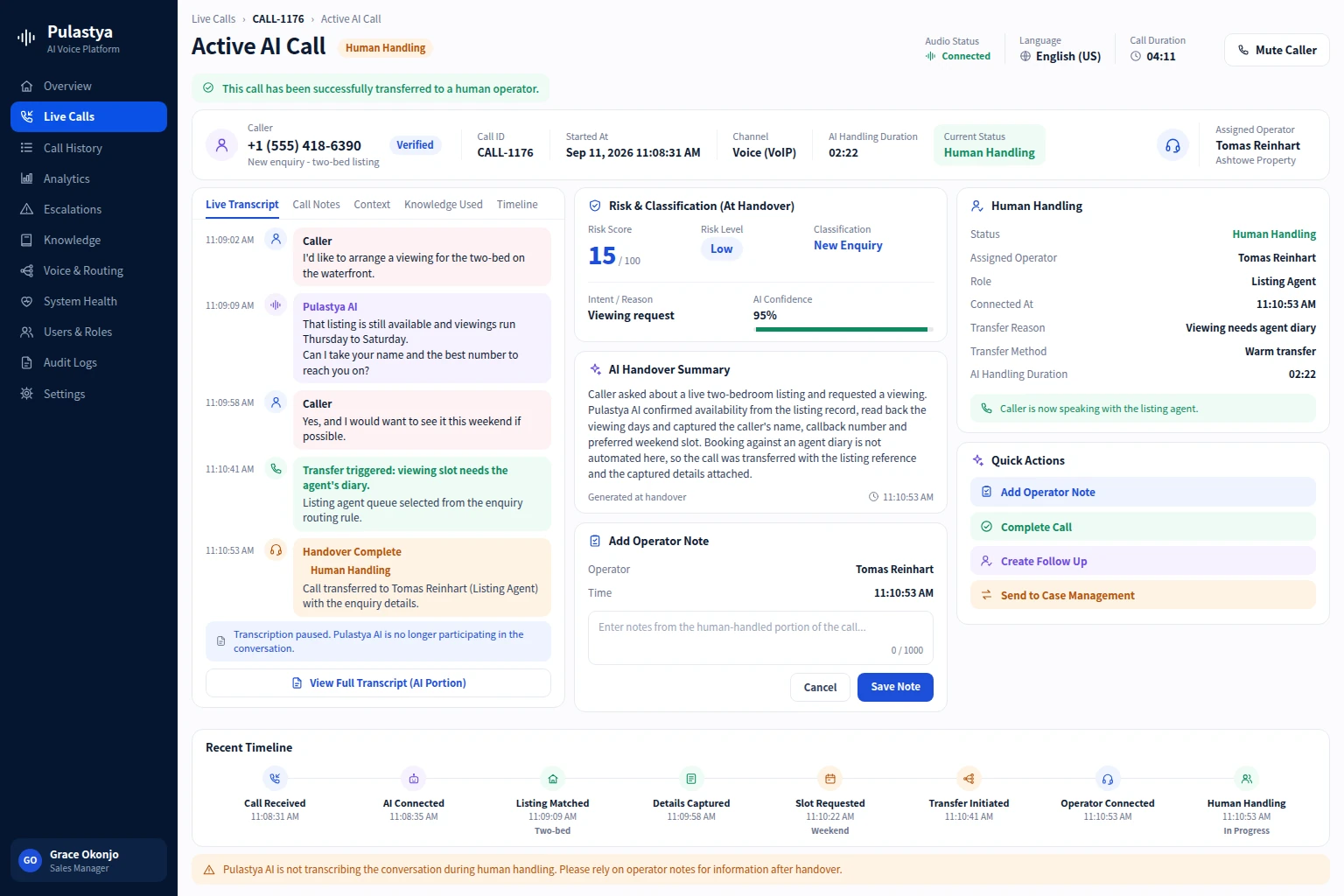
Routing configuration in a voice platform usually comes down to three settings, as the Pulastya screen above illustrates: a human transfer destination with warm transfer, such as a hunt group that rings several agents in turn; a failover line that takes the call if the voice service itself cannot continue; and the voice and speech behavior for the call, including barge-in so a caller can interrupt.
The detail worth testing in any product is whether the transfer carries the conversation context and a call summary with it, so the buyer is not asked to repeat the address and the timeline they just gave to a machine.
The coverage gap that matters in property is evenings, weekends and the first hour after a new listing goes live on a portal, which are precisely the windows when agents are out at viewings and a missed call becomes a lost instruction.
Rules for closed-office callers, such as what to capture and when to promise a callback, are covered in after-hours call handling with AI voice agents.
Follow-Up and CRM Updates After the Call
Every real estate call should end with a record the team can act on: who called, which property, what they want, how qualified they are and the agreed next step. In a typical implementation, those details are written to the CRM as a new lead or an update to an existing contact, with the call summary attached.
- Lead source: the listing, sign or portal the caller referenced.
- Enquiry type: buyer, seller, renter, landlord or existing client.
- Qualification fields captured on the call, recorded as the caller stated them.
- Next step and owner: viewing request, valuation visit or callback.
CRM integration depends on both the CRM and the voice platform, so confirm it with each vendor before relying on it.
Check which fields can be created or updated, how duplicate contacts are matched and whether the transcript or only a summary is stored. The guide to CRM personalization in AI voice agents shows how stored context can shape later calls.
Follow-up calls to leads who did not book, such as a check-in after an open house, are a sales workflow covered in AI voice agents for sales calls and follow-up.
Placing calls is a different compliance problem from answering them: outbound follow-up needs consent records, calling-hour rules and opt-out handling of its own, and those controls should be checked in whichever platform places the calls before the first one is dialed.
Fair Housing, Advertising Rules and Human Review
An AI voice agent in real estate must follow the same fair housing and advertising rules as the agents it supports, and those rules vary by country and state. The practical safeguards are approved scripts, a defined list of topics the agent will not discuss, and regular human review of transcripts.
- Use approved scripts for greetings, property descriptions and qualification questions.
- Do not characterize neighborhoods, schools or residents, or suggest who a property suits; route those questions to an agent.
- Ask every caller the same qualification questions, regardless of how they sound or where they call from.
- Describe listings only in approved wording that matches the published advertisement.
- Identify the business clearly and give recording notices where required.
- Review a sample of transcripts regularly for off-script answers and correct the source content.
Have your brokerage's compliance lead or legal counsel review scripts, off-limits topics and recording notices before launch. Your business remains responsible for call consent and local recording requirements.
Decision guide
Real Estate Call Handling Decision Matrix
| Call topic | Default AI action | Reason |
|---|---|---|
| Listed features and asking price | Answer from approved listing data | Published information with a named owner |
| Availability and status | Check current data, otherwise capture | Status changes between document updates |
| Viewing or valuation request | Capture, or book if integrated | Depends on showing rules and calendars |
| Offers and negotiation | Transfer to the listing agent | Needs professional judgment |
| Neighborhood character or residents | Decline and route to an agent | Fair housing risk |
Setting a default action for each call topic keeps the AI voice agent accurate on listings and out of conversations that need an agent.
How to Get Started With a Real Estate AI Voice Agent
Start with inbound listing enquiries on one office line, prove that answers stay accurate and handoffs reach agents, then widen the scope. A small launch with strict update routines earns agent trust faster than a broad one.
- Choose the first call typesBegin with listing enquiries and viewing requests before seller valuations or tenant calls.
- Prepare listing contentUpload current listing summaries and name who updates them when price or status changes.
- Approve scripts and limitsAgree qualification questions, off-limits topics and transfer rules with your compliance lead.
- Set routing and fallbackDefine listing, rotation and after-hours destinations, plus callback capture when nobody answers.
- Test and reviewRun test calls on sold listings, price changes and off-limits questions, then review transcripts weekly.
Most of this work is configuration rather than engineering, which is why the sensible unit of a first launch is one line and one month, not a platform migration.
Pulastya, the voice agent platform from SDLC Corp, is one example of that shape: a four-step setup aimed at business teams rather than developers, where you create an account, connect a number, add the documents the agent answers from, then test and launch, with a browser test call available before any real caller reaches the line.
If you are weighing the pattern up for property enquiries, start with voice AI for real estate lead response, or see an AI voice agent handle a live call before you commit a line to it.
Conclusion
An AI voice agent for real estate can help brokerages respond to property enquiries, capture buyer and seller leads, record viewing requests and route callers to the right agents, including when teams are busy with showings or away from the office.
Reliable results depend on approved, up-to-date listing information, clear scheduling and transfer rules, accurate lead records and regular human review. An AI voice agent should handle routine questions and coordination while referring negotiations, sensitive topics and uncertain answers to qualified real estate professionals.
Start with a focused inbound-call pilot, test listing accuracy and handoffs, and expand only after the team can consistently follow up on captured enquiries.
Frequently Asked Questions
Yes, if it answers from approved, current listing information such as listing summaries and published viewing times. The main risk is stale data, so each listing source needs an owner who updates it when price or status changes. Questions that material does not cover should go to an agent.
It can capture viewing requests on any call, and book directly only when it has access to the showing calendar and its rules. Without that integration, it records the property, preferred times and contact details for the listing agent to confirm. Occupied homes and seller notice rules often need agent confirmation anyway.
It matches the caller's request to rules the brokerage sets, such as sending calls about a specific address to that listing's agent, sharing new enquiries across on-duty agents and connecting existing clients to their assigned agent. A warm transfer passes a summary, so the agent does not repeat questions.
Use approved scripts, ask every caller the same qualification questions, define topics the agent will not discuss, such as neighborhood character or who a home suits, and review transcripts regularly. The rules vary by location, so have legal or compliance advisors review the setup before launch.