Most voice AI enquiries arrive in the same shape: would this work for us.
The answer depends less on the industry named on the door than on the shape of the calls arriving at the number. A test that works on any spoken request is more useful than a list of industries, because most real enquiries sit between the examples.
- Judge the call, not the sector The same five questions decide whether a spoken request is safe to automate, whatever industry it arrives in.
- Group by job to be done Answering, booking, resolving, qualifying and intake behave alike across sectors, so the design patterns transfer.
- Industry sets the boundary Sector rules mostly decide what the agent must never decide, and where a person takes the call over.
An industry label tells you the vocabulary and the regulator. It does not tell you whether a call can be automated safely, because the same clinic line takes a routine hours question and a clinical emergency.
So the frame comes first. Five questions decide whether a spoken request is a good candidate, and they hold for requests no vendor has a template for.
How to Read a Voice AI Use Case
Vendors present this category as a list of things that worked somewhere else, which is little help when your own call mix is not on the list. A more durable tool is five questions that apply to any spoken request.
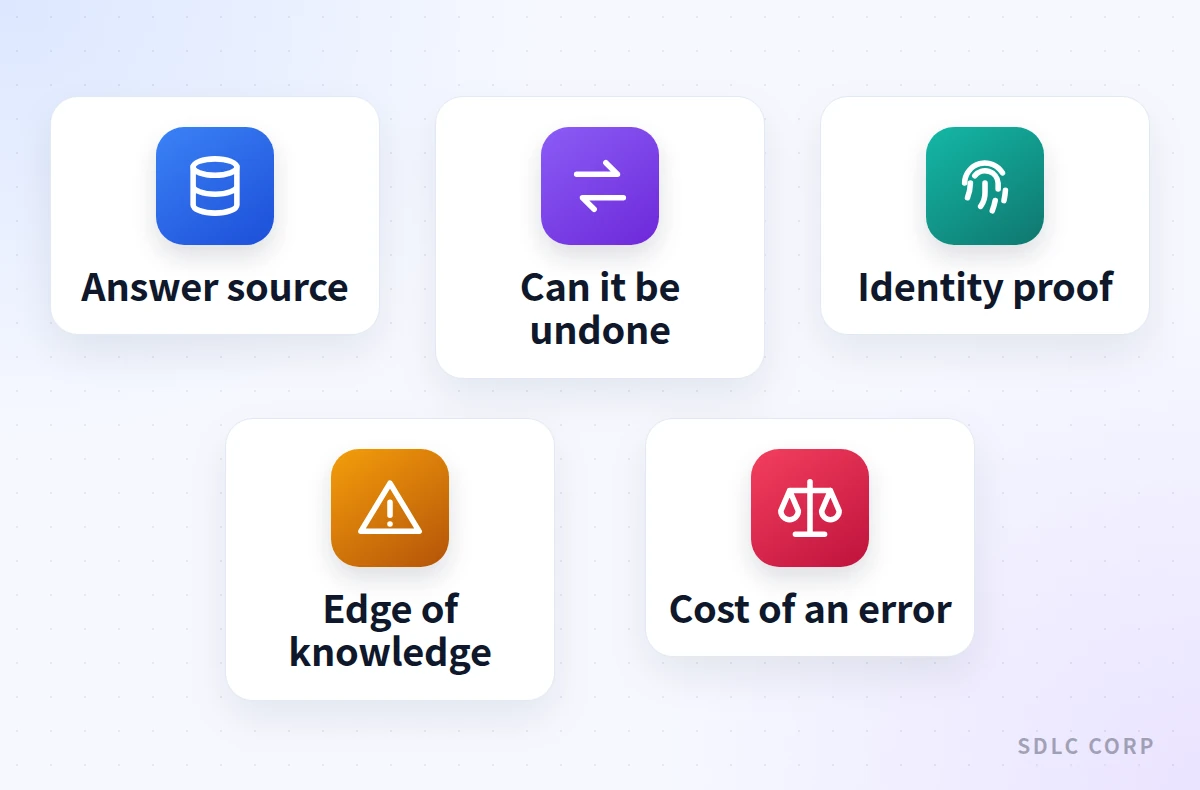
| Question | Why it decides the outcome | What a weak answer implies |
|---|---|---|
| Where does the answer live? | Content you control is safe to answer from; account state is not | A live lookup is needed, so this is an integration project |
| Can the action be undone? | A wrong booking is a phone call; a wrong cancellation is a complaint | Require confirmation, or leave the action with a person |
| Does it need identity proof? | Account-specific work must know who is on the line | Use an authenticated channel, not voice proofing |
| What happens at the edge? | Every call can leave the covered ground, and most do | The agent guesses, and a near-answer sounds like an answer |
| What does one error in fifty cost? | It sets how much verification the design must carry | The error is unrecoverable, so automation is the wrong tool |
The Two Halves of Where an Answer Lives
Documents you control change on a schedule someone owns: hours, policies, service descriptions, published pricing. An agent can answer from them on day one, and a wrong answer is fixed by fixing the document.
Account state is different. Order position, claim stage and ticket status change without telling anyone, so those answers need a live lookup and a verified caller. A question like where is my order sits on either side of that line.
The Edge Is the Design
Every use case has a boundary, and the behavior there is what callers remember. A system that says it lacks context and offers a transfer beats one that produces a confident near-answer, because a near-answer about coverage or delivery gets acted on.
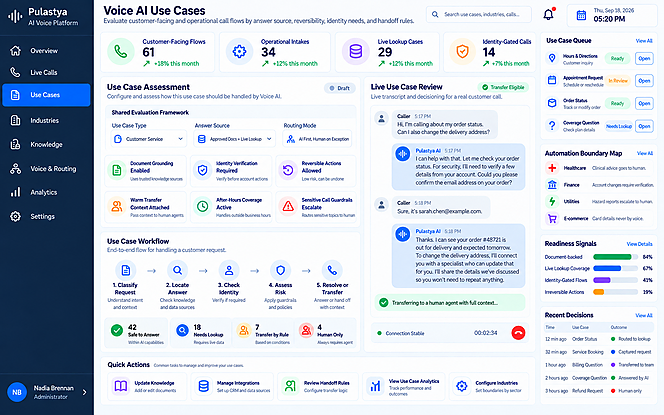
Pulastya, the SDLC Corp platform for inbound and outbound business calls, works that way. Answers are grounded in documents the organization provides, and when the agent lacks context it says so and offers a transfer.
The last question is the one evaluations skip. Ask what it costs when the agent is wrong once in fifty calls, not whether it can be wrong. A misheard delivery date costs a callback; a misheard dosage costs something you cannot take back.
That test produces a better stop list than any inventory of forbidden topics, because it scales with the action rather than the subject. The triggers are in when an AI voice agent should transfer a call, and the harder categories in handling sensitive calls.
Score a candidate before you scope it. A call that needs a live lookup, cannot be undone, requires identity proof and is unrecoverable when wrong is not a starting point, however many of them arrive.
Customer-Facing Use Cases
Calls from customers divide into four jobs: answer and route, book, resolve, and qualify. The sector changes the vocabulary and the escalation rules, not the mechanics, which is why a hotel reservation line and a clinic front desk end up alike.
Answer and Route
The front-desk job is the usual entry point: greet, answer what approved content covers, capture what it does not, and send the rest to a person. That scope is in what an AI receptionist handles on business calls.
The same agent earns its keep outside staffed hours, where missed calls concentrate. Fewer destinations are awake at night, so accurate capture matters more than resolution. The rules are in after-hours call handling with AI voice agents.
Book, Change and Confirm
Booking is where reversibility bites first. Taking a request is safe. Confirming a slot needs the calendar that owns it, and changing or canceling one needs a verified caller. Both patterns are in AI appointment scheduling on business calls.
Resolve Support Calls
Support splits along the answer-source line above. Policy questions come from documented content. Account questions need a lookup and a caller whose identity has been established.
Which support calls belong to an agent is covered in AI voice agents for customer support. The highest-volume subset, where is my order or claim or ticket, has its own patterns in automating status and order enquiries.
Qualify and Follow Up
Sales calls invert the priorities, because an enquiry answered in a minute beats a flawless callback next morning. What to ask, and how to tier the result, is in lead qualification on inbound and outbound calls.
The wider program, including follow-up and rep handoff, is in AI voice agents for sales calls and follow-up. Direction changes the obligations, and the split between inbound and outbound voice AI sets out what each owes.
Operational and Back-Office Use Cases
The calls nobody markets are often the better first project, and they share a shape: classify the request, collect the mandatory fields, check something live, write a record, read back a reference. The value is the record, not the conversation, as what a voice automation platform automates end to end sets out.
| Where the calls come from | What must exist afterwards | The question that decides scope |
|---|---|---|
| Customers reporting problems | A ticket with the mandatory fields confirmed | Can the agent write to the system of record, or only capture? |
| Employees needing IT help | A resolved request or a routed incident | Which requests are safe without proving who is calling? |
| Drivers and field technicians | A status update against the right job or load | Which transactions may commit without a person checking? |
Intake is the canonical case: a caller reports a problem, and a ticket has to exist afterwards with the fields the queue expects. The sequence, including what to do when a mandatory field never arrives, is in automating service request intake by voice.
The internal service desk is the same workflow with a known caller population and a directory to check against. Access requests are the tempting part, and identity proof is sharpest there; see an AI voice agent for the IT service desk.
Drivers and technicians call from noisy places with one hand free, which makes voice natural and recognition hard. Commit rules differ per transaction, as voice automation for logistics and field service sets out.
Escalation is heavier here, because a parked request has a queue waiting behind it. Pulastya attaches the conversation context and call summary to a warm transfer, so whoever picks up starts from what the caller already said.
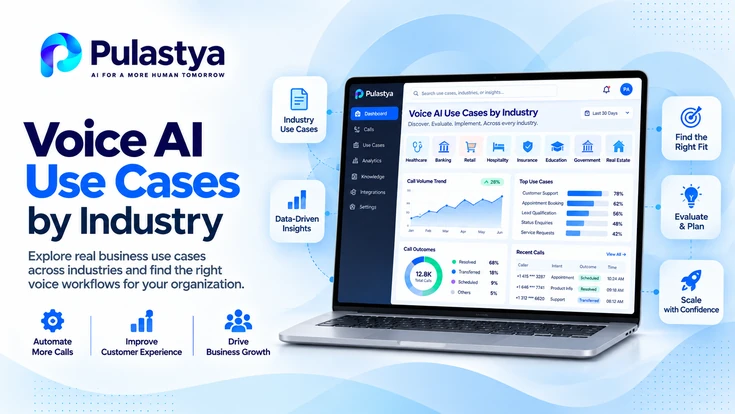
Use Cases by Industry
Industry changes two things rather than the mechanics: the vocabulary callers use, and the line the agent must never cross. The useful question in any sector is therefore where that line sits rather than which features are listed, because in regulated sectors the design work is deciding what the agent is not allowed to decide.
Healthcare
Practice lines are dominated by administrative work: appointment requests, preparation instructions, referrals and records requests. Rules on patient information generally expect strict limits on what a call collects and stores, while clinical questions and emergencies stay with clinicians. See AI voice agents for healthcare calls.
Hospitality
Hotels run reservations and guest services through one number. Availability, amenities and directions are documented answers; a booking change is an account action. Rate accuracy is the reputational risk, since a quoted price is heard as a promise. See AI voice agents for hotels and hospitality.
Insurance
Insurance calls split cleanly. Policy documents and process explanations can be answered from approved content. Coverage, eligibility and claim outcomes cannot, and are generally expected to rest with licensed people. Loss intake and claim-status enquiries are the realistic scope, in AI voice agents for policy and claims calls.
Real Estate
Property enquiries are a speed problem: the buyer who called three listings works with whoever answered. Qualification, viewing requests and agent routing fit that pattern, while price, terms and the advice a licensed agent owes stay with the agent. See AI voice agents for real estate lead response.
E-commerce and Retail
Order, delivery and returns calls show the answer-source split most clearly: the returns policy is documented, the order position is account state behind verification. Card details do not belong in a spoken conversation. See AI voice agents for order, delivery and returns calls.
Automotive
A dealership publishes one number and three businesses answer it: sales, service and parts. Sorting the caller comes before anything else, because a service booking and a vehicle enquiry share almost no fields. A vehicle also sells once, so an agent may capture interest but must never imply that a specific unit is held. See AI voice agents on dealership sales, service and parts calls.
Banking and Financial Services
Two calls sound identical to the caller and are nothing alike underneath. How a product works is documented content the agent can answer from. What is happening on an account is account state, and it sits behind the bank's own identity process rather than anything the agent decides. See which banking calls an AI voice agent can take.
Education
An education office has a predictable day: absence reporting concentrated in one morning window in schools, clearing, enrolment and fee deadlines in colleges and universities, and admissions questions across the year. The boundary is the individual record, never answered to an unverified caller, and welfare concerns go straight to a person. See AI voice agents on school, college and university lines.
Government and Public Services
A caller on a public service line usually has no alternative provider and often no alternative channel, which changes what a failed call costs. Service and status enquiries carry the volume. Eligibility questions have to stop short of advice, and an emergency arriving on a non-emergency line needs a route of its own. See AI voice agents on public service phone lines.
Home Services and Trades
A trade business misses calls for a structural reason rather than a careless one: everyone is on a job. The agent's work is to separate urgent from today from next week, take a job description someone can schedule from, and never quote a price or diagnose a fault down the phone. See AI voice agents for trade and home services calls.
Utilities
A utility line carries steady traffic — readings, bills, moves, tariff questions — and a spike that arrives without warning when something fails. Separating a hazard report from a status question is the safety-critical decision, and outbound notice reduces the spike before it reaches the line. See AI voice agents on utility and outage calls.
If Your Sector Is Not on the List
Go back to the first section. A pharmacy, a credit union and a municipal services line need no page of their own here: their call mix answers the five questions without help from a sector label.
Requirements that do not vary by sector, such as integration depth, security review and governance, are in what an enterprise voice AI platform includes.
To see the pattern working, the enterprise voice AI platform from SDLC Corp handles inbound and outbound business calls, grounds answers in documents you provide, and keeps transcripts, call summaries and a call dashboard. Pulastya also allows a browser test call before a number goes live. To see the routing settings, book a walkthrough.
Conclusion
Choosing a voice AI use case starts with the call, not the industry. Routine questions, booking requests, lead qualification and service intake are often stronger candidates when answers come from approved content, actions are reversible and the agent can hand off uncertain requests. Calls involving private account data, regulated decisions or costly errors need verified identity, live integrations or a person in control.
Review your most common call reasons against the five tests: answer source, reversibility, identity, edge behavior and error cost. Begin with one clearly scoped workflow, define what the agent may do and when it must transfer, then evaluate real calls before expanding. That keeps automation useful for callers while protecting the decisions that should stay with your team.
Frequently Asked Questions
Run your top call reasons through five questions. Where does the answer live, in documents you control or in a live system. Can the action be undone. Does it need proof of identity. What happens when the request goes past what the agent knows. And what one wrong call in fifty costs.
Pick the highest-volume request whose answer is already documented and whose action is reversible. Hours, service and policy questions, appointment requests and routine intake usually qualify. Identity changes, irreversible actions and regulated conversations should wait until the routine paths are stable.
Less than vendors suggest. Answering, booking, qualifying and intake work much the same way across sectors. What differs is the vocabulary callers use, the approved content the agent answers from, and the rules deciding which requests must reach a person.
It should not give regulated advice, decide a clinical, coverage, legal or financial question, prove identity for a sensitive account change, or take card details by voice. It should also stop when a caller asks for a person, or when the request goes past the content it can answer from.
Yes, and most deployments do. The agent identifies the request first, then applies the rules for that request type, so one number can answer a question, capture a booking and route a complaint. Keep each request type scoped separately, with its own content and default action.