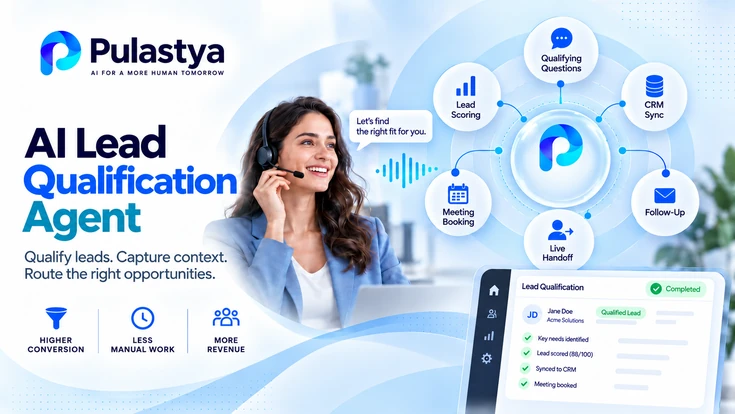
An AI lead qualification agent is a voice agent that asks prospects agreed qualifying questions, records the answers as structured lead data and decides the next step: a live transfer, a booked meeting, follow-up or a polite close.
It is for sales and marketing teams with more leads than reps can qualify quickly.
- Criteria first Every question maps to a lead attribute that your team uses to route, prioritize or prepare.
- Explainable tiers Leads are tiered by stated rules with a reason attached, not by an opaque score.
- Outcome on every lead Each call ends in a transfer, a meeting, a follow-up task or a recorded close.
The business outcome is that reps spend their time on leads that fit, and every lead, qualified or not, leaves the call with consistent data and a recorded reason for its status. Qualification stops depending on which rep happened to pick up.
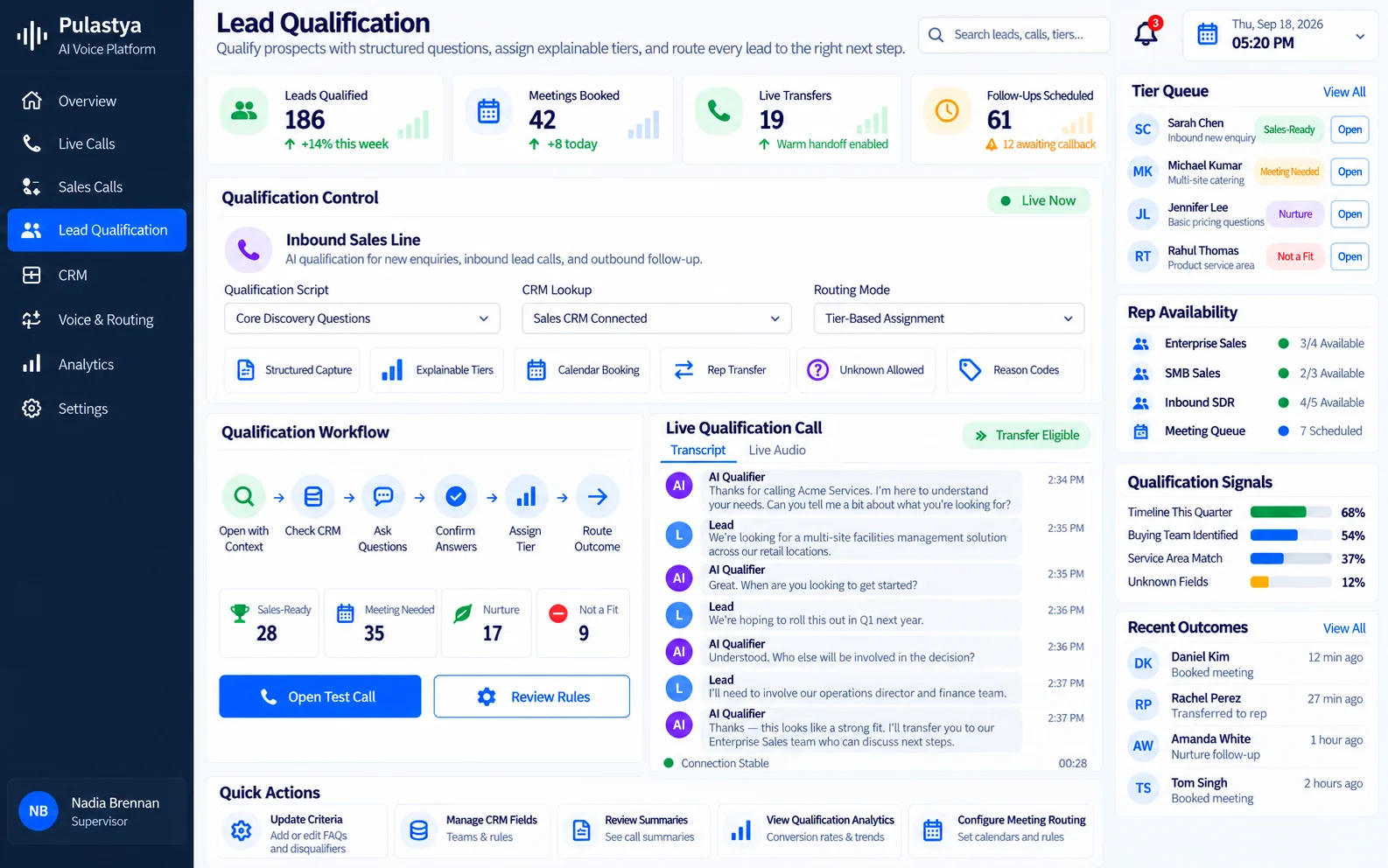
The agent does not replace sales judgment. It gathers facts against criteria your team defines, applies those criteria the same way on every call and passes sales-ready leads to a person with the conversation already summarized.
What an AI Lead Qualification Agent Does on a Sales Call
An AI lead qualification agent runs the discovery portion of a first sales conversation. It confirms what the lead is trying to solve, checks fit against your criteria, captures answers in defined fields and routes the lead. That makes it different from basic lead capture, which records contact details and a message without deciding anything.
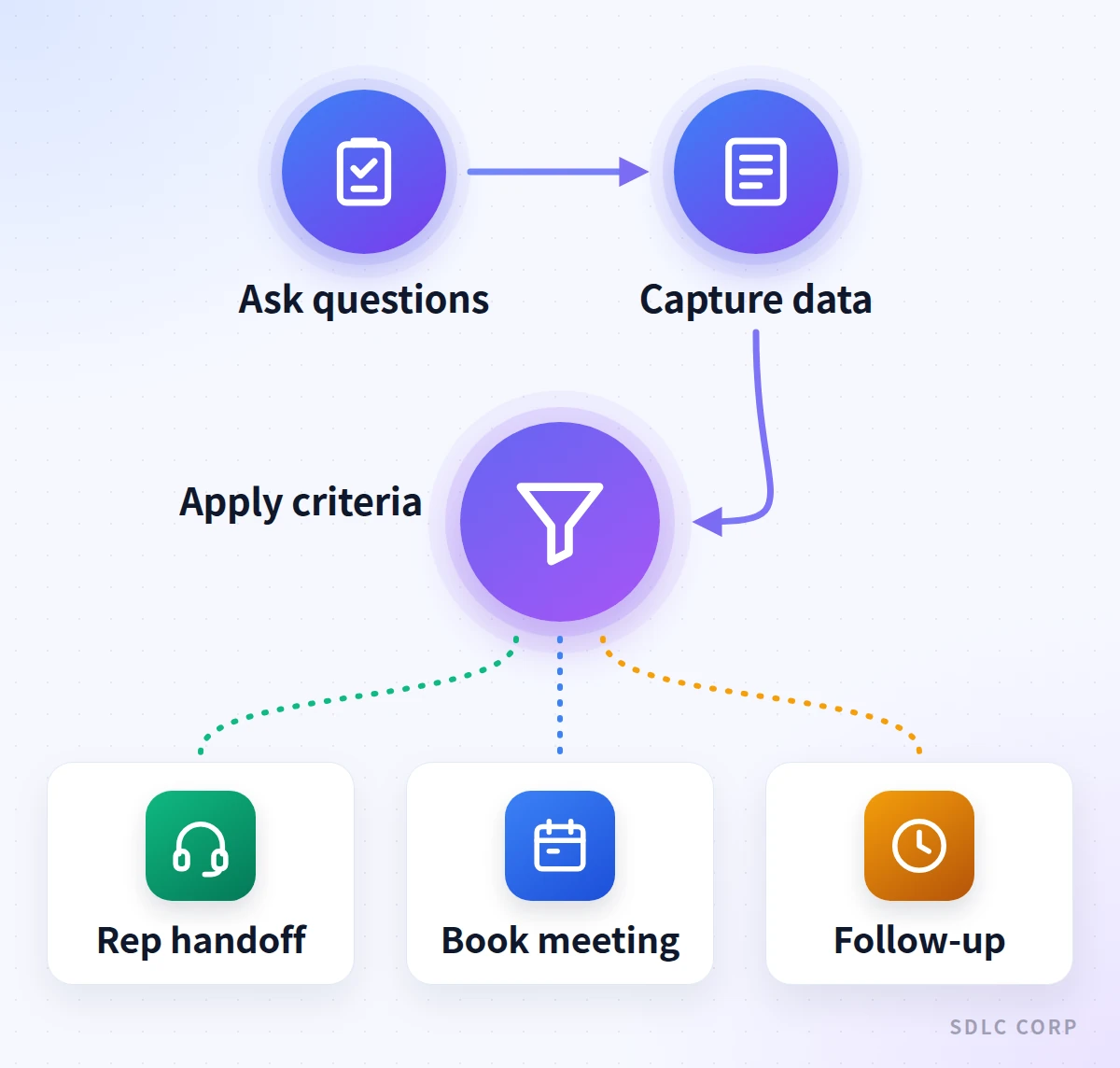
Cover need, timing, fit and decision process in a natural conversation rather than a fixed interrogation.
Write each answer to a defined field with allowed values, including unknown when the answer never comes.
Place the lead in a tier using rules that sales and marketing agreed on in advance.
Transfer, book a meeting, create a follow-up task or close, and record the disposition.
Qualification is one stage in a wider sales call program that also includes speed-to-lead, follow-up cadence and rep coordination. The overview of AI voice agents for sales calls and follow-up explains how those stages connect.
The Lead Qualification Workflow, Step by Step
A qualification call moves through six stages: open with context, check existing records, ask questions, confirm key answers, apply criteria, then route and record. Each stage produces something the next one uses, which is why the order should stay consistent even when the conversation wanders.
- Open with contextState who is calling or answering and why, referencing the enquiry or form the lead submitted where one exists.
- Check existing recordsLook up the lead so the agent does not ask for information the business already holds.
- Ask qualifying questionsWork through the question set, adapting the order to the conversation while covering every required field.
- Confirm key answersSummarize need, timeline and the proposed next step back to the person on the call.
- Apply criteriaAssign a tier and reason code from the captured attributes.
- Route and recordTransfer, book, set follow-up or close, then write the disposition and call summary.
After the opening, the workflow is the same for inbound and outbound calls. What changes is how much context the agent starts with and which rules govern placing the call at all.
Inbound versus Outbound Lead Qualification
Inbound qualification happens when the lead calls you, so intent is already present and the agent's job is to understand it quickly. Outbound qualification happens when the business calls a lead, often after a form fill or event, so the agent must establish who is calling and why before asking anything.
| Factor | Inbound qualification | Outbound qualification |
|---|---|---|
| Who starts the call | Prospect calls the business | Business calls the lead |
| Starting context | Caller explains the need | Lead source, form data or prior activity |
| Opening priority | Understand the request quickly | Identify the business, purpose and permission |
| Operational controls | Hours, routing and handoff rules | Consent, calling hours, retries and opt-outs |
| Typical systems | Phone line, approved knowledge and CRM | Lead list, dialer, campaign rules and CRM |
Outbound qualification usually runs inside a dialer and campaign setup. The explainer on what an AI dialer is and how it places calls covers the architecture, and automating outbound calling campaigns follows a lead list through to outcomes.
Lead records need to be clean before any agent calls them: validated numbers, deduplicated contacts and a known source. The guide to uploading and managing leads for AI calling covers validation and status handling. Consent and calling-hour rules vary by jurisdiction, so review consent and do-not-call controls with legal counsel before launch.
Both directions run the same criteria, so an answer the agent invents does not just mislead the caller. It becomes a stored attribute, and an attribute is what the tier is computed from. Anything the agent asserts about scope, fit or availability has to come from material the business approved, not from model recall.
The operational controls in that last row decide whether outbound qualification is workable at all, and none of them follow from the ability to place a call. Settle them first, rather than assuming that writing the criteria sheet is the hard part of an outbound program.
Qualifying Questions and the Lead Attributes They Capture
A qualifying question earns its place only if the answer fills a field that changes what happens next. If an answer does not affect routing, priority or the rep's preparation, drop the question. Short question sets are more likely to be completed and keep the call feeling helpful rather than like a screening.
| Question intent | Lead attribute | How it is used |
|---|---|---|
| What problem are you trying to solve? | Need category | Match to the right offer or team |
| When do you want this in place? | Timeline band | Prioritize near-term buyers |
| Who else is involved in the decision? | Decision process | Prepare the rep for the meeting |
| Where are you located or operating? | Service area or region | Check fit and assign territory |
| Roughly what size is the requirement? | Scope or volume band | Route to the right sales tier |
Structured Capture Rules
- Use defined values or bands where possible, such as a timeline of this month, this quarter or later.
- Treat unknown and declined as valid answers, so the agent never invents a value to complete a record.
- Keep the caller's own words in the notes alongside each normalized field.
- Confirm critical fields, such as contact details and timeline, before the call ends.
Budget questions need care. Many teams ask about scope or volume and leave pricing discussion to reps. Question sets also differ by industry: real estate lead response, for example, depends on buyer or seller status, target area and move timeline.
Lead Scoring With Explainable Tiers
Intent scoring on qualification calls works best as a small set of tiers defined by explicit rules, with a reason recorded for each lead. Tiers such as sales-ready, meeting needed, nurture and not a fit are easier to audit than a numeric score produced without a visible basis.
- Explicit criteria: the need matches an offer, the timeline falls within a defined window and the lead is within the service area.
- Conversation signals: the caller volunteers a deadline, names the other people who have to agree, or describes what they have already tried, each stored as observed behavior.
- Disqualifiers: outside the service area, no current need, or a stated request not to be contacted.
- Reason codes: every tier assignment carries the criteria that produced it.
Let rules make the tier decision and let the model do what it handles well: interpreting free-form answers and mapping them to fields. When the evidence is mixed, the default should be human review, not an optimistic tier.
Calibrate tiers with the people who receive the leads. Review a sample of transcripts with reps each week and adjust the criteria wherever reps consistently disagree with the tier the agent assigned.
CRM Lookup Before Questions and CRM Updates After the Call
A qualification agent touches the CRM twice, and the two touches do different jobs. The read that happens before the questions start decides which questions to skip. The write that happens when the call ends is what turns a conversation into lead data anyone else can act on.
Keep the read narrow. For qualification it only has to answer three things: does this contact already exist, is someone already working them, and is there a flag that means the question set should not run at all. Shaping the rest of the conversation around the record is a job for the wider sales call, not for the question set.
What the Call Should Write Back
- Each normalized attribute with its allowed value, or an explicit unknown where the answer never came.
- The assigned tier together with the reason code that produced it.
- The caller's own wording kept alongside the normalized field it was mapped to.
- A call summary and a transcript reference, so the tier can be checked against what was actually said.
Which attributes a given integration can create, and whether it can create them without a person retyping anything, differs enough between products that it is worth testing with your own field list. The article on using CRM data in AI voice conversations covers data minimization in more detail.
Where automatic write-back is not available, the transcript and the call summary become the only evidence that qualification happened, and a person has to carry the attributes across by hand. Decide which of the two you are relying on before treating the CRM as the system of record for lead data.
Routing Qualified Leads to a Rep or a Booked Meeting
Each qualification tier should map to one default action, so a lead's route is predictable before the call starts. Sales-ready leads go to a rep while intent is fresh, leads with complex requirements get a booked meeting, and the rest receive follow-up or a clear close.
Live Transfer to a Rep
A live transfer works only when a rep is available and receives context first: the need, timeline, tier and anything the agent said about next steps. The guides to passing lead context to a sales rep and AI-to-human transfer in outbound campaigns cover availability checks and failed transfers.
What travels with the call is what makes qualification worth doing. The captured attributes should arrive with it, so whoever picks up already knows the need, the timeline, the tier and the criteria behind it.
The conversation has to arrive too, showing which questions were actually asked and which answers came back as unknown. Attributes without it hand over a verdict with no evidence, and the conversation without them leaves the sorting undone that the agent was there to do.
In Pulastya, SDLC Corp's voice agent platform, that pairing is what the receiving person sees on pickup: the live transcript of the qualification conversation, an AI handover summary and the reason the call was transferred, so a rep can open on the answers the lead already gave rather than asking for them again.
A route also needs somewhere definite to land. Name the destination each tier points at, set a rule for who rings next when the first person is busy, and keep a failover line, so a sales-ready lead never reaches the end of a tier decision and then a dial tone.
Booked Meetings When No Rep Is Free
The meeting-needed tier and the unanswered transfer both land here, and AI appointment scheduling covers the mechanics. What qualification adds is the tier and its criteria, so the calendar invitation carries the reason the lead was routed this way and not straight to a person.
Dispositions and Follow-Up After Qualification
Qualification is only finished when the tier becomes an outcome value your existing lead statuses already recognize, carrying the criteria that produced it. A lead ruled out for sitting outside the service area and a lead ruled out for having no timeline are different leads, and the criteria are what tell them apart later.
One distinction is worth protecting above the others. A lead the criteria excluded and a lead the agent never reached must never share a value, or the weekly criteria review gets measured against calls that never got as far as a question.
The full outcome set for a call program, and the automation that turns each value into one owned next action, are set out in logging sales call outcomes and triggering the next action.
Decision guide
Qualification Tiers and Default Actions
| Tier | Typical signals | Default action |
|---|---|---|
| Sales-ready | Clear need, near-term timeline, within fit | Live transfer with summary |
| Meeting needed | Likely fit, complex requirements | Book a discovery meeting |
| Nurture | Plausible fit, no current timeline | Follow-up task with date and owner |
| Not a fit | Outside service area or offer | Close politely and record reason |
| Incomplete | Dropped call or key answers missing | Retry within calling rules |
Agreeing on tiers, signals and default actions before launch keeps qualification consistent and auditable.
How to Launch an AI Lead Qualification Agent
Launch with one lead source and one agreed set of criteria, then expand after sales confirms the tiers match reality. Qualification that reps do not trust gets ignored, so rep involvement in design and review matters more than question wording.
- Agree on criteria with salesDefine tiers, disqualifiers and the default action for each, and write them down.
- Build the question setMap every question to an attribute and remove any that do not change the outcome.
- Define fields and dispositionsSet allowed values, required fields and disposition codes that match your CRM statuses.
- Set handoff pathsName transfer destinations, the fallback when no rep answers and the meeting booking rules.
- Pilot and calibrateRun a limited pilot, compare each assigned tier against the tier your sales team would have chosen, and tune the criteria before adding sources.
Judging an AI voice agent platform for lead calls such as Pulastya against this workflow comes down to three questions about data rather than about calling.
Can the agent answer a caller's questions from your own approved documents instead of guessing. Does every assigned tier have a transcript behind it. Does a transfer carry the captured attributes forward, or does the receiving person start from nothing.
A browser test call before launch is the quickest way to hear whether the question set sounds like a conversation or like a form being read out.
Conclusion
An AI lead qualification agent turns first sales conversations into consistent, actionable lead records. It asks questions linked to your qualification criteria, captures answers without inventing missing details, applies explainable tiers and routes prospects to a live rep, a booked meeting, follow-up or a recorded close. That gives sales teams a repeatable process while keeping the evidence behind every qualification decision.
Start with one lead source, a short question set and routing rules agreed with your sales team. Test CRM updates, live handoffs and fallback actions during a pilot, then use transcript reviews to refine the criteria. The goal is not to replace sales judgment but to help qualified leads reach the right person quickly and give every other lead a clear next step.
Frequently Asked Questions
Ask only questions whose answers change routing, priority or rep preparation. Most sets cover the need, timeline, decision process, location or service area and rough scope. Keep the set short, let the agent adapt the order to the conversation, and treat unknown or declined as valid answers rather than guessing.
Yes, if the voice platform supports outbound calling. Outbound qualification typically runs through a dialer with lead lists, calling hours, retry rules and opt-out handling. The agent must identify the business and the purpose of the call before qualifying. Requirements for consent and calling times differ between jurisdictions, so check them with legal counsel first.
The most reliable approach is a small set of rule-based tiers assigned from captured attributes, each with a reason code explaining the decision. The model interprets free-form answers and fills fields, while the rules decide the tier. Reps should review transcripts regularly so criteria stay aligned with real deals.
It can, but many teams avoid direct price questions on a first call. Asking about scope, volume or the size of the requirement usually gives reps enough to route and prepare, while budget and pricing conversations stay with reps who can respond to them. Either way, treat a declined answer as valid.