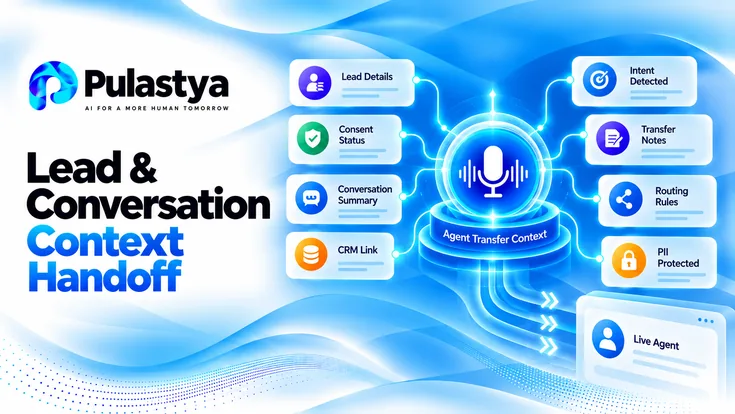
Provide precise lead and conversation context to a live agent so the agent can pick up the interaction with minimal customer friction, accurate compliance, and clear routing.
Focus on authorized identity, prior consent state, recent dialogue summary, campaign metadata, and required CRM links so transfers remain auditable and actionable.
- Minimum viable context Include identity tokens, last agent or bot utterances, consent status, campaign ID, and required CRM link; keep payload parsimonious and clearly typed.
- Data safety and authorization Apply role-based masking, transfer logs, and short-lived tokens. Avoid including raw sensitive data unless the receiving role is authorized and it is necessary for resolution.
- Handoff ergonomics Format context to reduce agent clicks: use one-line summaries, prioritized actions, and direct deep links into the CRM or call recording at the correct timestamp.
A receiving agent needs a concise, actionable context package that reduces wrap time and error. The package should prioritize identity verification cues, campaign intent, recent transcript highlights, and system links to CRM records or call recordings. Keep the handoff small, focused, and machine-readable where possible.
Design the handoff to enforce data minimization and role-based access. Only include fields needed for the next human step. Use labeling that maps to agent UI elements and acceptance checks. Where policy or regulation applies, surface consent flags and permitted contact channels in the same payload.
What Context a Receiving Agent Needs
Agents require identity confirmation and the interaction goal before they accept a transfer. Present a primary identity field, two verification cues, and the customer stated objective. This prevents redundant questions and enables the agent to start resolution instead of reestablishing context.
Provide a terse conversation synopsis: two to four bullet points that capture the customer request, past commitments, and any unresolved objections. The synopsis should read like a headline plus short supporting items so agents can scan in under ten seconds.
Include consent and regulatory flags that affect permitted actions. Surface whether the customer consented to recording, data sharing, or product-specific disclosures. If the call is under a special regulation, flag the applicable rule to force the agent into the correct script or workflow.
Supply campaign metadata that explains source and intent: campaign name, channel, campaign owner, and outbound script variant. Link the campaign ID to analytics for later QA and escalation, enabling agents to understand whether this is a retention, sales, or service transfer.
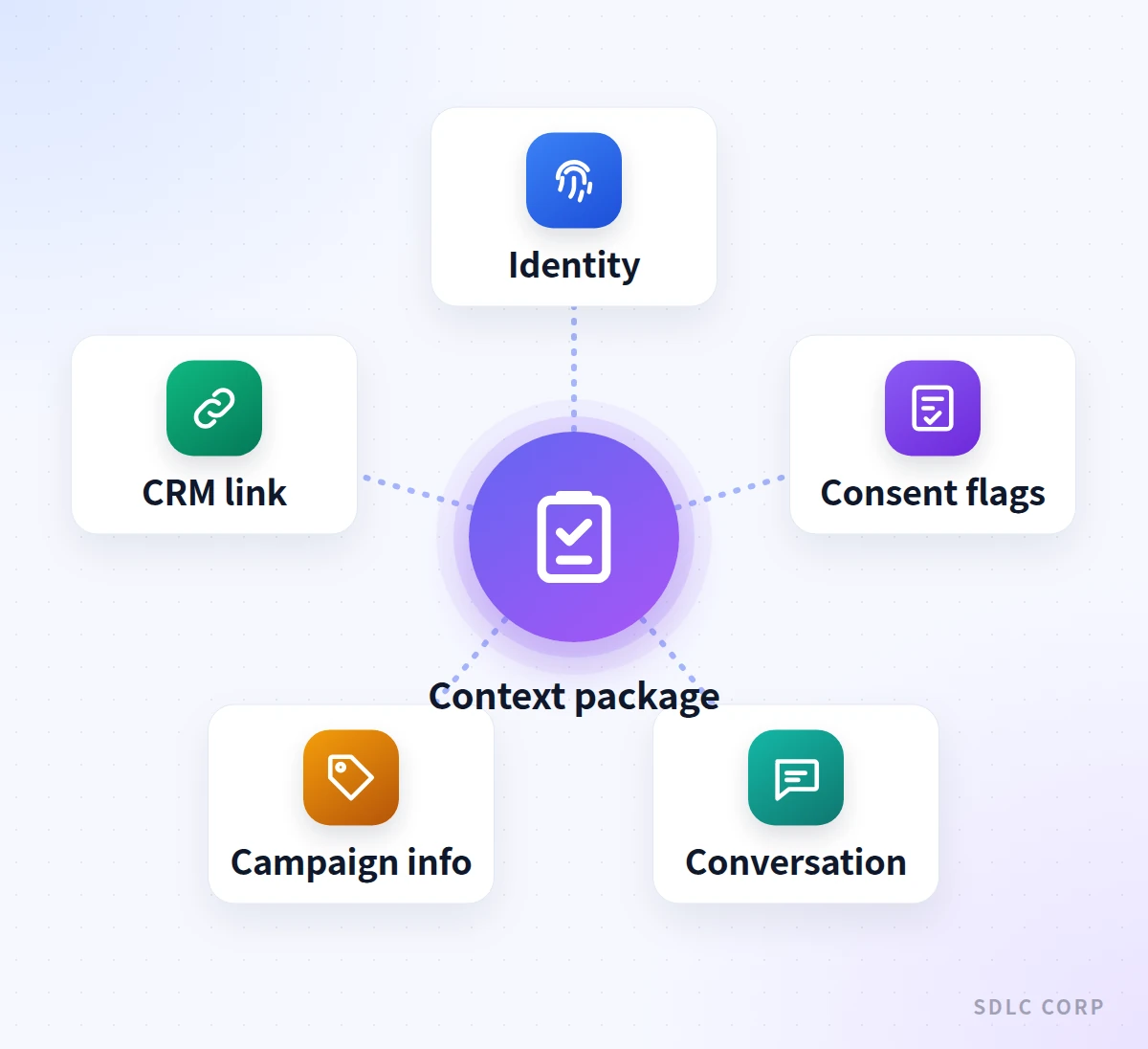
- Identity: primary name plus two verification cues such as last four digits or account alias
- Consent flags: recording allowed, data sharing permitted, special regulatory status
- Conversation highlights: customer objective, objections, prior promises
- Campaign context: campaign ID, channel, script variant, outbound owner
- Direct artifacts: CRM lead link, recording link with timestamp, transcript snippet
Make the first visible field the verification cue and the second the required next action.
The context package
What Each Handoff Field Lets the Receiving Agent Do
| Field | Purpose |
|---|---|
| Identity plus two verification cues | Confirm who is on the line without restarting verification from scratch |
| Consent and regulatory flags | Show whether recording and data sharing are allowed and which script or workflow applies |
| Conversation synopsis | State the customer objective, open objections and prior promises in a ten-second scan |
| Campaign metadata | Explain source and intent so the agent knows if this is a sales, retention or service call |
| Artifact pointers | Short-lived links to the CRM record, recording timestamp and transcript snippet |
| Reason code and schema version | Record why the transfer happened and exactly what was delivered, for audits |
Every field earns its place by enabling a specific agent action or audit need; anything that does not should stay out of the payload.
Packaging Lead, Campaign and Conversation Details Safely
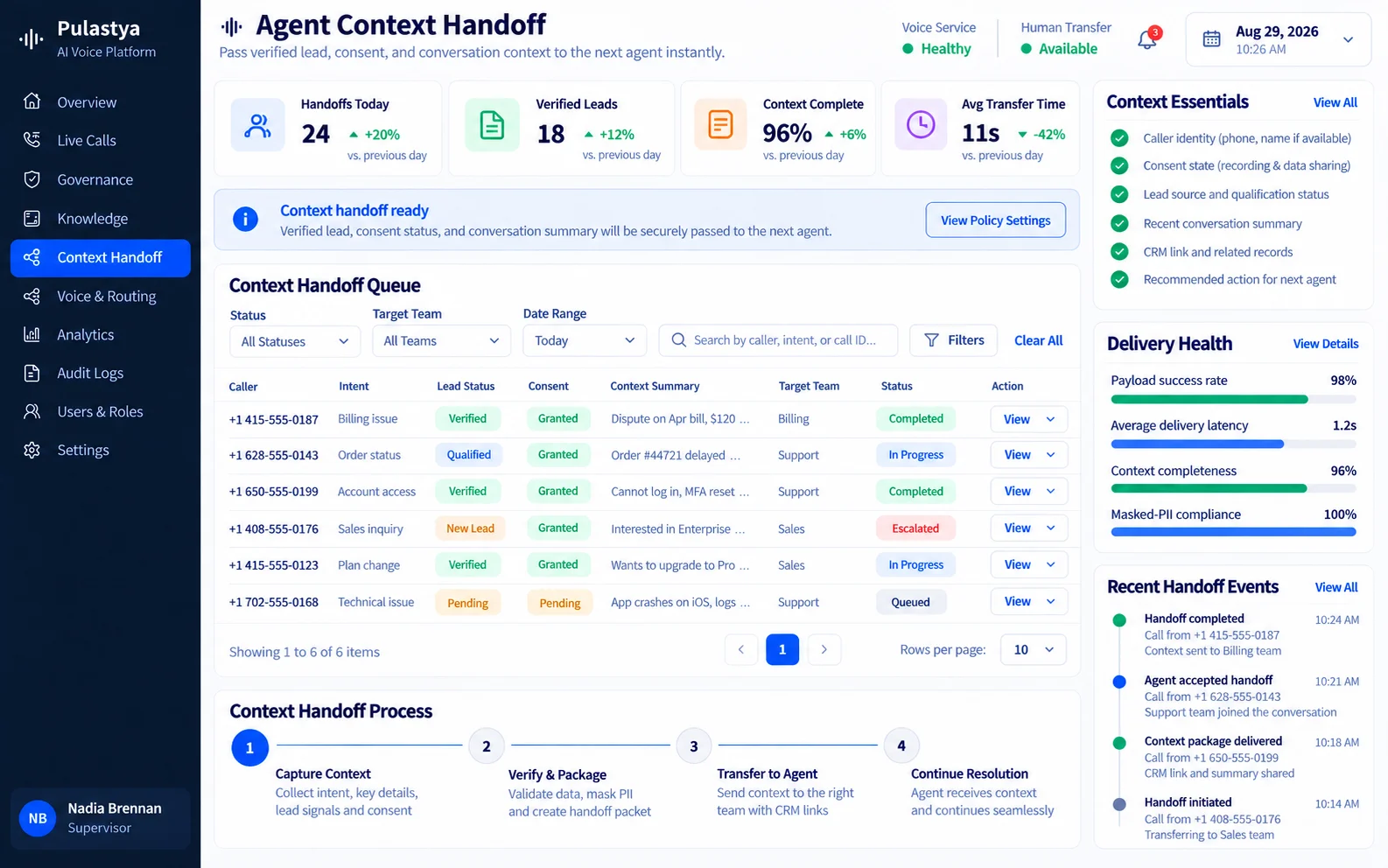
Define a compact context schema that maps to agent UI fields and RBAC rules. A schema reduces inconsistent labels, ensures required fields are present, and makes it possible to validate handoffs before they reach a human. Use short-lived tokens to link to full records.
Prefer pointers to heavy data over embedding sensitive values. For example, include a call recording URL signed for time-limited access rather than placing audio blobs in the payload. The agent UI can fetch the recording after authorization checks pass.
Normalize field names across campaigns so agents do not face different label conventions. Use canonical keys such as lead_id, campaign_id, consent_status, summary, and action_recommendation. This reduces training time and scripting mismatches.
Implement an approval or validation step for automated transfers. Before routing to a live agent, run a rules check that flags missing verification cues, unresolved compliance markers, or when sensitive data would be exposed unnecessarily.
- Use a compact schema with canonical keys and a version field
- Send pointers to large/sensitive artifacts using short-lived signed links
- Validate transfers against consent and verification requirements before routing
- Encrypt payloads and log access events for auditability
- Render context as actionable UI elements: headline, artifacts, actions
Pack metadata as pointers with short-lived access tokens rather than embedding raw sensitive data.
A validated schema only works if the voice layer, lead record and agent desktop all read and write it the same way, which is integration work many teams scope with a partner for AI development services.
Passing Only Authorized and Useful Information
Establish role-based policies that determine what each agent type may see. Different groups-sales closer, billing specialist, fraud team-require distinct data. Apply masking rules that strip or redact fields when the receiving role lacks authorization.
Use consent flags to gate data release. When consent_status is negative or unknown, do not include PII beyond minimally necessary identifiers. If a customer revoked consent for recording, exclude the recording link from the context package.
Log every handoff event and the exact fields delivered. Maintain these logs to support audits and dispute resolution. Include the operator ID that initiated the transfer and the reason code from the automated assistant or campaign flow.
Implement attribute-level authorization rather than whole-payload approvals. Allow agents to request escalation when additional fields are required for issue resolution, and capture a supervisor approval event as part of the transfer record.
- Role-based masking: different fields for different agent roles
- Consent gating: exclude recordings or PII when consent is absent
- Attribute-level requests: allow supervisor-approved reveals with audit
- Automated redaction for payment or national ID fields
- Handoff audit: record fields delivered, actor, timestamp, and reason code
Treat each field as a permission check point; require explicit authorization before exposing high-risk data.
How Context Changes the Handoff Experience
Context-rich handoffs reduce agent greeting and verification time and improve first-contact resolution. When agents receive prioritized actions and verification cues, they spend time solving the problem instead of reconstructing the conversation, improving operational KPIs such as handle time and resolution rate.
Present the handoff as a short task card in the agent desktop that includes a headline, priority, three-line transcript excerpt, and action buttons. Action buttons should include: open CRM at record, play recording from last interaction, and escalate with prefilled reason.
The transfer type changes how much the card has to carry. In a warm transfer the AI or a colleague briefs the receiving agent before connecting the customer, so the card confirms what was said.
In a cold transfer there is no consult, so the card, delivered as a screen pop or CRM note with the live call, is the only briefing the agent gets.
Provide a decision checklist that helps agents confirm readiness: verify ID if required, confirm consent flags, honor prior promises, and perform the recommended next action. Embed these checks into wrap or disposition flows to capture adherence.
Example scenario: an automated outbound call raises a billing dispute and escalates to an agent. The context package contains the billing item, recorded promise from the bot, and consent to record. The agent opens the deep link, verifies two cues, and issues a correction without re-questioning the customer.
- Task card model: headline, priority, transcript excerpt, action buttons
- Checklist: verify ID, check consent, honor promises, take recommended action
- Handoff sequence: schema validation, masked routing, agent task, action execution
- Feedback loop: agent-rated handoff quality to improve upstream automation
- Escalation pack: required fields and approvals for next specialist
Turn context into an actionable task card rather than a raw data dump to speed correct decisions.
For handoffs outside sales and campaign work, see what an AI voice handoff should include.
When the package is sent depends on the transfer itself; the guide to outbound voice handoff covers triggers, warm and cold methods, and fallbacks.
Context handoff is where AI sales calls turn into conversations with reps. The guide to AI voice agents for sales calls and follow-up covers speed-to-lead, follow-up and call disposition around that moment.
Conclusion
A reliable AI voice agent handoff depends on transferring more than a customer name or call transcript. Human agents need accurate lead details, a concise conversation summary, relevant consent and authorization information, and direct access to the appropriate CRM records. Structuring this information into a secure, actionable context package helps agents continue conversations without unnecessarily repeating questions or losing important details.
For enterprise teams, the priority should be consistency, data minimization, and accountability across every transfer. Standardized context fields, role-based access, validation checks, and handoff audit logs help create a more dependable experience. By designing AI-to-human transfers around what the receiving agent actually needs, businesses can improve conversation continuity while maintaining control over sensitive customer information.
Frequently Asked Questions
Minimum acceptable context includes a primary identity field with one or two verification cues, a concise summary of the customer request, consent flags relevant to recording and data sharing, the campaign identifier, and a direct link to the CRM record or recording. Anything beyond this should be justified by a clear agent action.
Apply role-based masking and automated redaction for sensitive fields. Provide short-lived, audited click-to-reveal access when necessary and require supervisor approval for payment or national ID data. Record each reveal event in the audit trail and tie it to an explicit justification.
Design the agent UI to present a one-line intent headline, prioritized next actions, then direct artifacts. Use the context schema to populate fixed UI slots so agents scan predictable locations. Include a recommended action and a small transcript excerpt to eliminate guesswork.
Log the handoff event, schema version, exact fields delivered, the initiating actor or automation ID, receiving agent ID, timestamp, and the reason code. Also log any click-to-reveal actions and supervisor approvals. Keep logs sufficient for compliance review and dispute resolution without retaining unnecessary raw data.
Prefer pointers to recordings and transcripts with short-lived signed access instead of embedding large media. Exclude recordings when consent is absent. If recordings are necessary, ensure encrypted delivery, access logging, and compliance with retention and disclosure policies.