A reliable AI voice handoff gives the next human or system immediate, actionable context so agents can resolve the call faster and avoid repeating questions.
Enterprise teams should standardize precise fields, formats, and operational constraints in a handoff payload to reduce average handle time, improve compliance, and preserve conversation continuity.
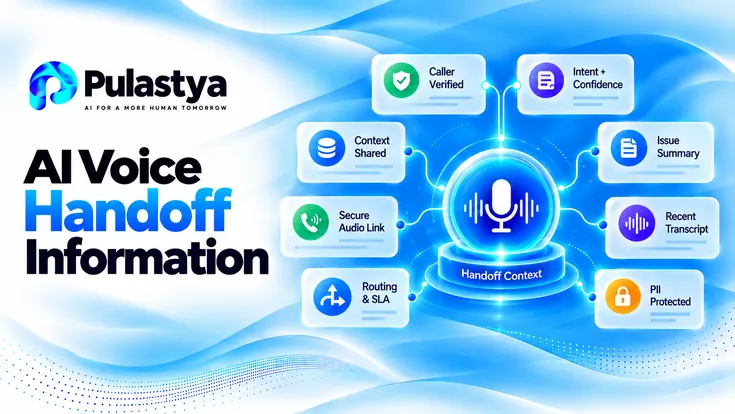
- Minimal payload first Include only the fields an agent needs to accept and continue the call: caller ID, verified identity state, primary intent, current issue summary, and last three utterances with timestamps.
- Context plus actions Add stateful context such as session variables, attempted remediation steps, NLU confidence scores, and recommended next actions to reduce friction when the agent takes over.
- Operational constraints Standardize format, size, latency limits, and data-retention rules; ensure PII handling and authentication tokens align with the contact center's compliance policies.
Begin by defining the minimal and extended payload elements used when a voice AI transfers a live call. Minimal data must let an agent decide whether to accept the call, confirm caller identity, and pick up the conversation thread. Extended data supports faster resolution: issue history, attempted remedies, sentiment trend, and precise timestamps for recent utterances.
Design handoff data for two audiences: a human contact-center agent and downstream automated systems such as CRM plugins or case-management APIs. Humans need clear prose and call notes; systems need typed fields, stable keys, and machine-readable timestamps. The payload must also respect latency, privacy law, and agent UI constraints so it remains practical for production operations.
What Minimal Fields Must a Handoff Payload Contain?
A minimal handoff payload should be compact and deterministic so agent desktops and routing systems can parse it instantly. Required fields include call_id, session_id, caller_phone, caller_display_name, verified_identity (boolean or confidence score), primary_intent, issue_summary (one short sentence), and last_utterances (array with speaker labels and timestamps).
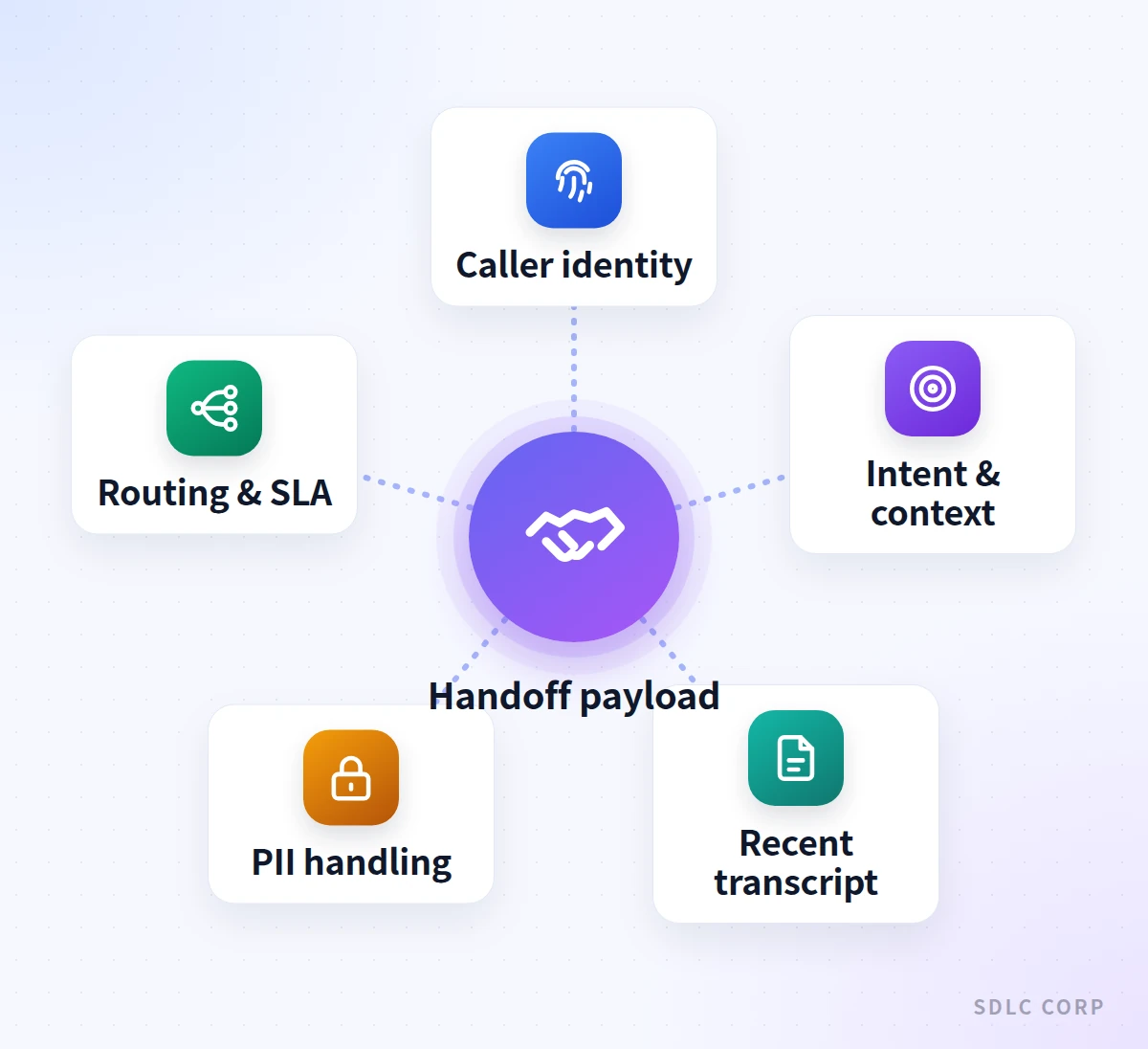
These values let an agent recognize the caller and decide the next steps without replaying audio.
The same payload serves both transfer types. In a warm transfer, the AI briefs the receiver or confirms availability before connecting the caller, and the payload backs up that briefing on the desktop. In a cold (blind) transfer, the live call goes straight to the destination, so the payload is the only context the agent gets.
Include NLU confidence metrics for intent and entity extraction so agents can prioritize verification tasks. For example, primary_intent_confidence: 0.87 tells an agent when to treat intent as tentative. Keep confidence values standardized (0.0 to 1.0) and document how they map to internal verification workflows. When confidence is low, the agent UI should surface suggested verification prompts automatically.
Make the minimal payload size predictable and bounded; avoid embedding full transcripts or long freeform notes in baseline handoffs. A 1-2 kilobyte target for minimal payloads keeps routing predictable and prevents slowdowns in high-concurrency contact centers. If more detail is needed, provide a separate reference link or an on-demand transcript fetch option.
- call_id, session_id, and timestamp for correlation with recordings and logs
- caller_phone and caller_display_name for display and basic verification
- verified_identity flag plus method used (e.g., token, knowledge check)
- primary_intent and primary_intent_confidence to guide the agent
- issue_summary limited to one concise sentence
Start with a predictable minimal payload; add larger context only when system and UI constraints allow.
What Caller Context and Intent Details Accelerate Resolution?
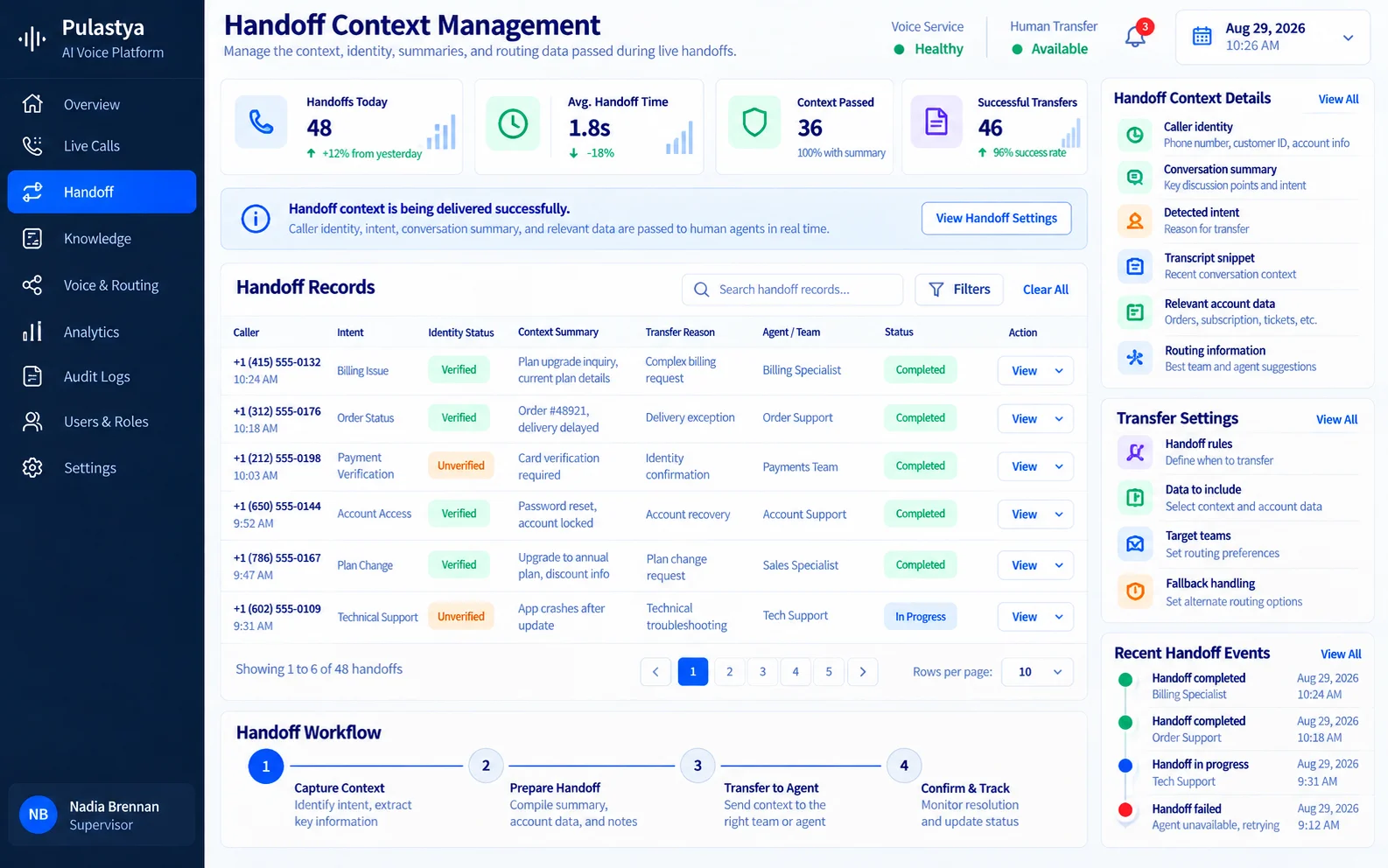
Provide structured context fields that give agents an immediate mental model: product or service type, account status, open-ticket IDs, recent transactions, and last successful agent action. These fields should use stable enumerations linked to backend systems to avoid fuzzy display values. When an agent sees account_status: overdue and last_payment_date, they can prioritize verification and billing steps quickly.
Capture intent history, not just the current top intent. An array of recent intents with timestamps reveals drift and attempts to self-serve. For instance, intents: [{name: "bill_inquiry", confidence: 0.92, ts: "2026-09-10T14:03:22Z"}, {name: "refund_request", confidence: 0.55, ts: "2026-09-10T14:01:10Z"}] shows the agent the conversation path and whether the AI attempted a payment correction before escalation.
Include recommended next actions generated by the voice AI but make them advisory. Recommended_action should be typed (e.g., VERIFY_IDENTITY, PROCESS_REFUND, SCHEDULE_CALLBACK) and include suggested scripts or verification questions. Label these suggestions with rationale and confidence so agents can accept, modify, or decline them based on live judgment.
- account_id and account_status with linked backend keys
- open_ticket_ids and last_agent_notes for thread continuity
- intent_history array with confidence and timestamps
- entities extracted (typed) such as order_number and product_code
- recommended_action with rationale and confidence
Give agents structured context and a short recommendation set; avoid ambiguous freeform notes as the primary source of truth.
Handoff payload
Handoff Fields That Keep the Agent From Re-Asking the Caller
| Field | Why it matters | Example |
|---|---|---|
| verified_identity + method | Lets the agent skip security questions the AI already asked | verified_identity: true, method: token |
| primary_intent + confidence | Shows whether to act on the intent or treat it as tentative | bill_inquiry, confidence 0.87 |
| issue_summary | Gives the agent the problem in one sentence before speaking | Unexpected charge; AI refund attempt failed |
| last_utterances | Recent turns with speaker labels, so no audio replay is needed | caller, 14:03:22Z: I was charged twice |
| recommended_action | Advisory next step the agent can accept, modify or decline | VERIFY_IDENTITY, with rationale and confidence |
Each field answers a question the agent would otherwise have to ask the caller again after the transfer.
What Transcript, Audio, and Silence Markers Belong in the Handoff?
Send a concise transcript section with the last few utterances plus speaker labels and precise timestamps. Include punctuation and normalized casing for readability, but limit the transcript to a recent, task-relevant excerpt or a small number of speaker turns to keep payload size manageable.
When more of the conversation is needed, reference a transcript URL or provide on-demand retrieval rather than embedding the entire conversation. The difference between the audio, the transcript and the summary, and who should be able to open each, is set out in call recording, transcription and summaries.
Transmit audio pointers rather than raw audio blobs when possible. Provide a secure short-lived link to recent audio segments and a pointer to the recording location. Include audio_segment_start and audio_segment_end timestamps relative to call start so the agent can play the most relevant segment immediately. This avoids heavy payloads while preserving the ability to hear tone or confirm information.
Mark silences, interruptions, and overlapping speech explicitly. Silence blocks and overlap markers help agents interpret whether the caller was listening, interrupted, or cut off. Use a small set of standardized markers like SILENCE_MS, OVERLAP_MS, and INTERRUPT_COUNT so downstream analytics and agents can use the same logic to determine whether to recap or probe further.
- last_utterances array with speaker, text, and ISO8601 timestamps
- transcript_excerpt limited to a recent task-relevant window for readability
- secure_audio_url with short TTL and segment timestamps
- silence_ms, overlap_ms, and interrupt_count to indicate flow issues
- indicator if ask-to-repeat or rephrase was requested by the AI
Prefer short transcript excerpts and secure audio references over large embedded audio to preserve speed and UI clarity.
How Should Authentication and PII Be Handled During Handoff?
Never include raw sensitive data in the default handoff payload. Replace PII fields with verification state and tokenized references.
For example, instead of sending full SSN or payment card numbers, include verified_identity_method, verified_identity_score, and tokenized_account_reference that the agent UI can resolve after the agent completes a secondary secure check. This approach minimizes exposure and simplifies compliance tracking.
Define clear retention and access rules in the payload metadata. Include fields like pii_flag, retention_ttl_seconds, and access_policy_id so downstream systems enforce the correct lifecycle. Payload metadata should also list the legal basis for processing (e.g., consent, contract) and data jurisdictions to help agents and systems apply the correct verification and disclosure workflows.
Log authentication attempts and redaction actions in the handoff record. If the voice AI performed identity checks, include details such as auth_attempts, methods_used (knowledge-based, token), and last_successful_check_ts. Such structured provenance lets auditors and supervisors trace why certain data was omitted or redacted before the agent received the call.
- avoid raw PII; use tokenized references and verification states
- include pii_flag, retention_ttl_seconds, and access_policy_id
- list authentication methods with timestamps and outcome codes
- ensure links to recordings and transcripts respect region-specific rules
- record redaction and why data was withheld for auditability
Tokenize or flag sensitive data; attach metadata that enforces retention and access controls automatically.
What Technical Mechanics and Latency SLAs Should Teams Set?
Set tight latency expectations for handoff payload delivery: set a delivery target that must be validated against the deployed telephony, network, and integration path.
Handoffs that arrive slower than agent answer time lead to agents accepting calls without context, which defeats the purpose. The risk is highest in a cold transfer, where no one briefs the agent before the caller is connected.
Measure p99 latency and budget network and processing time from the voice AI runtime to the agent desktop.
Standardize a lightweight schema and versioning in the payload so both AI and agent systems can evolve without breaking runtime parsing. Include payload_schema_version and backwards-compatible optional fields. Provide a quick feature flag or capability bitmask in the payload so older desktops can ignore unknown fields while upgraded interfaces can take advantage of richer context.
Design retry and fallback behavior for partial or failed handoffs. If a payload fails validation, route the call to a defined fallback queue with notes explaining missing context. Log handoff failures with error codes and correlation IDs for post-incident analysis. Provide automated alerts when handoff failure rates exceed a small threshold to prevent silent degradations.
- set p50 and p99 delivery targets and validate them on the deployed path
- include payload_schema_version and capability bitmask for compatibility
- implement retries, graceful degradation, and explicit error codes
- correlate handoff events with recordings using stable call_ids
- monitor handoff success rate and alert on rising failure trends
Treat handoffs as part of the real-time call path: measure strict latency SLAs and provide robust fallbacks for failures.
How Should Escalation Routing, Roles, and SLA Data Be Packaged?
Package routing hints and escalation requirements explicitly so the receiving system can route to the right team without manual intervention. Include target_skillset, urgency_level, sla_deadline_ts, and required_permissions. For example, target_skillset: "billing-specialist" plus urgency_level: "high" ensures the contact center routes directly to a team that can process refunds or account holds promptly.
Provide role-based visibility flags that control what the agent sees. Differentiate front-line agent payloads from supervisor or specialist payloads using a visibility_level field. This prevents overexposure of sensitive troubleshooting data to agents who do not need it while allowing supervisors to access full transcripts and diagnostic logs when required for resolution or compliance reviews.
Include SLA and escalation history to preserve continuity across handoffs. Fields like current_sla_breach_window_minutes, previous_escalations_count, and last_escalation_reason help the next handler understand operational constraints and avoid repeated re-escalations.
This also supports routing systems that make decisions based on time-to-SLA-breach to avoid penalties or customer dissatisfaction.
Example: A customer calls about an unexpected charge. The voice AI verifies identity, attempts a refund, and fails when the payment processor returns a tokenization error.
The handoff payload marks urgency_level as high, target_skillset as "payments-specialist", includes the payment_processor_error_code, and provides a secure_audio_url. The receiving agent uses those fields to skip basic verification, look up the processor error directly, and resolve the issue faster.
- target_skillset, urgency_level, and sla_deadline_ts for routing
- visibility_level to control what data different roles can see
- current_sla_breach_window_minutes and previous_escalations_count
- include error codes and backend reference IDs for faster lookup
- supply suggested reroute destinations and escalation playbook IDs
Embed routing hints, visibility rules, and SLA context so escalations proceed without manual reclassification.
How to Implement and Operate Handoffs at Scale
Operationalize handoffs with a short implementation checklist: define a minimal schema, document optional extended fields, implement tokenization and TTLs for secure links, enforce p99 latency targets, and build monitoring dashboards for handoff success rates. Run load tests that simulate peak concurrent sessions to ensure your handoff paths do not become a bottleneck under realistic call-center traffic.
Integrate the handoff schema into agent desktop and CRM adapters to guarantee consistent rendering. Use a small client library that normalizes timestamps, confidence scores, and enum values across desktop versions. Train agents on new UI indicators such as verified_identity_score and recommended_action so they trust the handoff and avoid redundant questioning, which preserves CSAT and reduces handle time.
For enterprise integrations that require vendor implementation help or custom connectors, evaluate partners on their experience with secure audio links, schema versioning, and low-latency pipelines. Consider a partner that can provide end-to-end testing and observability for handoff events.
- create and publish a stable handoff schema and version policy
- implement tokenized secure links and short TTLs for audio/transcripts
- build monitoring for latency p50/p99 and handoff failure rates
- run concurrency and failover tests that mirror peak traffic
- deploy a lightweight client library for agent desktops and CRM adapters
Treat handoffs as a first-class product: deploy schema governance, monitoring, and integration libraries to scale safely.
Handoff payloads carry the most weight on support lines, where agents pick up unresolved issues. The guide to an automating customer support calls shows where handoff fits among FAQ answers, service requests and after-hours coverage.
Conclusion
Effective AI voice handoff information helps human agents continue customer conversations without unnecessary repetition. A structured payload should provide essential caller details, identity-verification status, the primary intent, a concise issue summary, recent transcript excerpts, and relevant routing context. Keeping these fields consistent and readily available gives the receiving agent a clearer understanding of what has happened and what needs attention next.
For enterprise contact centers, dependable handoffs also require secure handling of sensitive information, reliable CRM and agent-desktop integrations, versioned schemas, and measurable delivery performance. Combining a compact baseline payload with controlled access to additional context helps teams build scalable AI-to-human transfers while maintaining operational visibility, security, and a smoother customer experience.
Frequently Asked Questions
No. Full transcripts increase payload size and risk overexposure of sensitive data. Send a short recent excerpt and a secure short-lived link to the full transcript or audio when required. Use access controls and logging for any on-demand retrieval to meet compliance and privacy requirements.
Base decisions on least-privilege principles and legal requirements. Tokenize full identifiers and expose only verification states or masked values in the default handoff. Grant access to full PII only after an authenticated, auditable agent action and when business necessity is documented.
Set a delivery target and validate it under the actual network, carrier, and integration conditions. Measure from voice AI handoff trigger to agent desktop receipt. Include retries and fallbacks and monitor p99 latency to prevent agents from answering without context.
Use semantic schema_versioning and include capability flags. Make new fields optional and provide a capability bitmask so older clients ignore unknown fields. Maintain backward compatibility for the minimal payload and schedule coordinated desktop upgrades with clear deprecation timelines.