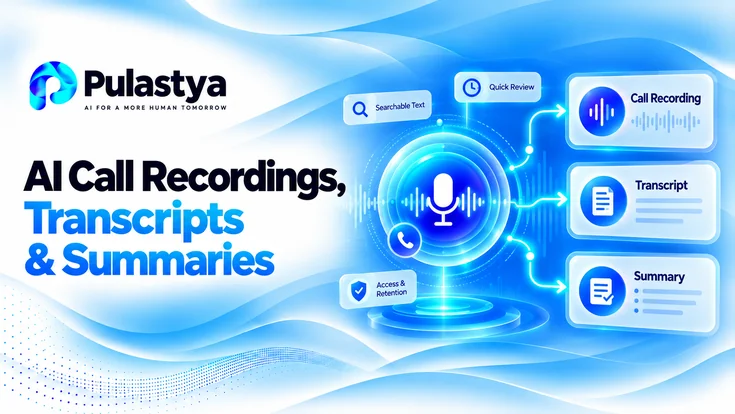
Every completed call leaves three separate records behind, and most teams treat them as one thing.
The audio, the text of what was said and the short written account of what happened are different objects, produced by different steps, useful to different people. Deciding that before volume arrives is far easier than deciding it afterwards.
- Three records, not one Audio, transcript and summary are produced by different steps and answer different questions about the same call.
- Each step loses something Compression makes a summary usable and also makes it the wrong record to rely on when accuracy is contested.
- Different clocks The three rarely deserve the same audience or the same lifespan, and separating them is cheaper than keeping everything.
The confusion is understandable. All three describe the same few minutes, and a dashboard usually shows them stacked on a single row, one click apart. But each is made from the one before it, and each throws something away in the process.
That loss is the point. A summary is short because it discarded most of the call, which is exactly what makes it readable and exactly why it cannot settle an argument about what was said.
Three Records, One Call
A finished call produces audio first, text derived from that audio second, and a written account derived from that text third. Each step is a transform, and each transform is lossy in its own direction.
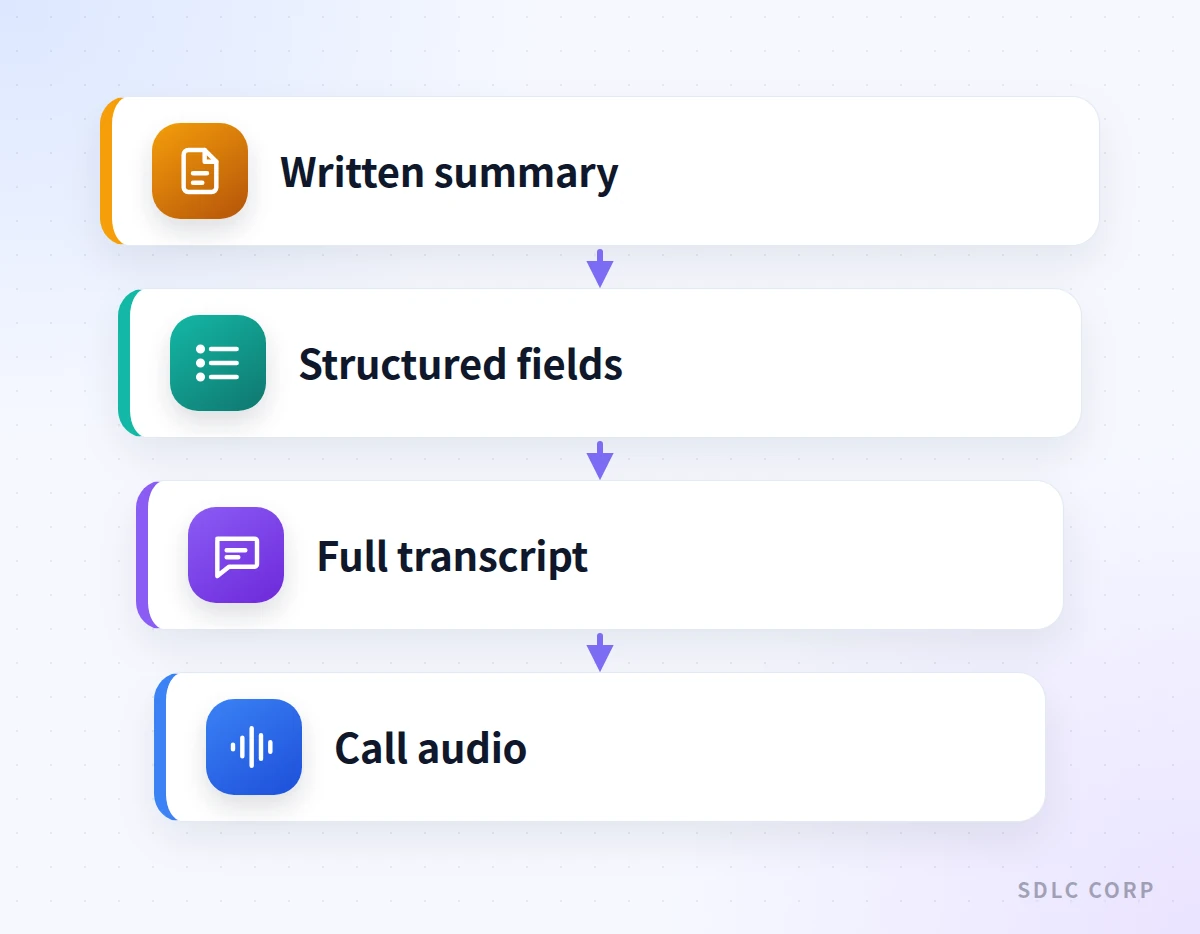
- The recording is the raw signal: everything that was audible, in the order and at the pace it happened.
- The transcript is what a recognition engine believed it heard, rendered as searchable text.
- The summary is a short written account of what the call was about and what was agreed or requested.
- Structured fields sit alongside these: named values pulled out deliberately rather than narrated.
| Record | Preserves | Loses | Best used for |
|---|---|---|---|
| Audio | Tone, pace, overlap, background, line quality | Nothing, but it cannot be searched | Disputes, coaching, tuning recognition |
| Transcript | Wording, order, who spoke when | Everything the words did not carry | Search, review, quality sampling |
| Summary | Outcome, request, next step | Wording, nuance, anything judged minor | Reading a call quickly, opening work |
The order runs one way. You can produce a transcript from audio and a summary from a transcript, but nothing recovers the recording from the summary. Anything discarded at a step is gone for every record after it.
Ask of any question about a call which of the three records can actually answer it. Most disagreements about call documentation are really disagreements about which record someone was reading.
What the Audio Holds That the Text Does Not
Text is a narrow channel. A transcript that reads as a calm exchange can come from a call where one party was audibly upset, and no reader of the text would know.
- Tone and volume, which carry frustration, hesitation and relief that the words deny.
- Timing: how long a pause ran, and whether an answer came instantly or after thought.
- Overlap, where two people spoke at once and the transcript had to choose a winner.
- Line conditions such as noise, dropouts and distortion that explain a misheard word.
Three situations need the audio and accept no substitute: a disagreement about what was actually said, an investigation into why recognition failed on a particular phrase, and any review of how a caller sounded rather than what they asked for.
The recording is also the heaviest and the most exposed of the three. It carries a voice, which is identifying in a way that text is not, and it carries every unrelated thing said within earshot of the handset.
The Transcript as the Working Record
The transcript earns its place by being searchable. A thousand recordings are an archive nobody opens; a thousand transcripts are a corpus you can query for a product name, a competitor or a phrase that signals trouble.
Verbatim or Tidied
A verbatim transcript keeps the false starts, repetitions and filler. A tidied one reads better and is easier to skim. The trade is that tidying is an edit, and an edited record is weaker where accuracy is contested.
Speaker labels and timestamps are worth more than they look. Labels let a reader tell a question from an answer without inferring it; timestamps let anyone jump straight to the moment in the audio rather than listening from the start.
One honest caveat belongs on every transcript. It records what the system heard, not what was said, and the two diverge most on exactly the values that matter: surnames, reference numbers, addresses and product terms. Capturing those deliberately is a different job, covered in turning spoken answers into structured values.
The Summary and What It May Be Trusted With
A summary is written, not captured. Something read the call and decided what mattered, which makes it an interpretation rather than a record, however accurate it usually is.
That is not a reason to distrust it. It is a reason to be clear about its job: a summary exists so a person can understand a call in fifteen seconds and decide whether to open anything else.
- Why the call happened, in the caller's terms rather than an internal category.
- What was asked for and what the agent actually did about it.
- Anything left open, including what the caller was told would happen next.
- A pointer to the transcript and the recording, so anyone who needs more can go deeper without searching.
The rule that holds up in practice is simple. A summary may start work and may route it. It may not end an argument, approve an exception or stand as the evidence that something was agreed, because it is a paraphrase of a paraphrase.
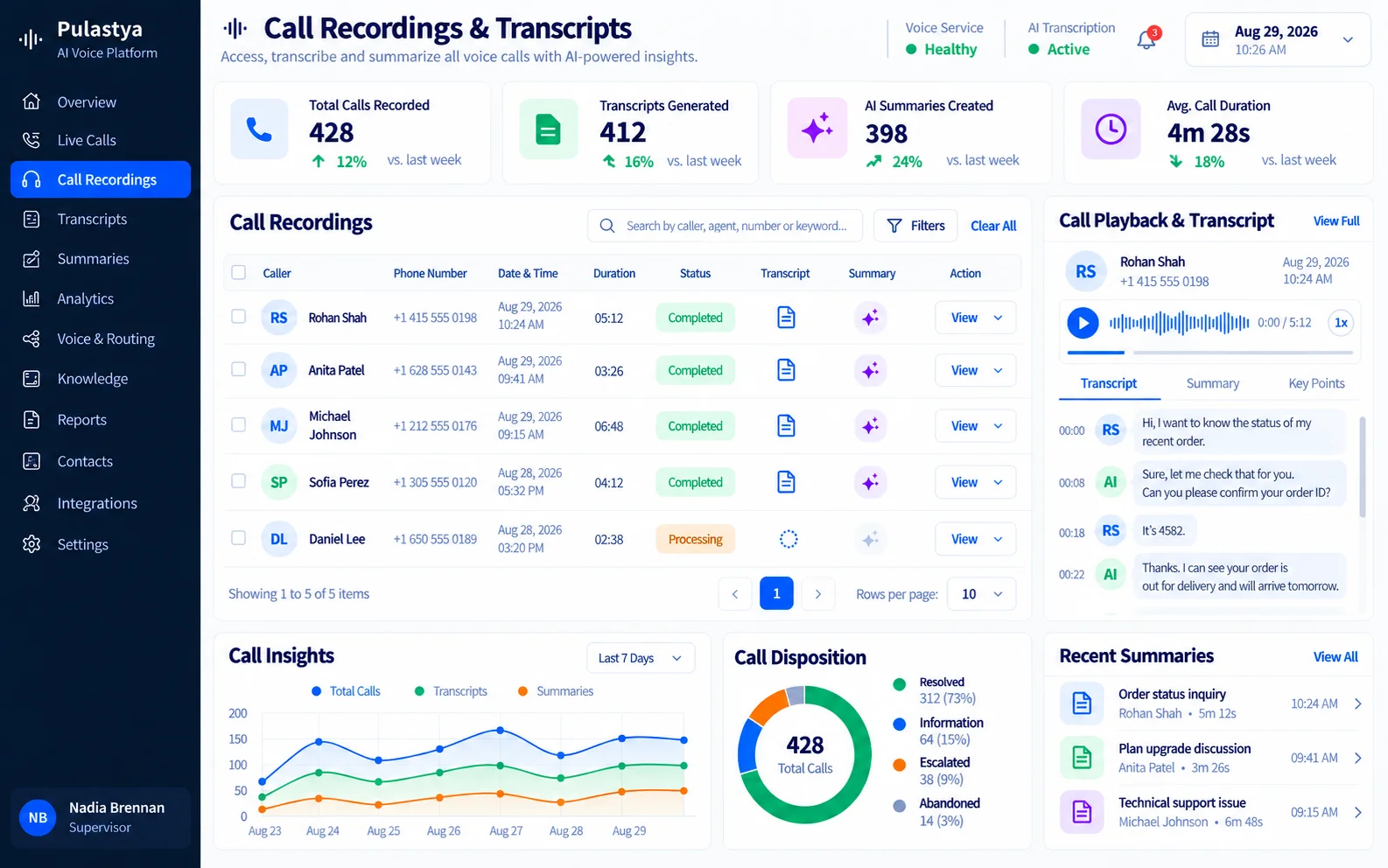
Pulastya, the SDLC Corp voice platform for inbound and outbound business calls, leaves a transcript and a call summary against every call and presents them on a call dashboard. That pairing is the practical shape: the short account for reading, the full text sitting one click behind it.
A summary attached to a live transfer is a different artifact with a different deadline, and what it needs to carry is set out in the information a handoff should carry.
Who Should Be Able to Open Which Record
Most teams grant all three to the same group by default, because the platform presents them together. That is usually more access than anyone needs and more than most would defend if asked.
A workable default runs the other way: the more a record compresses, the wider its audience can reasonably be.
The widest group. Anyone who has to act on the call or pick it up later needs to know what it was about.
A narrower group. Quality reviewers, the team that owns the process and whoever is investigating a specific case.
The narrowest group, requested rather than browsed, because the voice itself is the most identifying thing in the set.
Notice and consent before a recording starts are a separate question, and the answer is not universal. It turns on jurisdiction, on whether the call is inbound or outbound, on the purpose of the recording and on the sector, so establish the position that applies to your calls with counsel rather than inheriting a default.
How access is enforced rather than merely intended belongs with the controls that protect recorded voice data.
How Long Each Record Is Worth Keeping
The three do not share a clock. Holding audio for as long as you hold summaries is a common default and rarely a considered one, since the audio is the heaviest to store and the most costly to expose.
- Name the reason each record existsWrite down what you would use it for. A record with no stated use has no defensible retention period.
- Set a period per record, not per callSummaries can often outlive transcripts, and transcripts can often outlive the audio they came from.
- Check the duties that apply to your callsMinimum and maximum periods vary by jurisdiction, sector and call purpose, so have the applicable ones established with counsel.
- Make deletion happen by itselfA retention policy that depends on someone remembering is a policy that quietly keeps everything forever.
The asymmetry is worth stating plainly. Deleting a record you later wanted costs an inconvenience. Holding a record you had no reason to keep costs you every time someone asks what you hold and why.
Retention duties on call recordings are jurisdiction-dependent and sector-dependent, and they can differ from the duties on the transcript of the same call. Treat any figure you inherit as a starting point for legal review, not as a rule.
Where these decisions sit in a wider accountability picture is covered in governance for enterprise voice deployments.
Conclusion
AI call recordings, transcripts, and summaries support different business needs, even when they come from the same conversation. Recordings preserve the captured audio, transcripts make conversations easier to search and review, and summaries help teams understand outcomes and follow-up actions quickly. Choosing the right record for each task improves review processes and reduces unnecessary information handling.
For enterprise teams using AI voice platforms such as Pulastya, effective call documentation requires more than generating transcripts and summaries. Organizations should define access permissions, verify important information against source records, establish suitable retention periods, and maintain clear links between summaries and the underlying conversation. These practices support operational consistency while helping teams manage privacy, accuracy, and accountability.
Frequently Asked Questions
It depends on what you would use it for. The transcript answers questions about wording and the audio answers questions about how something was said, plus any case where the accuracy of the transcript itself is doubted. If none of those arise in your work, the recording is mostly storage and exposure you are carrying for no stated reason.
It is safer not to. A summary is generated from the transcript by a step that decides what matters, so it is a paraphrase rather than a capture. Use it to understand a call quickly and to route work, and go to the transcript or the recording when the question is whether a specific thing was actually said.
Because recognition works from sound, and surnames, codes and product terms are exactly the items with the least context to correct a misheard syllable. That is why values you intend to act on should be captured and confirmed during the call rather than read back out of the transcript afterwards.
Not automatically. They carry different information, serve different purposes and carry different exposure, so they can reasonably have different periods. Applicable minimums and maximums vary by jurisdiction, sector and the purpose of the call, so set the periods with counsel rather than applying one number across everything.
Fewer people than can read the summaries. A practical pattern is that summaries are broadly readable, transcripts go to quality and process owners, and audio is requested for a named reason rather than browsed. The voice is the most identifying part of the set, which is what justifies the narrower door.