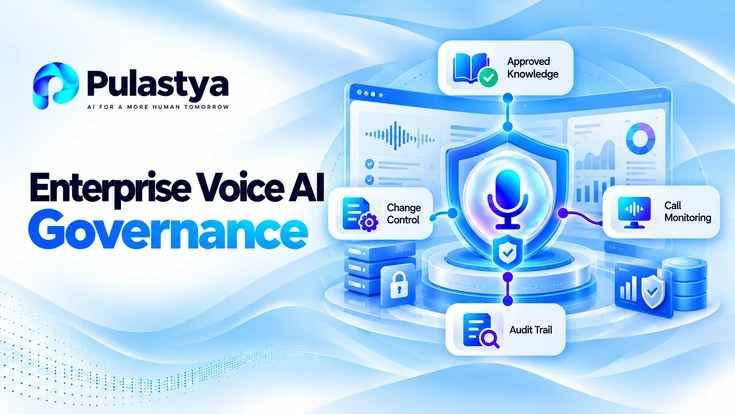
Voice AI governance is the set of decisions that make an agent's phone calls answerable: who is accountable for what it says, what record exists after the call ends, who may change its behavior, and what evidence the organization can produce when someone asks.
It is the layer regulated buyers examine first.
- Accountability stays with you The organization that owns the number owns what the agent says on it, whatever the platform does underneath.
- Evidence is a design choice Transcripts, summaries and decision records exist only because someone decided to keep them, and only for as long as they said.
- Change control is the real test A governed agent is one where prompts, knowledge and routing cannot reach live callers without an owner, a test and a record.
A voice agent is unusual among enterprise software. It speaks in the organization's name, in real time, to a person who cannot see the policy behind the answer. There is no draft stage, no reviewer between the model and the caller, and nothing to retract once it has been said. Voice is usually one channel inside a larger effort, and where voice sits in an enterprise conversational AI programme puts it in context.
Governance for a system like that rests on four questions: who is accountable for what is said, what call data the deployment creates and how long it is kept, how answers stay tied to an approved source, and how changes to behavior are controlled and recorded.
What Governance Means for a System That Talks
Most AI governance frameworks were written for systems that produce documents, scores or recommendations that a person reviews before anything happens. A voice agent removes that review step. Its output is an utterance, delivered to a caller who may act on it immediately.
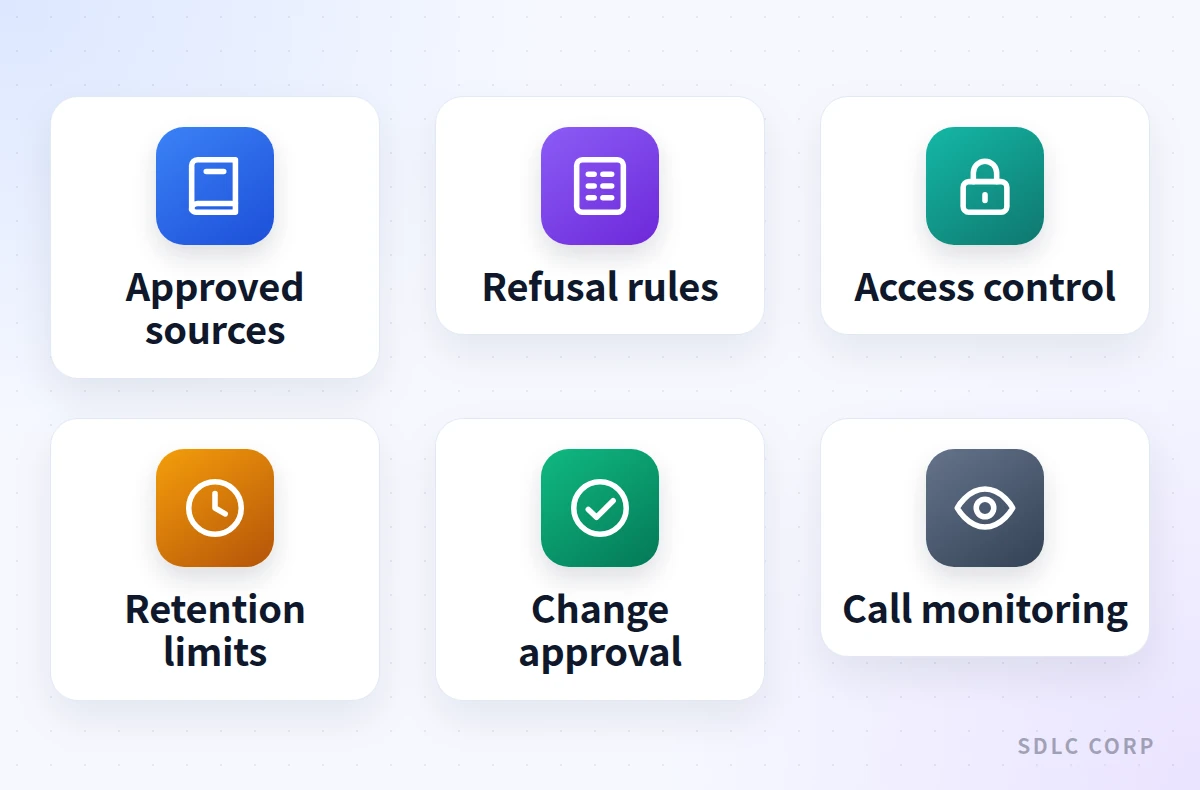
That changes what governance has to control. You cannot inspect an answer before it is spoken, so you govern everything upstream of it: the sources the agent may draw on, the rules it must apply, the situations it must refuse, and the people who may change any of those.
Accountability does not move to the vendor. A platform is responsible for behaving as documented, and the organization whose number the caller dialed is responsible for what the caller was told. Contracts allocate commercial risk. They do not move the conversation.
| Control area | Typical owner | Evidence a reviewer will ask for |
|---|---|---|
| What the agent may say | Business or service owner | Approved source documents and their version history |
| What it must refuse | Risk, legal or compliance | Written exclusions and the routing rule that enforces them |
| Call data and retention | Security and data protection | Retention schedule, access list and deletion records |
| Changes to behavior | Platform or operations owner | A change log showing who changed what, and when |
| Ongoing performance | The team that answers the calls | Transcript reviews, escalation reports and metric trends |
Two of those rows are usually under-built. The rules an agent must apply before it speaks belong in a deterministic layer rather than a prompt, which a policy and rule engine for voice AI covers. The live signals that raise a call's risk level mid-conversation are handled in dynamic risk assessment on a call.
Governance is also a platform property, not only a policy document. Whether a team can operate a voice deployment safely depends on what the software lets them see and change, which is part of judging an enterprise voice AI platform in the first place.
Data, Recordings and Retention
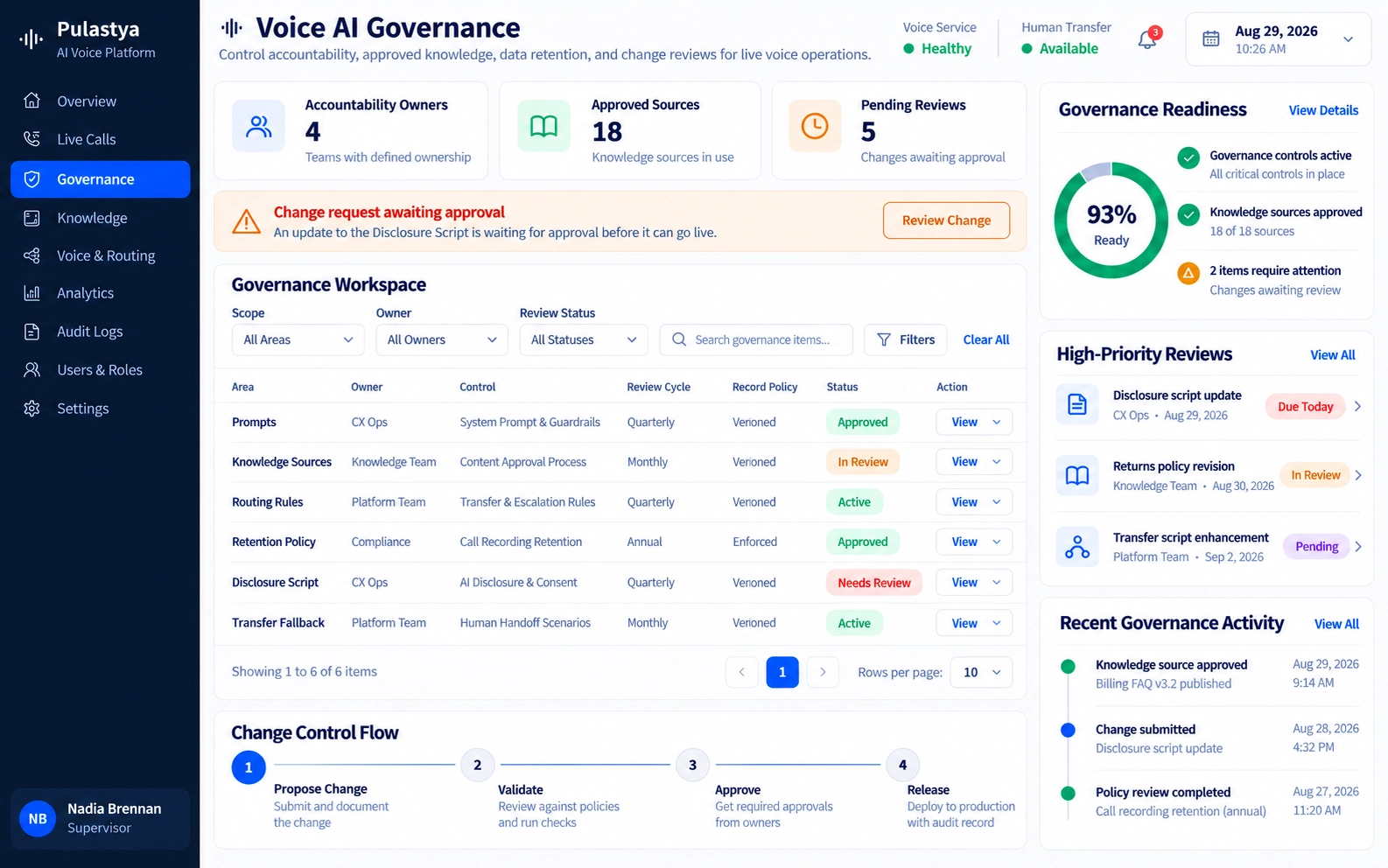
Every answered call creates more than a conversation. Depending on configuration it produces audio, a transcript, a summary, structured fields extracted from what the caller said, and records in whatever systems the call touched. Each artifact carries a different sensitivity and a different useful lifetime.
- Audio: the most sensitive artifact, and the one most often kept far longer than anyone deliberately decided.
- Transcripts: searchable and easy to copy, which is usually where personal data actually concentrates.
- Summaries and extracted fields: low volume, but they flow into other systems and inherit those systems' access rules.
- Platform records: call metadata, routing decisions and configuration history, which together form the audit trail.
Disclosure and consent obligations differ by jurisdiction, by whether the call is inbound or outbound, and by whether it is recorded. The shape of a program, from disclosure through to audit evidence, is set out in compliance for AI voice agents. Outbound adds calling windows, suppression and opt-out handling, covered in AI dialer compliance.
The control side, meaning which encryption, access and isolation measures apply to which artifact, is the subject of voice data security and privacy. Calls that touch health, financial or account-sensitive matters need a narrower path again, described in handling sensitive calls with voice agents.
The cheapest governance decision available is to capture less. Audio you never recorded needs no retention schedule, no access review and no deletion process. Decide artifact by artifact what the business actually uses, then keep only that, for a stated period, with a named owner attached to it.
Data leaving the call is where retention surprises usually start, because a summary written into a customer record then lives under that system's rules rather than the voice platform's. Where that boundary falls belongs with voice AI integrations and the systems around them.
A governance review will also ask which vendors sit in the call path. Pulastya, the SDLC Corp voice platform for inbound and outbound business calls, keeps transcripts, call summaries and a call dashboard as the record of what happened, and customers connect their own Twilio and OpenAI accounts, with those providers billing usage directly.
Knowledge Control and Answer Accountability
An answer is only as accountable as the source behind it. When a caller is told something wrong, the first question is where the statement came from, and the only useful answer is a document someone can open, correct and republish.
That makes the knowledge base a governed asset rather than a content folder. Each source needs an owner, an approval step before it reaches live calls, and a retirement path for when it stops being true. Knowledge governance for voice agents covers that lifecycle in detail.
Every topic the agent may answer maps to a document a person owns and can correct.
Content reaches calls through a review step rather than a direct edit to production.
Each source carries a review date and a trigger list instead of an open-ended life.
What the agent says when nothing covers the question is written down and tested.
Accuracy then has to be maintained against a moving business. Prices change, policies are revised, and a document nobody has reviewed in a year is a live risk on every call. The signals that should trigger a review, and who owns each one, are in keeping a voice knowledge base accurate.
The failure this prevents has a name. A fluent, confident, wrong answer is worse on a phone call than in a chat window, because there is no text to re-read and the caller usually acts on it. The checks that stop an agent stating a fact it cannot support are set out in preventing hallucinations in AI voice agents.
Refusal is the other half of the same control. An agent that says it lacks the context and offers a transfer is safer than one that produces a near-answer. That is the behavior Pulastya is built around: answers come from documents the organization provides, and a gap becomes a handoff rather than a guess.
Testing, Monitoring and Change Control
Governance that cannot block a change is documentation. The practical test of a voice deployment is whether a prompt edit, a new knowledge document or a routing change can reach live callers without an owner, a test and a record behind it.
Testing has to cover more than intent accuracy. Speech recognition under noise, interruptions, transfers, failover and the refusal paths all need exercising before real traffic reaches the number, and again after every change. Testing AI voice agents before and in production sets out those layers.
- Propose the changeState what changes, which calls it affects, and who approved it going ahead.
- Re-run the same scenariosTest against the scripted and awkward calls the agent already passed, not only the new case.
- Release with a versionRecord what went live, when it went live, and who authorized it.
- Watch the first callsRead transcripts from the first live calls instead of waiting for the weekly report.
- Keep a way backKnow how to return to the previous configuration without rebuilding it from memory.
Monitoring is what turns transcripts into a control rather than an archive. Containment, transfer reasons, unanswered questions and repeat callers show where an agent has drifted from what was approved. Which of those numbers mislead, and how, is covered in AI voice agent metrics.
None of this is exotic. It is ordinary change discipline applied to a system that speaks for the business, and it is close to what a regulated buyer is actually asking when they ask how the agent is governed.
To see these controls in a working system, the AI voice platform for business calls from SDLC Corp exposes transcripts, call summaries and a call dashboard, and Pulastya supports a browser test call before a number goes live. To walk through those settings with someone, book a guided walkthrough.
Frequently Asked Questions
The organization whose number the caller dialed. A platform is accountable for behaving as documented, but the business owns the statement the caller heard and acted on. That is why approved sources, written exclusions and a change log matter more than any assurance in a contract.
At minimum, a record of what was said and what the system did about it. In practice that means a transcript or summary, the routing or transfer decision, the configuration version in force at the time, and enough metadata to find the call again. Decide this before launch rather than after a complaint.
For as long as a stated business or legal purpose requires, and no longer. Set the period per artifact, because audio, transcripts and extracted fields rarely justify the same retention. An artifact with no named owner and no end date is a liability rather than a record.
Disclosure expectations vary by jurisdiction, industry and whether the call is inbound or outbound, and they change. Treat disclosure as a policy decision made with your legal or compliance team, then enforce it in the opening line rather than leaving it to the model to improvise.
Ground answers in approved documents, define what the agent says when nothing covers the question, and test the refusal path as seriously as the happy path. An agent that offers a transfer when it lacks context is safer than one that produces a confident near-answer on pricing or policy.