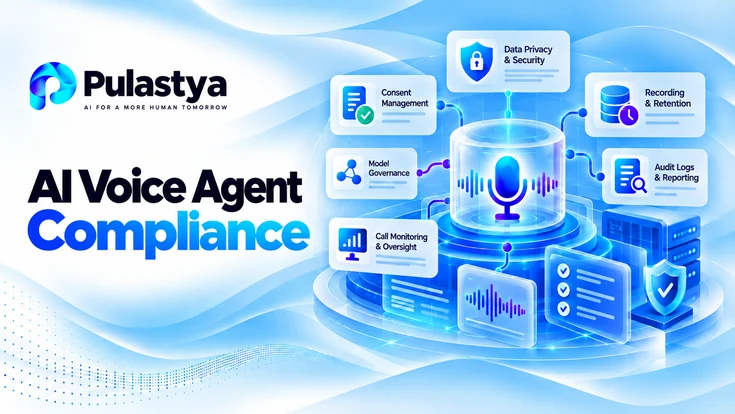
AI voice agent compliance demands a practical framework that ties regulatory requirements to real call-flow and system controls. Enterprises must align architecture, data handling, consent, and ongoing oversight to avoid regulatory exposure and operational risk while preserving user experience and uptime.
- Scope compliance to call stack Map laws to specific voice components, telephony, recording, ASR, model output, and storage, so controls and tests are actionable.
- Design for auditable decisions Capture decision metadata, model versions, and consent events to produce a reproducible trail for regulators and auditors.
- Operationalize privacy and security Apply role-based access, selective recording, and encryption to reduce exposure and accelerate breach response.
Regulated deployments require mapping laws and supervisory expectations to the voice-call stack: telephony, media recording, ASR and NLU, model inference, logging, and downstream storage.
Begin with a scope document that lists regulated jurisdictions, applicable statutes, and primary business processes affected by voice automation. Translate those items into system requirements such as recording retention periods, PII masks, and disposition workflows that legal and engineering can validate together.
Operational teams need concrete controls for monitoring, versioning, and incident response because voice agents introduce unique telemetry and human-safety risks.
Design decisions should balance latency, accuracy, and auditability: storing raw audio may be necessary for supervision but increases breach surface; on-device anonymization reduces risk but complicates compliance testing. Define the tradeoffs up front and set measurable acceptance criteria tied to regulatory obligations and third-party audit readiness.
Regulatory Mapping and Program Governance
Start compliance with a regulatory mapping exercise that converts legal obligations into technical and operational requirements. Identify the jurisdictions where calls will originate or terminate, then list statutes and rules that affect voice interactions, such as recording consent mandates, data residency rules, and sector-specific constraints like consumer-protection rules for automated calls or health privacy.
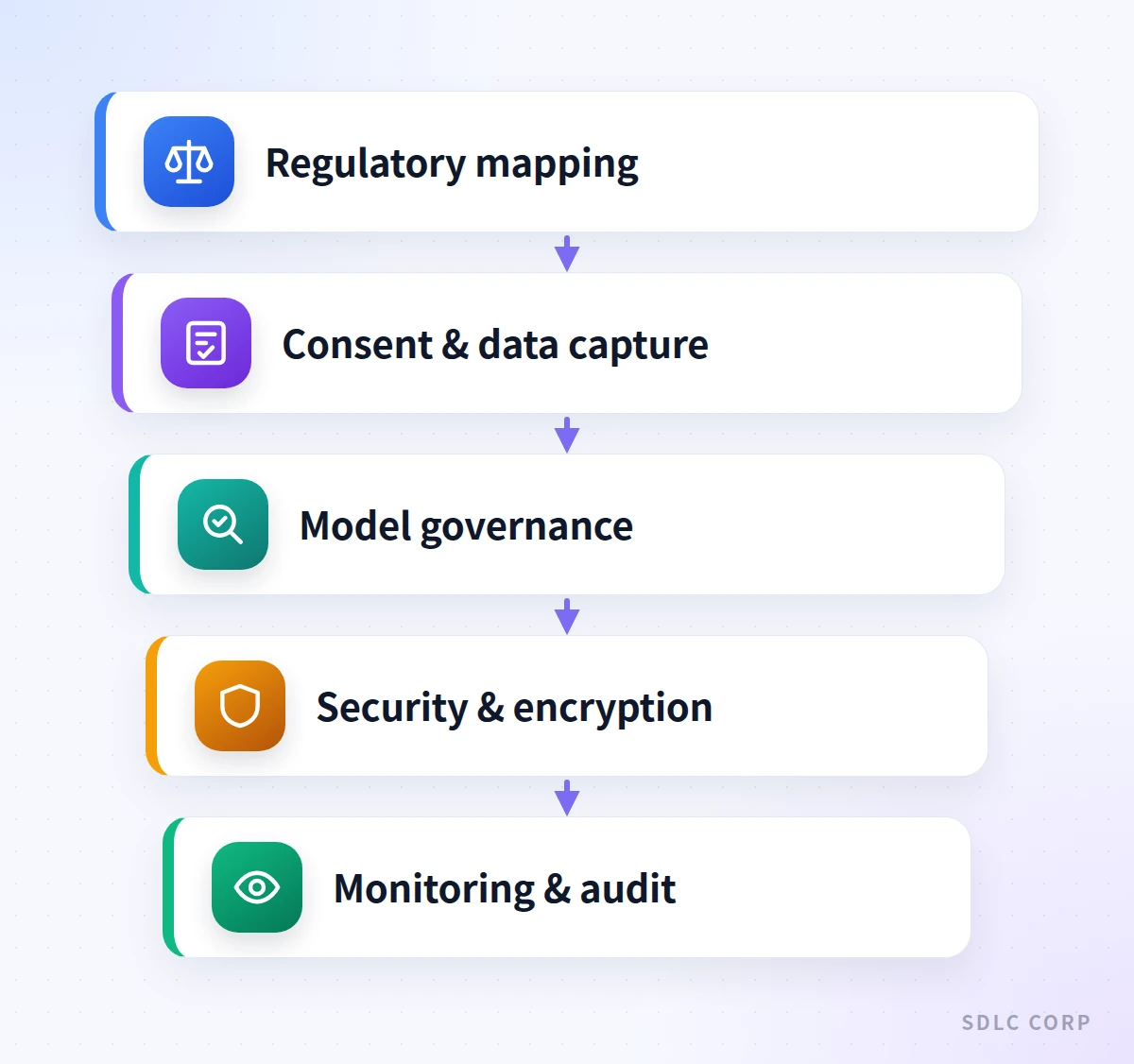
For example, US federal law permits recording with the consent of one party, while states such as California and Florida require consent from all parties, and the FCC treats AI-generated voices as artificial voices under the TCPA, so many automated calls need prior express consent.
Use that mapping to create control objectives and a prioritized implementation roadmap tied to release cycles.
Establish a steering committee with representation from legal, security, product, contact center operations, and vendor management. That committee should approve the scope document, sign off on risk acceptance, and maintain an issues log.
For enterprise scale, include KPIs such as percentage of calls with validated consent, time to revoke access, and frequency of model revalidation to keep governance measurable and auditable.
Adopt a versioned policy library that links each policy to system components and test cases. Policies should include retention schedules, access rules, and allowed use cases for voice transcripts and audio. Make policy artifacts machine-readable when possible so deployment automation can check policy compliance before shipping new agent updates or training data into production.
- Catalog jurisdictions and statutes that impact recording, storage, and consent for voice calls.
- Create traceable requirements tied to voice components: telephony, ASR, NLU, TTS, storage.
- Form a cross-functional steering committee for approvals and risk acceptance.
- Define measurable KPIs to prove operational compliance over time.
- Version policies and link them to test cases and deployment pipelines.
Turn legal requirements into testable system controls before you deploy at scale.
Data Capture, Recording, and Retention Controls
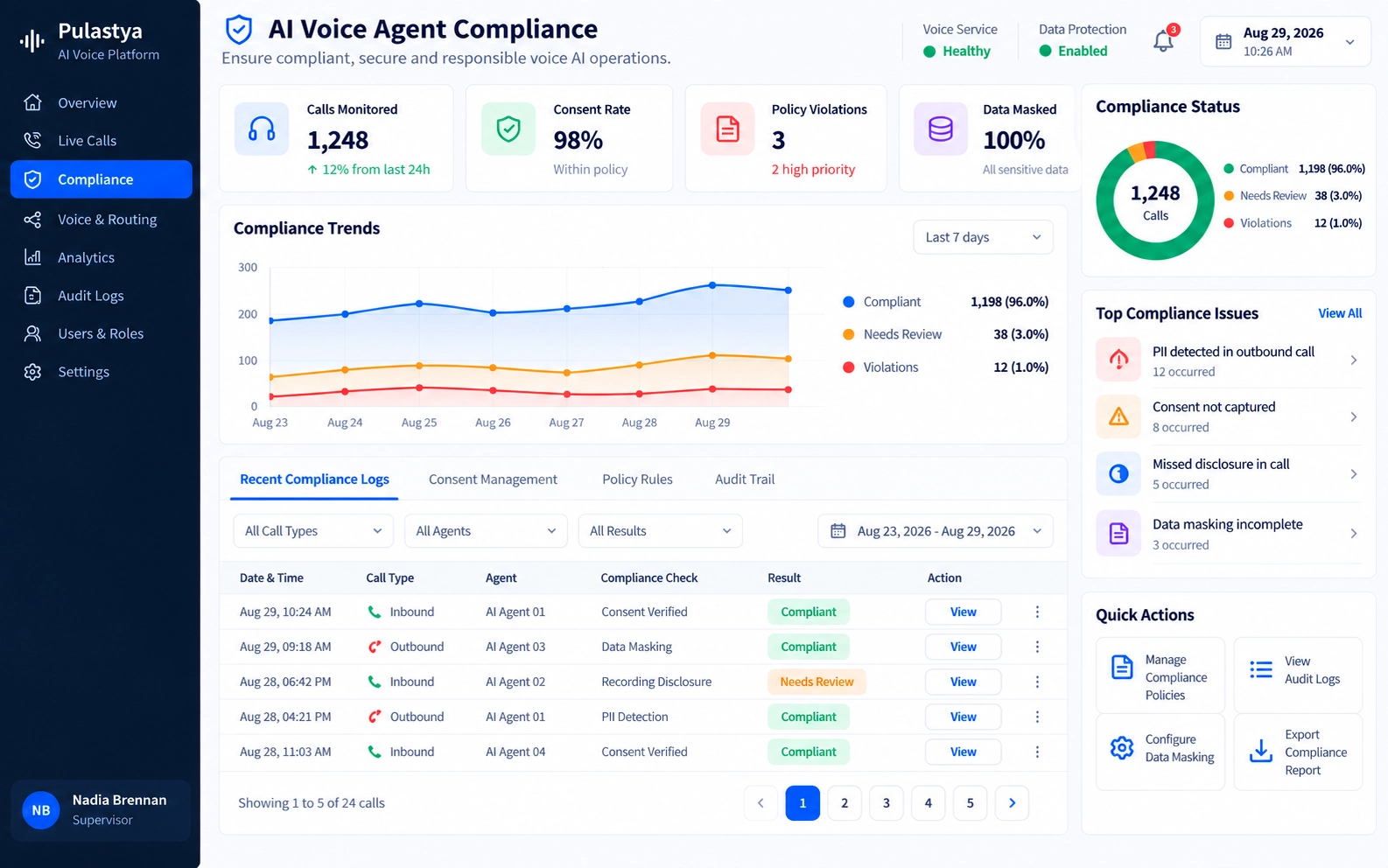
Decisions on whether to record audio or persist transcripts are central to compliance. Recording raw audio provides the strongest audit trail but increases exposure and cost.
For many regulated flows capture should be configurable per call leg and per agent intent so teams can enable recording only for segments that need it, for example identity verification or high-risk transactions, while skipping benign prompts.
Payment card flows need special handling. PCI DSS does not allow card verification codes to be stored after authorization, and a call recording counts as storage, so pause recording or use DTMF masking while card details are collected.
Retention schedules must mirror legal obligations and business needs. Automate lifecycle management with immutable logs showing who changed retention settings and why.
Implement selective redaction to remove or mask PII from transcripts after a business-approved retention window; keep keyed-hash or token references to the redacted values so auditors can verify what was removed without restoring raw PII to general access.
Plain hashes of short values such as account numbers can be reversed by brute force, so use a keyed hash or a token vault.
Make capture decisions reproducible and auditable by logging capture flags, recording start-stop timestamps, agent version, and consent tokens with each recording. Use metadata indexes to enable rapid legal holds and targeted e-discovery. Ensure the retention and deletion engine supports attestations so teams can demonstrate to regulators that records were deleted in accordance with the stated policy.
- Implement call-leg level recording toggles aligned to intent detection, and pause recording during card capture.
- Automate retention lifecycle with immutable audit trails that record policy changes.
- Employ selective redaction and keyed-hash or token references instead of restoring raw PII.
- Log capture metadata, timestamps, agent model version, consent token, at ingestion.
- Support rapid legal hold and targeted e-discovery via indexed metadata.
Record selectively and log every decision so retention actions are auditable.
Compliance evidence chain
From Disclosure to Audit Evidence on Every AI Voice Call
- Disclose AI use and recordingTell the caller at call start; log consent with time and the exact wording used
- Capture only what the flow needsRecord high-risk segments only; pause or mask card entry and redact PII
- Apply the retention scheduleDelete or redact on schedule; legal holds override deletion
- Package audit evidenceConsent token, capture flags, model version and deletion attestations
Each step leaves a logged artifact, so an auditor can trace one call from its disclosure to its deletion.
Consent Management and Caller Rights
Whether consent is required, and what it has to cover, depends on the jurisdiction, the direction and purpose of the call, whether an artificial or prerecorded voice is used, whether the call is recorded, and the sector involved. Establish the rules that apply to your own campaigns with counsel rather than assuming a single standard.
Where consent is the basis being relied on, capture it as an atomic event with a verifiable token: who consented, when, what they were told, and any limitations. Store that token with the call metadata so later queries, such as audits or regulator requests, can reconstruct the consent trail quickly.
Provide mechanisms for immediate revocation. Withdrawing consent generally stops future recording and processing rather than making past processing unlawful, but it can trigger deletion duties, for example under GDPR when no other legal basis applies.
Build workflows that can locate all artifacts tied to a consent token and either delete, redact, or quarantine them based on legal guidance. For high-volume environments, implement automated workflows that escalate revocation requests to legal when conflicting jurisdictional rules apply.
Respect caller rights beyond consent, including access, correction, and objection where applicable. Expose enterprise APIs for rights requests and set processing targets inside statutory deadlines, such as one month under GDPR or 45 days under the CCPA, both extendable in some cases.
Maintain a rights-request ledger that logs verification steps taken to confirm requestor identity and the subsequent actions performed on the voice data.
Choosing a voice platform does not move these obligations to the vendor. Pulastya AI, for example, leaves call consent and local recording requirements with the customer, and its call transcripts and summaries give compliance reviewers a record of what was said on each call.
- Capture consent as a verifiable token linked to call metadata and transcripts.
- Support immediate revocation and deletion workflows with automated artifact searches.
- Escalate complex jurisdictional revocations to legal with full context.
- Expose APIs and SLAs for access, correction, and objection requests.
- Log verification steps and actions in a rights-request ledger for audits.
Treat consent as an immutable event linked directly to call artifacts and workflows.
Model Governance, Versioning, and Explainability
Model governance must document provenance, training data sources, and validation metrics for each model version used in production. Maintain a model registry that records training datasets, hyperparameters, and evaluation reports tied to each version. This registry should be queryable by auditors and used by deployment pipelines to block unapproved models from reaching live agents.
Explainability for voice agents focuses on why a specific action occurred in a call-flow: why a model classified intent X, why a sensitive noun was redacted, or why a fallback to human agent happened.
Capture structured decision logs with model version, confidence scores, NLU parsing details and, for LLM-based agents, the prompt version, retrieved knowledge sources, and tool calls. These logs enable supervisors and examiners to reconstruct decision logic without exposing raw training data.
Periodic revalidation is critical where models interact with regulated decisions. Define revalidation cadence driven by model change, drift detection, or regulatory triggers. Retain test suites that include fairness, bias, and safety checks specific to the voice domain, e.g., performance across accents, age ranges, and audio qualities, and require passing results before production rollout.
- Maintain a model registry with provenance, training datasets, and evaluation reports.
- Log decision artifacts: confidence, parse results, prompt and model version, and knowledge sources used.
- Require explainability logs for decisions that affect consumer rights or transaction outcomes.
- Run domain-specific test suites for accent, noise, and demographic performance before release.
- Set revalidation cadence tied to drift detection, retraining, or regulatory events.
Make every model decision reproducible by linking model metadata to call-level decision logs.
Security Architecture and Encryption Practices
Implement defense in depth across network, compute, and storage layers for voice data. Encrypt audio and transcript at rest using enterprise key management and rotate keys on a schedule aligned with corporate policy.
Encrypt signaling and media in transit: TLS for SIP signaling and WebSocket media streams, SRTP for RTP media, with ephemeral session keys. Segment access to storage by role so only authorized processes can retrieve raw audio, while downstream services receive redacted or derived artifacts.
Control access with fine-grained role-based access control and attribute-based policies tailored to contact center operations. Separate duties between personnel who can listen to raw audio and those who can only view redacted transcripts. Add just-in-time access workflows with time-limited credentials and mandatory session recording for privileged actions to deter misuse.
Prepare for data breach scenarios with tabletop exercises focused on voice-specific risks such as unauthorized call playback or export of audio archives. Maintain incident playbooks that include rapid freeze of key material, targeted revocation of tokens, and expedited notifications to regulators and impacted individuals when obligations require disclosure.
- Encrypt audio and transcripts at rest with enterprise KMS and rotate keys per policy.
- Encrypt signaling and media in transit (TLS, SRTP) with ephemeral session keys.
- Apply RBAC and ABAC to segregate raw audio access from redacted access.
- Use just-in-time credentials and session recording for privileged access to audio.
- Run voice-focused breach tabletop exercises and maintain a targeted incident playbook.
Treat raw audio as high-value material and lock access behind layered controls.
Operational Controls, Agent Design, and a Scenario
Operational controls include runtime checks, graceful fallbacks, and human-in-the-loop escalation criteria. Define guardrails in the call-flow that detect high-risk phrases or failed identity proofs and route those calls to supervised agents.
Implement explicit human review checkpoints for transaction confirmations above a defined risk threshold, and provide supervisors with contextual metadata and the exact model version that produced the decision.
Design agent prompts and confirmations with compliance in mind. Open each call by telling the caller they are speaking with an automated agent and whether the call is recorded.
Use explicit language for consent and transaction validation steps, avoid ambiguous phrasing that could be interpreted as implied consent, and require verbal confirmation tokens where lawfully necessary. Balance brevity and clarity so prompts do not degrade user experience while still producing the evidence auditors need.
Example: a regulated payments provider deploys an AI voice agent to handle payment changes. The provider configures the system to record only the segments covering authorization and amount changes, captures consent tokens at the start, and routes any low-confidence authorization to live agents.
That operational rule limits exposure and creates a clear audit trail showing that high-risk actions always carry a human oversight path.
- Define runtime guardrails that escalate high-risk calls to supervised agents.
- Require explicit verbal confirmation for sensitive actions and link confirmations to consent tokens.
- Design prompts to be clear and auditable without harming caller experience.
- Log low-confidence events and divert them automatically to human review.
- Use metadata and model-version context at supervisor consoles to aid audits.
Operational guardrails and clear prompts convert policy into enforceable call-flow behavior.
Monitoring, Auditing, and Continuous Compliance
Continuous monitoring should blend quality assurance, compliance sampling, and technical telemetry. Implement channels that surface anomalies like sudden spikes in redaction failures, consent token mismatches, or elevated fallback rates. Correlate these signals with model version and deployment events so teams can trace incidents to specific releases or configuration changes quickly.
Auditing requires both scheduled reviews and on-demand forensic capability. Build automated sampling rules that surface calls for review based on risk indicators, such as transaction size, caller jurisdiction, or low-confidence NLU results, and retain the ability to pull complete audio and decision logs under legal hold.
Maintain an evidence repository that packages call audio, transcripts, model logs, and consent tokens into an audit bundle, so a regulator request can be answered from one place.
Close the loop with continuous improvement: use audit findings to update intent models, adjust prompts, and refine retention rules.
Track remediation items with ownership and deadlines, and require verification steps that confirm fixes behave as intended in production. Regularly exercise the entire compliance chain from consent capture to deletion so the organization can prove the system operates as claimed under regulatory scrutiny.
- Monitor redaction accuracy, consent token integrity, fallback rates, and model confidence in real-time.
- Correlate anomalies with deployments and configuration changes for fast root cause analysis.
- Automate risk-based sampling and support full-audit bundle generation for legal holds.
- Track remediation items with ownership, verification steps, and closed-loop evidence.
- Regularly exercise end-to-end compliance scenarios to prove controls under scrutiny.
Make monitoring and auditing systemic so compliance is verifiable, not assumed.
For outbound consent, calling-hour and do-not-call rules, see AI dialer compliance.
Important: Requirements vary by jurisdiction, call purpose, technology, and the relationship with the recipient. Organizations should verify applicable laws, maintain appropriate records, and obtain legal review before deploying automated voice workflows.
Compliance decisions overlap with security and privacy controls and, for outbound campaigns, calling-hour and time-zone rules.
Conclusion
AI voice agent compliance works when regulatory mapping becomes enforceable behavior in every call. Enterprises need clear AI and recording disclosures where required, verifiable consent, selective capture, protected transcripts, defined retention and deletion rules, and traceable model decisions. Linking these controls to call-level metadata creates the evidence needed to investigate failures and respond to audits without retaining more personal data than necessary.
The operating model matters as much as the technology. Assign owners for policy updates, caller rights requests, incident response, model revalidation, and remediation. Test end-to-end scenarios from disclosure through deletion, and use risk-based monitoring to catch gaps early. Before adding a new jurisdiction, campaign, or agent capability, review applicable requirements and verify that human escalation, access controls, and audit evidence still meet the approved standards.
Frequently Asked Questions
No. Recording every call increases exposure and cost. Apply selective recording tied to intent and risk: capture identity verification steps, payment authorizations with card details masked, and high-risk transactions while skipping routine informational exchanges. Log decisions to record so audit trails can prove why specific calls were retained.
Store consent as a verifiable token with metadata, time, presented language, and who consented, and link it to call metadata and transcripts. This enables rapid reconstruction of consent events for audits and supports automated revocation workflows where required by law.
For decisions that affect rights or transactions, capture model version, confidence scores, NLU parse results and, for LLM-based agents, the prompt version, retrieved knowledge sources, and tool calls. Store these decision artifacts with timestamps and call identifiers so auditors can reconstruct why the agent acted a certain way without exposing raw training data.
Use selective retention, redact PII in transcripts, encrypt raw audio with enterprise key management, and restrict access via role-based controls. Keep keyed-hash or token references to redacted values so you can prove what was removed without restoring full PII to general access.
Often, yes. The EU AI Act requires telling people they are interacting with an AI system unless that is obvious, some US states add their own disclosure rules, and the FCC treats AI-generated voices as artificial under the TCPA, which requires prior express consent for many automated calls. A short disclosure at the start of each call, logged with the call, is the simplest control; confirm local rules with counsel.