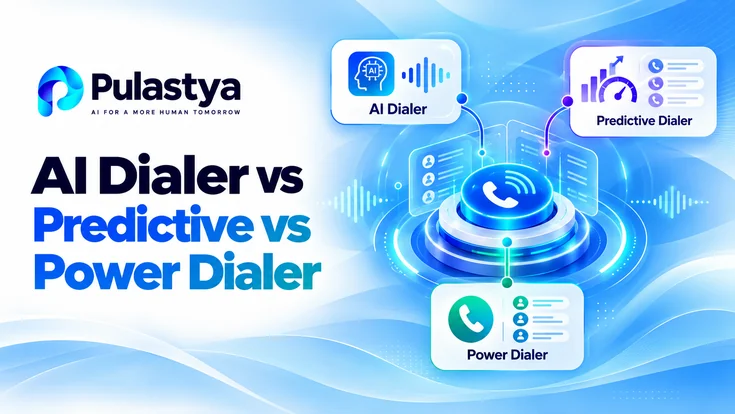
AI dialer, predictive dialer and power dialer differ by how they schedule outbound calls, how many calls they place per agent, and whether they add conversational automation. Predictive dialing times calls to maximize agent occupancy. Power dialing controls a steady stream.
AI dialers add machine learning, intent detection and automated talk-handling to change prioritization and live-agent handoffs.
- Match model to outcome Select the dialer that aligns with campaign goals: throughput, conversion quality, or automated handling of routine interactions.
- Balance pacing and occupancy Higher agent occupancy often increases call volume but reduces time for meaningful conversation. Choose a model that matches agent skill and list freshness.
- Treat AI as workflow augmentation AI dialers can add prioritization and partial conversation automation; pilot and validate advanced autonomy before scaling it.
Compare models by three operational dimensions: dialing logic, agent involvement and conversation capability. Dialing logic determines throughput and drop risk. Agent involvement defines whether a human handles the primary interaction. Conversation capability ranges from simple IVR prompts to AI-driven intent recognition and partial automated handling.
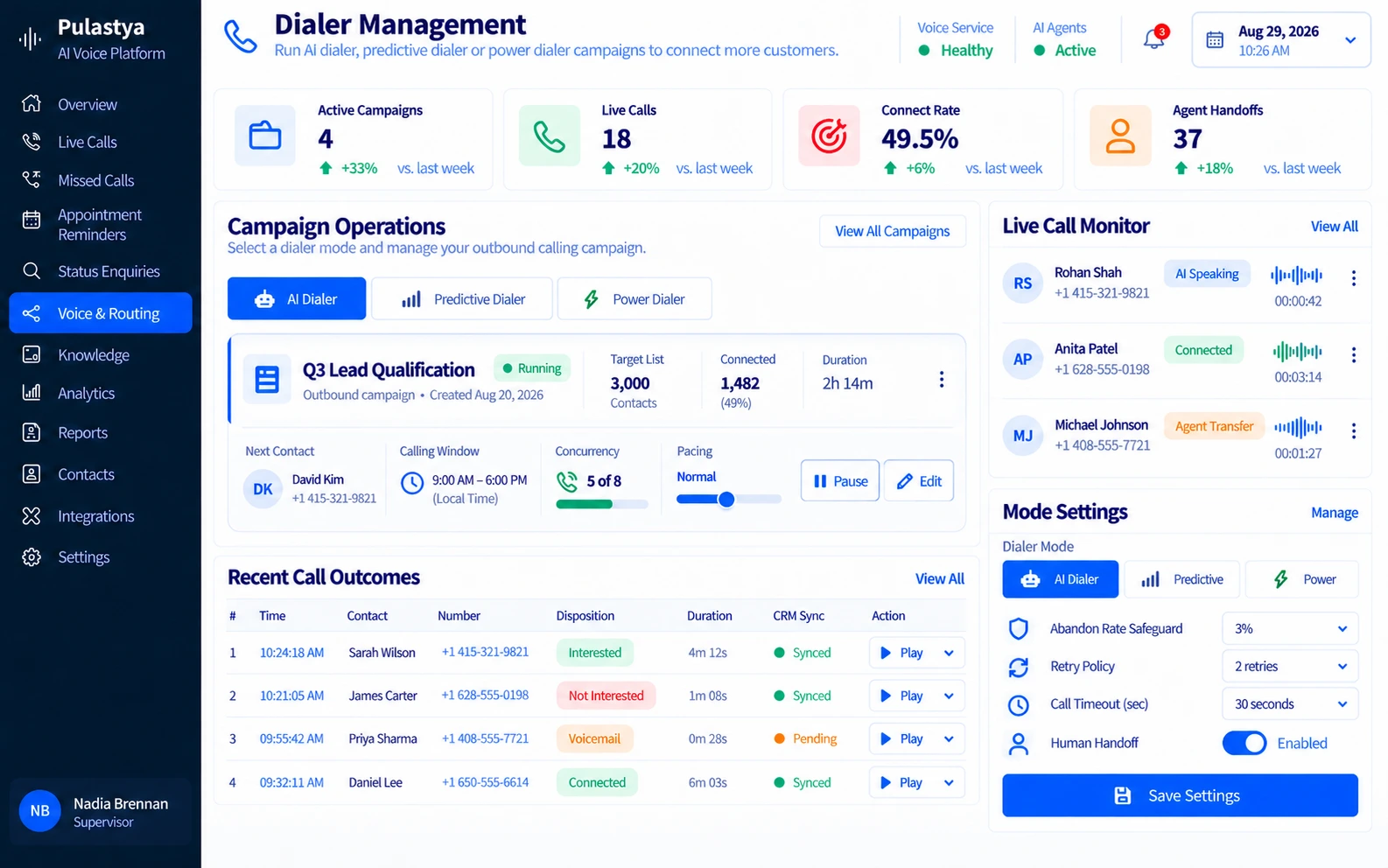
Enterprise selection should map to conversion objectives, list quality and agent skills. High-volume lead-capture favors dialing that maximizes throughput. Complex or consultative selling requires controlled pacing and higher live-agent presence.
AI enhancements can shift workload, but evaluate them in controlled pilots rather than treating them as an out-of-the-box replacement for human salescraft.
How the Three Dialer Models Differ
Power dialer: dials one or a small fixed number of lines per available agent. It minimizes dropped calls and preserves agent talk time, making it suitable where each call requires an attentive human response and list contact rates are moderate to high.
Predictive dialer: uses historical call-answer patterns and agent availability to place multiple calls in parallel and bridge answered calls to the first available agent. It improves agent occupancy but increases the chance of abandoned calls and requires careful pacing and regulatory controls.
AI dialer: layers machine learning and natural language processing onto dialing and routing logic. It can prioritize contacts, route based on intent signals, and in some deployments provide partial automated conversation handling or real-time assistance to agents.
Comparison checklist: evaluate each model against these operational attributes.
- Agent occupancy: predictive increases occupancy; power preserves talk time; AI can shift occupancy by automating parts of the interaction.
- Drop-risk management: power minimal; predictive requires abandonment mitigation; AI needs both pacing and conversational safety checks.
- Implementation timeline: power short, predictive moderate due to tuning, AI longer due to data and integration needs.
- Best fit summary: power for high-quality conversations; predictive for high-volume outreach; AI for prioritized routing and partial automation.
Choose the dialer that aligns with outbound objectives, list quality and the level of permissible automation.
Compare dialer modes
Power, Predictive and AI Dialers: How Each Paces Calls and Where It Fits
| Dialer mode | How it dials | Trade-off, best fit |
|---|---|---|
| Power dialer | One or a few fixed lines per available agent; a person takes every answer | Minimal drop risk, lower throughput; consultative sales and renewals |
| Predictive dialer | Parallel calls paced from answer patterns; answers go to the first free agent | Highest occupancy but abandoned-call risk; large, high-volume lists |
| AI dialer | Prioritizes contacts; AI handles routine parts, then routes by intent | Needs pacing plus conversational safety checks; triage and qualification |
| Mixed strategy | Different modes for different campaign phases | Predictive for reach, power for conversion, AI for qualification |
Pacing is the core difference: the more calls placed per agent, the higher the occupancy and the more abandonment and safety controls the campaign needs.
Pacing, Live-Agent Involvement and Conversational Capability
Pacing describes how fast the system places calls relative to agent availability. Tight pacing increases throughput but shortens pre-call context. Slower pacing reduces idle time savings but increases available prep and personalization time for the agent.
Live-agent involvement ranges from full-control live calls to assisted conversations where AI supplies prompts or suggested replies. Maintain clarity on which parts of the call remain human-controlled and which are automated to preserve compliance and quality.
Conversational capability covers speech recognition, intent classification, turn-taking and generated responses. Basic systems offer playback prompts or DTMF menus; advanced AI may provide real-time suggestions or conduct portions of the exchange under supervision.
Treat advanced autonomous conversation as an experimental workflow: run controlled pilots with clear escalation rules and monitoring metrics before scaling it.
- Set confidence thresholds for AI handoffs and automatic responses to avoid misrouting or wrong commitments.
- Define agent takeover rules and maximum handoff latency to keep customer experience consistent.
- Monitor voice-quality and ASR error rates as KPIs before scaling automated conversation features.
- Document when the system may speak autonomously and ensure auditable transcripts for review.
Explicit handoff and confidence rules determine whether automation improves throughput without degrading conversational outcomes.
When Predictive, Power and AI Dialers Fit Different Campaigns
Predictive dialers work best for campaigns where contact lists are large, leads are time-insensitive and maximizing agent talk-time drives marginal conversions. Use them when teams have strong compliance controls and the goal is volume-driven pipeline growth.
Power dialers suit consultative selling, technical support outreach and any campaign where one meaningful conversation per contact matters more than raw call volume. They give agents time for discovery, note-taking and personalized closing steps.
AI dialers fit campaigns that can benefit from prioritized outreach, automated qualification, or conversational triage. Typical uses include lead scoring automation, automated appointment confirmations and handling routine, scriptable queries before routing to agents.
Practical scenario: a mid-market sales team with 20 agents and a list of 2,000 contacts. Use predictive dialing to keep agents engaged during a product launch when contact freshness is low. Switch to power dialing for high-value prospects requiring deep demos.
- High-volume list nurturing: predictive dialer to maximize conversations per agent-hour and surface engaged contacts.
- Complex sales or renewals: power dialer to preserve agent context and improve conversion per contact.
- Triage and qualification: AI dialer to automate screening and route only qualified or complex leads to agents.
- Mixed strategies: combine models across campaign phases to balance reach and quality.
Mix and pilot models by campaign phase: use predictive for reach, power for conversion, and AI for qualification and routing.
Questions to Ask Before Choosing a Model
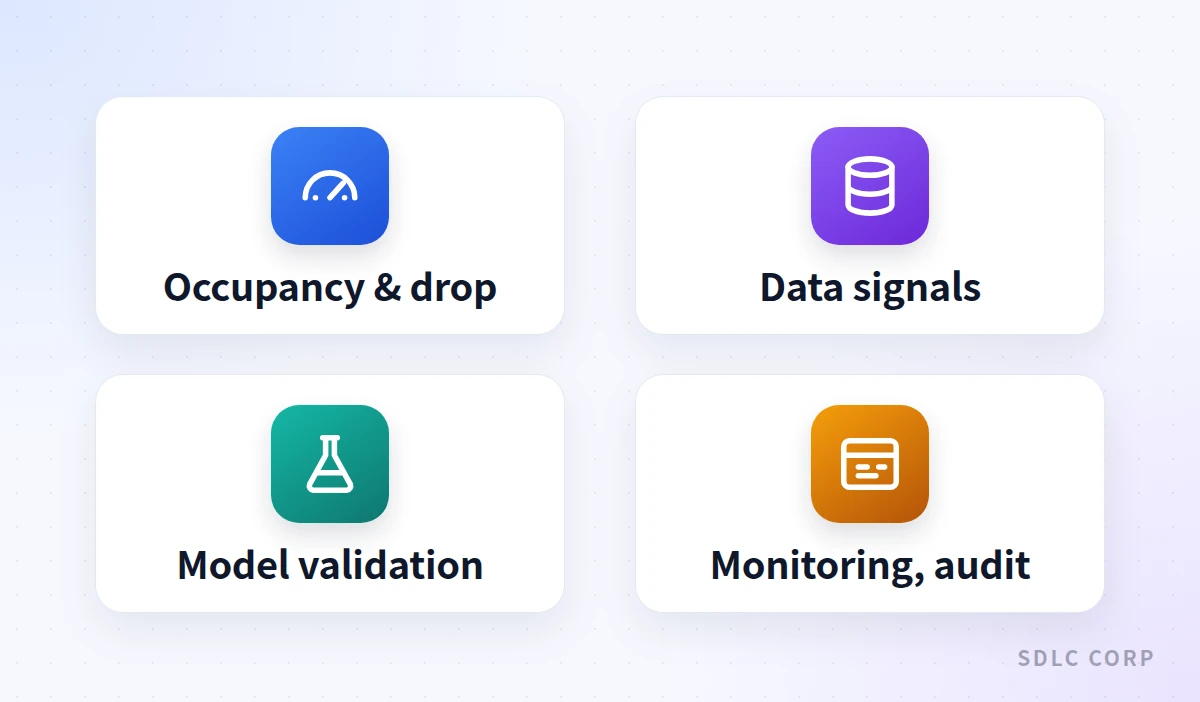
Operational questions: what are target agent-occupancy and acceptable drop rates? Define acceptable tradeoffs between throughput and call abandonment before evaluating vendors or building in-house solutions.
Data and integration questions: what customer signals are available to prioritize contacts? Evaluate CRM, lead-score and engagement-data integration needs to support AI-driven routing and prioritization.
Capability and validation questions: how will you measure ASR and intent-classification accuracy? Require vendors to disclose model evaluation metrics and provide sandboxed proof-of-concept testing.
Monitoring and governance questions: what alerts, dashboards and audit trails are required to track automation behavior? Specify logging requirements, human review cadence and retraining workflows for any ML components.
- What are acceptable agent idle and abandonment thresholds for each campaign?
- Which CRM fields and real-time signals will the dialer consume for routing decisions?
- Can the vendor support sandbox testing and transparent model-performance metrics?
- What are the escalation paths and SLAs for failed automated conversations?
Prioritize integration, measurement and human-in-the-loop controls when evaluating dialer choices.
For the components and call flow behind an AI dialer, see how AI dialers work.
To see how a chosen model runs from lead list to follow-up workflow, read about outbound campaign automation.
If an AI dialer fits your campaigns, the guide to choosing outbound AI calling software lists the controls to evaluate before choosing a platform.
Conclusion
Choosing between an AI dialer, predictive dialer and power dialer depends on your outbound campaign goals, list quality, agent capacity and compliance requirements. Predictive dialers can improve agent occupancy in high-volume outreach, while power dialers offer more controlled pacing for consultative sales and relationship-focused conversations.
AI capabilities can enhance either approach through lead prioritization, automated qualification, agent assistance and smarter routing. Rather than relying on one dialer model for every campaign, evaluate realistic call scenarios and measure connection quality, conversions, abandonment risk and customer experience. Pilot the approach that fits your workflow, verify human handoff controls and expand only when performance and compliance requirements are met.
Frequently Asked Questions
Predictive dialers are designed to maximize agent occupancy by placing multiple calls and routing answered calls to available agents. That advantage requires careful tuning to avoid abandoned calls and must be balanced against customer experience and regulatory constraints.
AI dialers can automate routine qualification, confirmations and information gathering, but fully replacing skilled live agents is rare for consultative sales. Pilot, validate and monitor advanced autonomous conversation rather than treating it as an immediate replacement.
Request sandbox tests, model performance metrics, transcript samples and error-rate reporting. Evaluate ASR accuracy, intent classification precision and fallback behavior. Insist on transparent validation before scaling any AI-driven conversation capability.
Assess real-time voice routing latency, scalability for concurrent calls, CRM and data integration, and logging pipelines for transcripts and events. AI capabilities add needs for model hosting, feature pipelines and monitoring infrastructure.
Compliance depends on jurisdiction and campaign context. Predictive dialing increases the risk of abandoned calls, so implement recordable consent flows, abandonment mitigation and regulatory controls. Treat compliance validation as a required vendor and legal checkpoint.