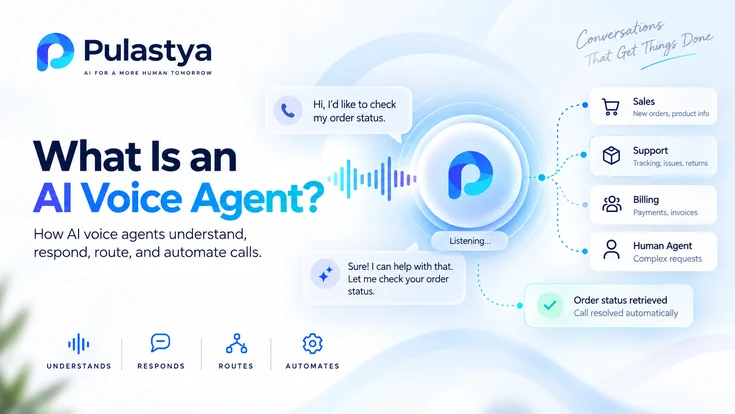
An AI voice agent is a real-time voice system that can listen, interpret intent, retrieve a trusted source of truth, and respond, trigger a workflow, or hand the call to a person with context intact.
- Core idea Voice AI combines speech understanding, decision logic, grounded knowledge, and action handling in one call flow.
- Control model Approved knowledge, live APIs, and policy rules should stay separate so each control point can be governed.
- Operational goal The system should either resolve safely, create the next step, or escalate with enough context to avoid repetition.
That distinction matters because many buyers are not comparing voice AI to nothing. They are trying to separate a conversational operating layer from older speech bots, menu trees, and FAQ playback systems that can recognize words but cannot reliably manage a live business process.
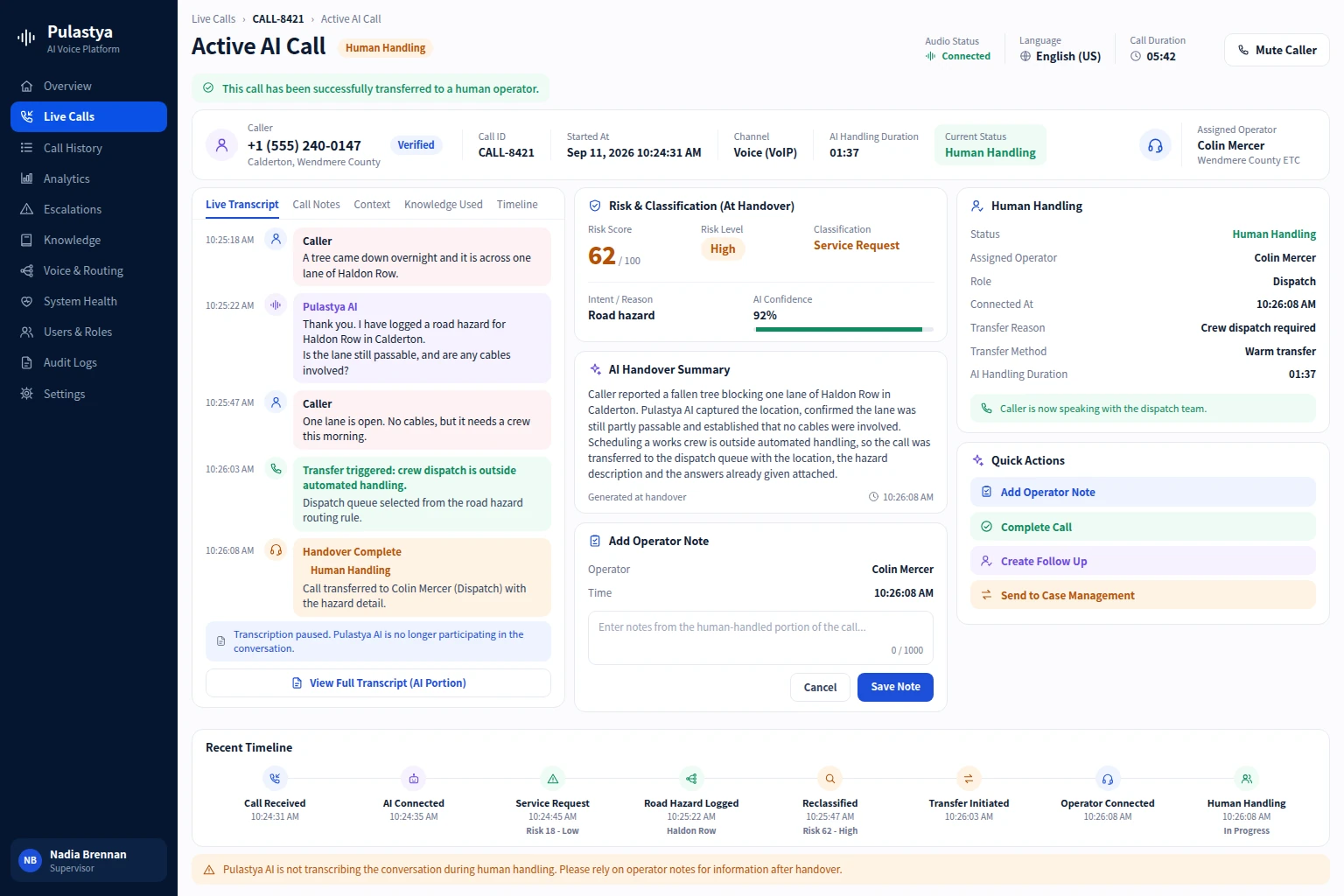
What an AI Voice Agent Is - And What It Is Not
An AI voice agent is not just a voice front end for scripted prompts. It is a call-handling layer that can keep track of what the caller wants, extract relevant details, and decide whether the next best action is an answer, a workflow step, a route decision, or a human transfer.
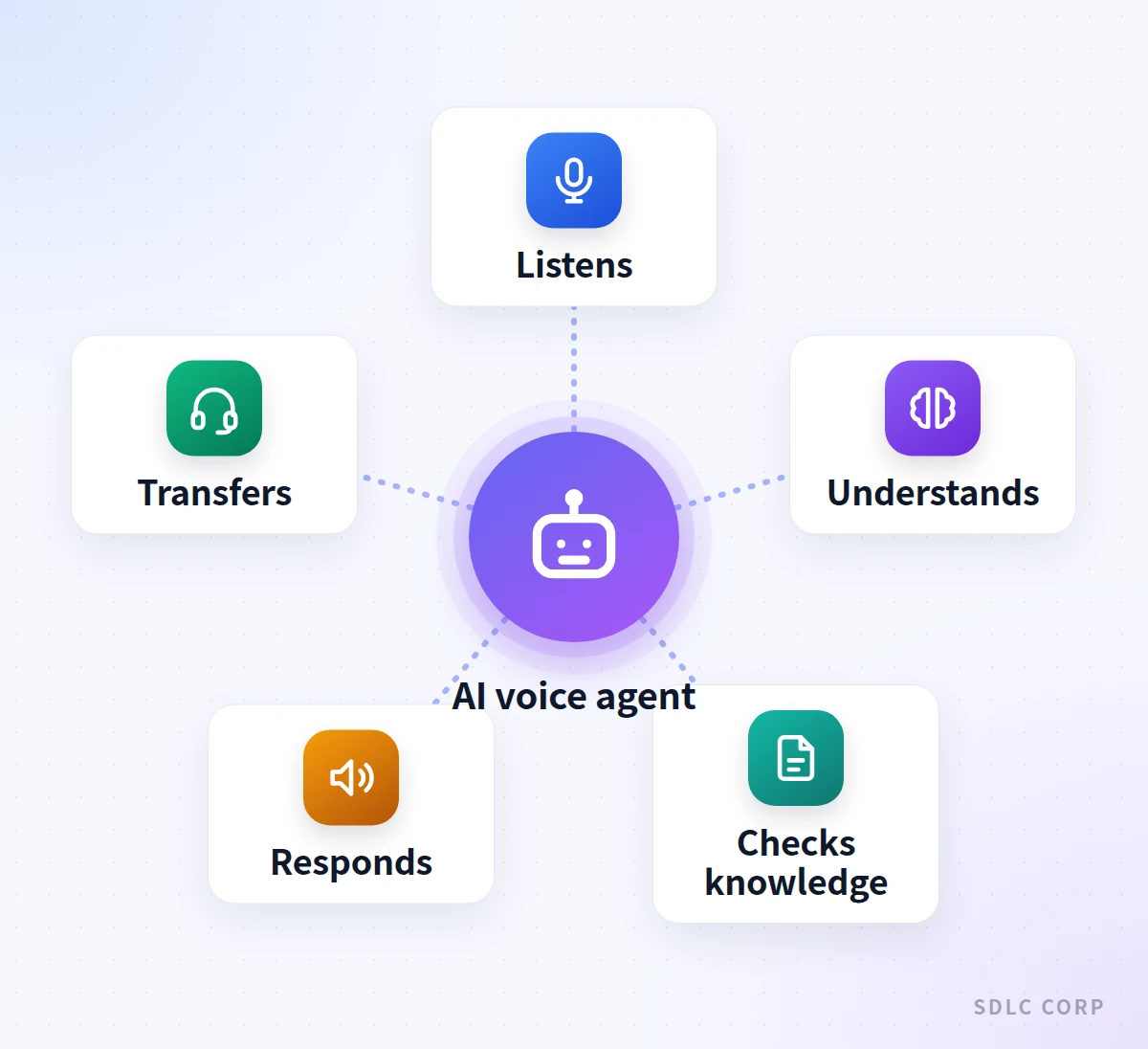
If your evaluation starts with an AI voice agent vs IVR question, the practical difference is that IVR mainly moves callers through predefined menus, while a voice agent can handle open-ended requests and adapt the next step to intent, context, and rules.
That does not make every speech bot an AI voice agent. Systems that only play prompts, collect keypad input, or replay brittle scripts may improve access, but they do not deliver conversational understanding or policy-aware orchestration.
Inbound and Outbound AI Voice Agents
An AI voice agent works in two operating modes. Both use the same speech, understanding, knowledge and action layers; what changes is who starts the call and which rules apply before the conversation begins.
Inbound: Answering Calls to a Business Number
In inbound mode, the agent answers calls that customers, patients or prospects place to a business number. It handles intake, answers questions from approved knowledge, captures the details a team needs, routes the request, and transfers the caller to a person when the call needs judgment or approval.
Because the caller chose to call, the main design work is answer quality, routing accuracy and clean handoff. After-hours and overflow coverage are common starting points. The guide to inbound AI voice agents covers this mode in detail.
Outbound: The Agent Places the Call
In outbound mode, the agent places calls on the business's behalf: follow-ups on inquiries, appointment or payment reminders, lead qualification, and renewal conversations. The same loop runs once the person answers, but the business started the contact, so more rules apply before and during the call.
Outbound programs need consent where the law requires it for automated or AI-generated voice calls, clear disclosure of who is calling and why, calling hours that respect the recipient's time zone, and prompt handling of opt-out requests.
Confirm the rules for each market with legal counsel before launch. The overview of AI outbound calling software covers outbound use cases and the controls to plan for.
- Inbound: the caller starts the call; the agent answers, routes or transfers.
- Outbound: the business starts the call; consent, disclosure and calling-hour rules apply first.
- Both: the agent should transfer to a person with context when a call goes beyond its scope.
The Real-Time Voice Loop: Telephony to Speech Recognition to Language Understanding to Orchestration to Response
The runtime loop usually starts with telephony and audio capture. Speech recognition turns the caller audio into text, language understanding interprets intent and entities, and an orchestration layer decides whether the system should answer, ask a follow-up question, look something up, call an API, or transfer the conversation.
That flow is why the channel behaves differently from a voice AI vs chatbot decision. Voice has to manage turn-taking, interruptions, latency, and repair. A response that would be acceptable in chat can sound broken on a phone call if it arrives slowly, ignores context, or asks the caller to repeat information already provided.
In practice, the orchestration layer matters as much as the model. It is where timing, fallback behavior, escalation paths, and live workflow decisions are coordinated so the caller experiences one continuous conversation instead of a set of disconnected subsystems.
The real-time loop
What Happens Between a Caller Speaking and the Agent Replying
- Caller speaksAudio arrives over the phone line; the agent tracks turn-taking and interruptions
- Speech recognitionStreaming transcription turns caller audio into text as the person talks
- Understanding and contextIntent, extracted details and what was already said earlier in the call
- Knowledge, live systems and policyApproved knowledge for facts, APIs for current data, rules for what is allowed
- Response or actionSpoken answer, follow-up question, workflow step or route decision
Possible outcomes
- Next turn, same contextContext carries forward so the caller does not have to start over
- Transfer when neededJudgment, approval or risk sends the call to a person with a summary
Notice that knowledge, live data and policy sit between understanding and the reply, so the agent checks before it answers or acts.
Intent, Context and Entity Extraction During a Call
Intent tells the system what the caller is trying to achieve, but context explains how to handle the request. A billing dispute, password reset, appointment request, or urgent complaint may all need different treatment even when the caller uses informal language or changes direction mid-call.
Entity extraction turns the conversation into structured inputs such as account identifiers, dates, product names, locations, or service types. That allows the voice agent to ask only for missing fields rather than repeating the entire intake every time the conversation crosses into a new branch.
Good implementations also keep short-term memory for the active call. If the caller says, "I need to reschedule the same appointment for Friday morning," the agent should understand both the current request and the earlier reference without starting the intake process again.
Using RAG for Approved Knowledge and APIs for Live Transactional Data
A strong voice system separates static knowledge from live state. Use RAG for voice AI when the answer depends on approved, versioned information such as policy text, store hours, eligibility rules, or product guidance that should be retrieved with provenance rather than improvised from model memory.
Use authorized APIs when the caller needs current or account-specific data such as claim status, shipment timing, appointment availability, or a balance lookup. Those facts can change in real time, so they should come from the operational system that owns them rather than from a document store.
That split is important for safety. Retrieval helps answer factual questions consistently, while API calls handle current state and actions. Mixing both concerns into one ungoverned knowledge layer makes it harder to audit what the AI said and why it was allowed to act.
- RAG is best for approved documents, scripted explanations, and policy-backed answers.
- APIs are best for current account context, transactional state, and authorized action requests.
- Audit logs should record which source, rule, and system call contributed to the final response.
Rules, Risk and Policy-Controlled Actions
Language understanding should not be the final control point for sensitive actions. Production voice systems need explicit rules for authentication, transfer triggers, after-hours handling, risk thresholds, retry limits, and what the agent is allowed to do with or without human approval.
Risk can also change during a call. A routine inquiry may turn into a fraud alert, a high-value account request, or a regulated complaint once new details are spoken. The system should therefore reevaluate the conversation continuously instead of assuming the first intent classification is the whole story.
This is where deterministic controls are useful. The model can interpret language and summarize the situation, but the business should still own the hard boundaries that decide whether an action proceeds, pauses for verification, or escalates immediately.
Answer from approved knowledge and log the source used for the response.
Allow a live read action only after the required identity and policy checks pass.
Escalate or freeze the action path when the conversation crosses a defined threshold.
When the AI Should Resolve, Create a Workflow, Route or Transfer
Resolution works best when the request is narrow, the facts are grounded, and the action is low risk. For example, an agent can often answer a benefits question, provide status, or collect standard intake data without needing a live person on the line.
A workflow is more appropriate when the system has enough information to create the next step but not enough authority to complete the full outcome. That might mean opening a service request, capturing callback details, or packaging the conversation for a specialist team to complete later.
Transfers should happen when judgment, exception handling, or compliance rules require a human. The handoff should include intent, the key extracted entities, a short summary, attempted actions, and relevant transcript context so the caller does not have to restart from zero.
- Resolve when the answer is grounded and the action is safe.
- Create a workflow when the call can move forward asynchronously.
- Route or transfer when a person needs to decide, approve, or intervene.
Enterprise Deployment Considerations: Observability, Audit, Access Control and Failover
Enterprise teams need visibility into more than answer quality. They need to monitor telephony health, speech latency, understanding confidence, route outcomes, transfer rates, and where callers abandon the flow. Without that operational view, problems show up first as customer frustration rather than as manageable diagnostics.
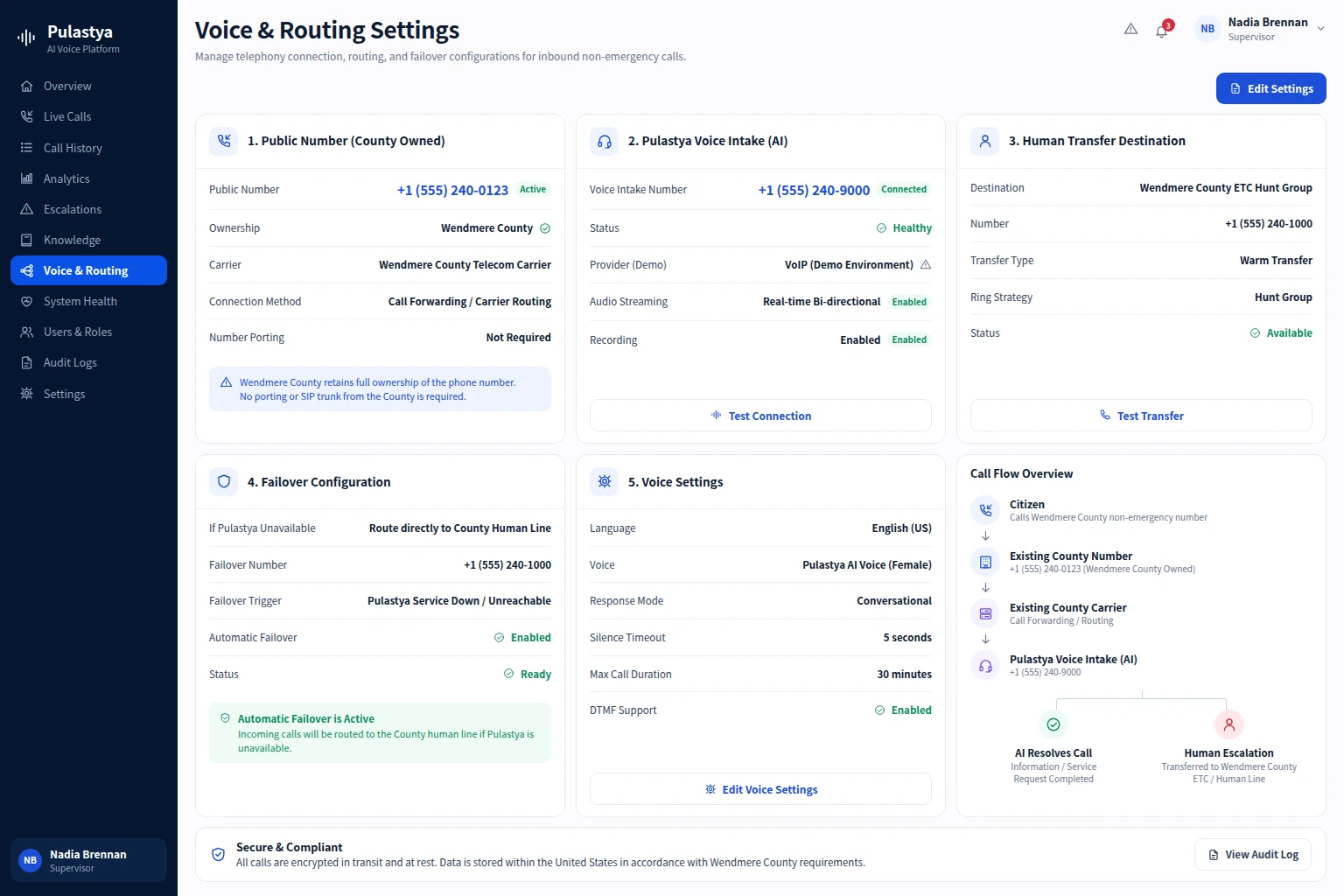
Audit and access control are equally important. Every live response should be traceable to retrieved evidence, live system calls, or configured rules. Access policies should separate read-only lookups from write actions, and failure paths should be explicit so the agent can degrade safely when a dependency is unavailable.
Failover is not only a telephony concern. It includes what happens when speech quality degrades, a live system times out, or an approved answer is unavailable. The system should have a defined fallback path instead of improvising around missing evidence.
The AI call intake and routing case study shows how Pulastya keeps intake, routing, and human transfer connected within one controlled call flow.
Conclusion
An AI voice agent becomes valuable when it is treated as an orchestrated operating system for phone conversations rather than as a talking FAQ. The real design work is deciding what knowledge it can trust, what systems it may access, when it should act, and when it should hand the conversation to a person.
Pulastya applies these principles to inbound and outbound business calls. Answers come from business documents the team uploads, calls that need a person are transferred with conversation context, and transcripts, summaries and outcomes appear on a call dashboard.
Teams evaluating these control points can explore the Pulastya AI Voice Platform to see how voice intake, routing, call transcripts, and contextual handoff fit together.
Two common business applications of these building blocks are the AI receptionist, which answers and routes front-desk calls, and the AI voice agent for customer support, which resolves repeat questions and escalates complex issues.
Frequently Asked Questions
Speech recognition only converts audio into text. A voice agent also interprets intent, tracks call context, retrieves approved information or live data, applies rules, and chooses the next action.
Use a live system when the answer depends on current or account-specific information such as an appointment slot, order state, or balance. Use approved knowledge when the answer is a governed fact or policy.
Understanding the request is not the same as being allowed to act on it. Rules define authentication, risk thresholds, escalation triggers, and which actions are safe to automate.
In a warm transfer, the AI or agent reaches and briefs the receiving person before connecting the caller. The briefing should pass the minimum useful context: the reason for the call, the current status, key extracted details, any attempted actions, and a concise summary so the next person can continue without repetition.