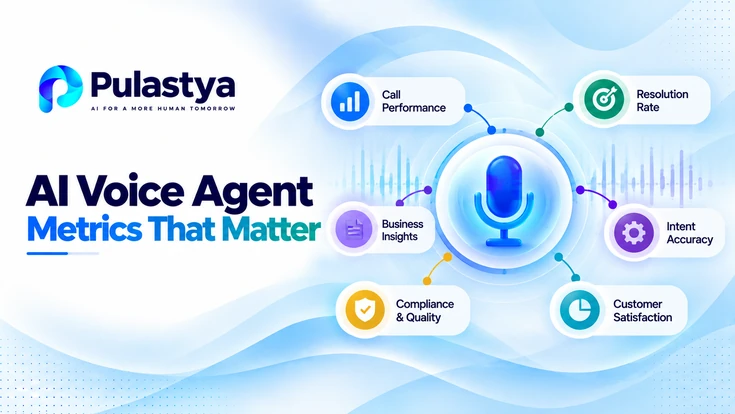
AI voice agents deliver measurable cost and experience outcomes only when teams measure the right indicators.
The metrics worth prioritizing align technical performance, contact center operations, and customer satisfaction so stakeholders can make disciplined tradeoffs, set reliable SLAs, and plan continuous improvement without chasing vanity numbers.
- Outcome first Select metrics that map directly to the desired business outcome, not just model performance.
- Cross-functional ownership Define metric owners across engineering, operations, and product and enforce data contracts for each signal.
- Continuous measurement Automate sampling, annotation, and drift detection to keep voice agent performance stable after launch.
Start by defining the business outcome you expect from voice automation: containment, speed, accuracy, or a mix. That outcome determines which metrics matter and which signals are noise. Technical teams should instrument ASR, NLU, and latency metrics; operational leaders should track transfers, handoffs, and cost per contact; product owners should own outcome mappings and SLA thresholds.
Organize metrics into measurement domains, connect them to revenue and cost levers, and back them with concrete monitoring and governance patterns. Use the resulting metric list to build dashboards, alerts, and data contracts before deployment.
Map Metrics to Business Outcomes
Begin measurement by mapping each metric to a clear business outcome: containment rate maps to cost savings, successful completion rate maps to reduced repeat contacts, and average handle time maps to agent throughput.
Create a short table that links each KPI to a dollar, time, or experience outcome. That mapping makes it easier to prioritize fixes and justify model improvement spend.
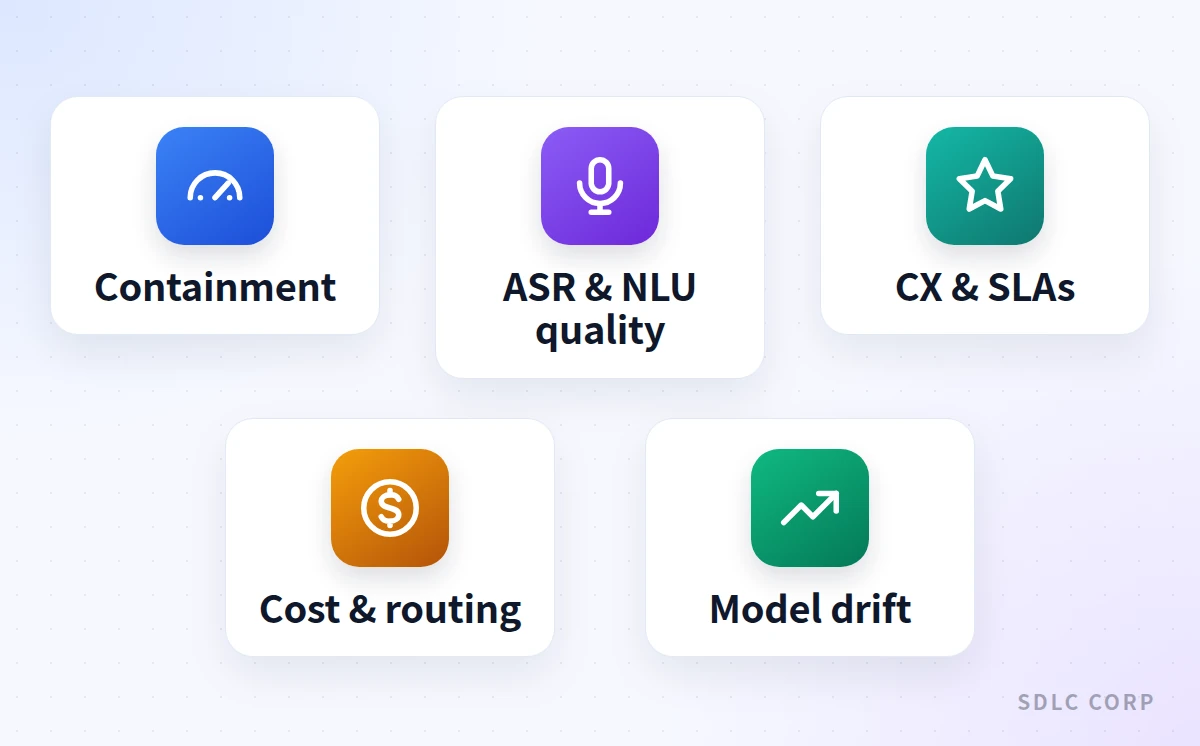
Avoid tracking technical metrics in isolation. For example, improving word error rate may have little impact on containment if your intent classifier remains brittle. Build composite metrics that combine ASR, intent confidence, and intent-to-action conversion to show the full funnel from speech to solved issue. Use those composites to guide A/B experiments and backlog priorities.
Set enterprise-grade SLA targets and error budgets tied to business impact rather than raw model accuracy. Define escalation thresholds and remediation steps when composite metrics cross error budget limits. Make these agreements visible to stakeholders and automated where possible so that operational teams can trigger retraining, annotation, or temporary human-in-the-loop routing when needed.
- Link each KPI to a concrete business outcome and a numeric target.
- Create composite funnel metrics that show speech to resolution flow.
- Establish SLA targets and error budgets tied to business impact.
- Use metric mappings to prioritize engineering and annotation work.
- Publish ownership and remediation steps for each KPI.
Metrics must directly explain how voice automation delivers cost or experience improvements.
Containment, Completion, and Deflection
Containment rate is the share of calls that end without reaching a human agent. On its own it can flatter the agent: a caller who hangs up in frustration, or calls back an hour later, still counts as contained.
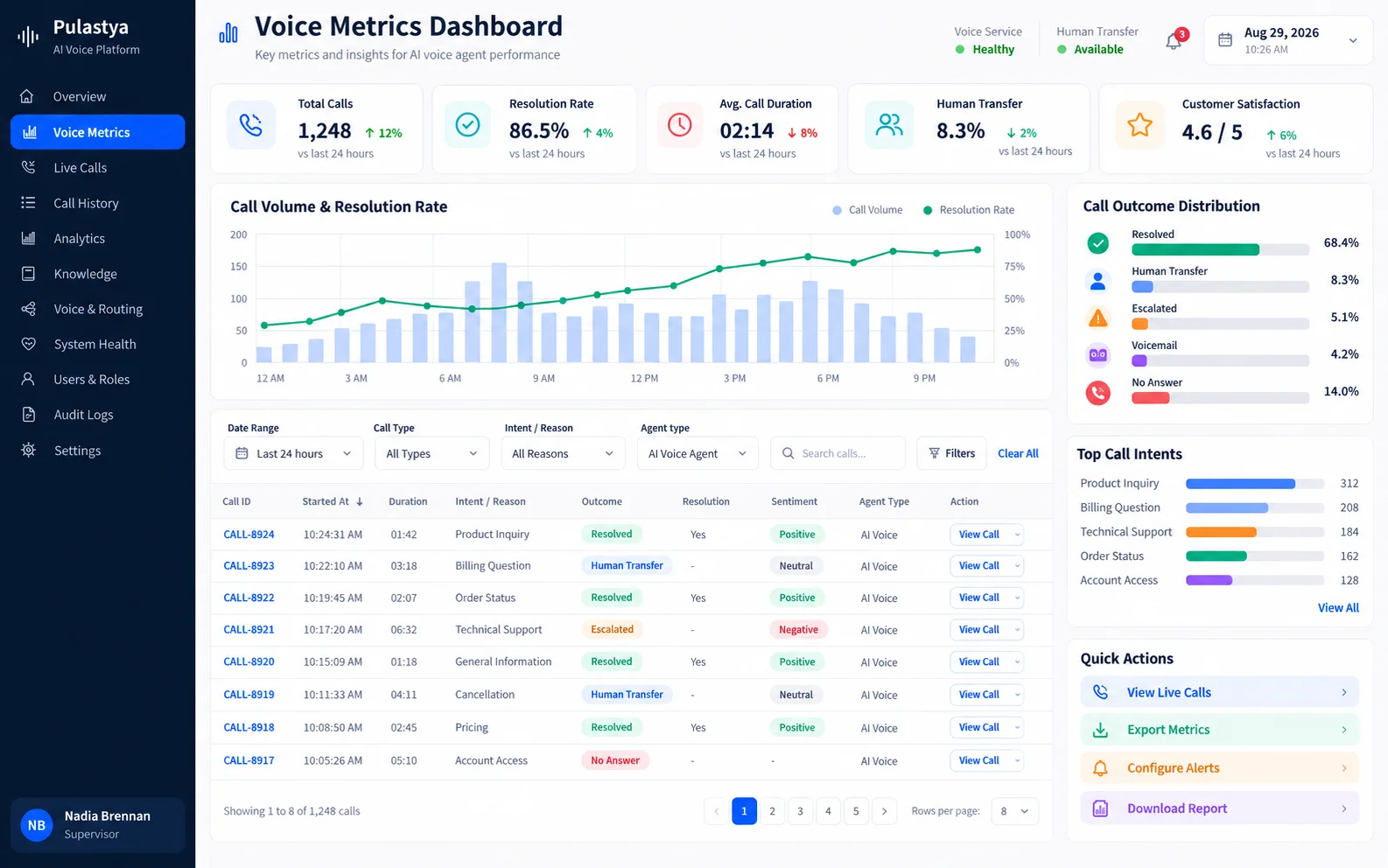
For enterprise measurement, pair raw containment with verified resolution: the call ended without a transfer, the task was completed, and no repeat contact arrived within a defined window such as 24 hours or seven days. Track both by intent, customer segment, and channel to identify where automation delivers real value and where human routing remains necessary.
Completion rate measures successful task completion given an intent correctly recognized. Distinguish recognition success from task success: a correct intent prediction that still fails to produce a correct downstream action should reduce completion. Instrument downstream APIs and fulfillment steps to detect these end-to-end failures and close the loop.
Deflection quantifies contacts prevented through proactive prompts or self-service. Measure prevented repeat contacts and avoid attributing seasonality to deflection gains. Use controlled experiments to isolate deflection impact on total contact volume, and monitor for negative side effects such as increased average handle time on escalated calls.
- Report raw containment next to verified resolution: no transfer, task done, no repeat contact in the window.
- Track completion as end-to-end success, including backend fulfillment verification.
- Segment containment and completion by intent, product, and customer tier.
- Use experiments to validate deflection effects on total contact volume.
- Monitor for escalation cascades caused by overly aggressive deflection.
Containment and completion are distinct signals and must both be instrumented end to end.
Metric definitions
Core Voice Agent Metrics, What They Count, and Where They Mislead
| Metric | Definition | Watch for |
|---|---|---|
| Containment rate | Share of calls that end without reaching a human agent | Hang-ups and quick callbacks still count as contained |
| Verified resolution | No transfer, task completed, no repeat contact within the window | Backend outcomes that were never actually confirmed |
| Completion rate | Tasks finished correctly after the intent was recognized | Correct intent labels hiding failed downstream actions |
| Transfer rate by reason | Share of calls handed to people, split by reason code | Recognition failures filed under policy transfers |
| Response latency (p95) | End of caller speech to first reply audio, 95th percentile | Averages that hide slow turns in the tail |
| Cost per resolved contact | Telephony, model, API and human minutes divided by resolved calls | Leaving out human time spent after handoff |
Read containment next to verified resolution: a metric that ignores repeat calls can rise while callers are failing.
Conversation Quality: ASR, NLU, and Dialog Metrics
Measure ASR quality with word error rate against human-verified reference transcripts on a sample of calls, plus targeted error counts for domain vocabularies. Track recognition errors on critical entities such as account IDs, product names, and order numbers separately. Sample calls and annotate failure modes so the engineering team can prioritize acoustic model tuning, lexicon updates, or custom entity models.
NLU metrics should include intent recognition accuracy, slot filling accuracy, and intent confidence calibration. Record false acceptance and false rejection rates per intent and monitor confidence score distributions. Poor calibration leads to both unnecessary handoffs and unhandled intents; use calibration checks to adjust thresholding or routing rules.
Dialog-level metrics capture turn success, clarification rate, and escalation triggers. Monitor average dialog turns to resolution and the rate of repeated clarifications for the same slot. High clarification rates often indicate poor prompt engineering or ambiguous NLU training data; use conversational transcripts to create targeted training examples and prompt rewrites.
- Track ASR errors on critical domain vocabulary separately from generic WER.
- Monitor intent accuracy, slot accuracy, and confidence calibration distributions.
- Record false acceptance and false rejection rates per intent.
- Measure clarification rate and average dialog turns to resolution.
- Annotate sampled dialogues for repeat failure mode analysis.
Conversation quality metrics must be tied to critical domain entities and dialog outcomes.
Customer Experience Signals and SLAs
Customer experience metrics include CSAT, effort score, and post-call follow-up rates. For voice agents, design micro-surveys and silent sentiment signals to avoid survey fatigue. Correlate CSAT with containment and completion so you can quantify the tradeoff between automation efficiency and perceived experience for different customer segments.
Average handle time and first-contact resolution remain valuable operational measures. Report AHT separately for automated sessions, assisted sessions, and human-only sessions to reveal workload shifts. Use AHT trends to model agent capacity impact and calculate realized cost savings versus forecasted savings.
Listen for silent signals such as long silence intervals, abrupt call drops, or repeated rephrasing. These often precede negative CX outcomes even when the session completes successfully. Implement alerts on sudden shifts in these signals so product and ops teams can investigate prompt, language, or backend changes causing regression.
- Correlate CSAT and effort score with containment and completion rates.
- Separate AHT by automated, assisted, and human sessions for clarity.
- Monitor silent signals like long pauses, call drops, and rephrasing.
- Use micro-surveys selectively to validate model-driven improvements.
- Create alerts for sudden shifts in CX signals to trigger investigations.
Combine explicit and implicit CX signals to detect regressions early.
Operational Metrics, Cost, and Routing
Operational metrics include transfer rate, escalation rate, human handle time after handoff, and average speed of answer when routed to humans. Measure transfer reason codes to differentiate transfers caused by recognition failure from those caused by policy or backend system constraints. That granularity directs fixes to model, prompt, or integration workstreams.
Call logs are the raw material: Pulastya AI, for example, records each call's status, duration, outcome, transcript, and summary on its call dashboard. Those records answer different questions and carry different access rules, as call recording, transcription and summaries sets out.
Compute cost per resolved contact by combining telephony minutes, speech and language model usage, cloud processing, fulfillment API costs, and human-assisted minutes. With a bring-your-own-keys platform such as Pulastya AI, those providers bill the usage directly, so pull those invoices into the model.
Use containment and completion as inputs to a cost model that projects monthly savings and break-even points for model improvement investments. Update the model quarterly to reflect changes in cloud pricing or contact mix.
Example: A retail enterprise launches a returns voice agent that has a high containment but rising post-call human work due to poor refund API integration. Measuring escalation reasons and post-handoff handle time revealed the backend mismatch; a small API fix cut post-handoff human time and raised realized savings without retraining the model.
- Track transfer and escalation reasons to assign remediation work.
- Measure human handle time after handoff and its contribution to cost.
- Model cost per resolved contact using containment and fulfillment costs.
- Update cost models regularly to reflect pricing and traffic changes.
- Use transfer reason codes to separate model versus integration failures.
Operational metrics bridge technical performance and realized cost savings.
Model Performance, Monitoring, and Drift Detection
Operationalize continuous model monitoring: track latency, inference errors, model confidence distributions, and label drift. Measure response latency as the time from the end of the caller's speech to the first audio of the reply, and report percentiles such as p50 and p95 rather than averages.
Implement automated sampling of low-confidence and mispredicted conversations for annotation so you can retrain models on representative failures. Define retraining triggers based on stable thresholds for drift and degradation rather than on ad hoc judgments.
Instrument versioned model rollouts and canary tests to compare new models against production baselines using the composite metrics defined earlier. Use statistical tests for intent accuracy and containment lift, and throttle rollouts when degradation appears. Maintain a rollback plan and automated health checks that verify downstream fulfillment correctness after model switches.
Include resource metrics such as inference timeouts, queue depth, and retry rates to capture operational degradation that affects CX. Correlate these system signals with customer-visible metrics to isolate whether issues stem from model behavior, infrastructure, or third-party APIs, and automate alerts that clearly assign primary ownership to engineering or vendor teams.
- Monitor latency, inference errors, confidence distributions, and label drift.
- Automate sampling and annotation for low-confidence and failed cases.
- Use canary rollouts and statistical tests to validate new models.
- Define retraining triggers based on measurable drift and degradation.
- Correlate system resource metrics with customer-visible regressions.
Treat model rollouts like production releases with canaries, tests, and rollback plans.
Measurement Program: Governance, Tools, and Scaling
Build a measurement program that assigns ownership for each metric, defines data contracts, and enforces sampling rules. Required artifacts include a metric catalog, event taxonomy, sample annotation guide, and incident playbooks tied to metric thresholds. Governance ensures consistent interpretation of composite metrics across product, engineering, and operations.
Choose tooling that supports both streaming telemetry and responsible labeling workflows. Centralize logs, transcript storage, annotations, and dashboards so teams can pivot quickly from detection to remediation. Integrate labeled samples with model training pipelines so that annotation work flows directly into retraining and evaluation cycles.
Version metric definitions as carefully as models. When the definition of containment, resolution, or a transfer reason code changes, record the effective date and either restate historical figures or mark the break on dashboards, so trend lines stay comparable and no one mistakes a definition change for a performance change.
- Publish a metric catalog, event taxonomy, and annotation guide as core artifacts.
- Assign metric owners and define remediation playbooks for breaches.
- Centralize telemetry, transcripts, and annotation storage for traceability.
- Integrate labeled samples into retraining pipelines to shorten feedback loops.
- Version metric definitions and mark definition changes on dashboards.
Create data contracts and tooling that close the loop from detection to retraining.
For the equivalent measures for outbound campaigns, see AI dialer metrics.
Conclusion
Effective AI voice agent measurement starts with business outcomes, not isolated model scores. Track containment alongside verified resolution and task completion so dropped calls and repeat contacts do not inflate success. Combine these measures with ASR and NLU quality, response latency, customer satisfaction, transfer reasons, and cost per resolved contact. Review results by intent and customer segment to see where automation genuinely improves service.
Make measurement an ongoing improvement process. Give every KPI a clear definition, owner, target, and action plan, then use call logs, representative sampling, drift alerts, and controlled rollouts to detect problems early. Validate downstream task completion before claiming savings, and use the evidence to improve prompts, routing rules, integrations, or models. The goal is reliable customer resolution at a sustainable cost without sacrificing the experience.
Frequently Asked Questions
Product owners should start with containment and completion rates mapped to revenue or cost goals, then add customer experience signals like CSAT and AHT. Prioritizing metrics that directly connect to business outcomes enables focused investment and clearer ROI calculations.
Retrain based on measurable drift triggers rather than on a calendar. Use monitoring of confidence distributions, label drift, and failed-case sampling to define retraining thresholds. For LLM-based agents, many fixes come from updating prompts, knowledge documents, or routing rules rather than retraining a model.
Instrument downstream fulfillment and verification steps to measure task success. Combine ASR, NLU, and fulfillment signals into composite metrics that represent whether the customer issue was resolved, not just whether the intent was labeled correctly.
Use stratified sampling that oversamples low-confidence interactions, transfers, and customers in high-value segments. Maintain a baseline random sample for trend analysis and a failure-focused sample to accelerate root cause analysis and annotation throughput.
Containment rate counts calls that end without reaching a human agent. Resolution rate counts calls where the issue was actually solved, usually verified by task completion and no repeat contact within a set window. A caller who hangs up mid-conversation raises containment but lowers resolution, so report both side by side.