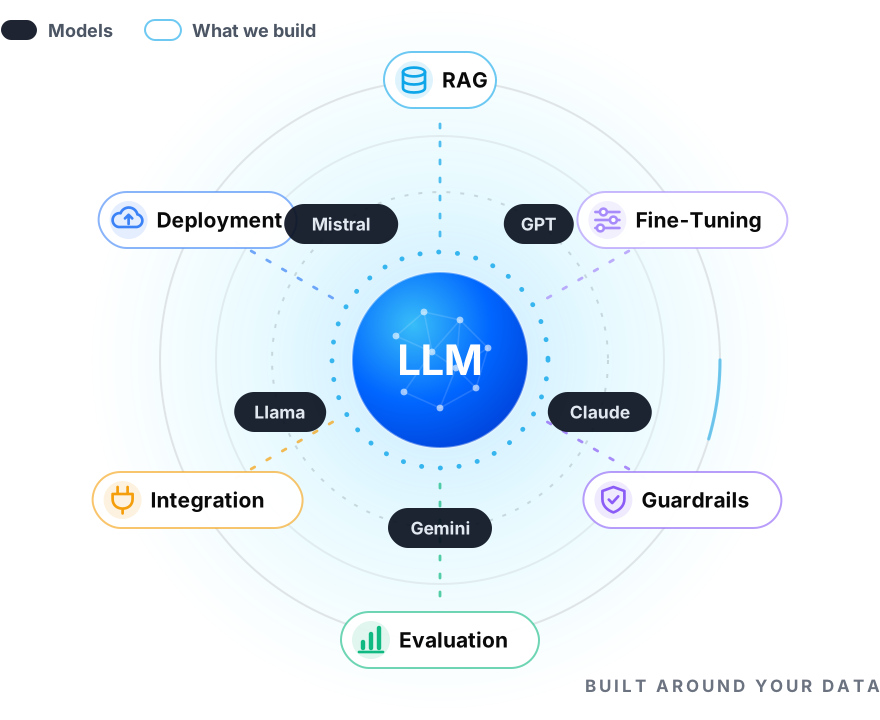
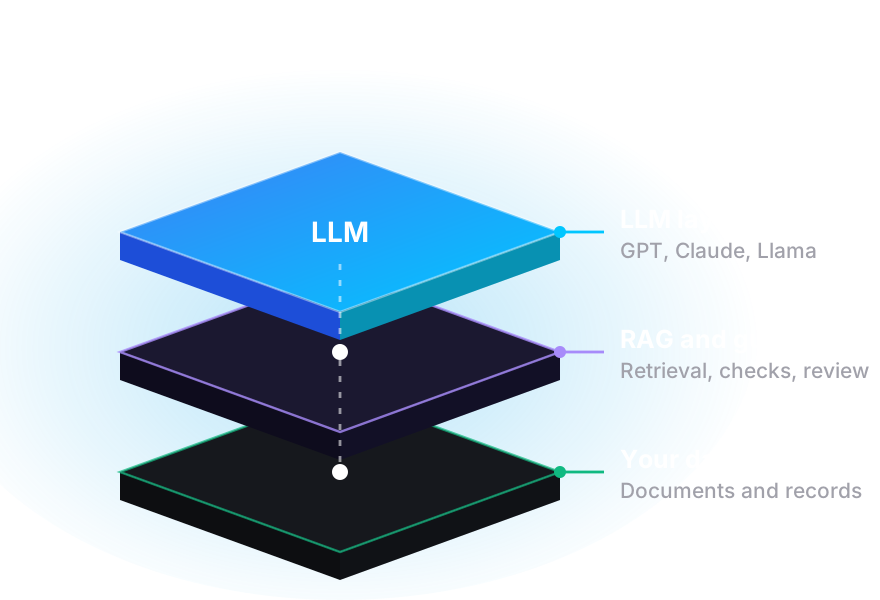
LLM development services cover the design, fine-tuning, integration and deployment of large language model applications that work on your company's data. As an LLM development company, SDLC Corp builds custom solutions with RAG, fine-tuning and private deployment, from the first use case to production. Our clients are enterprises, government bodies and product companies that need LLMs inside their own systems.
Our 400+ AI specialists are part of SDLC Corp’s 1,200+ engineering team. Together, they have trained or deployed 125+ AI models and completed 120+ enterprise AI integrations.
Trusted by enterprises, government bodies and universities worldwide
SDLC Corp's LLM development services take a large language model from use case to a production system your team owns. Most projects combine two or three of the services below.
01 / 07
Strategy
Consulting
Our AI consulting team finds the use cases where a language model gives a clear return, then sets the data, model and budget plan. As a result, you start with one measurable pilot instead of a broad AI program.
Build
Custom Development
Our AI development team builds copilots and assistants for your workflows, or LLM features inside your own SaaS product. For example, an assistant can answer ERP questions in plain English while each user keeps their existing access rights.
Conversational AI
Chatbot Development
Support and sales chatbots answer from your knowledge base and escalate complex cases to staff. Our chatbot development team also logs every conversation, so your reviewers can check answers and improve them.
Model Training
Fine-Tuning
We train a model on your labeled examples, so it follows your formats, tone and domain terms. We use efficient fine-tuning methods such as LoRA when full retraining is too costly.
Retrieval
RAG Integration
We index your documents so the model can retrieve approved information and cite its sources. Our RAG development services team handles indexing, permissions and retrieval quality.
Systems
System Integration
We place the model inside the software you already run, such as Odoo, Salesforce, SAP or a custom portal. For rollouts across several ERP and CRM systems, see our AI integration services.
Operations
Deployment and Support
We deploy on AWS, Azure or Google Cloud, or as a private deployment when data must stay inside your network. After launch, the same team monitors the system and handles model updates.
By Industry
LLM Use Cases by Industry
Each industry gives a model a different kind of data. Therefore, the right approach and guardrails change with the use case.
01 / 06
Banking · Insurance · Lending
FinancialServices
Claims and policy assistants answer staff questions from policy wordings, claim files and underwriting rules. In addition, they summarize long claim histories before a person makes the decision.
Clinical note summaries and intake assistants work on patient records under strict access control. Health data stays in a private environment, and a clinician reviews every output.
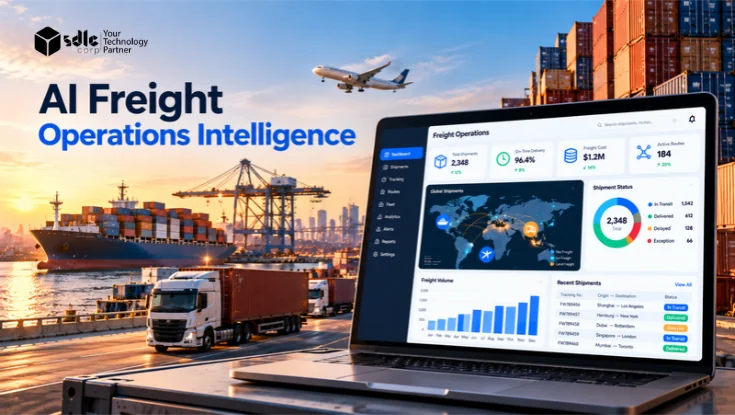
The model reads freight invoices, bills of lading and carrier emails, then maps each charge to a shipment. Approved lines then post to the TMS or ERP through its API.
Assistants answer questions about machine data, orders and quality reports in plain language. For instance, a plant manager can ask for last week's scrap rate by production line.
Models write product content, enrich catalogs and draft support replies from your product data and policies. Meanwhile, agents edit each suggested reply before they send it.
Citizen service assistants answer questions from published rules, forms and guidance. Every answer cites its source, and complex cases go to a staff member.
Approach
Choosing Between RAG and Fine-Tuning
We start by testing prompts and your data. RAG connects an LLM
to current business information, while fine-tuning adapts model
behavior. Many systems combine both based on accuracy, cost
and deployment needs.
RAG compared with fine-tuning and a combined approach, by best use,
data needed, knowledge freshness, relative cost and time to first release
Aspect
RAG
Fine-Tuning
Both
Best for
Answers from documents and records that change
Consistent formats, tone and domain-specific tasks
Domain assistants needing current facts and consistent responses
Data needed
Source documents and retrieval test examples
Task-specific training examples
Source documents and training examples
Keeps knowledge current
Yes, when sources and indexes are updated
Not automatically; model updates may require retraining
Yes, through updated retrieval sources
Relative cost
Depends on indexing and retrieval usage
Depends on training and inference costs
Includes training and retrieval costs
Time to first release
Often faster with ready data
Depends on data and training scope
Depends on training and integration scope
Process
Large Language Model Development Process
Our LLM development process runs in six stages. Each stage ends with an output your team reviews before the next one starts.
01
Requirement Analysis
We define the use case, users, data sources, accuracy target and budget.
OutputUse case brief and success metrics
01
02
Data Collection and Preprocessing
Next, we gather approved documents and records, then clean, deduplicate, chunk and label them.
OutputClean dataset and data map
02
03
Model Selection and Training
We compare candidate models on your data for quality, cost and latency, then set up RAG or training.
OutputModel choice with test scores
03
04
Fine-Tuning and Validation
Where RAG alone falls short, we fine-tune on labeled examples and validate against a held-out test set.
OutputTuned model and validation report
04
05
Testing and Evaluation
Then we test accuracy, hallucination rate, security and permissions against real business questions.
OutputEvaluation results and sign-off
05
06
Deployment and Monitoring
Finally, we release in stages and track answer quality, latency and user feedback in production.
Before release, we evaluate LLM performance on your business data. Our AI governance consulting team helps define risk ownership, approval criteria and responsible AI controls.
LLM Evaluation
Before launch, we test real business questions against expected answers. Each model or prompt change is checked for accuracy, unsupported claims and retrieval quality, so release decisions rely on measured results.
Users
Guardrails
LLM
Retrieval
Data sources
Guardrails
Input and output guardrails help detect prompt injection, off-topic requests and unsafe answers. These checks address risks in the OWASP Top 10 for LLM Applications. Flagged or low-confidence answers can be routed for human review.
Users
Guardrails
LLM
Retrieval
Data sources
Data Security and Privacy
We minimize or mask sensitive data where appropriate, while retrieval respects each user's access permissions. For each project, we select model endpoints and settings based on agreed privacy, retention and data-use requirements.
Users
Guardrails
LLM
Retrieval
Data sources
Compliance
We configure audit logging for relevant activity, with privacy and retention controls. Our approach draws on the NIST AI Risk Management Framework and considers applicable EU AI Act and industry requirements.
Users
Guardrails
LLM
Retrieval
Data sources
Cost and Latency
We track cost per request and response time for each workflow. Caching, smaller models and prompt optimization can control spending while maintaining the answer quality each use case needs.
Users
Guardrails
LLM
Retrieval
Data sources
Why SDLC Corp
Why SDLC Corp for LLM Development
We apply experience from our own AI products to client LLM projects, combining model evaluation, enterprise integration and production monitoring.
Proven Delivery
LLM Products in Production
We build and operate Data AI Ninja for document processing and Pulastya AI voice agents, bringing practical product experience to client LLM development.
Flexibility
Model Flexibility, Less Lock-In
At the same time, we select models based on quality, cost and deployment needs, keeping prompts and integrations portable where practical to reduce vendor dependence.
Clients retain ownership of custom code and project IP under the agreed contract, with clearly defined deliverables, documentation and handover terms.
Case Studies
LLM Projects We’ve Taken Live
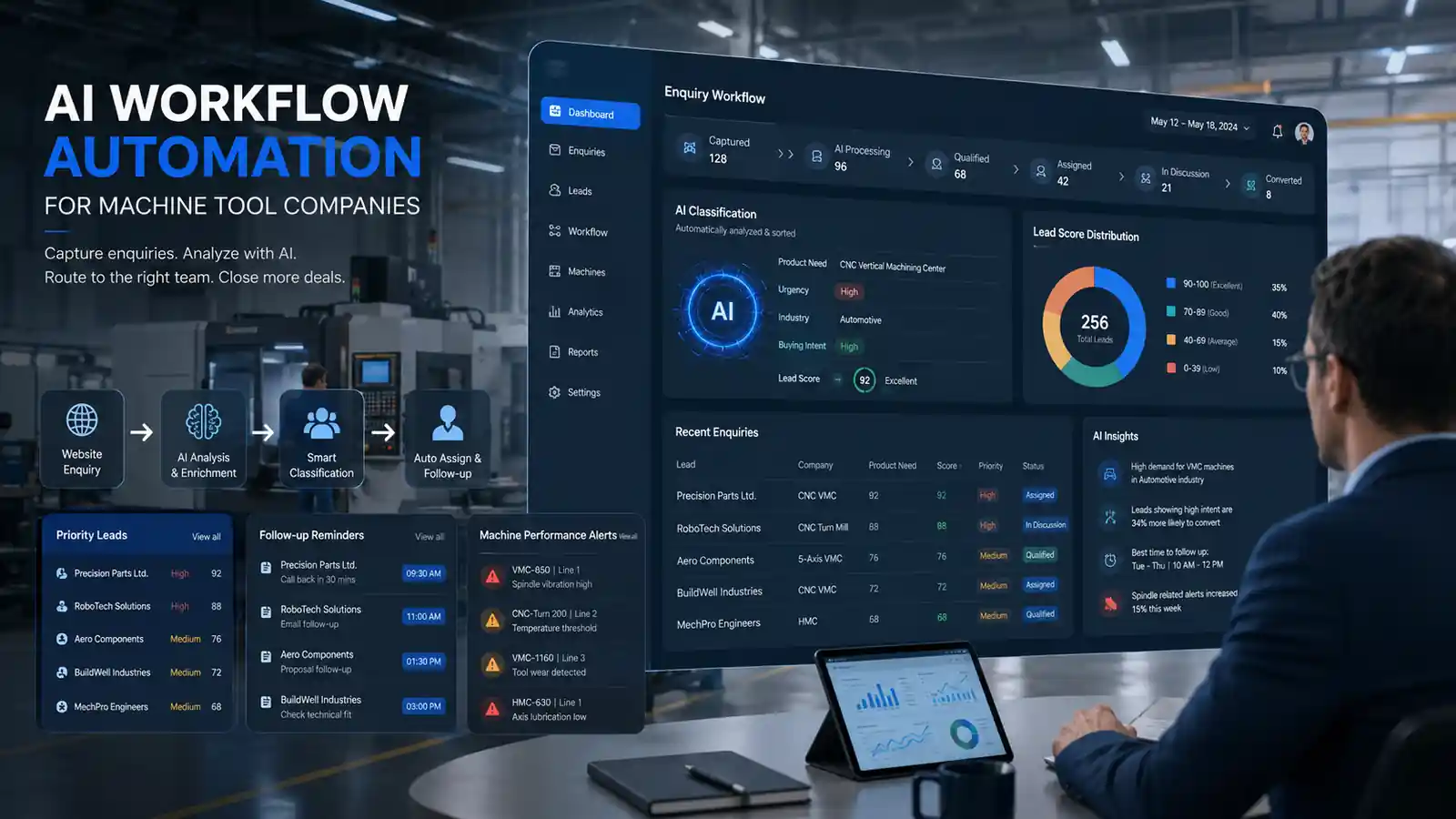
Explore LLM and AI projects integrated with real
business systems, including ERP assistants,
workflow automation, freight intelligence
and voice agents.
01 / 04 Case Study
AI Inside ERP
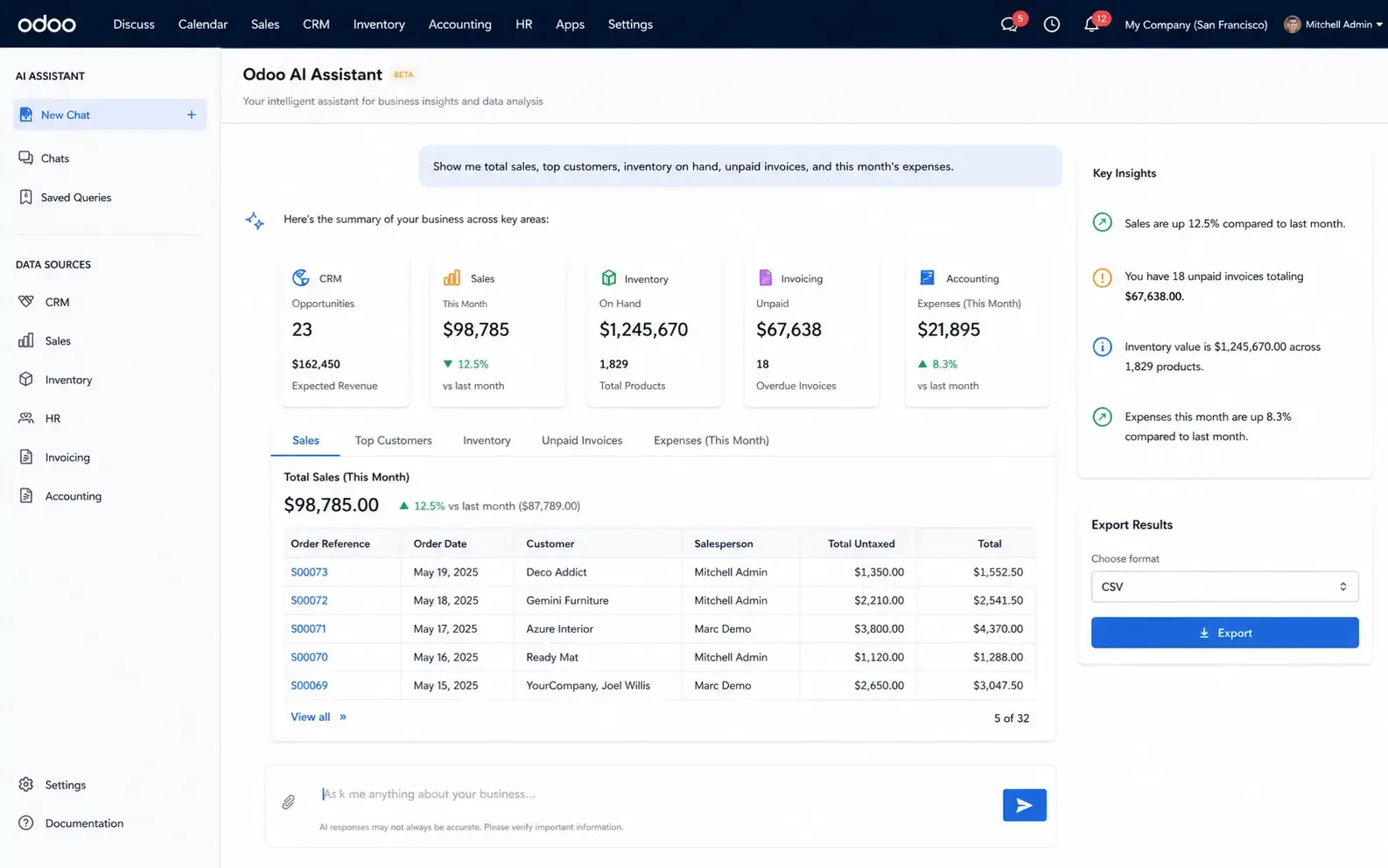
Odoo AI Assistant
Employees ask plain-English questions and get
answers from live Odoo records, within their
existing role permissions.
They've quickly understood our business context, moved fast, and brought recommendations rather than questions.
What stood out was their ability to translate our broad operational challenges into clear system features without overcomplicating the solution.
What impressed us most about SDLC Corp was their ability to understand our clinical requirements and translate them into practical technology solutions.
The predictive shipping models they implemented have saved us both time and cost while improving our accuracy and customer satisfaction.
Their data-driven methodology and exceptional command of artificial intelligence made a significant impact on our business operations.
Get Started
Build an LLM on Your Data
Share your use case and data sources.
Our engineers will scope the approach and first release.
Find out what LLM development includes and how we choose the right model and approach. We also explain data security, testing, cost, timelines and support after launch.
LLM development services build applications on large language models, from selecting a use case through production. Work includes data preparation, model selection, RAG or fine-tuning, integration, evaluation, deployment and monitoring. The result is an LLM application connected to your business data and workflows.
LLM development focuses on language-based applications such as assistants, enterprise search and document processing. Generative AI development is broader, covering image, audio and video generation as well. For projects beyond language workflows, explore our generative AI development services.
Choose RAG when answers need current information from your documents or systems. Fine-tuning can improve consistent formats and task-specific behavior when prompting alone falls short. Some applications use both. We evaluate answer quality, available data and cost before recommending an approach.
Rarely. Training a large language model from scratch requires substantial data, computing resources and investment. For most business use cases, we adapt established models such as GPT, Claude, Llama or Mistral using RAG, prompting or fine-tuning. This is generally faster and more cost-effective than training a foundation model.
We work with OpenAI GPT, Anthropic Claude, Google Gemini, Meta Llama and Mistral models. Selection depends on your use case, data security, quality targets, latency and budget. Open-weight options such as Llama or Mistral can also support private deployments when the model license and infrastructure allow.
We use agreed data environments and minimize or mask sensitive information where appropriate. Access controls, retention periods and model-provider data settings are defined for each project. Our information-security management practices are supported by ISO/IEC 27001:2022 certification.
Before launch, we test representative business questions against expected answers. We measure answer accuracy, unsupported claims, citation quality, latency and cost per request. Model and prompt changes are retested against agreed evaluation criteria, and production monitoring helps detect changes in quality after launch.
Timelines depend on data readiness, fine-tuning needs, integration complexity and approval requirements. A RAG pilot using one prepared document set can launch sooner than an enterprise assistant connected to several systems. After discovery, we provide a stage-by-stage delivery estimate based on the agreed scope.
Our Clutch profile lists a $10,000+ company-wide minimum project size and a $25–$49 hourly range. These are not LLM-specific quotes. For planning, LLM projects may fall into three indicative budget ranges, depending on scope, integrations and deployment needs:
LLM proof of concept: under $40,000. An initial pilot can focus on one use case and a limited document set, such as a RAG assistant. Deliverables may include a working prototype, an evaluation test set, results and a go/no-go recommendation. The final estimate depends on data preparation and integration requirements.
Production LLM application: $40,000 to $120,000. A production engagement can connect an LLM application to business systems and user workflows. Scope may include access controls, guardrails, monitoring, deployment and documentation. Cost depends on the number of integrations, evaluation requirements and whether private infrastructure is needed.
Enterprise LLM deployment: $120,000+. An enterprise deployment may span multiple workflows, departments and data sources, sometimes using a private or VPC environment. Scope can include security reviews, audit logging, evaluation pipelines, monitoring and operational handover. The timeline and price depend on architecture, compliance and rollout requirements.
Model usage, hosting and ongoing support may add recurring costs. We estimate these separately and provide a project-specific quote after reviewing the requirements.
Yes. Our support can include monitoring, prompt and index updates, issue resolution and evaluation of newer models before release. The agreement defines maintenance scope, documentation, response arrangements and the responsible support contact.
Contact Us
Talk to an LLM Development Expert
Share your use case, data sources and integration requirements. Our LLM engineering team will assess the approach and discuss scope, delivery milestones and budget considerations.