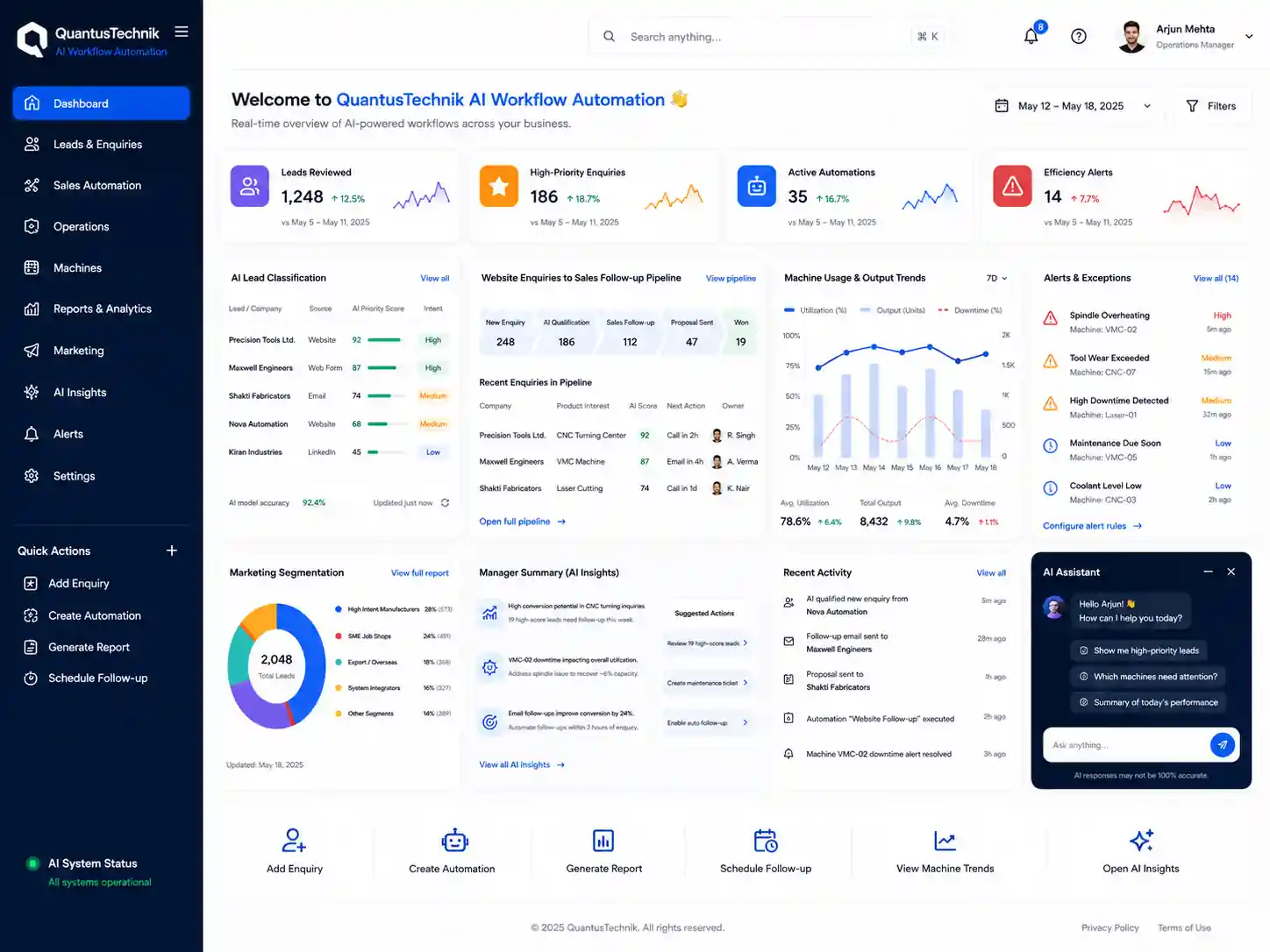
How QuantusTechnik Improved Sales and Machine Insights With AI
QuantusTechnik managed website enquiries, product discussions, machine usage data, and manager reports across different workflows. SDLC Corp added AI workflow automation to score leads faster, route enquiries clearly, and review machine performance signals. As a result, teams identified priority work sooner, received clearer machine alerts, and reduced manual reporting effort.
Product Hunt Listed
Trusted Software Partner
Multiple Products Listed
QuantusTechnik AI Workflow Automation Project Snapshot
A quick view of the AI workflow automation project, including the client need, core processes, business goal, and final outcome.
Process Intelligence for Sales, Machine Data, and Reporting
QuantusTechnik needed AI across sales, website enquiries, machine data, marketing, operations, and reporting. SDLC Corp added practical AI logic to reduce repeated checks and help teams act faster.
Manual Review Slowed Lead, Machine, and Report Decisions
Teams still checked lead priority, machine usage signals, follow-ups, and manager updates by hand.
Sales, Marketing, Operations, Leadership, and Machine Teams
The setup supported sales teams, marketing teams, operations teams, leadership teams, and machine monitoring users.
Faster Action With Clearer Workflow Signals
Reduce manual lead review, improve enquiry routing, track machine usage signals, and improve leadership reporting visibility.
Final Outcome
QuantusTechnik improved lead prioritization, website response speed, machine signal review, campaign tracking, and leadership reporting visibility.
QuantusTechnik Needed Faster Use of Sales and Machine Data
QuantusTechnik works with precision manufacturing businesses across India. Its teams handle machine tool enquiries, product discussions, customer follow-ups, machine usage data, and marketing responses.
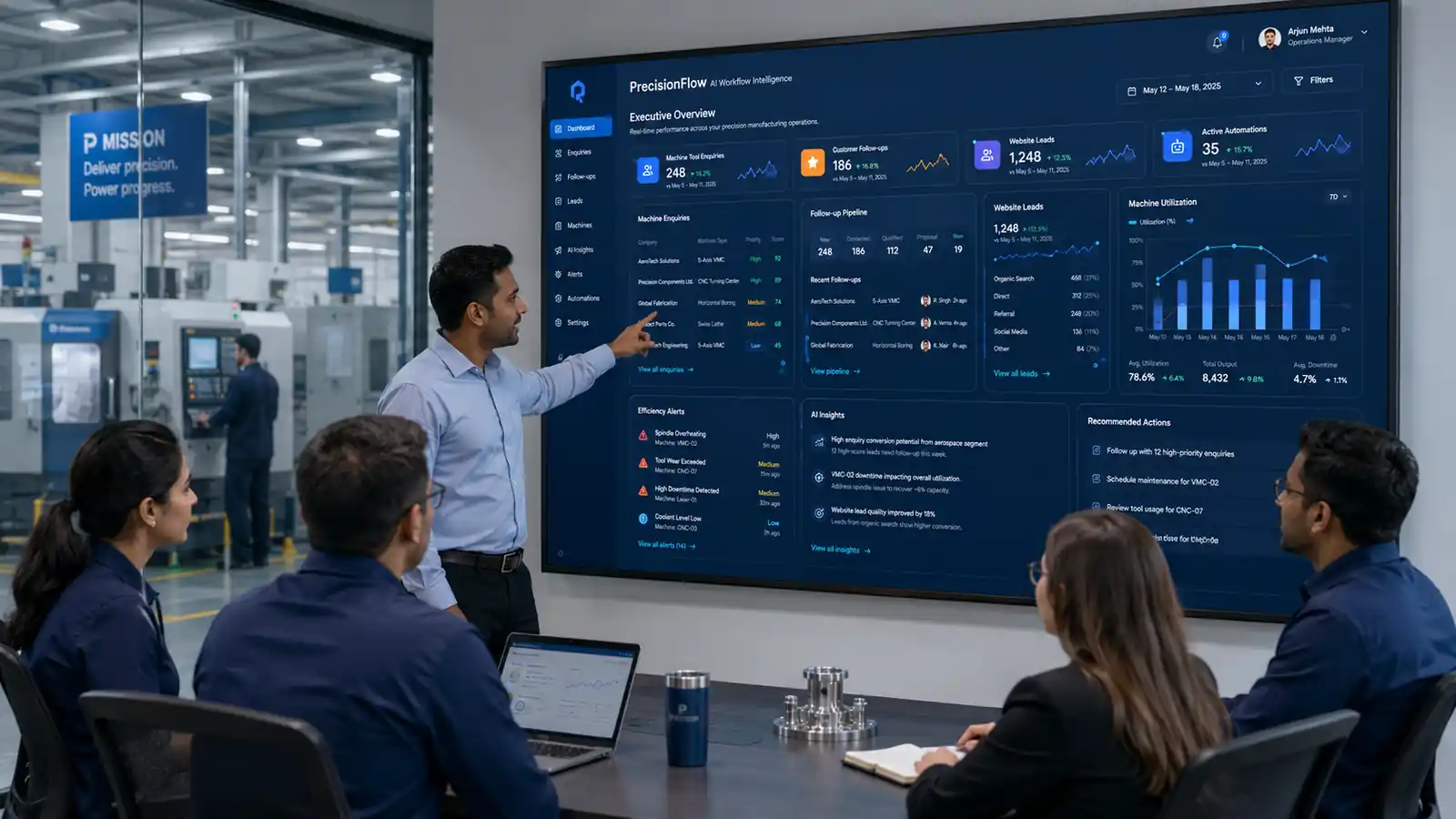
Teams Checked Leads and Machine Signals Manually
QuantusTechnik already had useful sales, enquiry, machine, and marketing data. However, teams still reviewed lead priority, follow-ups, usage signals, and report updates manually.
This slowed enquiry routing, delayed sales follow-ups, and made machine issue detection harder.
With AI workflow automation, teams could move from manual data review to faster lead action, clearer machine monitoring, and easier leadership reporting.
Technical Enquiries Needed Faster Sorting
Sales teams needed a quicker way to sort product needs, urgency, industry, and buying intent.
Machine Data Needed Clearer Action
Teams needed faster signals from machine usage, output, and efficiency changes.
Manual Process Gaps Across Sales and Machine Data
QuantusTechnik had useful sales, enquiry, machine, and reporting data. However, teams still checked leads, sorted enquiries, reviewed machine alerts, and prepared manager updates by hand.
Finding High-Value Leads Took Too Long
Sales users needed a faster way to spot high-intent enquiries, reduce delayed response time, and plan stronger follow-ups.
Slower Sales Response Times
Delayed follow-ups reduced the chance of converting high-intent enquiries into sales opportunities.
Website Leads Needed Clearer Routing
Manual sorting slowed the first response and made lead ownership unclear across the sales team.
Missed First-Contact Windows
Leads waited longer than necessary, increasing the risk of losing interest before a sales rep made contact.
Machine Signals Were Hard to Read
Machine data showed usage, output, cycles, and efficiency changes — but teams needed clearer alerts to know what required action.
Delayed Machine Action
Teams couldn't act early on machine changes, increasing the risk of unplanned downtime and missed service triggers.
Managers Needed Faster Business Summaries
Leadership needed quick KPI views, trends, exceptions, and action points without checking raw data every time.
Slower Decision-Making
Without quick summaries, leadership couldn't act on fresh KPI data — slowing responses to sales trends and operational changes.
Manual checks slowed lead handling, delayed sales follow-ups, reduced machine signal visibility, and made business reporting harder across every team.
Solution
How AI Automation Improved Lead Review and Machine Data Tracking
SDLC Corp automated QuantusTechnik’s leads, machine data, campaigns, and reports for faster review and clearer updates.
Sales Leads Got Clear Priority
AI reviewed enquiry details, product interest, urgency, and business value. This helped sales users focus on high-priority leads first.
Website Enquiries Moved Through Automated Routing
The system checked enquiry type, product need, industry, and response owner. This reduced delays in first sales action.
Machine Signals Became Easier to Review
AI reviewed usage, cycles, output, and efficiency changes. Teams could see which machine signals needed faster action.
Managers Received Ready-to-Review Summaries
The system turned sales, marketing, machine, and operations data into KPI notes, trend signals, and next-step points.
AI workflow automation helped QuantusTechnik reduce repeated checking, act faster on sales enquiries, review machine signals clearly, and give managers cleaner business updates.
AI Workflow Automation Rollout for QuantusTechnik
SDLC Corp followed a clear rollout plan 4 phases, 8 steps from reviewing workflows to deploying the final AI automation setup.
Workflow Review
Reviewed lead handling, enquiry routing, machine signal checks, and reporting processes to understand where AI could add real value.
Use Case Selection
Selected AI use cases where lead prioritization, machine signal review, and manager-ready updates could deliver clear business outcomes.
Data Check
Reviewed lead data, enquiry details, campaign responses, machine records, operations updates, and reporting inputs for AI readiness.
AI Logic Build
Designed logic for lead scoring, enquiry routing, follow-up signals, machine usage review, campaign grouping, and manager summaries.
Workflow Connection
Connected lead alerts, machine signals, follow-up needs, campaign updates, and manager actions with daily team decision-making.
Real Testing
Tested lead scoring accuracy, alert timing, enquiry routing, machine signal checks, and reporting outputs against live data.
Feedback Update
Refined scoring rules, routing logic, machine review signals, and summary outputs based on team feedback before final go-live.
Final Rollout
Deployed the complete AI workflow setup — QuantusTechnik moved to a cleaner AI-enabled process across all key business teams.
QuantusTechnik used AI to review priority leads, route enquiries, track machine signals, and prepare clearer manager summaries — all through one connected workflow.
AI Workflow Features for Faster Lead and Machine Data Review
QuantusTechnik used AI automation to sort leads, route enquiries, track machine signals, and prepare clearer reports.
AI Lead Classification
Sorted enquiries by need, urgency, customer type, and product interest.
Automated Enquiry Routing
Sent each enquiry to the right sales or technical team.
Sales Follow-Up Signals
Reminded teams when a lead needed the next action.
Customer Need Mapping
Matched enquiry details with the right product fit.
Machine Usage Review
Checked usage patterns to spot early machine changes.
Efficiency Trend Signals
Highlighted changes in output, downtime, and performance.
AI-Based Lead Segmentation
Grouped leads by industry, need, and campaign source.
AI Reporting Automation
Created cleaner daily reports for faster manager review.
These AI features helped QuantusTechnik review leads, machine data, and reports with less manual work — all running inside one connected workflow.
AI Tools Used in the QuantusTechnik Workflow
The setup used GPT-4o, Python, LangChain, PostgreSQL, pgvector, and n8n to score leads, route enquiries, check machine data, and prepare manager notes.
Clear AI Stack, Clear Role
Each tool had a fixed job. The model handled summaries and intent. Python handled rules. n8n moved the work to the right team.
- Lead scoring used Python rules and enquiry context
- GPT-4o summarized leads and report notes
- pgvector helped match similar enquiries
- n8n triggered routing, alerts, and reports
OpenAI GPT-4o
Used to summarize enquiries, read intent, create manager notes, and explain machine signal changes.
Python Workflow Logic
Scored leads, checked urgency, applied routing rules, and prepared data before sending it to the dashboard.
LangChain
Managed prompts, context, and structured outputs for lead review and report summary tasks.
PostgreSQL + pgvector
Stored leads, campaign data, machine logs, and reports. pgvector helped find similar past enquiries.
n8n Workflows
Sent enquiries to owners, triggered follow-up alerts, and pushed daily report notes to managers.
JavaScript Reporting View
Showed priority leads, routing status, machine signals, follow-ups, and daily manager summaries.
Workflow: Website forms, CRM records, campaign data, and machine logs entered PostgreSQL. Python scored the records, GPT-4o prepared short notes, pgvector matched similar cases, and n8n sent alerts, routing updates, and reports.
What Changed After AI Workflow Automation
AI helped QuantusTechnik move from manual checks to faster lead handling, clearer machine signals, and easier manager reporting.
Lead Handling
Teams checked leads manually.
AI helped score and classify leads faster.
Website Enquiries
Teams routed enquiries by hand.
AI sorted enquiries and routed them to the right team.
Sales Follow-Ups
Follow-ups depended on manual checks.
AI added reminders and next-action signals.
Marketing
Campaigns used broad lead groups.
AI helped create better lead segments.
Machine Data
Teams reviewed raw machine data manually.
AI highlighted usage patterns and output changes.
Reporting
Managers spent time checking data.
AI created summary views and trend notes.
Decision-Making
Action took longer.
Teams received clearer next-step signals.
AI reduced manual checks, improved lead response, made machine data easier to review, and gave managers faster business summaries.
Results
Business Results After AI Workflow Automation
AI workflow automation helped QuantusTechnik reduce manual lead checks, route enquiries faster, review machine signals sooner, and prepare manager updates with less repeated work.
Lead Review Time Dropped from 20 Minutes to 5 Minutes
Sales users could identify urgent and high-value enquiries faster instead of checking each enquiry manually.
Website Enquiries Reached Owners Within 10 Minutes
Earlier, enquiry assignment depended on manual checks. After automation, each enquiry moved to the right owner based on need, product type, and urgency.
Follow-Up Visibility Improved from 60% to 95%
Lead scores, reminders, and next-action signals helped teams track more open follow-ups without missed updates.
Machine Signal Review Moved from Weekly to Daily Checks
Teams reviewed usage, cycle behavior, output trends, and efficiency changes sooner with cleaner signal tracking.
Manager Report Prep Reduced from 4 Hours to 45 Minutes
Managers received KPI notes, exceptions, and suggested actions from connected data sources with less manual report work.
Campaign Segmentation Became 3x Faster
Teams grouped leads by product interest, industry, and buying intent faster for focused marketing follow-ups.
Overall, teams identified priority enquiries sooner, routed leads faster, reviewed machine signals daily, and prepared manager updates in under 1 hour with less manual work.
Ready to Add AI Workflow Automation to Your Business?
Use AI workflow automation to improve sales follow-ups, website enquiry routing, machine data review, marketing actions, operations, and AI reporting insights from one connected process. SDLC Corp helps businesses plan and build enterprise AI development solutions around real team workflows.
- Contact Us
Let’s Talk About Your Product
What happens next?
- We review your requirements
- Strategy call with experts
- Clear roadmap & estimate
- NDA Protected
- Enterprise Grade Delivery
- Global Clients
- By submitting this form, you acknowledge that SDLC Corp may process your details to respond to your inquiry. See our Privacy Policy and Cookie Notice.