Operational Challenges in Energy and Utilities
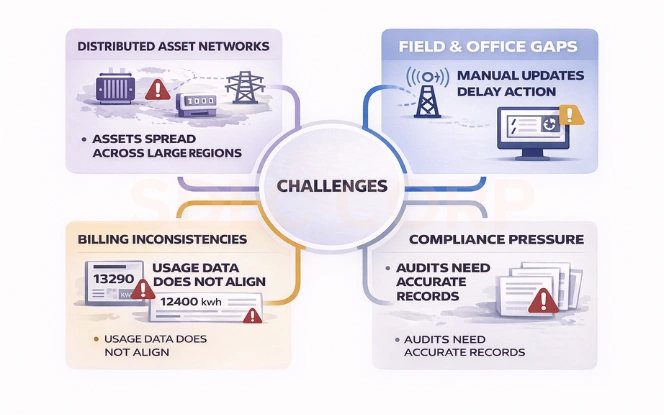
The operational complexity of energy and utility businesses is structural. Assets are distributed across wide geographic areas and age at different rates. Field technicians work remotely, often without reliable access to central systems. Billing depends on meter data that flows through separate infrastructure. Compliance requirements are specific, documented, and subject to audit. These challenges compound when the systems handling them are not integrated.
Distributed asset networks with no central visibility
Transformers, meters, transmission lines, turbines, and substations are spread across regions. Without centralised tracking, maintenance teams cannot monitor asset health systematically — reactive maintenance replaces preventive maintenance, and failure rates increase with asset age.
Poor coordination between field and office teams
Field technicians rely on paper-based job sheets or phone calls to report progress. Office teams wait for end-of-shift summaries to update asset records. This delay lengthens outage response times, creates gaps in service history, and limits the ability of managers to allocate resources dynamically during incidents.
Billing errors from disconnected customer and meter data
When meter readings, usage data, and customer records sit in separate systems that are reconciled manually, billing errors accumulate. Disputes follow, customer service costs rise, and the revenue recognition cycle lengthens. Organisations that move billing onto the same system as their operational data reduce this reconciliation overhead significantly.
Compliance and audit pressure from incomplete records
Energy providers must maintain detailed inspection logs, safety records, and environmental reports — per asset, per site, per regulatory requirement. When these records are scattered across spreadsheets, email chains, and disconnected systems, audit preparation becomes a manual assembly exercise with meaningful risk of gaps.
Limited operational visibility for management decisions
Without real-time dashboards, managers cannot see outage status, asset downtime, maintenance backlog, or team productivity in a single view. Decisions are made on delayed information, and patterns that indicate systemic problems — a transformer type with high failure rates, a region with chronic maintenance backlogs — remain invisible until they become crises.
How Odoo Helps the Energy Sector
Odoo addresses energy and utility operational challenges by replacing the manual data transfers between disconnected systems with automated workflows in one platform. When a field technician closes a work order, the asset history updates, the spare parts inventory adjusts, and the billing system receives the service confirmation — without anyone manually entering the same information in three places. That is what integration means operationally: fewer gaps, fewer errors, and faster response.
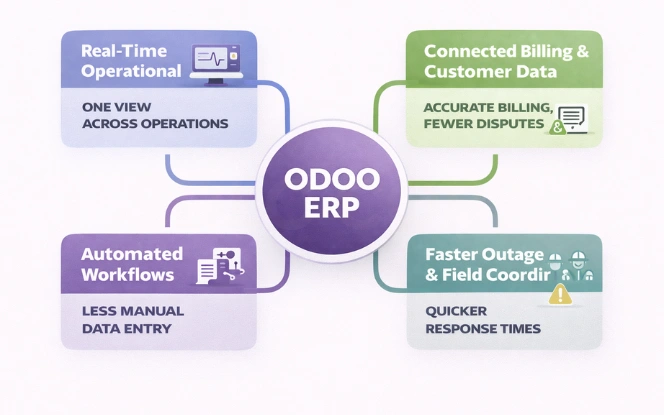
Real-time visibility into operations
Managers monitor asset condition, maintenance progress, field activities, and inventory levels from one dashboard. When an outage occurs or an asset reading triggers an alert, the current status is visible immediately — not in the next morning's report.
Customer data aligned with billing
Customer records, meter data, and invoices remain connected throughout the billing cycle. Service history informs billing calculations. When a customer disputes a charge, the support team can access the relevant readings, work orders, and approvals from one screen — reducing resolution time and improving the accuracy of the response.
Automation reducing manual overhead
Repetitive tasks — duplicate data entry between systems, manual work order creation from inspection schedules, manual invoice generation from meter readings — are automated. Teams spend less time on administrative correction and more time on operational work that requires judgement and expertise.
Compliance supported by organised records
Inspection results, service logs, safety certifications, and approval records are stored and searchable in one system, linked to the specific assets and activities they relate to. Audit preparation moves from a manual assembly exercise to a reporting task. See our dedicated guide to enhancing compliance and safety in the energy sector with Odoo.
Faster response during outages and incidents
Live updates from field teams allow control centres to track restoration progress in real time. Managers can reassign technicians dynamically based on current location and workload. Parts availability is confirmed before dispatch. The combination reduces mean time to restoration and limits the service disruption experienced by customers.
Key Odoo Modules for Energy and Utility Teams
Odoo covers energy and utility operations through a set of interconnected modules rather than a single specialised product. The value is in the connections — a maintenance work order linked to an asset record linked to an inventory position linked to a supplier and a cost centre. These are the modules that deliver the most operational benefit for energy and utility businesses.
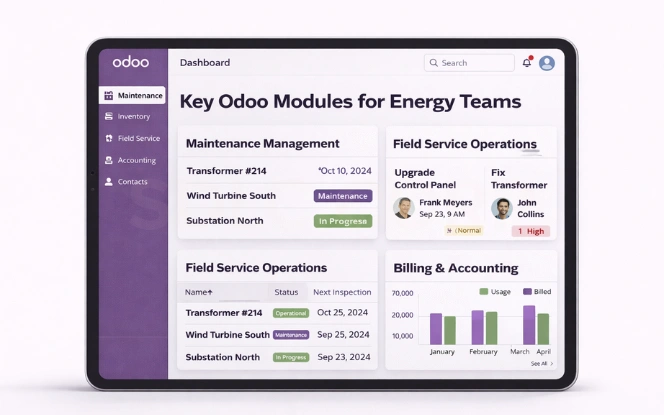
Maintenance management
Preventive and corrective maintenance planning for transformers, turbines, meters, substations, and pipelines. Service history, inspection results, and upcoming schedules are documented per asset. Automated reminders trigger work orders before failures occur. See our guide to planning preventive maintenance schedules with Odoo.
Inventory and spare parts
Tools, components, and critical spare parts tracked across warehouses, depots, and field vehicles. Real-time stock visibility confirms availability before dispatching technicians. Automated reorder points prevent emergency procurement. Demand patterns inform stocking decisions per location and asset type.
Field service operations
Task assignment, route planning, and real-time job updates managed from one interface. Field technicians capture photos, meter readings, safety observations, and service notes on site via mobile. Office teams see job status without waiting for paper forms or end-of-shift calls.
Billing and accounting
Usage-based invoicing, payment tracking, and financial reporting integrated with operational data. Meter data flows directly to billing calculations, reducing the manual reconciliation that causes errors and disputes. Full financial audit trail maintained automatically. See our billing and invoicing with Odoo accounting guide.
Customer and service records
Customer profiles, service history, billing activity, meter data, and communication logs connected in one view. Support teams access the full account picture when responding to enquiries or disputes — without switching between systems.
Reporting and analytics
Configurable dashboards for asset health, maintenance trends, outage frequency, team productivity, and financial performance. Scheduled report generation for internal reviews and regulatory submissions. Data that previously required manual assembly is available on demand.
Smart Grid and IoT Support with Odoo
Modern energy networks are instrumented with sensors that generate continuous data on load, voltage, temperature, flow rates, and equipment condition. The value of this data depends entirely on what happens with it — alerts that notify the right person in time to act, trends that surface before failures occur, usage patterns that inform maintenance scheduling and capacity planning. Odoo's IoT integration brings sensor data into operational workflows rather than keeping it isolated in monitoring systems
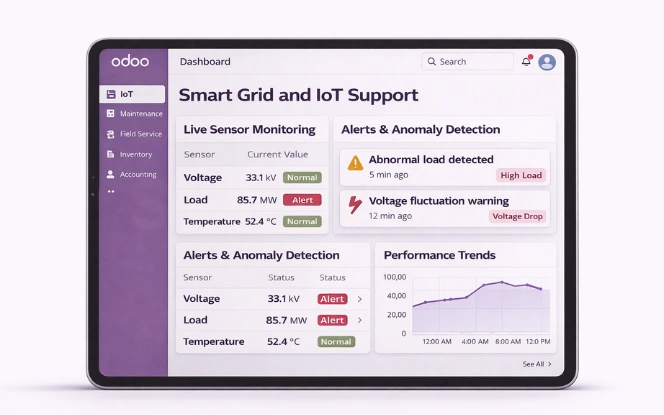
Sensor data monitoring
Load, voltage, temperature, pressure, and flow readings from connected devices feed into Odoo's dashboards. Network conditions are visible as they change — not after a problem has escalated. Operators detect stress points early and can intervene before failures occur.
Automated anomaly alerts
When sensor readings cross defined thresholds, Odoo triggers alerts and can automatically create maintenance work orders. The combination of notification and task creation means the right team is informed and assigned before a manual escalation is needed.
Performance dashboards
Raw sensor data is converted into trend indicators and performance metrics. Managers track network stability, equipment utilisation rates, and consumption patterns over time — supporting maintenance scheduling based on actual usage rather than fixed calendar intervals.
Automated meter reading
Smart meter data captured automatically removes the manual entry step that causes billing delays and errors. Usage data is current, billing calculations run against accurate inputs, and the reconciliation exercise between meter records and billing records is eliminated.
Implementation note: Odoo's IoT integration capabilities depend on the Odoo version and the specific devices and protocols in use. Smart meter integration, SCADA connectivity, and sensor network integration typically require custom configuration work. The scope and complexity vary significantly by infrastructure. An Odoo consulting engagement scoping the integration requirements before project start avoids surprises.
Managing Renewable Energy Workflows with Odoo
Renewable energy operations — solar farms, wind parks, hydroelectric facilities — have operational characteristics that differ from conventional utility infrastructure. Output varies with environmental conditions. Maintenance intervals are tied to performance degradation rather than fixed schedules. Environmental and production reporting has specific regulatory requirements. Odoo supports these workflows by providing the same asset management, field service, and compliance capabilities as for conventional infrastructure, configured for the specific equipment and reporting requirements of renewable installations.
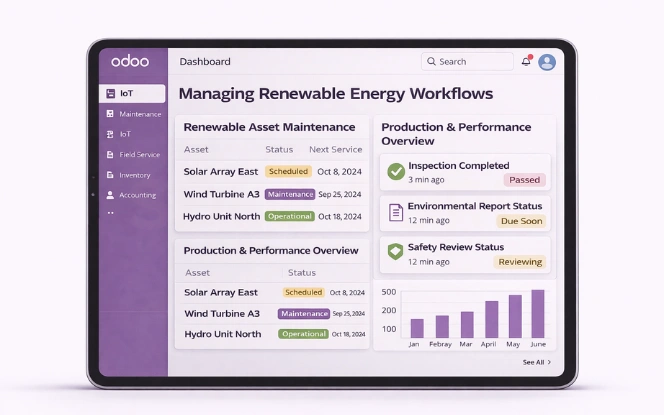
Solar panel and inverter maintenance scheduling
Preventive maintenance schedules for solar panels, inverters, and tracking systems are managed in Odoo's maintenance module. Service intervals are linked to performance data — when output degrades below threshold, a maintenance work order is triggered automatically rather than waiting for a calendar-based inspection cycle.
Wind turbine inspection and service records
Inspection history and maintenance actions are recorded per turbine, including blade condition assessments, gearbox service records, and electrical system checks. Long-cycle maintenance visibility — covering multiple seasons and service events — supports safety reviews and reliability analysis across the turbine fleet.
Hydro plant operational metrics
Flow rates, pressure readings, water level measurements, and temperature data are stored centrally per plant component. Teams review trends to ensure stable operation within design parameters. Seasonal variation in water availability is tracked historically and used to plan maintenance windows with minimal production impact.
Environmental and regulatory compliance reporting
Environmental monitoring data, emissions records, and regulatory documentation are stored and organised in Odoo alongside operational records. Compliance reports draw from the same data used in operations rather than being assembled separately — reducing preparation time and improving consistency between operational and regulatory records.
Production trend analysis and capacity planning
Historical output data per installation is analysed to identify performance trends, compare actual against projected generation, and evaluate equipment degradation rates. This supports investment decisions about capacity upgrades, equipment replacement, and operational improvement initiatives.
Field Service and Mobile Teams in Energy Operations
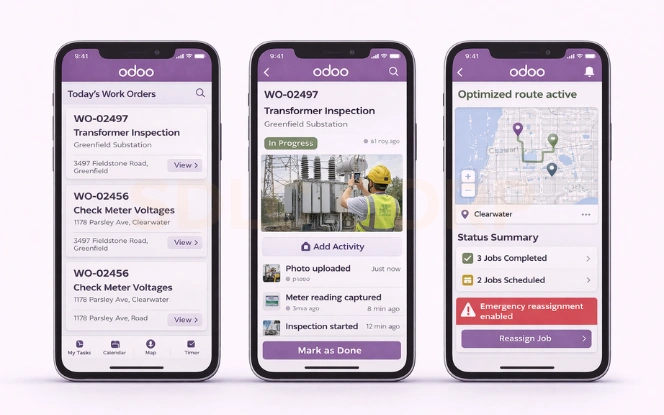
Field technicians are the operational front line for energy and utility businesses. Their work — inspections, fault diagnosis, repairs, installations, meter readings — is the source of the asset condition data the rest of the business depends on. When their tools are paper forms or disconnected mobile apps, that data arrives delayed, incomplete, or unreliable. Odoo's field service module gives technicians accurate job information before they leave the depot and captures what they find in real time.
Complete job briefs on mobile
Technicians receive full job details, asset history, safety notes, required tools, and parts information on their mobile device before arriving on site. Rework from missing information is significantly reduced when the technician has the relevant asset history in hand.
Real-time field data capture
Photos, meter readings, safety observations, and service notes are uploaded immediately from the field. Office teams see job progress without waiting for paper forms or end-of-shift calls. Asset records update in real time as work is completed.
Route optimisation
Efficient routing reduces travel time between jobs and reduces fuel cost. Technicians complete more tasks per shift without increased workload. Route plans adapt dynamically when emergency jobs are added or job priorities change.
Emergency reassignment
During outages or equipment failures, managers see technician locations and current workloads in real time. Jobs can be reassigned dynamically to the nearest available technician. Response time improves, and the coordination that previously happened by phone is managed systematically.
Compliance and Reporting for Energy and Utility Businesses
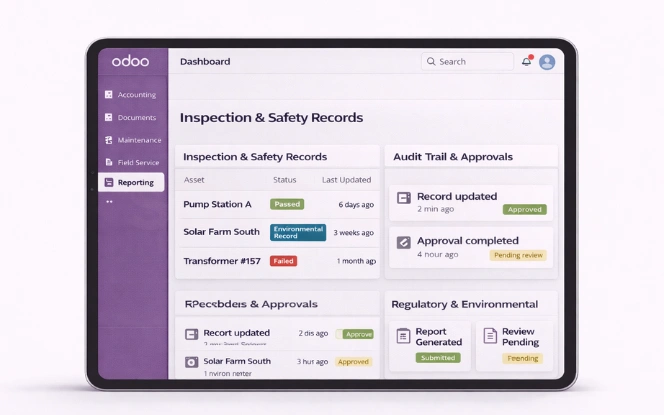
Energy and utility compliance is not optional and not administrative — it is a licensing condition. Safety inspection records, environmental monitoring data, asset maintenance logs, and financial audit trails must be accurate, complete, and retrievable on demand. When these records are scattered across spreadsheets, email chains, and disconnected systems, the combination of preparation time and gap risk in each audit cycle is significant. Odoo reduces both by centralising compliance data alongside operational data in one system.
Centralised inspection and safety records
All inspection results, safety certifications, test records, and approval documents are stored in Odoo and linked to the specific assets, activities, and personnel they relate to. Retrieval during an audit is a search and filter operation — not a manual assembly exercise across filing systems and email archives.
Time-stamped audit trails
Every record update — who changed what, when, and from what previous value — is logged automatically. This provides a transparent history of operational and financial activity that satisfies both internal governance requirements and external regulatory examination. The trail is built by the system as work happens, not reconstructed after the fact.
Operational and environmental reporting
Outage duration and frequency, asset downtime, maintenance activity, emissions data, and energy production metrics can all be reported from Odoo's analytics tools. Leaders review trends and plan improvements against current data. Regulatory submissions draw from the same operational records rather than requiring a separate data collection exercise.
Configurable approval workflows
Sensitive actions — safety procedure overrides, high-value procurement, contract approvals, system configuration changes — pass through defined review steps with notifications to the relevant approvers and a documented audit record of the decision. This reduces compliance risk from informal processes and provides accountability for high-consequence decisions.
Planning an Odoo implementation for your energy or utility operation?
Our Odoo consulting team maps your asset structures, field workflows, and compliance requirements before any configuration begins. Scoping sessions are no cost.
Start the conversation