Enterprise AI Development
Services
Build AI that works across the enterprise - not just inside one isolated application.
Our enterprise AI development services help organizations design, integrate and scale artificial intelligence across business functions, applications, data platforms and operational workflows - from enterprise architecture and shared AI services to governance, security, integrations and phased rollout.
Proven Enterprise AI Delivery
Trusted by Fortune Global 500 leaders, governments & top universities across 30+ countries










Powered by leading cloud & AI platforms
Awards & industry recognition


Recognized for
AI Delivery
Enterprise technology delivery across artificial intelligence, ERP, CRM, cloud, data and workflow modernization.
Top AI Solutions Provider for Enterprises — 2025 Read the announcement
Top AI Development Company by Selected Firms
Top AI App Developers by C2C Reviews
Top IT Consulting, SI & Managed Services Company by ITRate
Top Software Development Company by Selected FirmsReviewed on Clutch, GoodFirms, Selected Firms and DesignRush.
Enterprise AI Development
Services We Deliver
Move from disconnected AI experiments to a coordinated enterprise AI capability.
Blueprint
Enterprise AI Architecture
Define how models, AI applications, enterprise systems, data services, identity, security and governance work together.
Applications
Enterprise AI Applications
Build intelligent applications for finance, operations, customer service, sales, HR, IT and other enterprise functions.
Reuse
Shared AI Services
Create reusable capabilities such as model gateways, evaluation services, access controls, logging, routing and enterprise integration services.
Coordination
Cross-System AI Workflows
Coordinate AI across CRM, ERP, service platforms, databases, document systems and internal applications.
Foundation
Enterprise AI Platform Engineering
Build common technical foundations that multiple AI teams and applications can reuse.
Rollout
AI Scale and Rollout
Move validated capabilities from pilots into controlled multi-team and multi-department production programs.
Already know what AI capability you want to deploy? Explore AI Integration & Implementation Services.
Enterprise AI
Solutions
Different departments may need different AI capabilities, but they should operate within a coherent enterprise architecture.
Knowledge
Enterprise Knowledge Systems
Give employees controlled access to organizational policies, procedures, documentation and operational knowledge.
Operations
Intelligent Operations
Use AI to support documents, exceptions, forecasting, classification, analysis and operational decisions.
Customers
AI-Powered Customer Experience
Embed AI into customer service, commerce, support and other customer-facing applications.
Decisions
Enterprise Decision Intelligence
Combine data, predictive models, business rules and human oversight to improve operational and strategic decisions.
Employees
Employee AI Assistants
Provide role-aware AI inside enterprise applications and internal workflows.
Platforms
AI-Enabled Enterprise Platforms
Embed AI directly into ERP, CRM and business platforms instead of creating disconnected AI tools.
The last one is the difference between an AI programme and a collection of AI subscriptions.
What Enterprise AI
Can Improve
The gains come from coordination, not from any single model.
Breadth
Cross-Functional Productivity
Use common AI capabilities across multiple departments instead of deploying isolated tools for every team.
Context
Operational Visibility
Connect AI output with the applications where business activity is already recorded.
Speed
Decision Speed
Give teams faster access to analysis, scenarios and recommendations.
Standards
Process Consistency
Apply common evaluation, access and operating standards across AI applications.
Efficiency
Technology Reuse
Avoid rebuilding model access, identity, integration and monitoring capabilities for every project.
Scale
Controlled Scale
Expand successful AI applications while maintaining security, governance and operational ownership.
Technology reuse is usually where the first measurable saving appears, long before any single application pays for itself.
Enterprise AI
Architecture
Enterprise AI needs several coordinated layers, each with a clear owner.
Layer 01
Business Applications
Deliver AI through the applications employees and customers already use - ERP, CRM, internal portals, service platforms, productivity applications and customer-facing software.
Layer 02
Integration Layer
Use APIs, application services, events and enterprise connectors to move approved information between AI and operational systems.
Layer 03
Shared AI Services
Reusable capabilities: model access, routing, evaluation, logging, identity, prompt services and policy controls.
Layer 04
AI Capabilities
Specialist workloads: predictive machine learning, LLM applications, RAG, AI agents, document intelligence, generative AI and computer vision.
Layer 05
Enterprise Data
Provide governed access to the information required by production AI.
Layer 06
Governance and Security
Apply permissions, risk controls, model governance, evaluation and human oversight.
Layer 07
Monitoring
Track operational quality, failures, costs, adoption and business outcomes.
Layer 03 is the one most organizations skip, and the reason their fifth AI project costs as much as their first.
Standardize
the AI Layer
Enterprise AI becomes difficult to manage when every team builds its own stack.
Access
Model Gateway
Provide controlled access to approved models and providers.
Identity
Identity and Access
Apply enterprise authentication and authorization to AI applications.
Quality
Evaluation Services
Use shared evaluation practices across important AI workloads.
Telemetry
Observability
Track model requests, system behavior, failures and operational performance.
Rules
Policy Controls
Enforce approved providers, models, data rules and tool permissions.
Connectors
Integration Services
Create reusable interfaces between enterprise systems and AI applications.
The goal is not to centralize everything - it is to standardize the pieces that benefit from reuse, security and enterprise control.
Enterprise AI
Portfolio Management
Scaling AI requires visibility across the complete portfolio.
Register
Use Case Inventory
Track proposed, experimental, pilot, production and retired AI initiatives.
Business
Business Ownership
Assign an accountable business owner to important AI applications.
Technical
Technical Ownership
Define who maintains integrations, infrastructure and application behavior.
Dependencies
AI Dependencies
Track models, providers, data sources and enterprise systems associated with each application.
Stage
Production Status
Know which initiatives are proof of concept, pilot, production, expanding, under review or retired.
Value
Business Outcomes
Track whether production AI is delivering the result originally used to justify investment.
Most organizations discover during this exercise that they own more AI than they thought, and fewer production systems than they claimed.
Enterprise AI
Operating Model
Technology alone does not make AI scalable.
Demand
Business Teams
Own use cases, workflows, adoption and expected outcomes.
Build
AI Engineering
Build and operate applications and shared AI services.
Inputs
Data Teams
Provide reliable access to required enterprise information.
Controls
Security
Define identity, application, provider and network controls.
Oversight
AI Governance
Define risk classification, lifecycle requirements and oversight.
Foundation
Platform Teams
Operate shared infrastructure and reusable enterprise capabilities.
Priority
Executive Sponsors
Set priorities and resolve cross-functional decisions.
Goal
Repeatable Delivery
The objective is repeatable AI delivery rather than rebuilding the operating structure for every project.
Cross-functional decisions are where AI programmes stall; naming who resolves them is cheaper than escalating each one.
Enterprise AI
Security
AI applications should inherit enterprise security requirements, not invent their own.
Identity
Enterprise Identity
Connect AI applications with approved identity systems.
Permissions
Role-Based Access
Restrict functionality and information according to user permissions.
Data
Data Controls
Define which information each AI application can access.
Providers
Model Access
Control approved model and provider usage.
Credentials
Secrets Management
Protect credentials, API tokens and enterprise service accounts.
Boundary
Network Architecture
Deploy AI services within suitable cloud, private or hybrid environments.
Evidence
Audit Logging
Record important system, model and administrative activity.
Review
Provider Assessment
Assess what each provider may process and retain before it is approved for enterprise use.
An AI application that cannot use your existing identity system will not pass enterprise security review, whatever it does.
Security, Privacy and Responsible AI
Applicability depends on geography, industry, the data processed, the deployment model, the use case and your own legal and regulatory obligations.
Enterprise AI
Governance
Governance needs to scale with the AI portfolio.
Know
AI Inventory
Know which AI systems are operating across the organization.
Tier
Risk Classification
Apply stronger controls to higher-impact applications.
Models
Model Governance
Track approved models, providers and material changes.
Oversight
Human Oversight
Define where review, approval or override is required.
Quality
Evaluation Standards
Set acceptance requirements before production release.
Change
Change Management
Re-evaluate systems after important modifications.
Operating
Production Review
Monitor quality, incidents and business outcomes.
Program
Organization-Wide Design
Where governance has to span the whole portfolio, it becomes its own engagement rather than a workstream inside one programme.
For organization-wide governance, see our AI Governance Consulting Services.
Enterprise AI
Integration
AI must work with the applications that run the business.
ERP
ERP
Connect AI with operations, finance, inventory, supply chain and transactional workflows.
CRM
CRM
Bring AI into sales, customer and service processes.
Service
Service Management
Integrate AI with ticketing and internal support.
Data
Data Platforms
Give AI controlled access to enterprise information.
Collaboration
Collaboration Platforms
Deliver appropriate AI capabilities inside employee workflows.
Interfaces
APIs
Expose reusable AI capabilities to multiple applications.
For detailed deployment and enterprise-system connectivity, see our AI Integration & Implementation Services.
Specialized
AI Capabilities
Enterprise AI programs typically contain several specialist workstreams. This page coordinates those capabilities without competing with their dedicated service pages.
LLM
LLM Applications
Language-model applications, structured generation, fine tuning and private deployments.
Explore LLM Development ServicesRAG
RAG Systems
Enterprise retrieval, vector search, grounding and knowledge applications.
Explore RAG Development ServicesAgents
Agentic AI
Tool-using agents and controlled multi-step workflows.
Explore Agentic AI DevelopmentGenerative
Generative AI
Text, image, video, code and multimodal generative applications.
Explore Generative AI DevelopmentML
Machine Learning
Forecasting, predictive models, recommendations, anomaly detection and classification.
Explore Machine Learning DevelopmentEnterprise AI decides how these fit together, who owns each one, and what they share. The engineering belongs to the teams above.
Enterprise AI
and Data
Enterprise AI depends on reliable business data, but data-platform modernization should remain a separate workstream.
Access
Data Access
Give AI controlled access to approved information.
Fitness
Data Quality
Ensure operational information is reliable enough for its intended AI use.
Accountability
Data Ownership
Keep accountability for enterprise data clear.
Origin
Data Lineage
Understand where important AI inputs originate.
Currency
Real-Time Data
Use events or streaming when applications depend on current operational information.
Reuse
AI-Ready Data Products
Create reusable data services for important AI workloads.
For broader data-platform and AI-readiness modernization, see our Enterprise Data & AI Modernization Services.
Scale From Pilot
to Enterprise
A successful proof of concept is not yet an enterprise AI capability.
Stage 01
Validate
Prove that the application solves the intended business problem.
Stage 02
Integrate
Connect it with real users, applications and workflows.
Stage 03
Control
Add production security, governance, evaluation and ownership.
Stage 04
Standardize
Move reusable capabilities into shared enterprise services.
Stage 05
Expand
Roll out to more users, departments or processes.
Stage 06
Optimize
Measure adoption, quality, cost and business outcomes.
Most pilots fail at stage 02 or 03, not at stage 01.
Enterprise AI
by Function
The same shared services support very different departmental workloads.
Finance
Finance
Support forecasting, scenario analysis, document processing, reporting and decision workflows.
Operations
Operations
Apply AI to workflow intelligence, exceptions, documents and operational decisions.
Service
Customer Service
Use assistants and AI-enabled workflows across internal and external support.
Sales
Sales
Support research, qualification, summaries, CRM workflows and decision assistance.
People
Human Resources
Improve employee support, internal knowledge and administrative workflows.
IT
IT
Use AI across internal support, service management, enterprise knowledge and operational processes.
Finance and IT are usually the first two to reach production, because both already have structured systems to integrate with.
Enterprise AI
by Industry
The architecture is consistent. The constraints and the systems are not.
Finance
Financial Services
Build governed AI across operations, analysis, documents and controlled customer workflows. Payment workflows can be designed around applicable PCI DSS requirements.
Health
Healthcare
Support documentation, administration, knowledge and operational workflows. HIPAA-aligned controls can be applied where US healthcare data is involved.
Logistics
Logistics
Connect AI with shipment operations, documents, ERP, service and enterprise support.
Industry
Manufacturing
Use predictive, visual and language AI across operations and enterprise applications.
Retail
Retail and E-Commerce
Apply AI across customer experience, content, merchandising, forecasting and operations.
Nonprofit
Nonprofits and NGOs
Use AI within connected ERP and organizational platforms to support operations, programs, reporting, communications and internal productivity.
Public
Government and Public Sector
Deploy AI with clear ownership, human oversight, governance and enterprise security.
Enterprise
Enterprise Operations
Apply consistent architecture across finance, HR, sales, support, service management and internal applications.
The nonprofit and public-sector cases are the ones where AI inside the operating platform matters most, because the alternative is more tools for teams that already have too few people.
Enterprise AI
Technology Ecosystem
Selected per workload, standardized where reuse pays.
Accessed through a shared gateway
Where the business already runs
How applications are built
Governed access to business information
Where it runs
Built once, reused across teams
Enterprise AI Programs
in Production
Real implementations showing how AI can operate within larger enterprise environments.
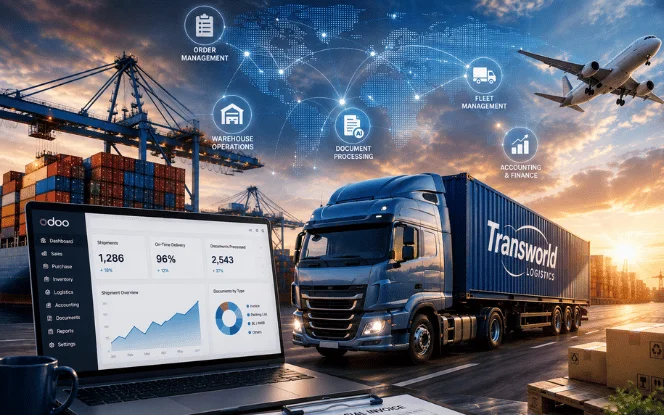
Global Logistics Enterprise
A logistics organization needed more than an isolated AI tool. Fleet, warehouse, accounting and order workflows first needed a connected enterprise platform before AI-assisted document processing could deliver measurable operational improvement.
SDLC Corp implemented an ERP foundation and introduced AI extraction and validation at the point where manual document handling was creating delay. Pattern: operational documents to AI processing to validation to human review to enterprise ERP.
Best proof forAI built around the operating system of the business
- ERP modernization
- Fleet workflows
- Warehouse operations
- Accounting
- Shipment workflows
- AI document extraction
- Operational validation
- Human review

Featured image from the Transworld Logistics case study.
Causeway - Global NGO ERP
Causeway is our own global NGO ERP, connecting funding, finance, grants, procurement, programmes and people in one enterprise system - with AI included rather than sold as a separate tool.
Causeway AI spans Finance, Grant, Donor, Programme, Procurement, Compliance and Beneficiary intelligence plus executive analytics and workflow agents. Asked which grants have reports due within 30 days and unresolved financial exceptions, it connects award dates, budgets, expenditure, commitments and exception records, then offers source-record drill-down.
Best proof forAI inside the operating platform, with the ERP still holding authority
- Fund accounting
- Grant dimensions
- Donor reporting
- Programme delivery
- Procurement controls
- Configurable approvals
- Shared records and APIs
- Source-record drill-down
“Grant and finance owners retain responsibility for review and approval.”
AI-Powered Forecasting Platform
An enterprise forecasting solution combining predictive machine learning with GPT-4o-supported scenario simulation and real-time risk analysis.
The platform connected with SAP and financial data sources so finance teams could evaluate scenarios using current operational context rather than a month-old extract.
Best proof forAI, financial systems and executive workflows working as one
- Predictive models
- Financial-system integration
- SAP connectivity
- Scenario simulation
- Risk analysis
- Executive decision support
- Real-time feeds
- Historical data

Published in our enterprise AI portfolio.
Global Logistics Knowledge Assistant
A global logistics organization used an enterprise AI assistant across IT, HR policy and system-access support, built on GPT-4o and LangChain with a RAG architecture over the internal knowledge base.
It was integrated with ServiceNow and Slack, so employees reached it inside the service and collaboration platforms they already used rather than through a standalone chatbot.
Best proof forAI embedded across enterprise service and collaboration platforms
- Internal support
- Enterprise knowledge
- IT service requests
- HR policy
- ServiceNow
- Slack
- System access
- RAG architecture

Published in our enterprise AI portfolio.
Multimodal Clinical Assistant
A healthcare implementation combining voice, image and text inputs to support documentation and onboarding workflows, built with Gemini 1.5 and Claude 3.
It generated real-time summaries and EMR-ready documentation, integrated with Epic and hospital backend systems.

Best proof forseveral AI capabilities operating together inside one enterprise estate

- Multimodal AI
- Voice input
- Image interpretation
- Documentation assistance
- EMR-ready output
- Epic integration
- Hospital systems
- Structured workflows

Published in our enterprise AI portfolio.
Every figure is quoted from the page that publishes it. One panel carries figures rather than a screenshot, because no image is published for it.


What Clients Say
About SDLC Corp
Founders, CEOs, and operating leaders share what it's like to build with SDLC Corp.
Eric Leist
CEO, Edgerton Strategies
Doug Schmidt
CEO, Roofaid USA

Reyzal Razmi
All Star Influencers



They approached our Salesforce discovery with real technical depth, uncovered structural gaps others missed, and delivered a solution that worked exactly as promised.
SDLC CORP built a mobile application that met our strategic requirements with strong technical execution. The solution performs reliably and has become an important operational asset.
They saw inefficiencies in our Salesforce workflow and redesigned our entire quote-to-cash system. We now operate faster, cleaner, and with better accuracy.
From planning to post-launch, SDLC Corp guided us every step of the way. Their support makes them more than a vendor. They're a trusted partner.
The SDLC Corp team scaled our platform with impressive technical expertise, ensuring it's secure, robust, and ready for future growth.


The SDLC Corp team scaled our platform with impressive technical expertise, ensuring it's secure, robust, and ready for future growth.
From planning to post-launch, SDLC Corp guided us every step of the way. Their support makes them more than a vendor. They're a trusted partner.
They saw inefficiencies in our Salesforce workflow and redesigned our entire quote-to-cash system. We now operate faster, cleaner, and with better accuracy.
SDLC CORP built a mobile application that met our strategic requirements with strong technical execution. The solution performs reliably and has become an important operational asset.
They approached our Salesforce discovery with real technical depth, uncovered structural gaps others missed, and delivered a solution that worked exactly as promised.
Enterprise Engineering
at Scale.
The enterprise systems AI has to work inside are systems we already build and operate.
Our Enterprise
AI Process
Seven stages, from portfolio assessment through to operating the result.
Assess
Enterprise priorities, existing AI initiatives, applications, data, integration constraints, security and governance maturity.
Prioritize
Select use cases that can demonstrate measurable business value.
Architect
Define AI, integration, security, data and governance architecture.
Build
Develop priority applications and reusable enterprise services.
Validate
Test quality, integrations, security and business workflows.
Scale
Expand validated capabilities across teams and departments.
Operate
Monitor adoption, quality, reliability, cost and business outcomes.
Enterprise AI
Roadmap
Six phases, each ending in something the business can see.
Phase 01
Assessment
Current AI inventory, application inventory, enterprise priorities, data readiness and governance maturity.
Phase 02
Priority Use Cases
Business outcomes, ownership, feasibility and KPI definition.
Phase 03
Foundation
Integrations, shared AI services, identity, security and controlled data access.
Phase 04
AI Enablement
Priority applications, evaluation, governance and user adoption.
Phase 05
Scale
Additional departments, reusable services, additional use cases and standard operating practices.
Phase 06
Business Value
Adoption, productivity, quality, operational cost, measurable outcomes and improvement.
Phase 03 is deliberately small: build only the shared capabilities the first production use cases actually need.
Improve Existing
Enterprise AI
Already running several AI pilots but struggling to turn them into a coherent enterprise capability?
Signs a portfolio of pilots is not an enterprise capability
The goal is not to centralize everything. The goal is to standardize the pieces that benefit from reuse, security and enterprise control.
If the question is still which use cases are worth funding, start with AI consulting services.
Why Choose SDLC Corp
for Enterprise AI
Enterprise AI is an integration and operating problem as much as a modelling one.
Breadth
AI and Enterprise Engineering
Work across AI, ERP, CRM, cloud, applications, data and integration rather than treating AI as a standalone technical layer.
Depth
Specialized AI Practices
Dedicated teams across LLM, RAG, Agentic AI, Generative AI, machine learning and enterprise integration.
Platforms
Enterprise Platform Experience
Embed AI inside the platforms where organizations already manage operations.
Control
Governance by Design
Include ownership, permissions, evaluation and oversight in enterprise AI programs.
Scale
Scale Beyond Pilots
Design shared services and rollout models that support multiple teams and use cases.
Enterprise AI
vs AI Development
One capability, or many working together.
Use when the primary requirement is to build one specific AI capability or application.
Use when the requirement is to build and scale AI across multiple business systems, functions or teams.
Unit
One Application
Development delivers a capability.
Unit
A Portfolio
Enterprise AI coordinates many.
Reuse
Built for Itself
A single application optimizes for its own use case.
Reuse
Built to Be Shared
Shared services optimize for the fifth project, not the first.
Both
Same Programme
Enterprise programmes contain many individual builds.
Explore AI Development Services for a single capability.
Enterprise AI
vs AI Integration
One enterprise AI program may contain many individual integration projects.
Connects a defined AI capability with existing systems and gets it running in production.
Coordinates multiple AI capabilities, platforms and shared services across the organization.
Scope
One Capability
Integration connects what already exists.
Scope
The Whole Estate
Enterprise AI decides what should exist and be shared.
Output
A Running Workflow
One business process completing end to end.
Output
A Reusable Foundation
Services the next project does not have to rebuild.
Relation
Contained Within
Integration projects sit inside the enterprise programme.
Enterprise AI
vs Data Modernization
One builds the foundation. The other builds on it.
Focuses on modernizing the data estate so AI has something reliable to work with.
Focuses on the AI applications, services and operating structure built on those foundations.
Layer
The Data Estate
Platforms, pipelines and quality.
Layer
The AI Estate
Applications, services and controls.
Order
Usually First
AI inherits whatever the data estate gives it.
Order
Often Parallel
Priority use cases rarely wait for a full modernization.
Practice
Separate Workstreams
Keeping them separate keeps both accountable.
Enterprise AI
vs AI Consulting
Decide, then build.
Determines where AI can create value, which use cases should be prioritized and what the AI roadmap should be.
Builds and scales the approved enterprise AI capability.
Stage
Before Funding
Consulting reduces uncertainty.
Stage
After Funding
Enterprise AI delivers the programme.
Output
A Decision
Roadmap, priorities and business case.
Output
A Capability
Applications and services in production.
Signal
Which You Need
If the roadmap is approved, you need the build.
Services Related to
Enterprise AI
The specialist engagements an enterprise AI programme draws on.
Build
AI Development Services
Build individual custom AI applications.
Explore AI Development ServicesConnect
AI Integration & Implementation
Connect AI with ERP, CRM, databases and operational systems.
Explore AI Integration ServicesControl
AI Governance Consulting
Build enterprise controls, risk tiers, lifecycle governance and oversight.
Explore AI Governance ConsultingLLM
LLM Development Services
Build enterprise language-model applications.
Explore LLM Development ServicesRAG
RAG Development Services
Build enterprise knowledge and retrieval systems.
Explore RAG Development ServicesAgents
Agentic AI Development
Build enterprise agents and controlled action workflows.
Explore Agentic AI DevelopmentGenerative
Generative AI Development
Build enterprise text, image, video and multimodal generation applications.
Explore Generative AI DevelopmentData
Enterprise Data & AI Modernization
Modernize data platforms, pipelines and AI readiness.
Explore Data & AI ModernizationEnterprise AI
Resources
Sequencing, prioritization, governance and integration - the four things that decide whether an enterprise AI programme scales.
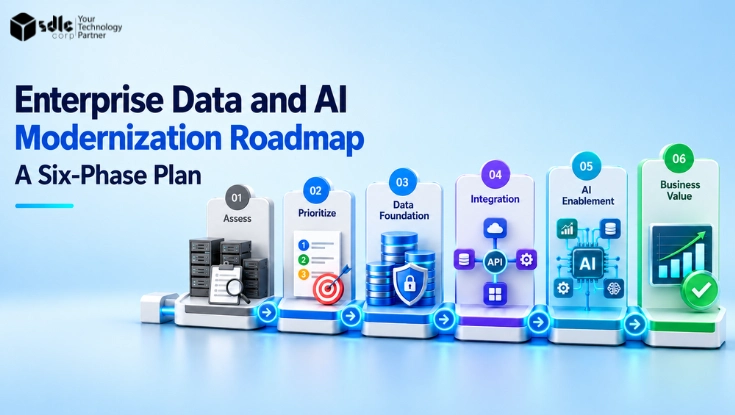
RoadmapData and AI Modernization Roadmap
How to sequence enterprise data foundations, integration and AI enablement.
Read the modernization roadmap
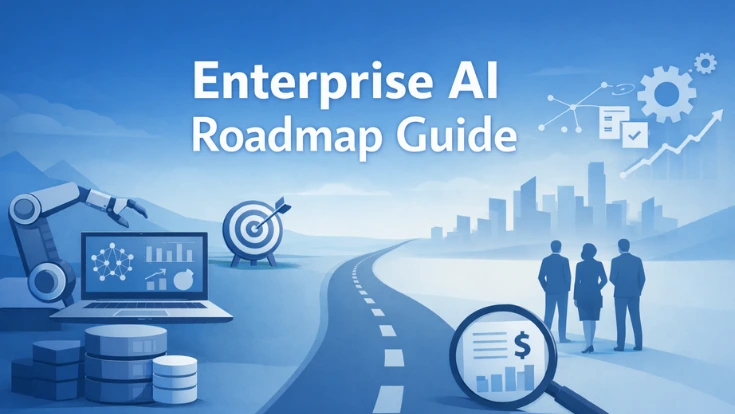
GuideEnterprise AI Roadmap
How to prioritize AI use cases and measure value before scaling.
Read the enterprise AI roadmap
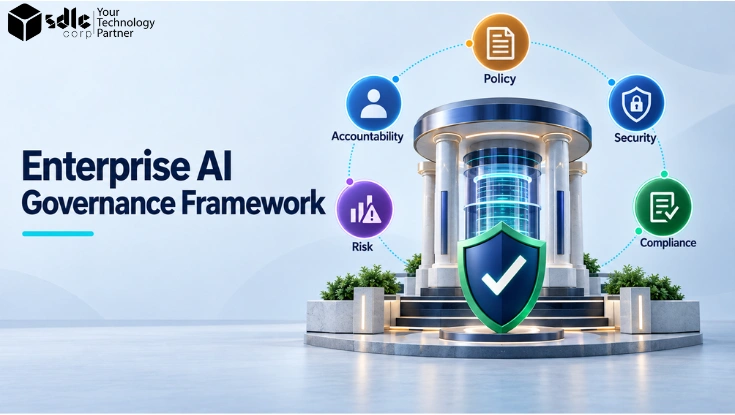
GovernanceEnterprise AI Governance Framework
How AI inventory, risk tiers and lifecycle controls support enterprise AI.
Read the governance framework
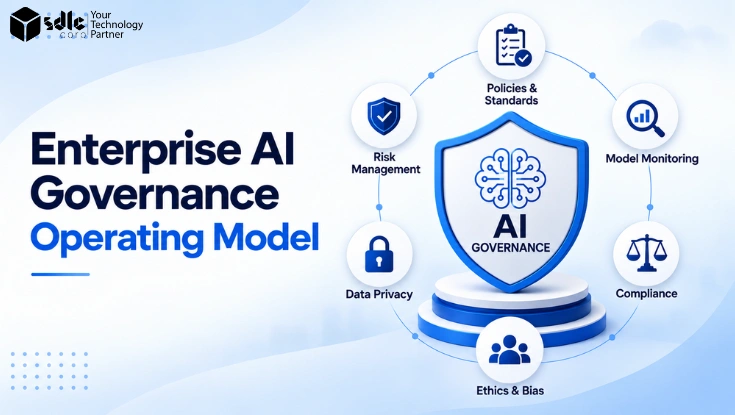
Operating ModelAI Governance Operating Model
How decision rights and governance forums support AI scale.
Read the operating model
IntegrationIntegrating AI Into Enterprise Systems
How AI connects with ERP, CRM, identity, APIs and operational applications.
Read the integration guideScale AI Across
Your Enterprise
Move from isolated AI projects to a coordinated enterprise capability with shared architecture, integration, security, governance and operational ownership.
From AI-enabled ERP platforms and enterprise assistants to predictive intelligence and reusable AI services, our enterprise AI team can help move successful use cases into production at organizational scale.
Contact Us
Share a few details about your project, and we’ll get back to you soon.
Let's Talk About Your Project
- Free Consultation
- 24/7 Experts Support
- On-Time Delivery
- sales@sdlccorp.com
- +1(510-630-6507)