Data modernization and AI modernization are often grouped into one transformation program, but they solve different problems. Understanding the difference helps organizations invest in the right workstream at the right time.
Many enterprises describe their goals as "modernizing data and AI" in a single sentence. In practice, the two workstreams change different parts of the technology environment, involve different teams, and are measured in different ways.
Treating them as one activity leads to two common failures: AI programs that stall because the underlying data was never addressed, and data programs that deliver technically sound platforms that no analytics or AI use case actually uses.
What Is Data Modernization?
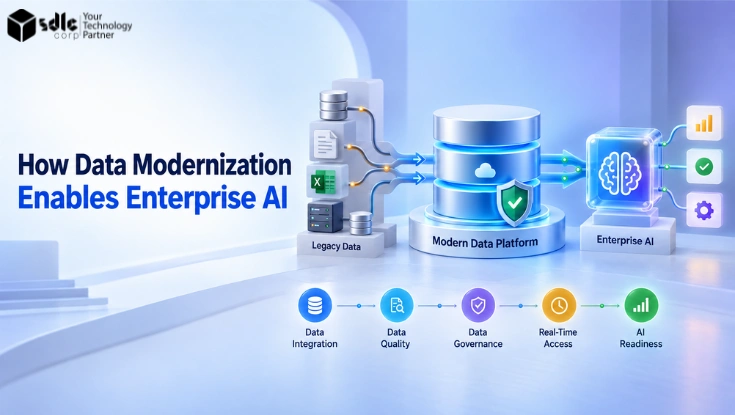
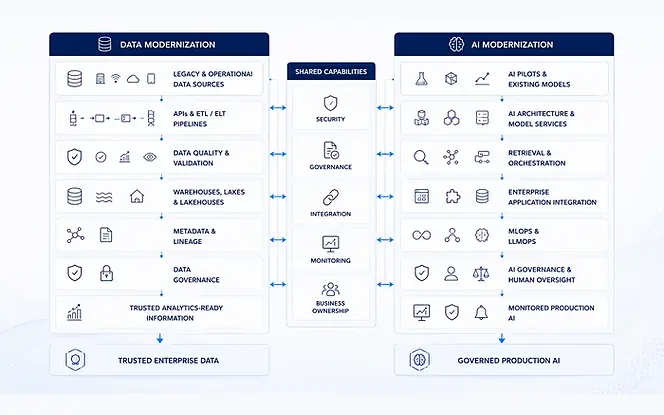
Data modernization improves how an organization connects, stores, governs, and delivers its information. It covers data architecture, pipelines and integration, data quality, warehouses and lakehouses, metadata and lineage, governance, and the reporting foundations that analytics depends on. IBM provides a useful external overview of data modernization and its core components.
The output is trusted, accessible enterprise information: reports that agree with each other, records that require less manual reconciliation, and datasets that new applications and AI systems can consume with confidence.
A practical program starts by identifying the business decisions that unreliable data currently slows down. Teams then trace those decisions back to source applications, integrations, transformations, definitions, access rules, and accountable owners.
The work may include consolidating duplicate pipelines, documenting critical entities, introducing automated quality checks, and publishing reusable data products. It should also define service expectations for freshness, availability, issue resolution, and approved use.
Progress is visible when reconciliation effort falls, reports use consistent definitions, integrations fail less often, and users can find approved information without opening support tickets. Migrating records alone does not prove that the data environment is modern.
Data modernization does not require replacing every system. Many programs retain important applications while modernizing how data moves between them and how it is governed. This incremental approach also applies to legacy software modernization. Our cloud data modernization strategy explains how to sequence platform, migration, governance, and operating-model decisions. For a coordinated service overview, explore our enterprise data and AI modernization services.
What Is AI Modernization?
AI modernization improves how artificial intelligence moves from isolated pilots into secure, governed, and monitored production systems. It covers enterprise AI architecture, model integration with business applications, MLOps and LLMOps, AI governance, monitoring, human oversight, and workforce adoption. Google Cloud’s guidance on MLOps automation and continuous delivery explains why production AI requires much more than model code.
The output is production AI embedded in real workflows: models deployed through repeatable processes, outputs that are evaluated and monitored, and systems with clear owners and controlled permissions.
Modernization begins with the path from idea to production. The organization needs a repeatable intake process, measurable acceptance criteria, approved data access, evaluation evidence, release controls, monitoring, escalation paths, and a named owner for every live capability.
For generative AI, the operating environment may also cover prompt and retrieval changes, grounding sources, output filters, human review, and model-provider updates. Traditional machine learning adds requirements for feature consistency, retraining, drift detection, and reproducible model versions.
Business adoption matters as much as technical deployment. A model that works in a test environment but remains outside the employee or customer workflow has not completed modernization. Teams must redesign the process, train users, collect feedback, and measure actual usage.
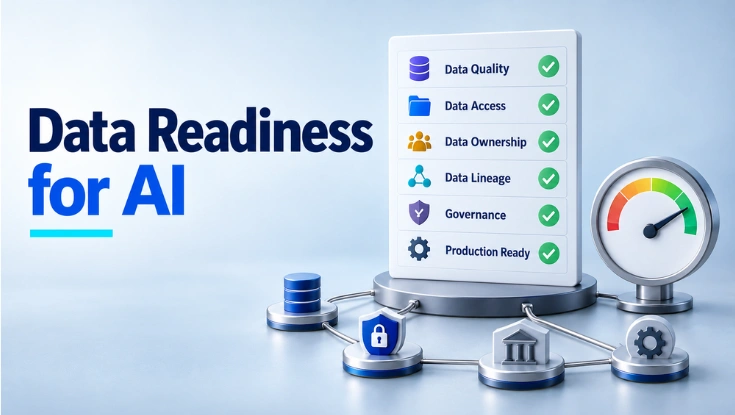
AI modernization does not mean replacing every existing model. Useful capabilities can be retained and brought into a modern operating environment. The enterprise AI data readiness assessment for production shows how to test whether those capabilities are ready to scale. Explore our AI development services for end-to-end delivery or our AI as a Service solutions for scalable APIs, model hosting, integration, and managed operations.
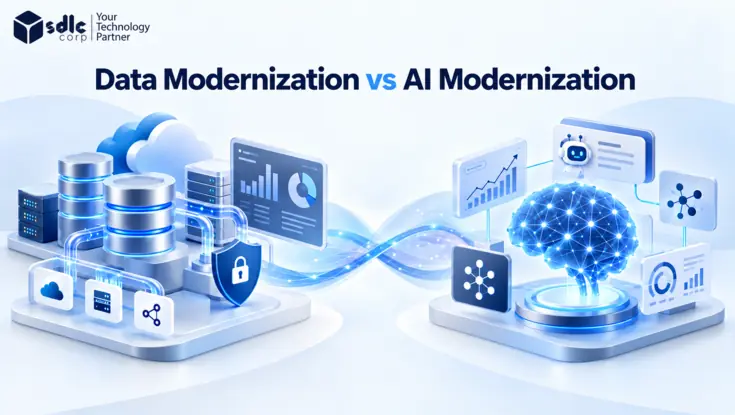
Data Modernization vs AI Modernization: Key Differences
| Area | Data Modernization | AI Modernization |
|---|---|---|
| Primary purpose | Improve the enterprise data foundation | Scale and operate AI reliably |
| Main problem | Fragmented, inconsistent, or inaccessible data | Isolated pilots and unmanaged AI systems |
| Core architecture | Pipelines, platforms, data models, and governance layers | Models, AI services, orchestration, and monitoring |
| Main technologies | ETL, ELT, APIs, data warehouses, data lakes, lakehouses, and catalogs | ML platforms, LLM services, vector databases, retrieval systems, MLOps, and LLMOps |
| Governance focus | Ownership, quality, access, lineage, and retention | Use case approval, evaluation, oversight, and model risk |
| Main output | Trusted and accessible enterprise information | Governed AI integrated into enterprise workflows |
| Typical users | Data teams, analysts, architects, and business owners | AI teams, application teams, risk teams, and operational users |
| Success measures | Data quality, reporting speed, and integration reliability | Production adoption, output quality, monitoring, and business outcomes |
The comparison shows why one budget line should not hide both workstreams. A data team may deliver trusted customer records while an AI team builds a service that uses those records. Their schedules connect, but their outputs and acceptance tests remain different.
Dependencies should therefore be written explicitly. If an AI release needs resolved customer identities, approved product descriptions, or near-real-time events, those items become named data deliverables with owners and readiness dates rather than assumptions inside the model backlog.
The same discipline protects the data program from overbuilding. Platform work should be funded because it supports defined reporting, operational, analytics, or AI outcomes. This keeps migration volume and tool adoption from replacing business value as the measure of success.
What Problems Does Each Solve?
Each workstream targets a distinct set of operational problems.
- Fragmented systems
- Conflicting reports
- Manual reconciliation
- Poor data quality
- Weak lineage
- Legacy data platforms
- Limited data access
- Pilots that cannot scale
- Manual AI deployment
- Inconsistent AI architecture
- Limited model monitoring
- Weak workflow integration
- Unclear AI ownership
- Unmanaged model and vendor dependence
If your most painful symptoms sit in the left column, the data foundation needs attention. If they sit in the right column, the AI operating environment does.
Most enterprises will see symptoms on both sides. The useful question is which constraint blocks the next valuable outcome. If analysts cannot reconcile revenue, repairing shared definitions may unlock more value than launching another AI pilot.
Conversely, an organization may already have governed data but lack release automation, evaluation standards, and operational ownership for AI. In that case, another warehouse migration will not move successful prototypes into production.
Turn each symptom into evidence. Record affected workflows, frequency, business impact, responsible teams, and current workarounds. Evidence makes sequencing defensible and prevents the loudest stakeholder or newest platform from defining the program.
Where Do They Overlap?
The two workstreams are separate, but they share several areas: security, governance, enterprise integration, cloud and infrastructure, program management, workforce adoption, monitoring, and business ownership. For AI-specific risk controls, the NIST AI Risk Management Framework is a practical external reference for incorporating trustworthiness into AI design, deployment, use, and evaluation.
The same teams may participate in both programs. A security team reviews access in both, a program office coordinates both, and business owners are accountable in both. Our enterprise AI data security and privacy guide explains the controls that must span data and AI delivery. What differs is the technical deliverable: one program delivers governed data, the other delivers governed AI systems.
Keeping the deliverables distinct while sharing these common functions is what allows the two workstreams to run in parallel without duplicating effort. The enterprise AI governance operating model provides a practical structure for ownership, review gates, oversight, and operational accountability.
Shared controls should include identity and access management, security logging, change records, incident management, vendor review, and evidence retention. Data-specific controls still govern quality, lineage, retention, and permitted access, while AI-specific controls govern evaluation, oversight, and output risk.
A common steering group can resolve dependencies and funding conflicts, but it should not own every technical decision. Named data, platform, AI product, security, and business owners need authority within clear boundaries so routine work does not wait for executive approval.
Does Data Modernization Need to Come First?
An organization does not need to modernize every enterprise dataset before implementing AI. However, the data required for a production AI use case must be reliable, accessible, governed, and suitable for that use. When infrastructure and platform changes are also required, a structured cloud transformation workstream can support the modernization sequence.
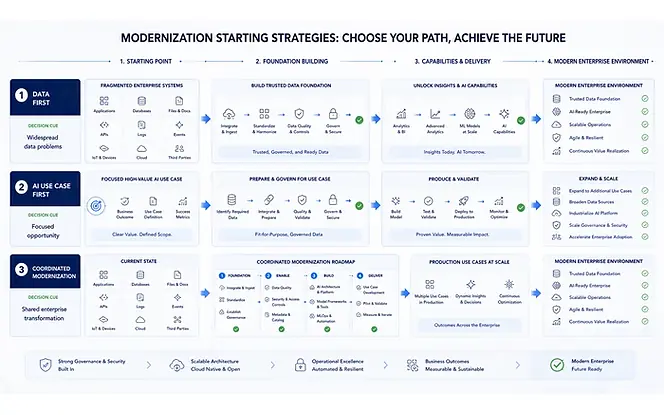
In practice, there are three workable sequences.
Start With Data
Best when data fragmentation and quality problems affect the entire organization. If reporting, operations, and compliance all struggle with the same broken foundation, fixing it first benefits every later initiative, including AI.
Start with the few domains that support several high-priority outcomes. Establish common definitions, ownership, access, lineage, and reliable pipelines there first. This creates reusable value without turning the program into an unrestricted enterprise-wide cleanup.
Start With an AI Use Case
Best when a high-value AI use case has a limited and manageable data scope. The team modernizes only the data that use case needs, proves the value, and expands the foundation from there.
Choose a case with an accountable business owner, available subject-matter experts, measurable baseline performance, and a reversible workflow. Document any temporary data preparation so the pilot does not hide manual work that production cannot sustain.
Modernize Both Together
Best when multiple AI initiatives depend on shared enterprise information and reusable architecture. A coordinated program builds the data foundation and the AI operating environment in parallel, with shared governance from the start.
Maintain separate backlogs for the two tracks and connect them through dependencies, release gates, and shared outcomes. This makes delays visible and prevents AI delivery from treating unfinished data work as an external problem.
Modernization Signals And Suggested First Moves
Use the signals below to identify the constraint that deserves attention first. One signal is not a complete diagnosis, but several related signals usually reveal whether the immediate priority sits in the data foundation or the AI operating environment.
| Signal | Indicates | Suggested First Move |
|---|---|---|
| Reports conflict across departments | Shared definitions and quality controls are weak | Agree critical metrics, owners, and validation rules |
| Critical data is spread across legacy systems | The data foundation is fragmented | Inventory priority sources and sequence high-value integrations |
| Data ownership is unclear | Governance responsibilities are incomplete | Name domain owners and data stewards with decision rights |
| Integration is mostly manual | Data delivery is fragile and difficult to scale | Replace the highest-risk handoffs with governed pipelines or APIs |
| AI teams cannot access trusted data | Approved datasets and access paths are missing | Publish governed data products with access rules and service expectations |
| Quality problems repeatedly affect operations | Controls detect issues too late | Baseline critical defects and automate checks at pipeline boundaries |
| Several AI pilots already exist | Experimentation is ahead of production discipline | Inventory pilots and select one production candidate using business value and risk |
| Useful models cannot reach production | Release gates and target architecture are unclear | Define acceptance criteria, deployment patterns, and accountable owners |
| AI tools remain disconnected from workflows | Integration and adoption planning are incomplete | Map the target workflow, user decision, and required application connections |
| Deployment and monitoring are manual | AI operations are not repeatable | Introduce controlled pipelines, evaluation, telemetry, alerts, and rollback |
| Different teams duplicate AI capabilities | Reusable platform services and standards are missing | Standardize shared components while retaining business ownership |
| AI governance and ownership are unclear | Production accountability is weak | Assign use-case owners, approval roles, oversight, and incident responsibilities |
After identifying the strongest signal, validate it with workflow evidence, logs, quality reports, deployment records, and named stakeholder interviews. The first move should remove a real blocker and create evidence for the next investment decision.
When Should Both Be Modernized Together?
Some programs justify modernizing both workstreams in one coordinated effort:
- Enterprise AI transformation programs
- Public-sector programs combining legacy data, analytics, and AI modernization
- Multiple AI use cases using common data
- Analytics and AI platform consolidation
- Legacy system and workflow modernization
- AI-ready enterprise architecture programs
In these cases, running the workstreams separately creates duplicated integration work and conflicting governance. A single program with two clearly scoped tracks is more efficient. Microsoft’s Cloud Adoption Framework is another useful external reference for structuring strategy, planning, adoption, governance, security, and ongoing management.
Coordination does not mean forcing both tracks onto one schedule. Data foundations may serve several releases, while AI use cases can move at different speeds. A shared dependency map shows which work must align and which activities can progress independently.
Funding should also distinguish reusable capabilities from use-case delivery. Central investment often supports shared integration, governance, identity, and monitoring. Business units can fund the workflow changes and adoption work that produce value in their areas.
A Combined Modernization Roadmap
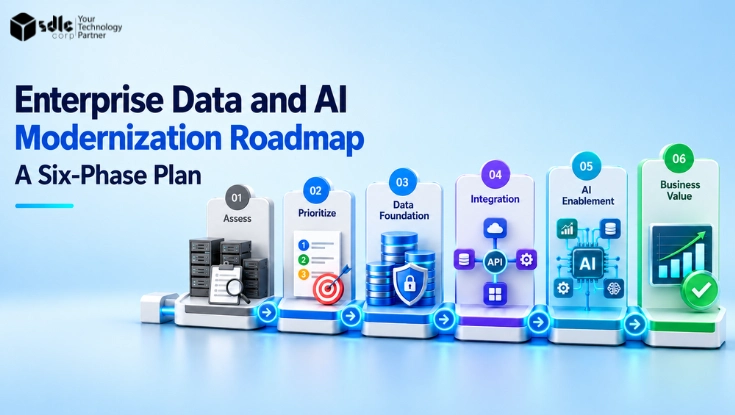
A coordinated program typically moves through six stages. Our detailed enterprise data and AI modernization roadmap explains the deliverables, dependencies, and exit criteria for every phase. The durations below are indicative planning ranges and will vary with scope, data condition, team capacity, and regulatory requirements.
- Assess systems, data, and AI capabilitiesIndicative duration: 4 to 6 weeks
- Prioritize business outcomes and use casesIndicative duration: 3 to 5 weeks
- Modernize priority data and integrationsIndicative duration: 8 to 16 weeks
- Establish data and AI governanceIndicative duration: 6 to 10 weeks, usually overlapping the foundation stage
- Deploy analytics and production AI capabilitiesIndicative duration: 6 to 12 weeks per first-wave use case
- Monitor, improve, and expandIndicative duration: ongoing
Each stage produces value on its own: the assessment clarifies priorities, the data stages improve reporting immediately, and the AI stages turn governed information into operational capabilities.
Stages can overlap when their entry criteria are satisfied. Governance design can begin while priority pipelines are being built, and production preparation can start once a use case has stable inputs, approved controls, and measurable acceptance criteria.
Do not treat the ranges as commitments before discovery. Unsupported integrations, undocumented transformations, identity-resolution problems, procurement lead times, security reviews, and scarce subject-matter experts can all extend delivery. Record these dependencies during assessment and update the plan as evidence improves.
Every stage needs an exit decision. The program should confirm deliverables, ownership, control evidence, unresolved risks, and readiness for the next investment. Phase completion should reflect operational readiness rather than the percentage of tasks marked complete.
Our Enterprise Data and AI Modernization Services page explains how both workstreams can be planned and delivered within one coordinated program.
Common Planning Mistakes
These planning mistakes appear in both data-led and AI-led programs.
- Treating AI as a Replacement for Poor Data
Models cannot compensate for missing, inconsistent, inaccessible, or poorly understood information. Fix the data required by the selected use case and document any limitations that remain.
- Waiting for All Enterprise Data to Be Perfect
Perfect enterprise-wide data is not a prerequisite for starting AI. Modernize the minimum trusted domain set a priority outcome requires, then expand when reuse is proven.
- Buying Platforms Before Defining Use Cases
Platform purchases made before priorities are set often solve the wrong problem. Define outcomes, decision owners, data needs, controls, and acceptance criteria before selecting technology.
- Combining Governance Without Clear Responsibilities
Data governance and AI governance share principles but need distinct owners, controls, evidence, and review processes. Publish decision rights and escalation paths before production releases begin.
- Launching Pilots Outside the Target Architecture
Pilots built without regard for security, integration, monitoring, and operating ownership must be rebuilt before they can scale. Define the production path while keeping experimentation lightweight.
- Measuring Technology Delivery Instead of Outcomes
Deployed platforms, migrated datasets, and model counts are not business results. Measure reliability, workflow adoption, control coverage, time saved, risk reduced, and the outcomes defined during prioritization.
- Underestimating Adoption And Operational Change
A technically successful release can still fail when users, support teams, and process owners are unprepared. Fund workflow redesign, training, feedback, support, and ongoing ownership as delivery work.
External support should also be evaluated against evidence, delivery accountability, knowledge transfer, and long-term operating fit. Use this framework to choose a data and AI modernization partner without relying only on tool lists or broad capability claims.
Conclusion
Data modernization and AI modernization answer different questions. One builds trusted, accessible enterprise information; the other turns that information and suitable models into governed production capabilities.
The right starting point depends on where your problems sit. Organization-wide data fragmentation calls for a data-first sequence. Stalled pilots and unmanaged AI systems call for an AI-first sequence. Multiple AI initiatives sharing common data justify a coordinated program.
Whichever sequence fits, keep the two workstreams clearly scoped, share governance and program functions between them, and measure business outcomes rather than technology delivery. A broader digital transformation strategy can connect these modernization decisions with application, process, cloud, and operating-model changes.
Frequently Asked Questions
Is AI Modernization Part Of Data Modernization?
No. They are separate workstreams. Data modernization improves the enterprise information foundation, while AI modernization improves how AI systems are built, deployed, governed, and monitored. Production AI depends on suitable data, which is why the two are often coordinated.
Can AI Modernization Begin Without A New Data Platform?
Yes. AI modernization needs reliable, governed data for each production use case, not a completed enterprise data platform. Many programs modernize only the data a priority use case requires and expand from there.
Does Data Modernization Always Require Cloud Migration?
No. Data can be modernized in the cloud, on premises, or in a hybrid environment. Cloud migration is an infrastructure decision, while modernization covers architecture, quality, governance, and integration wherever the data lives.
Can One Team Manage Both Workstreams?
Shared functions such as security, program management, and business ownership can span both. The technical deliverables differ, so most organizations keep distinct data and AI delivery responsibilities under one coordinating program.
Which Modernization Program Is More Expensive?
It depends on scope. Data programs are usually driven by the number of systems and the state of data quality, while AI programs are driven by the number of use cases and their governance requirements. An assessment of both is the reliable way to estimate cost.
How Long Does A Combined Program Take?
A focused workstream in either area may take a few months. A coordinated enterprise program covering data, analytics, and production AI is normally delivered through several phases, each producing usable results.
What Should An Organization Assess First?
Start with a joint assessment of systems, data quality, existing AI pilots, governance, and business priorities. The assessment shows whether data problems, AI operating problems, or both are blocking progress, and defines the right sequence.