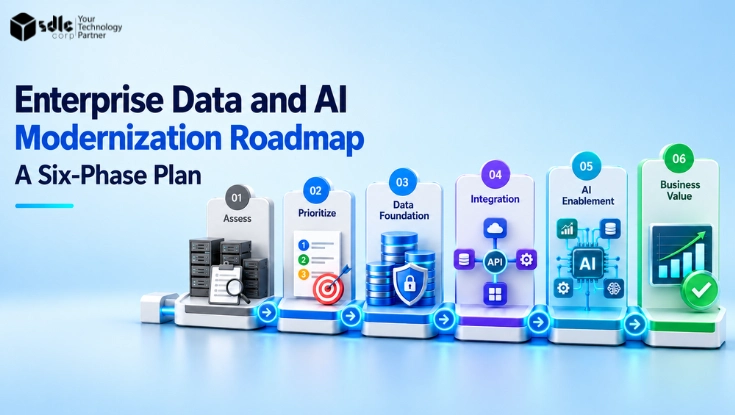
An enterprise data and AI modernization roadmap turns business priorities into a phased delivery plan.
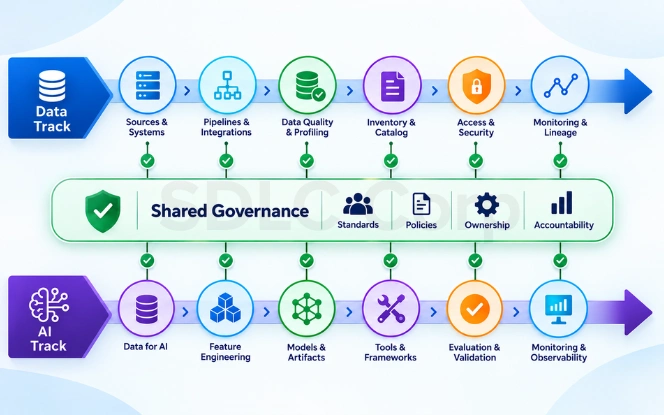
In practice, it coordinates two connected tracks: a data track that improves integration, quality, lineage, identity, and access; and an AI track that validates use cases, delivery requirements, human oversight, and production operations.
In addition, each phase should have named owners, measurable deliverables, dependencies, and clear exit criteria.
Sequence work by business outcome rather than vendor preference. Specifically, for each priority outcome, identify the data, integrations, controls, and AI capabilities required to deliver it.
Fund the smallest combination of work that can produce a measurable result, then use evidence from that phase to decide what scales next.
- Overall, an AI-ready roadmap runs two connected tracks: a data track for integration, quality, lineage, identity and access, and an AI track for use cases, oversight and production operations.
- Sequence modernization work around business outcomes rather than platform or vendor preference.
- Every phase needs named owners, measurable deliverables, dependencies and clear exit criteria before the next phase is funded.
- Governance starts at assessment and stays proportional to the risk class of each use case.
- Ultimately, measure foundation reliability, production adoption, governance coverage and business value, not datasets migrated or model counts.
Start With Outcomes, Not Platforms
Above all, start with specific business outcomes and the decisions they support. In practice, frame each outcome as an operational improvement or risk reduction tied to one process.
For example, automate ledger matching to shorten monthly-close reconciliation, or reduce parts-delivery delays in service operations. Also name the decision owner, expected workflow change, and acceptable error or latency for each outcome.
Next, turn each outcome into a short list of needs. In particular, identify the source systems, required freshness, need for record-level identity, and acceptable quality thresholds.
As a result, this prevents wholesale replatforming. Therefore, scope ingestion, cleansing, and access controls only where they affect the outcome. Finally, record the trade-off between breadth and speed.
Let Requirements Drive Platform Choices
Use outcome-driven scope for procurement and design. In practice, choose integration and storage patterns that meet the immediate need. Defer platform optimization until adoption and shared cross-domain needs are clear.
Above all, avoid platform-first procurement that assumes a broad migration. A large platform can deliver many features yet fail when it does not meet an immediate user need or incentive.
- First, create measurable outcome statements with decision owners and acceptance criteria for each prioritized use case.
- Next, map each outcome to the minimal datasets, latency, and identity resolution required to support the decision.
- Subsequently, estimate integration complexity per outcome to decide whether to build point-to-point feeds, canonical APIs, or a shared ingestion layer.
- Additionally, record tradeoffs: faster deployment versus long-term cost efficiency, and local workarounds versus centralized governance.
Prioritize outcomes first; let requirements drive platform choices rather than the reverse.
Moreover, where outcome definitions need delivery capacity behind them, an enterprise AI development company can scope the datasets, integrations, and model work each prioritized outcome depends on.
Assess the Current Environment
Next, run a focused current-state assessment that goes beyond a systems inventory.
Instead, combine technical discovery with process diagnostics: identify which reports and manual reconciliations are used to make business decisions, which APIs or files deliver those inputs, and which teams own each step of the workflow.
In addition, include an inventory of AI pilots and their production readiness, cataloging model inputs, training pipelines and monitoring status.
Specifically, diagnose constraints that block value: undocumented transformations, unsupported legacy connectors, missing identity keys, or absence of SSO and role-based access.
Then, for each constraint, record impact on outcomes and the likely remediation path, such as lightweight adapters, data contracts, or selective replacement. Next, classify capabilities as retain, improve, replace, consolidate or retire to guide sequencing and avoid rebuilding low-value components.
Capture Dependencies That Shape Sequencing
Likewise, capture dependencies that influence phase sequencing: vendor lock-in, regulatory constraints, long lead-time hardware, or teams with single-subject-matter experts. Afterward, use dependency maps to identify parallelizable work across the data and AI tracks and to set realistic exit gates.
Notably, failure modes include treating a broad inventory as a plan and missing diagnostic questions about ownership, SLAs and operational traces needed for production reliability.
- First, map business workflows to source systems and the reports that feed decision-making.
- Also catalog AI pilots with dataset dependencies, retraining cadence, and monitoring maturity.
- Also flag unsupported connectors, undocumented ETL steps, and single-person ownership risks.
- Finally, classify each capability by retain/improve/replace/consolidate/retire and capture downstream dependencies.
Overall, assessment must reveal operational constraints and ownership, not just a technology list.
Where discovery exposes fragmented storage, undocumented schemas, or missing identity keys, remediation usually runs through data engineering services before AI work is scheduled.
For an external reference to benchmark the current estate against, Microsoft publishes guidance on data strategy for AI and analytics.
Define the Target Operating Model

Next, design a target operating model that assigns decision rights across business units, data engineering, platform teams, AI owners, security and risk.
In particular, specify who approves data access requests, who signs off model acceptance tests, and who owns incident response for production data issues. Similarly, use concise responsibility maps that show where domain teams retain control and where centralized teams provide platform services.
Furthermore, define processes for common operational activities: domain onboarding, data contract negotiation, model evaluation and human review of high-risk outputs. Also include measurable SLAs for ingestion, data quality remediation times, and model performance degradation thresholds.
Moreover, make the operating model explicit about change management, including how backlog prioritization is governed across the two tracks and how costs are allocated.
Avoid Bottlenecks and Platform-Only Thinking
Still, avoid excessive centralization or hand-offs that create approval bottlenecks. Specify escalation paths and pre-approved exception categories so teams can move at velocity while still meeting control requirements.
However, a common failure mode is building a technically sound platform without the authority model to grant access and resolve cross-team disputes, which delays production handovers indefinitely.
- First, assign clear ownership for data domains, AI use cases, shared platform components and incident response.
- Additionally, define SLAs for ingestion timeliness, data-quality fixes, and model retraining or rollback procedures.
- Next, document onboarding and decommissioning processes for domains and use cases to limit technical debt.
- Finally, create escalation and exception paths so routine approvals do not require executive intervention.
In short, operating ownership must be explicit and measurable to translate platform capability into adopted outcomes.
Where the operating model spans on-premises and cloud estates, cloud transformation services can help define which platform responsibilities stay with central teams and which move to the domains.
A Six-Phase Modernization Roadmap
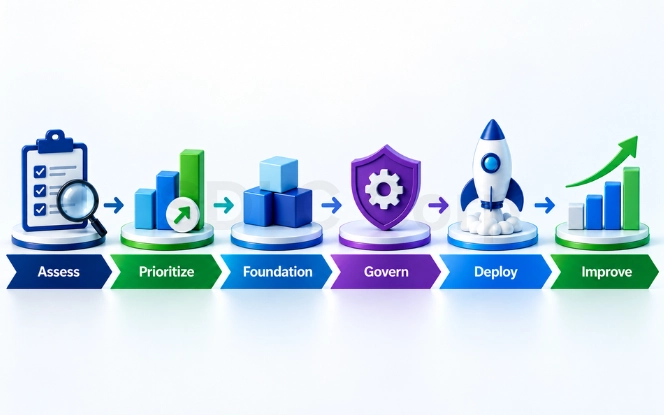
Phase 1: Assess
Initially, capture current-state inventories, workflow diagnostics and a risk map to produce a retain/improve/replace list. For the dataset-level checks that decide whether a use case can proceed, work through the AI data readiness assessment checklist.
Phase 2: Prioritize and Plan
Translate outcomes into first-wave use cases, define success metrics and scope minimal data and integration work, including required security and compliance controls.
Phase 3: Build Foundations
Subsequently, implement data ingestion, identity resolution and lineage for prioritized domains and integrations. Most of this phase is connective work across existing systems, which is where custom API development and integration services sit in the plan.
Phase 4: Governance and Operating Model
Meanwhile, establish data and AI governance policies, data quality standards and production ownership.
Phase 5: Deploy and Run
Next, move analytics and models into production using MLOps patterns with monitoring and rollback procedures. Google Cloud's guide to MLOps: continuous delivery and automation pipelines in machine learning sets out the maturity levels this phase works toward.
Phase 6: Continuous Improvement
Finally, operate and iterate on reliability, cost and measured value with a continuous improvement backlog.
Phase Reference Table
How to read this table: each row sets out the phase, its entry criteria, the exit criteria that confirm operational readiness, and the deliverables it produces. Durations are illustrative, and they will shift with data condition, scope and regulatory load.
Phase, entry criteria, exit criteria and deliverables across the six-phase roadmap
PhasePhase 1: Assess
Indicative duration: 4 to 6 weeks
- Entry criteria
- Agreed outcome definitions
- A dependency register
- Deliverables
- Assessment report
- Dependency map
- Initial cost estimate
- Minimal dataset lists
- Use-case alignment
- Defined success metrics
- Exit criteria
- Prioritized first-wave outcomes
- Risk-adjusted backlog
PhasePhase 2: Prioritize and Plan
Indicative duration: 3 to 5 weeks
- Entry criteria
- Assessment outputs
- Stakeholder alignment
- Deliverables
- Prioritized backlog
- Migration/adapter plan
- Acceptance criteria for each use case
- Data scoping
- Test plans for use cases
- Exit criteria
- Approved backlog
- Resource commitments and schedule
PhasePhase 3: Build Foundations
Indicative duration: 8 to 16 weeks
- Entry criteria
- Approved backlog
- Minimal dataset definitions
- Deliverables
- Ingestion pipelines
- Identity match services
- Lineage documentation
- Feature readiness
- Data quality gates
- Exit criteria
- Operational pipelines
- Lineage catalog for targeted domains
PhasePhase 4: Governance and Operating Model
Indicative duration: 6 to 10 weeks, usually overlapping Phase 3
- Entry criteria
- Foundational pipelines
- Catalogs in staging
- Deliverables
- Policy artifacts
- Data catalog enhancements
- Operating model templates
- Data quality rules and catalog
- Assigned ownership
- Model governance and approval
- Audit trails
- Exit criteria
- Governance policies adopted
- Roles and runbooks assigned
PhasePhase 5: Deploy and Run
Indicative duration: 6 to 12 weeks per first-wave use case
- Entry criteria
- Validated models
- Accepted test results
- Security sign-off
- Deliverables
- Production models
- CI/CD/MLOps pipelines
- Monitoring dashboards
- Operational data feeds
- Performance monitoring
- Exit criteria
- Models deployed with monitoring
- Alerts and rollback capability
PhasePhase 6: Continuous Improvement
Indicative duration: ongoing
- Entry criteria
- Production operations
- KPI baseline
- Deliverables
- KPI reports
- Cost-control measures
- Improvement roadmap
- Continuous retraining & evaluation
- Improvement backlog for scale
- Exit criteria
- Sustained value metrics
- Prioritized improvements and cost controls
Use clearly defined entry and exit gates tied to operational readiness for each phase to limit scope creep and manage risk.
Three Sequencing Patterns
Pattern 1: Data-first. Prioritize a foundational domain set and central ingestion so that many use cases benefit from the same work.
Pattern 2: AI-use-case-first. Focus the AI track on building a production pipeline for one bounded case, while applying point fixes to data supply.
Pattern 3: Coordinated advance. Advance data foundations and AI delivery together for shared domains, keeping separate backlogs and owners but synchronized roadmaps.
Pattern, best when, what to expect and the tradeoffs for each sequencing option
PatternData-first
- Fragmentation and quality issues affect multiple outcomes
- Expect
- Higher upfront platform work
- Lower incremental cost for later use cases
- Many use cases benefit from one foundational domain set
- Tradeoffs
- Longer initial lead time
- Potential overbuilding if outcomes do not materialize
PatternAI-use-case-first
- A single high-value use case has limited scope and clear ROI, for example an automated underwriting model with a narrow dataset
- Expect
- Rapid value from a production pipeline for that case
- Point fixes applied to data supply
- Tradeoffs
- Technical debt if reuse is not addressed
- Governance gaps if controls are deferred
PatternCoordinated advance
- Shared domains support multiple use cases and reuse matters
- Expect
- Less rework across tracks
- Stronger reuse of data foundations
- Separate backlogs and owners with synchronized release windows
- Tradeoffs
- Stronger program governance required
- Inter-track conflict and cost allocation decisions
Choosing Between the Patterns
- Choose data-first when multiple outcomes depend on the same fragmented data domains.
- Choose AI-use-case-first when a bounded, high-value use case has clean, accessible data.
- Likewise, choose coordinated advance when shared datasets and integrations serve multiple AI initiatives.
- Also document the expected reuse and technical debt for each pattern to inform funding and timelines.
Overall, match sequencing to business urgency, data condition and integration complexity; document expected reuse and debt.
Governance Across the Roadmap
Start governance during assessment by defining policies for access, approved usage, data quality thresholds and required evidence for model decisions.
Governance should be risk-proportionate: classify use cases by potential for financial, legal or reputational harm and apply controls accordingly. Specifically, record who must review and approve each classification and the criteria for escalation to higher scrutiny.
Establish shared principles between data governance and AI governance, for example common logging, change management and audit capabilities, while retaining separate controls where necessary, such as model evaluation protocols and data lineage requirements.
In addition, ensure technical controls exist for enforcement: automated access checks, schema validation, drift detection, and secure model registries with versioned artifacts.
Operationalize Governance and Enforcement
Therefore, operationalize governance through a lightweight approvals process and a governance callout that travels with the use case through the phases. Finally, ensure that governance artifacts are machine-readable where possible so gates can be enforced automatically by CI/CD pipelines.
Failure modes include approval bottlenecks, inconsistent enforcement and treating governance as a post-implementation audit rather than an integrated control.
- First, define risk classes for use cases and map governance controls to each class.
- Then create an approvals workflow with clear owners and measurable SLAs to prevent bottlenecks.
- Next, instrument technical enforcement: access control, schema validation, model registries and monitoring.
- Finally, use machine-readable governance artifacts to integrate gates into CI/CD and deployment pipelines.
In short, governance must be proportional, automated where possible, and integrated into the program lifecycle.
For an external baseline on sequencing governance, risk review, and lifecycle control across AI programmes, use the NIST AI Risk Management Framework. For the practices sitting underneath those controls, see responsible AI development.
Measure Program Progress
Next, track progress across four outcome dimensions: foundation reliability, production adoption, governance coverage and business value. For example, foundation reliability includes ingestion success rate, schema drift frequency and mean time to repair for data-quality incidents.
Meanwhile, production adoption tracks percent of targeted workflows using production outputs, user satisfaction and reduction in manual work. In turn, governance coverage measures percentage of outputs under approved controls and SLA compliance.
Also define KPIs per phase and per track so teams can see incremental progress.
Examples: reduction in manual reconciliations tied to a specific outcome, percentage of AI pilots that meet production-acceptance criteria, number of domains covered by automated lineage, and incidents per 1,000 production requests.
Consequently, use these to prioritize backlog items and to make go/no-go decisions at phase gates.
Metrics to Use and Metrics to Avoid
Avoid vanity metrics such as total datasets migrated or raw model counts. In short, those are delivery outputs, not outcome measures.
Additionally, build a small measurement dashboard that combines operational telemetry with business indicators and use it in governance reviews. Finally, ensure metrics are traceable back to the acceptance criteria defined for each first-wave use case to validate real value.
- Foundation reliability: ingestion success rate, schema drift frequency, mean time to repair.
- Production adoption: percent of workflows using production outputs, reduction in manual steps, user satisfaction.
- Governance coverage: percent of high-risk outputs under controls, SLA compliance and audit readiness.
- Business value: measurable workflow improvements, cost avoidance, or time-to-decision improvements tied to defined outcomes.
Measure operational reliability and adoption, not just delivery counts, and link metrics to acceptance criteria. Sustaining model accuracy, latency, and retraining against these measures is the remit of ML model engineering services.
Conclusion
A successful enterprise modernization program connects business outcomes to data foundations, AI delivery, governance and operating ownership. The two-track model keeps technical and organizational responsibilities distinct while ensuring they move toward shared goals.
Therefore, use phase gates, explicit exit criteria and proportional governance to prevent premature production deployments and to protect operational stability.
Select a sequencing pattern based on outcome urgency, data condition and integration complexity, and document expected reuse and technical debt for transparency.
Finally, maintain a short list of first-wave use cases with tight acceptance criteria and iterate on foundations based on validated adoption. Author/reviewer: SDLCCorp Enterprise Data Practice, providing enterprise-focused planning and architecture guidance.
- First, run a focused assessment and prioritize first-wave outcomes with clear acceptance criteria.
- Next, adopt the two-track model with distinct owners for data and AI backlogs and aligned gates.
- Use proportional governance and machine-readable artifacts to automate enforcement where feasible.
- Finally, measure reliability, adoption and business value to validate that modernization delivers operational outcomes.
Deliver early, measurable value by sequencing work around outcomes, operating ownership and gate-driven readiness.
Put the Roadmap Into Motion
If the roadmap spans architecture, migration, governance, integration, and AI delivery, enterprise data and AI modernization services can support the programme from assessment through phased implementation.
Frequently Asked Questions
No. Modernization should be driven by specific outcomes. The data required for a prioritized AI use case must be ready, but the entire enterprise data estate does not need modernization first. Use-case-first approaches can deliver rapid value when scope is narrow; data-first approaches suit broad fragmentation across domains.
A practical program usually has six stages: assess, prioritize, build foundations, establish governance, deploy to production, and operate with continuous improvement. The exact phases can overlap; what matters is clear entry and exit criteria for each stage and agreed deliverables so the program can gate progress against operational readiness.
Yes. Parallel tracks are effective when they share outcomes, governance and integration planning but retain distinct technical ownership. Synchronize releases, dependency maps and funding decisions so cross-track work does not stall; use a coordinated backlog and regular cross-functional reviews to resolve conflicts.
Agree a current-state assessment, prioritized outcomes, a target operating model and a first-wave scope before significant platform work. These deliverables align stakeholders on the minimal datasets, integrations and governance controls needed for early production and prevent platform procurement from driving scope.
Measure foundation reliability, production adoption, governance coverage and business value rather than only technical outputs. Use operational KPIs like ingestion success rates, percent of workflows using production outputs, SLA compliance and measurable workflow improvements tied to acceptance criteria.
No. The roadmap supports cloud, on-premises or hybrid deployments based on security, latency, cost and operational constraints. Choose platform architecture to meet the outcome requirements and governance needs; avoid mandatory platform standardization unless it demonstrably reduces operational friction.