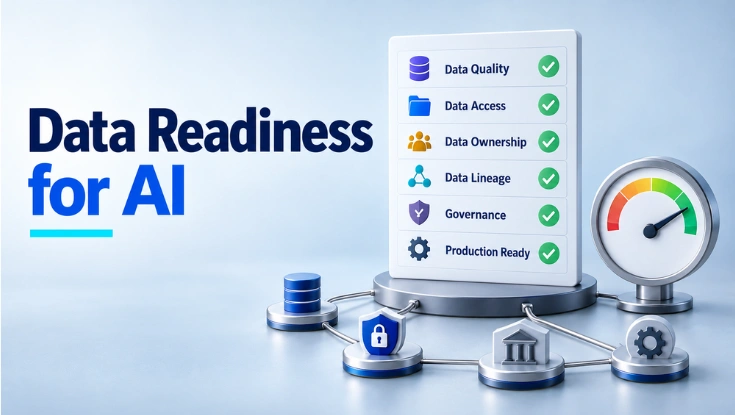
AI data readiness is an evidence-based decision about a specific use case. The assessment should show whether the required data can support a pilot or production.
It should also identify the gaps that must be resolved before the use case proceeds.
Evaluate source coverage, quality, freshness, access, metadata, lineage, security, privacy, and operational ownership against the actual workflow.
Require versioned and reproducible data or feature pipelines where repeatability matters. A dedicated feature store is optional and is useful only when reusable structured features and serving consistency justify it.
How to Use This Checklist
Assess each AI use case separately. Mark each requirement as met, partially met or missing, then document the gaps that could affect data quality, governance, security or production reliability. Use the results to prioritize remediation and determine which gaps need to be addressed before the use case moves toward production.
Gaps in pipelines, data quality controls, platform choices and observability typically fall under the data foundation workstream. Gaps in governance, operations and deployment typically fall under production readiness planning.
What the Assessment Must Prove
Readiness boundary: A readiness assessment decides whether a defined use case has sufficient data, controls, ownership, and evidence to proceed.
It does not run ongoing quality monitoring or remediate every defect. It identifies the gaps that specialist practices must close.
For the broader organization-level assessment, see AI Readiness: How to Assess Your Enterprise Before Scaling AI.
A readiness assessment should prove three things. First, the data can represent the business decision or user task the system must support.
Second, the controls must suit the intended workflow. Third, the team must explain the data source, how it changes, and who owns fixes when something breaks.
That evidence should stay concrete. Show the critical fields, source systems, transformation path, freshness expectations, access controls, and monitoring or reconciliation checks.
If those pieces are missing, state the gap directly instead of hiding it behind a generic maturity label.
- Can the required business entities, labels, or context be represented reliably?
- Are the critical pipelines reproducible and observable enough to support the use case?
- Do named owners exist for data quality, access, change approval, and incident response?
- Can the team explain what breaks if a source changes or a control fails?
A useful external reference point for readiness evidence and risk framing is the NIST AI Risk Management Framework. For delivery practices around reproducible data and ML pipelines, see Google Cloud's MLOps guidance.
Data Readiness Is More Than Clean Data
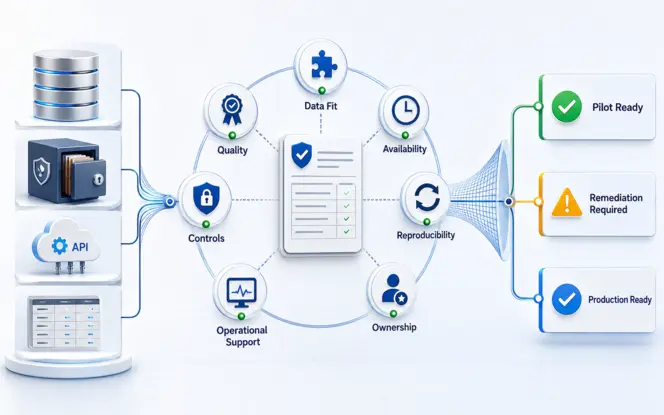
Clean records are necessary, but they are not the full readiness test. Many AI failures come from weak identity resolution, missing lineage, or unclear permissions.
Other failures arise from unstable transformation logic or freshness mismatches between training, retrieval, and live use.
Use the enterprise data quality framework for AI when the assessment identifies accuracy, completeness, or consistency gaps.
A readiness assessment should look across the full operating chain. Data must be usable, controlled, and repeatable within the required decision window.
A clean dataset that arrives too late or a fresh dataset with no owner—is still not ready.
- Quality answers whether the data is accurate and complete enough.
- Controls answer whether it can be accessed and used safely.
- Reproducibility answers whether the same logic can be rerun and explained.
- Operational readiness answers whether failures can be detected and fixed quickly.
Why Readiness Is Use-Case Specific
Readiness is always use-case specific. A weekly planning model, a real-time fraud decision, and a permission-aware retrieval workflow do not need the same freshness, identity, labeling, or oversight rules.
Start with the business decision and work backward into its data requirements. Define latency, missing-data tolerance, content sensitivity, failure impact, and the downstream action.
Then judge readiness against those constraints instead of applying one generic score to the whole estate.
- Define the use case, action, user, and failure impact first.
- Set freshness and control expectations from that context.
- Score only the data assets that materially affect the use case.
- Avoid promoting one team score as if it applies to every workload equally.
Seven Dimensions of Data Readiness
Use a small set of dimensions that teams can evidence consistently. The exact rubric can vary by company.
Seven dimensions usually keep the assessment complete without making it academic: data fit, quality, availability, controls, reproducibility, operational support, and ownership.
Treat these as diagnostic dimensions, not as a universal industry standard. The point is to create a repeatable internal scorecard that exposes gaps clearly enough for teams to act.
Use ISO/IEC 42001 to connect evidence with AI management responsibilities, DAMA-DMBOK for established data-management practices, and the EU AI Act where regulatory duties apply.
| Dimension | Example pass gate | Evidence to collect | Practical check |
|---|---|---|---|
| Data fit | Illustrative: about 90% entity coverage for the target use; set the actual threshold by use case and business risk. | Data dictionary, sample rows, label definitions, schema | Inspect samples, label distribution, and schema conformance. |
| Quality | Illustrative: about 1% null rate; define acceptable null and accuracy thresholds for the use case. | Quality reports, error and repair logs, ground-truth samples | Run random accuracy audits and null or duplicate-rate checks. |
| Availability | Illustrative: 99.9% SLA and latency within the required threshold; set targets by operational risk. | Access logs, latency metrics, uptime history, provenance timestamps | Run load tests, end-to-end latency tests, and synthetic request simulations. |
| Controls | No public access; retention rules enforced on the schedule defined by policy and risk. | Access lists, IAM configurations, consent records, retention policies | Test permissions, scan for PII, and verify retention enforcement. |
| Reproducibility | A rerun reproduces results within the drift threshold defined for the use case. | Pipeline code, DAGs, versioned artifacts, run logs | Rerun the pipeline, compare hashes or diffs, and check dependencies. |
| Operational support | Alerts are acknowledged within the target MTTA and a documented playbook exists. | Alerts, runbooks, incident logs, escalation paths | Simulate failures and verify alert delivery and playbook steps. |
| Ownership | A named owner responds within the SLA agreed for the team and use case. | RACI, dataset owner contact, change logs | Verify owner assignment and test the response path. |
Concrete example (Availability / Freshness): For a fraud decision, collect timestamped sample rows and end-to-end timing logs. Test with synthetic transaction injection and latency measurement.
An illustrative pass gate is a maximum two-second end-to-end latency. This is a heuristic, not a standard; define acceptable latency by use case and risk. Suggested owner: Data Platform.
Note: Numeric values shown above are illustrative heuristics to help teams design their scorecard. Do not treat these numbers as universal standards.
Set thresholds and service targets based on the specific use case, business risk, and operational constraints.
Use the scorecard to expose which dimension is weak. Do not let the scorecard become a substitute for evidence.
Pilot-Ready vs Production-Ready Data
Pilot-ready data is usually sufficient for controlled experimentation, narrow audiences, and reversible workflows. Production-ready data must support broader scale, tighter controls, stronger observability, and repeatable change handling.
The important distinction is not volume. It is operational burden. A pilot can tolerate manual checks, narrow exception paths, and temporary workarounds. Production cannot depend on hidden heroics or undocumented fixes.
For promotion criteria and operational handoffs, see how to move AI pilots into production.
- Pilot-ready: limited scope, explicit caveats, manual review, and reversible outcomes.
- Production-ready: stable ownership, stronger controls, monitoring, and support coverage.
- Pilot-ready can justify learning; production-ready must justify repeatable operation.
- Escalate only the gaps that block the intended promotion path, not every theoretical weakness.
Scoring and Prioritizing Readiness Gaps
Use the score to sequence work, not certify the estate
A readiness score should help prioritization, not pretend to be a law of nature. Use it as an internal SDLC Corp diagnostic or equivalent company rubric.
Set explicit weights that reflect business impact, data sensitivity, and operational risk.
Keep thresholds configurable and visible. Example score bands may help route work, but they should be treated as policy choices that can change by use case, regulation, or control expectations.
- Weight dimensions according to the use case and failure impact.
- Make threshold bands visible and explain what they trigger.
- Score evidence quality, not only self-reported confidence.
- Prioritize gaps by business consequence, not by how easy they are to fix.
Five-level scoring rubric (1-5)
Use this rubric to score the same seven dimensions defined above: data fit, quality, availability, controls, reproducibility, operational support, and ownership. Choose the level whose criteria best match observed evidence.
DimensionData fit
- 1 (Critical)
- Required entities, labels, or context are missing or unusable
- 2 (Poor)
- Partial entity coverage; granularity or labels mismatched to the task
- 3 (Adequate)
- Core entities and labels present for the target use case
- 4 (Good)
- Good coverage with documented definitions and granularity
- 5 (Excellent)
- Representative coverage validated against the decision the system supports
DimensionQuality
- 1 (Critical)
- Frequent errors, high null rate, no validation
- 2 (Poor)
- Many inconsistencies, limited cleansing
- 3 (Adequate)
- Occasional errors, basic validation and cleansing
- 4 (Good)
- Low error rate, automated validation, consistent formats
- 5 (Excellent)
- Verified quality against ground truth, continuous checks
DimensionAvailability
- 1 (Critical)
- Data cannot be accessed reliably or arrives too late to be useful
- 2 (Poor)
- Manual extracts; unstable latency or frequent delays
- 3 (Adequate)
- Accessible on a predictable schedule that meets the decision window
- 4 (Good)
- Automated delivery with monitored latency and stated SLAs
- 5 (Excellent)
- Meets latency and freshness targets with measured, auditable stability
DimensionControls
- 1 (Critical)
- Noncompliant or sensitive exposures
- 2 (Poor)
- Controls incomplete or inconsistently applied
- 3 (Adequate)
- Controls in place but gaps exist
- 4 (Good)
- Strong controls with regular review
- 5 (Excellent)
- Enforced, audited access, privacy, and retention rules
DimensionReproducibility
- 1 (Critical)
- No provenance; transformation logic unknown or undocumented
- 2 (Poor)
- Partial provenance, manual tracking, unversioned logic
- 3 (Adequate)
- Basic lineage and documented transforms
- 4 (Good)
- Automated lineage with versioned pipelines and dependencies
- 5 (Excellent)
- End-to-end traceability; reruns reproduce results within a defined threshold
DimensionOperational support
- 1 (Critical)
- No checks or alerts; failures found by users
- 2 (Poor)
- Ad hoc monitoring, no defined response path
- 3 (Adequate)
- Basic monitoring with a documented issue process
- 4 (Good)
- Proactive monitoring with alerting and incident playbooks
- 5 (Excellent)
- Automated checks, measured response times, and reviewed incidents
DimensionOwnership
- 1 (Critical)
- No named owner for the data or its fixes
- 2 (Poor)
- Ownership informal or disputed across teams
- 3 (Adequate)
- Named owners defined for quality and access
- 4 (Good)
- Owners defined for change approval, exceptions, and incident response
- 5 (Excellent)
- Accountable owners with agreed SLAs and periodic review
Remediation matrix
| Score band | Action | Trigger / notes |
|---|---|---|
| 1-2 | Must fix before production | High risk to correctness, safety, or compliance; remediation plan required |
| 3 | Manageable during pilot | Allowable with mitigations, monitoring, and explicit risk acceptance |
| 4-5 | Post-deployment | Track improvements and monitor; can be scheduled after release |
Example scorecard row
DimensionQuality
- Selected score
- 3
- Evidence
- 5% nulls in key fields; weekly validation runs
- Weight
- 20%
- Weighted contribution
- (3/5) * 20% = 12%
- Remediation
- Improve ETL cleansing in pilot; monitor error rate
A Six-Step Assessment Process
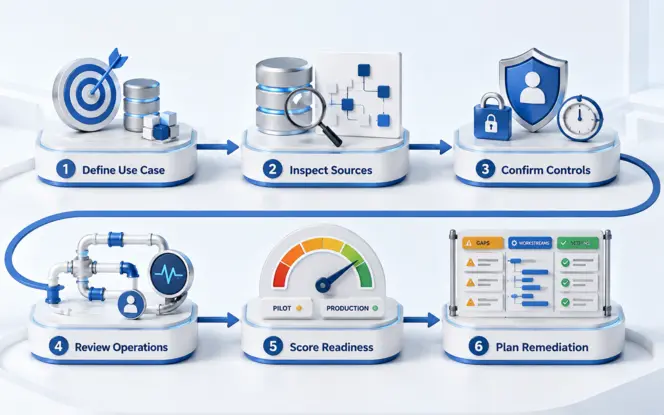
A practical assessment process is short and evidence driven. Start with the use case and its data dependencies, then inspect critical sources and transformations.
Test quality and access assumptions, confirm ownership and monitoring, and score the gaps. Then decide whether to proceed, limit scope, or block promotion.
The process should create reusable evidence rather than one-off slides. If the team later moves from pilot to production, most of the same artifacts should still be useful.
Use the enterprise data and AI modernization maturity model when the gaps indicate broader platform or operating-model weaknesses.
- Step 1: define the use case, decision window, and critical data assets.
- Step 2: inspect source quality, lineage, and transformation logic.
- Step 3: confirm access, privacy, and retention controls.
- Step 4: review reproducibility, monitoring, and owner accountability.
- Step 5: score the gaps and classify pilot or production readiness.
- Step 6: route unresolved issues into named remediation workstreams.
Turn the Score Into a Remediation Plan
Turn the score into a short remediation plan with named owners, expected evidence, and a clear retest trigger. Keep the plan tied to the weakest dimension instead of rewriting the whole platform strategy every time.
Route detailed fixes outward. Quality gaps belong with the data quality framework. Control gaps belong with governance and security. Pipeline and architecture gaps belong with the foundation and architecture pages. Promotion criteria belong with pilot-to-production.
- Convert each blocked dimension into a work item with an owner and retest condition.
- Separate near-term pilot mitigations from production hardening work.
- Use example 30-, 60-, or 90-day windows only as planning aids, not standards.
- Reassess after evidence changes instead of letting the initial score persist indefinitely.
Frequently Asked Questions
Data readiness asks whether the information required by an AI use case is relevant, accessible, reliable, governed, secure, and operationally suitable.
The assessment must include evidence such as samples, access proofs, metadata, and governance artifacts.
No. Data must be sufficiently reliable for the intended use and risk level.
Pilots can use documented compensating controls, but production requires programmatic access, ownership, permissions, and monitoring tied to clear success criteria.
Yes, when the preparation steps and their limitations are documented and reversible.
Manual preparation can support narrow pilots, but it does not demonstrate production readiness. List which manual steps must be automated before production.
Data readiness focuses on the information: relevance, quality, access, metadata, governance and monitoring. AI readiness is broader and also includes architecture, models, infrastructure, skills, change management and adoption planning.
A small cross-functional team should run the assessment: business owners, data engineers, data scientists, application owners, security, and governance representatives.
Assign a dataset owner who can approve data use and a technical owner who can prove access and monitoring.
Reassess before production and after any material change to sources, permissions, definitions, models, prompts, or workflows.
Also schedule periodic reassessments for high-risk use cases or when monitoring alerts indicate drift.
If you need the organization-level diagnostic that sits above a single use-case assessment, review enterprise data and AI modernization maturity model.