AI can perform well in a controlled demo and still struggle when it reaches real business operations. In many cases, the problem is not the model. It is the data behind it.
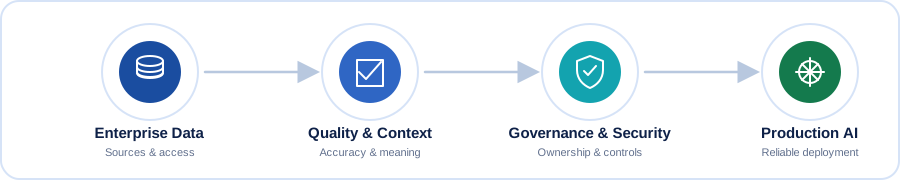
Production AI needs information that is accurate, available, secure, well-defined, and reliable. An AI data readiness assessment helps you find problems before you invest heavily in models, integrations, infrastructure, and deployment.
Key Takeaways
- Start with one clear AI use case. Do not try to prepare every dataset in the company at once. Focus on the data that directly supports the business problem you want AI to solve.
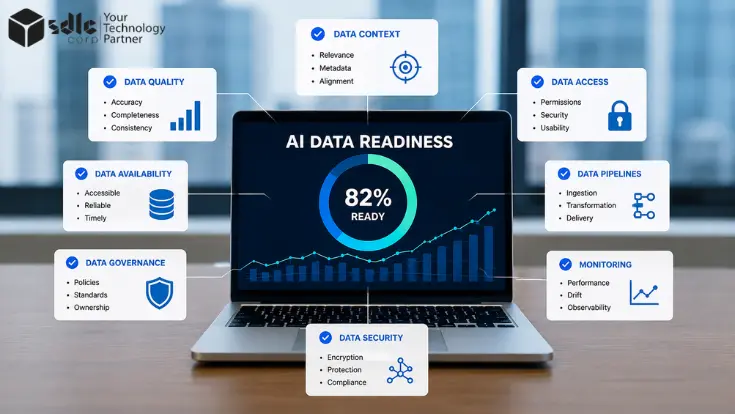
- Good data quality alone is not enough. AI-ready data also needs the right access, security, ownership, context, governance, and reliable pipelines.
- Fix critical risks before production. Privacy, security, compliance, access, and major data integrity problems should be treated as blockers, even if the overall readiness score looks strong.
- Both structured and unstructured data matter. Databases, APIs, PDFs, emails, policies, support tickets, and other documents may all affect how well an AI system performs.
- Clear ownership makes AI easier to manage. Important datasets should have defined owners, access rules, responsibilities, and escalation paths when problems occur.
- Production AI needs reliable data pipelines. Data must stay current, validated, available, and monitored after the AI system goes live.
An AI data readiness assessment checks whether the data required for an AI use case can safely and reliably support the system.
It goes beyond basic data cleaning. The assessment looks at whether the data exists, whether teams can use it, how trustworthy it is, who owns it, and whether it can continue flowing reliably after launch.
A practical assessment should answer questions such as:
- Do we have the data this AI use case needs?
- Is the information accurate and current?
- Can the AI application access it when needed?
- Do we know where the data came from?
- Is sensitive information properly protected?
- Are fields, documents, and business terms clearly defined?
- Can the data pipeline operate reliably in production?
- Who owns the data and handles problems when they appear?
Deloitte's AI data readiness guidance assesses data across areas including availability, volume and diversity, quality and integrity, governance, and responsible use.
McKinsey's 2026 research on AI data readiness also highlights the need to connect structured and unstructured information through governed, traceable, and reusable data foundations as organizations scale AI.
Why Data Readiness Matters Before Production AI

A proof of concept often uses a small, carefully selected dataset. Production systems face a much less controlled environment.
An AI application may need customer records, documents, transactions, product data, support conversations, APIs, operational systems, and live business events at the same time.
Problems become visible quickly when these sources are connected.
For example:
- Customer records may use different IDs across systems;
- Important fields may be missing;
- Old records may conflict with current information;
- Teams may not know which document version is approved;
- Permissions may differ between applications;
- Source systems may update at different times; and
- Pipelines may fail without clear alerts.
AI cannot remove these weaknesses. In some cases, it can make their impact larger because inaccurate or poorly controlled information can affect many users and workflows.
Checking data readiness before full enterprise AI development helps teams identify these risks while they are still easier and less expensive to address.
AI Data Readiness vs. General Data Quality
Data quality is part of AI readiness, but the two are not the same.
| Area | General Data Quality | AI Data Readiness |
|---|---|---|
| Main question | Is the data correct and complete? | Is the data fit for this AI use case? |
| Scope | Accuracy, completeness, consistency and freshness | Quality plus access, context, governance, security, pipelines and monitoring |
| Data types | Often focused on structured business data | Structured and unstructured enterprise data |
| Production focus | Reliable reporting and operations | Reliable AI training, retrieval, predictions and outputs |
| Ownership | Data teams may lead | Business, data, AI, security and system owners usually share responsibility |
A clean dataset is useful, but that alone does not make it AI-ready.
A customer dataset, for example, could be accurate but still unsuitable for AI if the system does not have permission to access it, key business definitions are unclear, or the production pipeline cannot keep it current.
Where Data Readiness Detail Lives
The dimension-by-dimension assessment of availability, quality, access, governance, security, context, pipelines and monitoring, along with a scoring model, is covered in the AI data readiness assessment checklist. The architecture work behind it sits in how to build an AI-ready data foundation.
This page picks up after that: what has to be true about ownership, controls, deployment and operations before a use case is allowed into production, and who holds each responsibility afterwards.
How to Prepare Enterprise Data for Production AI
The assessment tells you what is wrong or missing.
The next stage is remediation: deciding what to fix, in what order, and who owns the work.
Choose One High-Value Use Case
Define the business problem, intended users, expected outcome, and how success will be measured.
Map the Required Data
Create an inventory of the databases, applications, APIs, document repositories, and external sources the use case depends on.
Profile the Data
Measure completeness, duplicates, freshness, consistency, metadata quality, and other issues that could affect the AI system.
Prioritize the Highest-Risk Gaps
Do not attempt to clean the entire enterprise.
Focus first on problems that could reduce accuracy, create security risks, block access, or prevent the selected AI use case from working reliably.
Define Ownership and Access
Assign owners to important sources and establish permissions, classifications, approvals, and escalation paths.
Build Reliable Data Pipelines
Where practical, automate ingestion, transformation, validation, synchronization, and monitoring.
Organizations working across disconnected systems may need broader enterprise data and AI modernization before multiple AI use cases can share the same trusted foundation.
Test Real Production Conditions
Testing should include more than ideal examples.
Use cases should be evaluated against:
- Incomplete records
- Outdated documents
- Unusual inputs
- Restricted information
- Conflicting values
- Unavailable source systems
- Failed API calls
- Unexpected user requests
These conditions reveal problems that clean test datasets often hide.
Monitor and Improve
After launch, track both the AI system and the information feeding it.
When sources, policies, workflows, or business definitions change, update the data controls and testing process as well.
Common Signs Your Enterprise Data Is Not AI-Ready
The following warning signs often point to deeper readiness problems:
- Teams regularly export data into spreadsheets before they can use it.
- Nobody clearly owns important datasets.
- Different systems disagree about the same customer, product, or transaction.
- Data quality is discussed but rarely measured.
- Employees cannot identify the current version of an important document.
- Sensitive information has unclear access rules.
- AI teams build separate copies of production data for each project.
- Data pipelines fail without alerts.
- Every AI project rebuilds the same preparation work.
- Teams select models before reviewing the required data.
These problems do not mean an AI program should stop.
They show where preparation should begin.
AI Data Readiness Checklist Before Production
The earlier assessment measures readiness. This checklist serves a different purpose: it is a final pre-production review.
Before launch, confirm that:
Production Readiness Result
If several critical items remain unanswered, more preparation is usually a better choice than rushing into production.
AI-Ready Does Not Mean Perfect Data
The goal is not to make every enterprise dataset perfect. Teams should focus on the information that directly affects the AI use case and fix the issues that could reduce accuracy, security, or reliability.
Critical problems should come first. Incorrect permissions, outdated records, missing business context, and unreliable source data can create bigger risks than small formatting or completeness issues.
A practical AI data strategy improves information as the system develops. Teams can test real scenarios, fix the most important gaps, and strengthen the data foundation over time instead of delaying AI until every dataset is perfect.
How SDLC Corp Approaches AI Data Readiness
SDLC Corp's approach begins with the use case and the enterprise systems that support it.
A readiness engagement can include:
- Defining the AI use case and expected business outcome;
- Mapping required enterprise data and source systems;
- Reviewing quality, access, governance, security, and architecture;
- Identifying risks that could block production;
- Prioritizing remediation work; and
- Preparing reliable data pipelines and controls for AI deployment.
This approach separates problems that need immediate action from improvements that can happen as the AI program expands.
A Published SDLC Corp Data and AI Example
SDLC Corp’s work with Transworld Logistics shows how data preparation supports AI in real business operations. The project focused on processing invoice PDFs and connecting the extracted information with ERP and accounting systems.
The solution used AI to read invoice data, check the results, and send uncertain cases for human review. APIs then passed the verified information into the required business systems.
According to the published case study, invoice processing time dropped from 48 hours to 4 hours. The reported data-entry error rate also improved from 4–5% to 0.1%.
This example shows that successful AI depends on more than the model itself. The documents, validation process, system connections, and human checks all need to work together.
Production Acceptance: What Must Be True Before Go-Live
Data readiness answers whether the inputs are usable. Production readiness answers whether the organisation can run the system once it is live. The gate is a short list of conditions, each with a named owner.
- Named product and technical owner. One person accountable for the use case in production, not a committee.
- Defined intended use. What the system may and may not be used for, written down and approved.
- Acceptance criteria met. Quality, latency, cost per request and failure-rate thresholds tested on production-like data.
- Evaluation evidence. A stored evaluation run against a representative set, including known failure cases, with results attached to the release.
- Human review points. Where a person checks output, how they override it and what happens to the record when they do.
- Rollback plan. How to disable the feature, revert to the previous version and communicate that change.
- Support path. Who receives an incident, what the response expectation is and how users report a bad output.
Deployment Controls and Release Discipline
Treat an AI release like a change to a business process, because that is what it is.
- Versioning of everything that affects behaviour: model, prompts, retrieval configuration, tool definitions, thresholds and policy rules.
- Staged rollout. Internal users, then a limited segment, then general availability, with a defined hold point between stages.
- Change approval. A model or prompt change follows the same approval path as a code change, with the evaluation result attached.
- Environment parity. The evaluation environment uses the same retrieval corpus and tool permissions as production, or the numbers mean little.
- Kill switch. A tested way to turn the feature off without a deployment.
Operational Responsibilities After Launch
Most AI programmes underestimate the operating load. Assign it explicitly before go-live.
| Responsibility | Typical owner | Cadence |
|---|---|---|
| Output quality sampling and review | Business owner or operations team | Weekly at launch, then monthly |
| Drift, latency and cost monitoring | Platform or ML engineering | Continuous with alerts |
| Knowledge and retrieval corpus maintenance | Content or domain owner | On change, reviewed quarterly |
| Incident response and escalation | Support with an engineering path | On occurrence |
| Policy, risk and compliance review | Governance function | Quarterly or on material change |
| Re-evaluation against the test set | Engineering | Every release and on model updates |
Monitoring for production AI covers more than uptime: output quality, grounding and drift need their own signals, which is the scope of model monitoring and, for the surrounding system, MLOps practice.
Handoff Into Production
The handoff is where projects quietly fail. A workable one has four parts: a written runbook covering normal operation, known failure modes and escalation; a walkthrough with the team that will hold it; an agreed support period where the build team remains available; and a review date to decide whether the use case scales, stays as it is, or stops.
Scaling beyond the first use case is an operating-model question rather than a technical one: shared evaluation harnesses, a common permission model and a governance path that does not restart from scratch each time. That is the ground covered by the enterprise AI operating model, and the delivery side usually needs enterprise AI development support to connect the systems involved.
Conclusion
Production AI works best when the data behind it is accurate, secure, easy to access, and ready for real business use. A strong AI data readiness assessment helps teams find gaps early, reduce risk, and avoid problems after launch.
Start with one important AI use case and prepare the data it depends on first. Fix high-risk issues, set clear ownership, and build reliable data flows so the AI system can perform consistently as the business grows.
Planning a Production AI Project?
SDLC Corp can help review your data sources, quality, governance, access, security, and production pipelines, then turn the findings into a prioritized implementation roadmap.
Frequently Asked Questions
AI data readiness means the information required for an AI use case is available, usable, governed, secure, understandable, and reliable enough to support the intended system.
An AI data readiness assessment reviews the quality, availability, access, governance, security, context, pipelines, and monitoring needed for a specific AI project.
Data quality focuses mainly on whether information is accurate, complete, consistent, and current. AI data readiness also considers whether the data is suitable for a specific AI use case, accessible to the system, properly governed, secure, understandable, and supported by reliable production pipelines.
No. Start with the data required for a defined AI use case. Fix issues that could affect that use case first, then improve shared data foundations as more projects are added.
Common problems include missing information, duplicate records, stale data, incorrect labels, conflicting values, inconsistent formats, weak metadata, and unclear business definitions.
Generative AI often depends heavily on unstructured information such as documents, policies, emails, transcripts, and knowledge bases. Teams therefore need to review document freshness, metadata, permissions, extraction quality, retrieval behavior, and source traceability as well as traditional data quality.
The assessment often requires input from business owners, data teams, AI or ML teams, security, compliance, IT, and owners of the systems that provide the required information.
A formal review should happen before production, but readiness needs continued monitoring after launch. A new assessment may also be needed when data sources, models, security rules, policies, or business processes change.
Sometimes. A controlled pilot may be useful when known data gaps are limited and properly managed. Critical privacy, security, compliance, or access problems should be resolved before sensitive data is exposed to the AI system.