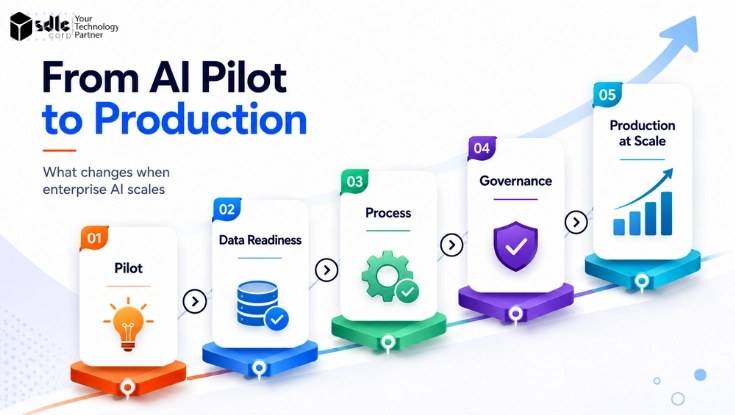

An enterprise AI delivery operating model defines how AI work is funded, built, owned, and operated after launch. In practice, it connects business owners, AI product teams, data teams, platform teams, and specialist functions around a repeatable delivery approach.
First, the model decides where use case ownership sits and which capabilities are shared. It also sets how reusable platform services are funded, how work moves into production, and who owns reliability and value after launch.
Governance forums, however, remain separate. The Enterprise AI Governance Operating Model covers how controls and exceptions are reviewed, whereas this delivery model organizes the teams that build and run each service.
- First, define team topology and accountability before debating tooling.
- Then separate product ownership from platform stewardship and control review.
- Also make handoffs and run ownership explicit across the lifecycle.
- Finally, fund shared capabilities without hiding their cost inside one use case.
AI Delivery Ownership Model
The core design question is where delivery ownership sits. Some organizations centralize most AI work in one team. In contrast, others push delivery into business aligned squads.
Many enterprises therefore settle on a federated model. In that setup, domain teams own use cases, while shared platform and specialist teams provide reusable services.
However, no single structure is universally correct. Instead, the operating model should show which responsibilities stay stable regardless of structure.
Specifically, those stable responsibilities are business ownership, data ownership, platform stewardship, model or application engineering, controls, and production support.
- Choose a delivery model that matches your organizational scale and domain complexity.
- Keep accountability for outcomes close to the business use case, because that is where value is measured.
- Use shared services only when reuse, controls, or skills justify central support.
- Otherwise, avoid structures where everyone contributes but no one owns the result.
Platform team sizing by portfolio stage
Platform capacity should grow with the number of live AI services. Team Topologies, for example, recommends small, long lived teams and platform teams that treat product teams as internal customers.
The ranges below are therefore starting assumptions. Calibrate them against your own delivery load, platform maturity, and support hours.
| Portfolio stage | Live AI use cases | Platform team size | Product teams supported | Platform to product engineer ratio |
|---|---|---|---|---|
| Pilot | 1 to 3 | 2 to 3 engineers, often shared with other work | 1 to 2 | About 1 : 3 |
| Early scale | 4 to 10 | One dedicated team of 5 to 7 | 2 to 4 | About 1 : 4 |
| Scaling | 11 to 30 | 1 to 2 teams, 8 to 14 people | 4 to 8 | About 1 : 5 |
| Enterprise | More than 30 | 2 to 3 teams, 15 to 24 people | 8 or more | About 1 : 6 to 1 : 8 |
Indicative planning ranges, not industry benchmarks. Add capacity when onboarding time or platform ticket queues keep growing.
What An Enterprise AI Operating Model Must Decide
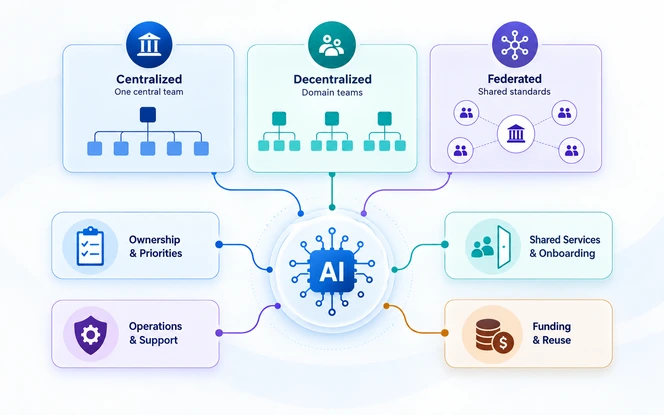
An enterprise AI delivery operating model should answer practical delivery questions directly. For example, it should define which capabilities stay centralized and which remain embedded in domain teams.
It should also name who shapes the backlog and who approves scope changes. Similarly, it should state who owns data issues that block a release and who supports incidents after launch.
Therefore, keep the focus on execution. Detailed governance committee design and control policy belong elsewhere, while this model makes AI delivery and run operations workable.
For risk responsibilities across the AI lifecycle, use the NIST AI Risk Management Framework as a primary reference. This article then translates those responsibilities into delivery roles, handoffs, and operating routines.
- Backlog ownership and prioritization rules, so that teams know who decides what ships next.
- Shared service boundaries and onboarding expectations for every consuming team.
- Run ownership, support coverage, and escalation routes after go live.
- Funding rules for reusable components versus one off delivery.
Centralized, Decentralized And Federated Models
Each operating model addresses a different coordination need. Centralized teams concentrate skills and controls. Decentralized teams, by contrast, prioritize speed and local autonomy.
Federated models, meanwhile, balance reuse with domain flexibility through shared standards and platform services. Therefore, map your organization against the factors below, and then validate the choice with a scoped pilot.
In Team Topologies terms, a federated model pairs stream aligned domain teams with a platform team. Enabling specialists then help those domain teams adopt shared practices faster.
Compare the three models
The table below compares each model on when it fits, what it costs, and how much coordination it demands. In other words, it turns the central decision into a side by side choice.
| Model | Best when | Trade-off | Coordination need | First leader steps |
|---|---|---|---|---|
| Centralized | Skills are scarce, compliance is strict, or the portfolio is small to moderate | Stronger consistency and controls, although domain autonomy is slower | Low between teams, since business units route work through one central intake | Stand up a center of excellence, then define SLAs and deliver early shared wins |
| Decentralized | Many capable domain teams need rapid delivery, and cross domain reuse is low | Faster innovation, but higher duplication and inconsistent controls | Low day to day, although teams need deliberate sharing to avoid duplicate tools | Set guardrails, provide lightweight platform APIs, and share best practice across domains |
| Federated | Scale is moderate to large, reuse potential is high, and interfaces are clear | Balances reuse and autonomy, but requires investment in standards and governance | High, because domain teams depend on shared standards, platform APIs, and a regular cross domain forum | Define APIs and standards, invest in a platform team, and name federated governance roles |
No model is permanent. Revisit the choice when portfolio size, reuse, or control demands change materially.
How to choose and validate the right model
- Decision checklist: first map scale, domain complexity, control needs, talent availability, and platform readiness to identify the closest fit.
- Pilot selection: then pick a representative portfolio slice, and measure time to value, compliance, and platform reuse before wider rollout.
- Governance: finally, define clear interfaces, SLAs, and a review cadence. Also reassess the model when portfolio size, reuse, or control demands change materially.
Define Business And AI Product Ownership
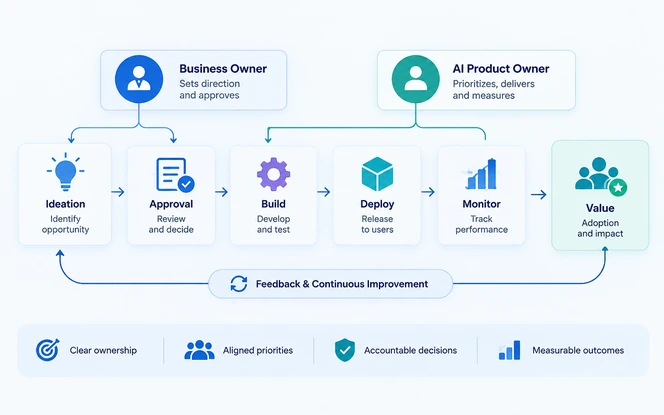
Business and AI product ownership must stay explicit. A business owner is accountable for the decision or workflow outcome.
An AI product owner, on the other hand, is accountable for turning that need into a maintained service. That includes prioritized work, adoption goals, and measurable performance.
Both roles can partner closely. However, they should not disappear into a generic committee, because teams without product ownership tend to ship models without a durable backlog or operating plan.
Ownership roles and time commitment
The table below names each ownership role, its decision authority, and the time it realistically needs. As a result, sponsors can staff these roles before delivery starts.
| Role | Owns | Decision authority | Time commitment |
|---|---|---|---|
| Executive sponsor | Portfolio funding and strategic priority | Approves funding, scale, and retirement decisions | Monthly portfolio review, plus escalations |
| Business owner | Workflow outcome, KPIs, and policy context | Approves go or no go and accepts business risk | Weekly, about 1 to 2 hours |
| AI product owner | Backlog, adoption, and service roadmap | Decides scope and release plan within budget | Full time, across one or two products |
| Delivery lead | Team capacity, dependencies, and release plan | Decides sprint scope and staffing mix | Full time |
| Platform owner | Shared services, standards, and onboarding | Decides platform roadmap and service levels | Weekly operations, plus quarterly roadmap review |
Time commitments are planning guides. Increase them for high risk or customer facing services.
- Name the business owner for the outcome and policy context.
- Similarly, name the product owner for delivery scope, backlog, and adoption.
- Clarify who decides whether to scale, pause, or retire the service.
- Above all, treat product ownership as an ongoing responsibility rather than project sponsorship alone.
Clarify Data, Model And Platform Responsibilities
Keep a strict separation of responsibilities so that incidents and changes go to clear artifact owners. Otherwise, every incident turns into a blame exchange between teams.
Specifically, data owners are responsible for data contracts, delivery, and pipeline reliability. Product and AI owners, in turn, own use case logic, evaluation, success criteria, and release readiness.
Platform teams, meanwhile, own reusable environments, tooling, integrations, and operating guardrails. Also use shared services selectively, when they deliver measurable reuse, control, or reliability benefits.
Responsibility matrix by lifecycle phase
The RACI below shows what each function does in every phase. It also adds a time commitment column, so that each role fits into real calendars.
| Function | Discovery | Build | Deploy | Run | Time commitment |
|---|---|---|---|---|---|
| Business owner | ADefines outcomes and KPIs | CAccepts scope and acceptance criteria | AApproves go or no go | CReviews value and ROI | Weekly, about 1 to 2 hours |
| Product / AI owner | RDefines use case, metrics, and eval criteria | AOwns logic, tests, and validation | RSigns off readiness and runbooks | AMonitors performance and triggers retraining | Full time |
| Data owner | RAssesses availability, quality, and contracts | RBuilds pipelines and enforces contracts | CValidates contract changes with consumers | RMaintains pipelines and alerts on breaks | Weekly, plus on call for contract breaks |
| Platform team | CAdvises on reusable options and constraints | RProvides environments, CI/CD, and tooling | RSupplies deployment templates and guardrails | ROperates services, access, and scale | Project based, plus weekly operations |
| Model engineering | RProves feasibility and estimates effort | RBuilds training pipelines, evals, and CI | RPackages models, supports canary and rollback | CDebugs issues and ships model updates | Full time in build, part time in run |
| Security / Compliance | CFlags regulatory constraints | CReviews controls and data protection | CApproves the checklist for sensitive cases | CAudits and joins incident response | As needed review, within agreed SLAs |
| SRE / Ops | CDefines SLOs and operability needs | RImplements observability and alerting | RCoordinates cutover and rollback plans | RMaintains uptime and incident management | On call rotation, plus weekly operations |
R = responsible, A = accountable, C = consulted. Each phase has exactly one accountable role.
Example: a data contract change breaks a production model
When an upstream data change breaks a live model, recovery should follow a fixed order. As a result, each step has one clear owner.
- First, the data owner patches the pipeline or backfills data to restore the expected contract shape, and then updates the contract definition.
- Next, the product or AI owner assesses business impact and decides whether to request an immediate rollback or accept a hotfix.
- Then model engineering adjusts or retrains the model, validates the result against acceptance tests, and prepares the deployment artifact.
- After that, platform and SRE teams coordinate the deployment or rollback and confirm that observability still works.
- Finally, security and compliance join the response when the change affects data sensitivity.
In short, the data owner fixes the contract, while the product owner stays accountable for the go or no go decision.
Example: a platform runtime patch for a security issue
Security patches follow a similar pattern. However, the platform team leads the response instead of the data owner.
- First, the platform team applies the runtime patch within the agreed maintenance window or through the emergency process.
- Meanwhile, the platform team notifies product and data owners both before and after the change.
- Then SRE validates stability, runs smoke tests, and rolls back if needed.
- Finally, security verifies the controls and completes compliance signoff.
In other words, the platform team applies the patch, SRE verifies operations, and security signs off.
Codify handoffs in runbooks and SLAs
To preserve this separation, write these handoffs into runbooks, SLAs, and a simple RACI for each artifact. That includes the data contract, the model, and the runtime.
In addition, record response time targets and rollback responsibilities. As a result, nobody has to guess who acts first during an incident.
For the run side, the Google SRE Workbook also offers practical patterns for on call rotations, incident response, and postmortems. These patterns fit AI services as well as traditional applications.
Define Specialist Service Interfaces
Treat security, privacy, legal, risk, and compliance as specialist services. Each one needs defined entry points, turnaround expectations, and reusable patterns.
As a result, product teams know when a specialist review is required and what evidence to provide. They also know how approved controls flow back into delivery.
This approach keeps accountability with the product team. At the same time, it avoids duplicate specialist work across every use case.
Define Delivery Forums And Handoffs
Use delivery forums to resolve priorities, dependencies, platform capacity, release readiness, and operational ownership. In addition, define each handoff clearly.
Specifically, map the handoffs from discovery to build, from build to production, and from production to ongoing service management.
Governance approvals can feed into these forums. Nevertheless, the forum itself should stay focused on delivery decisions and ownership.
Fund Reusable Platforms And Use Case Delivery
Reusable AI and data capabilities rarely survive when they are funded only through individual project budgets. Therefore, the operating model should separate shared platform investment from use case delivery cost.
This split matters because shared capabilities often support many teams over time. For example, environments, observability, model registries, data contracts, and retrieval services all serve multiple use cases.
Consequently, hiding them inside one project creates underfunding and, later, resentment between teams.
- Fund shared platform capabilities as portfolio assets.
- In contrast, fund use case delivery according to business outcomes and domain priority.
- Make cost ownership explicit for shared services that many teams consume.
- Finally, review funding rules as the portfolio scales and shared demand increases.
Funding split ratios by portfolio stage
As the portfolio grows, the budget mix should shift toward shared platform and run costs. The ratios below show a typical starting split for each stage.
| Portfolio stage | Shared platform | Use case delivery | Run and support | Main funding source |
|---|---|---|---|---|
| Pilot | 15% | 75% | 10% | Central innovation budget |
| Early scale | 25% | 60% | 15% | Central platform budget, plus business unit delivery budgets |
| Scaling | 30% | 50% | 20% | Central platform, business units, and showback reporting |
| Enterprise | 25% | 45% | 30% | Portfolio budget, with chargeback for premium capacity |
Indicative ratios. However, a platform share above 35% often signals overbuilding, while less than 15% at scale usually hides platform costs.
Build, buy, or combine shared capabilities
When you decide which shared capabilities to build, buy, or combine, use Enterprise AI Platform Strategy: Build vs Buy vs Hybrid.
That sourcing decision informs the funding model. However, it does not replace clear ownership for the resulting platform.
Measure Adoption, Reliability And Accountable Value
Measure an AI operating model by delivery flow and durable business use, rather than by experimentation volume alone.
Accordingly, track adoption, release reliability, incident rate, cycle time, and whether named owners stay accountable after launch.
Then use these measures to tune the delivery model itself. If teams cannot move from idea to owned production service without hidden heroics, the operating model is the problem, even when individual projects look successful.
Cycle time targets for AI delivery
Cycle time turns the operating model into something you can measure. For reliability targets, the Google SRE Workbook explains how to set SLOs and error budgets.
The targets below give a starting point and a mature goal for each stage. Therefore, teams can see progress long before they reach the mature level.
| Stage | Starting target | Mature target | Accountable owner |
|---|---|---|---|
| Intake to approved scope | 3 weeks | 1 week | Business owner |
| Discovery to validated prototype | 6 to 8 weeks | 2 to 4 weeks | AI product owner |
| Prototype to production ready service | 12 weeks | 4 to 6 weeks | AI product owner, with platform team |
| Model or prompt change to production | 2 weeks | Under 2 days | Model engineering |
| Data contract break to fix | 3 days | Under 1 day | Data owner |
| Critical incident to restored service | Under 24 hours | Under 4 hours | SRE / Ops |
Indicative targets. Track the median and the slowest 10% of items, because averages hide the delays that depend on hidden heroics.
What to track after launch
- Measure cycle time from intake to a production ready service.
- Also track adoption and business use after deployment, not only release counts.
- Measure reliability, incident response, and run ownership quality.
- Finally, use the results to adjust staffing, shared services, and delivery boundaries.
Frequently Asked Questions
Federated models often suit regulated industries. Central platform teams provide hardened services and compliance capabilities, while business aligned product teams keep delivery responsibility. Also embed security, legal, and privacy liaisons early, with tiered review checklists tied to model criticality.
First, automate controls into CI/CD pipelines. Then use tiered reviews, so low risk changes take automated paths while high risk decisions get manual review. In addition, set review SLAs, name liaisons, and time box governance forums.
Fund core reusable platform capabilities centrally so that they can scale. In contrast, business units that capture direct value should fund use case delivery. Finally, require adoption and usage metrics before increasing platform spend.
Use a risk based cadence. For example, delivery teams may hold weekly syncs, while production services use monthly reviews. Higher risk systems, however, need more frequent checks. Also keep an escalation playbook, decision logs, and post incident reviews.
Platform teams own hosting, serving, CI/CD, and telemetry. Model teams, in contrast, own training, validation, explainability, and packaging. Meanwhile, data owners manage dataset quality and lineage. Therefore, publish a compact responsibility matrix to speed up incident response.