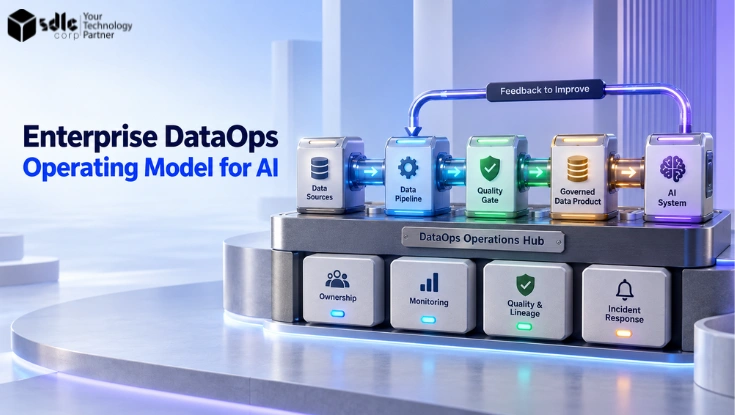
An enterprise DataOps operating model for AI defines how teams build, test, release, observe, and repair data pipelines. As a result, analytics and AI systems receive data they can trust. DataOps manages the reliability, quality, and operation of enterprise data pipelines and data products. MLOps and LLMOps manage deployment, evaluation, monitoring, and release for models and AI applications. The disciplines share tooling, but they own different failures, and the sections below keep that boundary in place while covering the operating components, metrics, and enterprise rollout.
The focus stays on data flow operations: contracts, tests, deployment, SLOs, incidents, and handoffs with product, platform, and model teams. Model lifecycle detail belongs with MLOps or LLMOps. Data products and mesh decisions belong in their own pages.
- Name a single accountable owner for pipeline reliability and contract changes.
- Run data changes through CI/CD and release gates, not only code changes.
- Publish SLOs, incident routes, and post-incident actions where consumers can see them.
- Draw the boundary with model operations and document the interfaces between them.
What Is DataOps for AI?
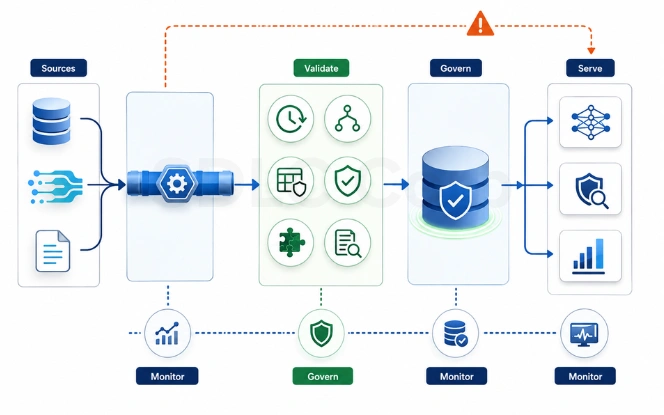
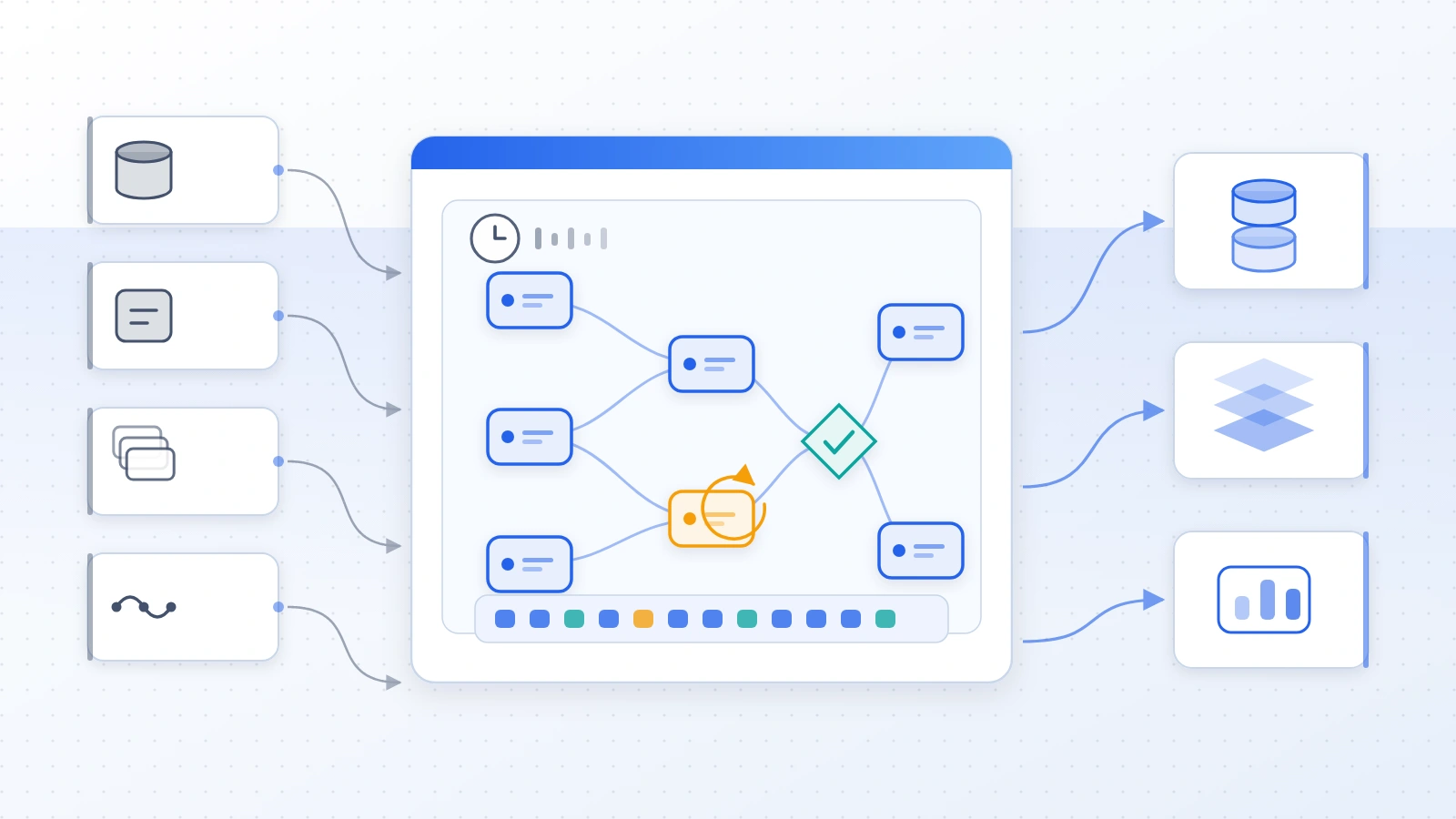
DataOps for AI is the practice of continuously delivering reliable, tested, and observable data to analytics and AI systems. It applies software delivery disciplines to data pipelines: version control, automated testing, CI/CD, monitoring, and incident management.
The DataOps Manifesto frames the same idea as an agile, collaborative, process-centric approach to analytics delivery rather than a tool category.
Enterprise AI raises the bar on what "reliable" has to mean. A dashboard tolerates a late partition; a fraud model scoring live transactions on stale features does not. That difference is what a DataOps operating model exists to manage.
An AI-serving pipeline therefore carries stronger requirements than a reporting pipeline:
- Freshness: data arrives inside the window the consuming workflow depends on.
- Lineage: every field traces back to its source and forward to its consumers.
- Schema stability: structural change is a controlled event, not a surprise.
- Quality: completeness, validity, and distribution checks run on every load.
- Feature availability: training and serving read the same values at the same time.
- Traceability: each output version links to the run, code, and inputs that produced it.
- Downstream model dependencies: the registry knows which models break when this table breaks.
DataOps for AI turns data delivery into an engineering discipline with owners, service levels, release gates, and incident procedures. Therefore, AI systems fail loudly rather than silently.
Why Enterprise AI Needs a DataOps Operating Model
Most AI failures in production are not model failures. They are delivery failures that reach the model unnoticed. For example, a source system changes a field, a nightly load arrives late, or a join silently drops a customer segment.
The model keeps scoring, the dashboard keeps rendering, and nobody sees the problem until a business number looks wrong weeks later.
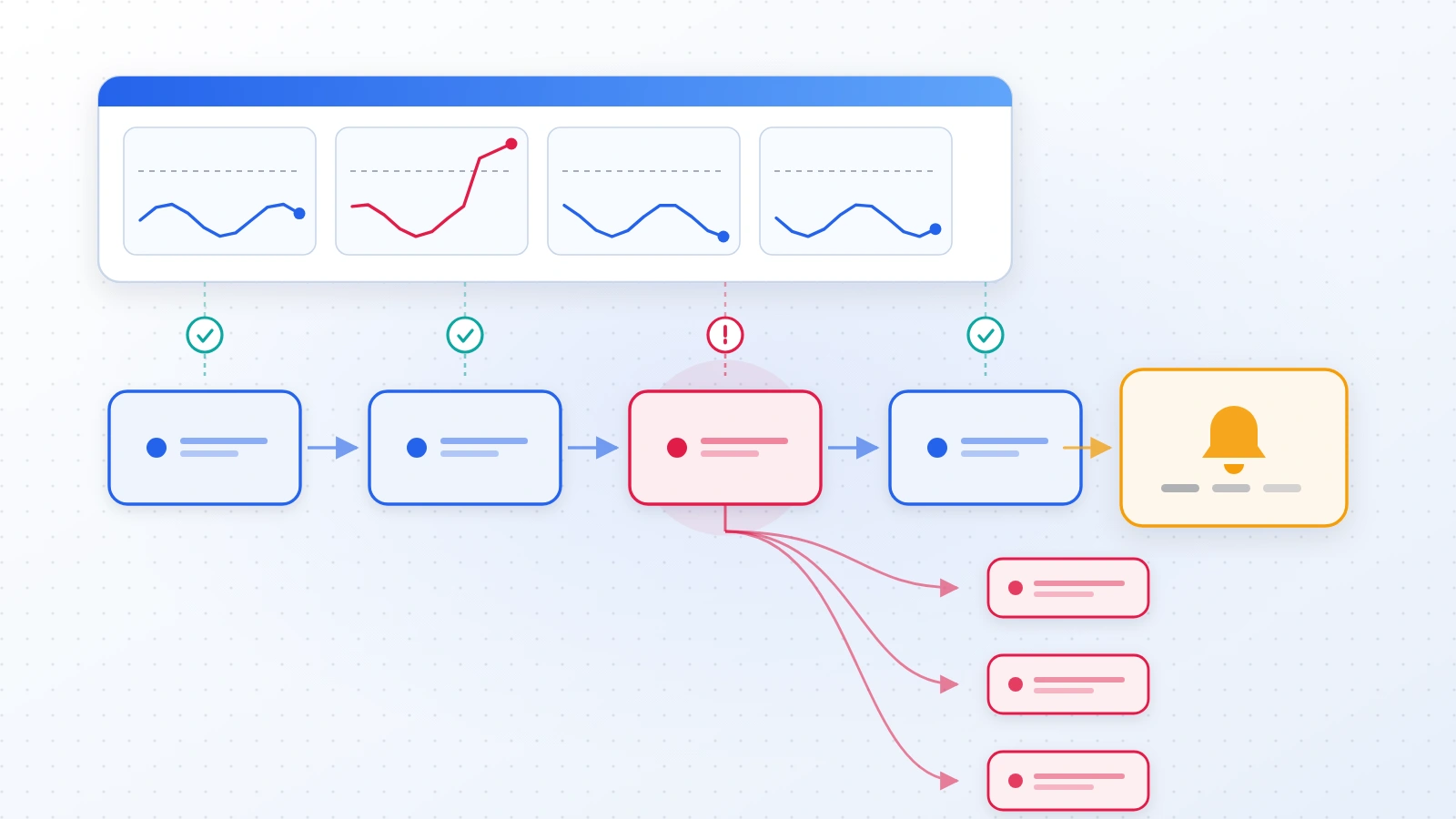
Source → pipeline → undetected quality issue → AI system → incorrect or stale output
Source → contract → tests → controlled release → observability → trusted AI data
The operating model closes that gap, and the business outcomes are measurable:
- Faster AI releases automated tests and promotion gates remove the manual review that stalls pipeline changes.
- Higher data reliability contracts and quality checks catch defects before consumers see them.
- Faster incident recovery named owners, runbooks, and trusted snapshots cut time to restore.
- Lower operational risk lineage and downstream registries make the blast radius of any change visible before it ships.
Governance benefits follow from the same controls. Auditable release records, documented ownership, and traceable lineage meet many expectations in frameworks such as the NIST AI Risk Management Framework. These expectations apply to organisations running AI in production.
DataOps vs MLOps vs LLMOps
These three disciplines are often merged into one platform conversation, which is where ownership disputes start. They operate on different artifacts.
| Discipline | Primary responsibility | Typical failure it prevents |
|---|---|---|
| DataOps | Reliable data pipelines, quality, contracts, delivery, and data incidents | A model scoring on stale, incomplete, or silently reshaped inputs |
| MLOps | Training, deployment, versioning, and monitoring of ML models | An unreproducible model or an undetected accuracy drop after release |
| LLMOps | LLM deployment, evaluation, prompts, RAG, safety, and inference operations | A retrieval or prompt change degrading answer quality in production |
The boundary is easier to hold when it is stated plainly: DataOps ensures trustworthy data reaches the AI system. MLOps and LLMOps ensure the resulting models and applications operate reliably. Interfaces between them belong in a written RACI, not in tribal knowledge. For a deeper split of the two model-side disciplines, see MLOps vs LLMOps.
Core Components of an Enterprise DataOps Operating Model
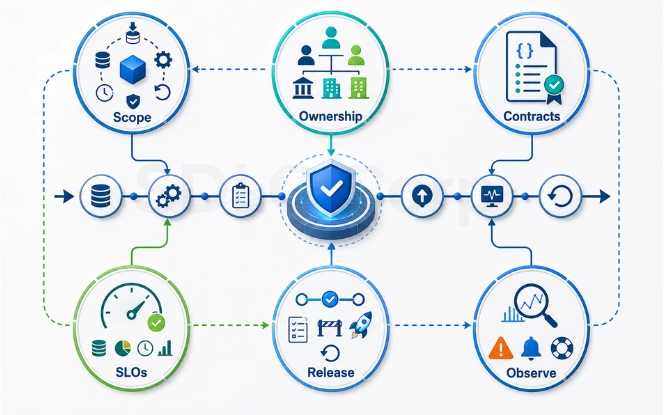
Six components carry the model. The rest of this guide expands the ones that need their own procedures.
Scope and principles
Keep the scope enforceable. DataOps covers data ingestion, transformation, testing, promotion, monitoring, change control, and restoration when data delivery fails. It does not own every model decision or every business workflow. Anything wider than that becomes unownable within a quarter.
- Own the path from source change to governed data delivery.
- Handle schema and contract changes as first-class operational events with their own approvals.
- Gate data logic behind tests and deployment controls, not only infrastructure.
- Leave model serving and inference behaviour to the MLOps or LLMOps operating model.
Ownership and responsibilities
A DataOps operating model needs clear interfaces with product, platform, governance, and model teams. Without them, DataOps becomes the default owner of every data problem in the company and stops being able to run a release calendar.
- DataOps owns data-pipeline reliability and change execution.
- Domain or product teams own the business context and the consumption need.
- Platform teams own shared tooling and runtime guardrails.
- Governance teams define policy requirements; they do not write pipeline runbooks.
Data contracts and quality controls
A data contract records the schema, semantics, freshness expectation, and owner of a dataset, and it fails the build when a producer breaks it. Pair each contract with quality rules that run on every load:
completeness against an expected key set, validity ranges, referential integrity, duplication checks, and distribution comparison against a rolling baseline. Contract enforcement is what converts a silent upstream change into a caught, attributable event.
The remaining three components
- Data SLOs: consumer-facing targets for freshness, completeness, and latency, with error budgets.
- CI/CD and release controls: tests, staging on representative data, promotion gates, canaries, rollback.
- Observability and incident management: the signals that detect failures and the procedures that resolve them.
Data SLOs for AI Pipelines
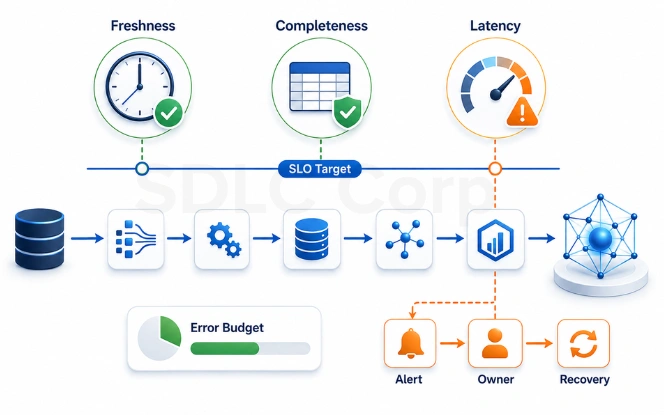
Derive data SLOs from consumer need rather than copying infrastructure uptime targets. Infrastructure SLAs describe the platform; data SLOs describe what a consumer can expect from the delivered data.
Three targets are usually enough to start, each bound to a named consuming workflow. The measurement and error-budget mechanics follow established practice from Google's SRE guidance on service level objectives.
- Freshness: 99.5% of daily partitions available within six hours of source cutoff.
- Completeness: at least 99.9% of expected records present after the daily load.
- Streaming latency P95 event-to-store latency below the service target (for example, 500 ms).
Each SLO needs four attachments before it means anything operationally: a target, an owner, an alert rule, and an escalation path.
| Metric | Target | Owner | Alert | Escalation |
|---|---|---|---|---|
| Daily partition freshness | 99.5% within 6h of source cutoff | Data-product team | Page on 3 consecutive daily misses, or immediately below 99.0% | On-call → product lead (30 min) → platform SRE (60 min) |
| Daily label completeness | ≥ 99.9% of expected records | ML-data team | Page immediately on any daily partition below target | On-call → ML-data PM → ML engineering lead |
| Streaming feature latency | P95 ≤ 500 ms event-to-store | Streaming team | Trigger after 3 consecutive 5-minute windows above target | On-call → team lead (15 min) → infra SRE (45 min) |
Error budgets and release gates. Calculate the budget as error budget = 100% − SLO target. A 99.5% freshness SLO therefore allows a 0.5% budget of missed partitions, tracked on a rolling 30-day window. Tie enforcement to consumption:
Above 50% budget spend in seven days, block non-critical releases and open an SLO review. Above 100%, halt releases for dependent models and require explicit sign-off before re-release.
Review targets on a cadence that matches the consumer workflow, and immediately after any material workflow change.
How DataOps Changes Should Be Tested and Released
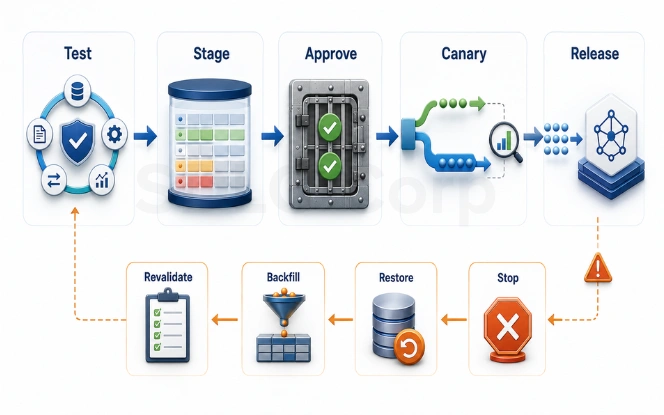
Data releases deserve the same discipline as software releases, with one addition: test business meaning, not only technical shape. A pipeline can compile, pass row counts, and still break a downstream decision because a semantic changed underneath it.
Google Cloud's MLOps guidance describes the equivalent automation maturity on the model side.
- CI test suite on every pull request: run unit tests for transformation functions, schema checks, contract compatibility checks, and transformation-correctness tests on representative inputs. Also run reconciliation tests for row counts, aggregates, key distributions, and referential integrity, alongside data-quality rules.
- Representative staging data production-sampled snapshots with PII masking where allowed, or synthetic data that preserves key distributions. Sample across time, segment, and region, and inject known edge cases to validate semantics.
- Promotion gates and approvals all CI tests passing, reconciliation deltas within threshold, contract compatibility confirmed. Automate promotion for low-risk fixes; require data-owner and business approval for schema or semantic changes.
- Canary strategies for data partitioned rollouts, percentage rollouts, or shadow publishing that writes new outputs alongside current ones for side-by-side comparison before consumers switch.
- Rollback and recovery keep immutable versioned outputs and trusted snapshots. On failure: stop promotion, repoint consumers to the previous version, restore the snapshot, backfill affected partitions, revalidate reconciliation, resume.
Release record template
ID: Author: Date: Description: Scope / affected tables/pipelines: Risk level (low/med/high): CI results: (unit, schema, transform, reconciliation) Staging data used: (sampled snapshot or synthetic; partitions sampled) Promotion gates: (list passed/failed) Canary plan: (partitions/percentage/shadow) Rollback plan:(trusted snapshot id, backfill steps, owner) Approvals: (data owner, business owner, release manager) Post-release checks: (reconciliation thresholds, SLO checks) Notes / links:(PR, runbook, metrics dashboards)Every high-impact change needs an explicit rollback or recovery path recorded before it ships. A release without one is an incident waiting for an owner.
DataOps Observability and Incident Response
DataOps observability tracks the signals that decide whether a pipeline can still be trusted. Six carry most of the diagnostic weight:
- Freshness time since the latest successful partition or event write.
- Completeness actual records against the expected key set, with null and duplication rates.
- Latency stage duration and end-to-end event-to-store distribution.
- Failures run failure rate and retry exhaustion per pipeline.
- Schema and contract changes detected structural change events, whether or not the run failed.
- Downstream impact which consumers, feature groups, dashboards, and models depend on the affected asset.
Use a standard signal model behind metrics, traces, and logs. OpenTelemetry is the practical baseline. Instrument pipeline stages as spans for ingest, transform, and load, with run and partition identifiers attached.
Keep high-cardinality identifiers such as run IDs in traces and logs rather than in metric labels. Model and business-layer signals belong with broader AI observability practice, not here.
One alert, fully specified. Partition freshness above 3,600 seconds for any pipeline in production → severity P1 → page the on-call SRE and notify the pipeline owner →
open an incident carrying the pipeline name, recent metric snapshot, run IDs from recent traces, and the consumer list from the pipeline manifest.
Incident and problem management
Separate restoring service from eliminating recurrence. Stabilise or contain the data flow first pause publication, roll back the last transformation, or repoint consumers to the last trusted snapshot.
Root-cause work determines whether the failure came from a source-system change, transformation logic, orchestration, or a broken contract. It also identifies whether the fix needs a new test, a contract clause, or an ownership change.
- Record the first responder, escalation route, and consumer communication path before the first incident, not during it.
- Restore safe data delivery before attempting redesign.
- Classify root causes as contract, quality, or process failures so patterns become visible.
- Track problem-management actions until the recurring cause is removed, not until the ticket closes.
From enterprise implementation experience: pipeline failures rarely stay inside the pipeline. A freshness or contract failure spreads into dashboards, feature stores, RAG indexes, and production AI applications. It may reach a business decision before anyone reads the alert.
For that reason, an incident record should name both the failed data asset and its downstream consumers. An incident without a consumer list understates its own severity.
Example: From Pipeline Change to Production Recovery
The following illustrative example shows how the components interact under pressure. It is a composite scenario, not a client account.
Scenario: customer transactions → feature pipeline → fraud model scoring live authorisations.
- A source team adds two new values to
transaction_typeand ships the change on its own release schedule. - Contract validation in CI detects the enum change and fails the compatibility check.
- The promotion gate stops the deployment before the transformed table is published.
- The alert routes to the named DataOps owner for the feature pipeline, with the consumer list attached.
- The fraud model continues scoring against the last trusted dataset version rather than a partially transformed one.
- The team updates transformation logic to map the new values and adds a regression test for the enum set.
- Reconciliation passes against the source, and the pipeline is promoted with a partitioned canary.
Without the contract and release gate, that pipeline would have appeared technically healthy. It could run on schedule without errors or failed jobs while silently changing the fraud model's inputs.
A business metric might have exposed the issue weeks later. Recovery would then require a backfill and model review instead of a one-day fix.
- Release with tests, dependency visibility, and stated rollback conditions.
- Contain incidents with a trusted snapshot or a publication pause.
- Classify root cause before assigning permanent remediation.
- Feed repeated failures back into contract and test design.
How AI Agents Are Changing DataOps
Operational tooling is absorbing AI agents faster than data teams are rewriting their runbooks. In DataOps, agents are proving useful on the repetitive diagnostic work that sits between an alert firing and a human deciding what to do.
- Anomaly triage: cluster related alerts and rank them by consumer impact.
- Lineage investigation: trace a failed asset back to the source change that caused it.
- Schema-change detection flag structural drift and draft the contract update.
- Incident summarisation assemble timeline, run IDs, and affected consumers into the incident record.
- Suggested remediation and runbook execution propose a backfill scope or roll back to a trusted snapshot.
- Impact analysis enumerate downstream models, features, and reports before a change ships.
The governance line matters more than the automation. Agents can investigate and recommend continuously; humans should retain approval authority over any change that alters production data, promotes a release, or modifies a contract.
An agent that can act without approval turns a detection improvement into a new class of incident.
DataOps Metrics That Matter
A useful DataOps scorecard measures delivery reliability and recovery quality. Key measures include SLO attainment, change-failure rate, detection time, recovery time, data-issue recurrence, and consumer-facing impact.
A core DataOps metric should help a team decide whether to change a contract, test, workflow, or ownership rule. Otherwise, the number is not useful.
- Report consumer-relevant SLO attainment first; platform uptime second.
- Track release quality through change-failure rate and time to recover.
- Expose weak processes through recurrence counts and manual-toil hours.
- Retire metrics that no longer trigger a decision.
Reliability reviews
Run a recurring reliability review to identify missed SLOs, repeated failure modes, release risk, and ownership gaps. Treat domains that repeatedly need manual workarounds as a design signal rather than a staffing one.
A useful review ends with a change to a test, contract, runbook, or ownership rule not simply another incident count. Escalate structural issues that no single pipeline team can resolve.
Related decisions and guides
How to Scale DataOps Across the Enterprise
A model that works for one domain rarely survives contact with twelve. Scaling fails in two predictable ways:
Central teams may standardise so heavily that domains lose context. Alternatively, domains may work so independently that no two pipelines fit the same on-call rota. Five moves keep both risks in check.
- Standardise reusable pipeline templates. Ship scaffolding that already includes tests, contract checks, telemetry, and a release record. New pipelines then inherit the operating model instead of reimplementing it, and reviewers assess business logic rather than plumbing.
- Establish common data-contract rules. One shared definition of what a contract must declare: schema, semantics, freshness, owner, compatibility policy: lets any team read any other team's contract without translation. Domain-specific clauses extend the standard; they do not replace it.
- Centralise shared observability patterns. Common metric names, label conventions, dashboard layouts, and alert severities make cross-domain incidents diagnosable. An on-call engineer covering an unfamiliar domain should still recognise the freshness panel.
- Keep domain ownership close to the business. Central platform teams own tooling and guardrails; domain teams own the data, its meaning, and its consumers. Centralising ownership of meaning is how a platform team becomes the bottleneck for every business question.
- Roll out domain by domain. Start with one domain that has real AI consumers and visible pain. Prove the model there, then use its templates and runbooks as the reference implementation for the next domain. Phased adoption also surfaces which standards were genuinely reusable and which were local assumptions.
Governance scales alongside the operating model. Publish the ownership registry, contract standard, and SLO catalogue in one place. Consequently, adoption becomes self-service instead of a series of onboarding meetings.
This model governs reliable data delivery. Policy, accountability, risk, and control decisions sit one level up, in the Enterprise AI Governance Operating Model.
Approved AI work then reaches production through the Enterprise AI Operating Model, which covers delivery teams, release ownership, and outcome measurement.
DataOps Best Practices for AI
- Attach every dataset to one named owner and one contract before it serves a production model.
- Fail the build on contract breaks; never let a schema change reach consumers as a surprise.
- Define SLOs from the consuming workflow, and give each one an alert and an escalation path.
- Test semantics, not only shape reconciliation and distribution checks catch what row counts miss.
- Keep a trusted snapshot and a version pointer for every published dataset so rollback is a repoint, not a rebuild.
- Record downstream consumers in every incident, and notify them before they notice.
- Close each reliability review with a concrete change to a test, contract, runbook, or ownership rule.
Frequently Asked Questions
DataOps for AI continuously delivers reliable, tested, and observable data to analytics and AI systems. It does this by applying software delivery disciplines to data pipelines. It defines ownership, SLOs, observability, change controls, incident procedures, and reliability reviews.
Next action: assign a pilot data product and apply the minimum artifacts and runbooks described in this model.
Most production AI failures start as data delivery failures that reach the model unnoticed, such as a late load or an uncontrolled schema change.
A DataOps operating model adds contracts, tests, release gates, and observability. These controls catch failures before consumers act on them. The result is faster releases, higher reliability, faster recovery, and lower operational risk. Next action:
map one production AI use case back to its pipelines and check which of those controls exist today.
Primary responsibility lies with the operations owner recorded for the data product; the data product owner retains accountability for business impact. Escalation to platform SRE occurs when platform components are implicated. Next action:
consult the product registry for the on-call operations owner and follow the runbook's triage steps.
Start with freshness, completeness, and latency, chosen from the needs of a named consuming workflow rather than from infrastructure uptime targets. Calculate the error budget as 100% minus the SLO target and tie release gates to budget consumption. Next action:
publish each SLO with its target, owner, alert rule, and escalation path in the product artifact store.
DataOps ensures trustworthy data reaches the AI system, covering pipeline reliability, contracts, SLOs, change controls, and data incidents. MLOps covers model training, deployment, versioning, and monitoring, while LLMOps covers LLM deployment, evaluation, prompts, RAG, and inference operations. Next action:
map interfaces between data product owners and model teams and document responsibilities in the RACI record.
Run release pipelines with automated tests, staging on representative data, and graduated rollouts such as canaries, partitioned releases, or shadow publishing. Tie release gates to SLO and error budget states, and require explicit approvals for schema or semantic changes.
Next action: require a change record with a rollback plan for every production change and validate the pre-deploy checks.
Standardise reusable pipeline templates and agree on common data-contract rules. Centralise observability patterns, keep data ownership with the domains, and roll out the model one domain at a time. Publishing the ownership registry, contract standard, and SLO catalogue centrally makes adoption self-service.
Next action: select one domain with production AI consumers as the reference implementation.