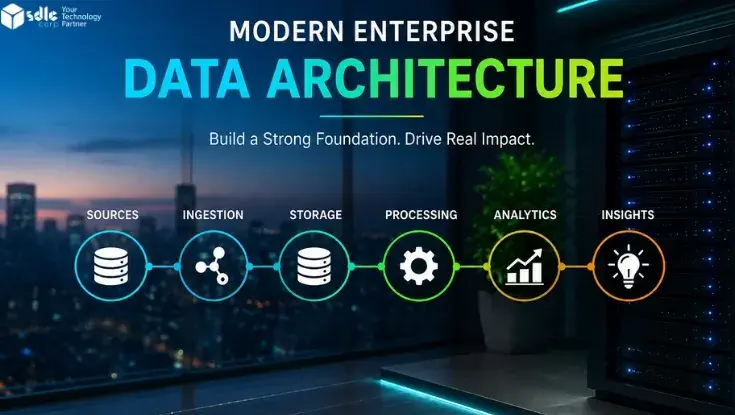
A modern enterprise data architecture defines how source systems, integration, storage, governance, and consumption fit together as one operating platform for analytics and AI.
The architecture should make ownership, contracts, identity, metadata, lineage, and failure boundaries explicit so teams can change individual technologies without losing control of the overall system.
Use five practical layers: source and interface, integration and movement, storage and processing, governance and control, and consumption.
Add a platform-control layer when provisioning, policy automation, observability, or shared runtime services need separate ownership. Specialist design decisions such as warehouse versus lakehouse selection or real-time replay behavior should plug into these layers rather than be re-explained as separate architectures inside the pillar.
Reference Architecture Boundary Map
Layered ownership boundaries for the modern enterprise data architecture
| Layer | Primary owns | Explicit not-owns | Examples |
|---|---|---|---|
| Source and integration layer | Capture, contracts, CDC, APIs, ingestion reliability | Real-time decision design | CDC streaming of order changes into the raw zone, with ingestion SLAs. Fraud scoring stays with the app team. |
| Storage and processing layer | Curated zones, table formats, workloads, lifecycle policy | Product-level warehouse vs lakehouse choice | Raw and curated zones, partitioning and retention rules. Teams pick the product within that policy. |
| Governance layer | Metadata, access, lineage, quality, stewardship | Full AI governance operating model | Catalog with lineage capture, RBAC and quality rules. Model governance stays with the ML team. |
| Consumption layer | Analytics, AI, reporting, retrieval, operational apps | Application modernization plans | Curated datasets, BI dashboards and retrieval APIs. App refactor roadmaps are owned by app teams. |
Core Design Principles
Architecture boundary: The reference architecture defines layers, interfaces, shared control planes, and failure boundaries. Specialist choices, storage patterns, streaming approaches, catalog workflows, and migration cutovers, should align with and inherit these boundaries.
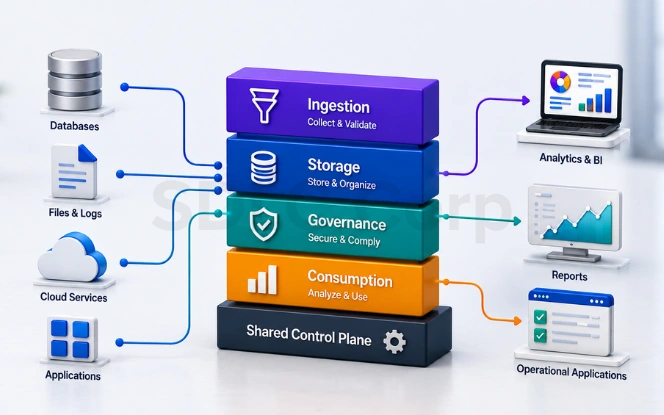
Norm: Require explicit owners and published interface contracts, and enforce metadata, identity, observability, and failure boundaries via the shared control plane.
Quick decision checklist
- Declare an accountable owner and measurable SLA for each layer: source capture, transformation, governance, consumption. Include escalation contacts and review cadence.
- Publish a data contract before downstream replication: schema, freshness SLO, access patterns, owner, and evolution rules. Gate deployments on contract validation.
- Operate a centralized control plane for metadata, policies, identity, and lineage with API hooks and CI validation for contracts.
- Define data products to include record-level fidelity, quality flags, and provenance metadata so they serve both reports and models.
- Enforce runtime contracts with automated validation and observable SLIs that map to cross-layer boundaries; surface violations in incident workflows.
Common failure modes and mitigations
- Hidden coupling: consumer jobs fail when producers change schemas. Mitigation: formal contract-evolution process plus CI compatibility checks and staged rollouts.
- Fragmented access control: inconsistent policies across tools. Mitigation: centralize identity and policy enforcement through the control plane and implement short approval workflows.
- Poor lineage: incidents are hard to trace. Mitigation: capture end-to-end lineage and surface it in runbooks and dashboards to speed root-cause analysis.
This section focuses on cross-cutting, normative rules and actionable checklist items. For concrete responsibilities and examples for each layer, see the "The Main Architecture Layers" section.
The Main Architecture Layers
Assign a clear owner to every cross-layer contract
Most enterprise data architectures need five practical layers: source and interface, integration and movement, storage and processing, governance and control, and consumption.
Some organizations also operate a platform-control layer for provisioning, policy automation, and observability. The exact implementation changes by estate, but the responsibilities stay recognizable.
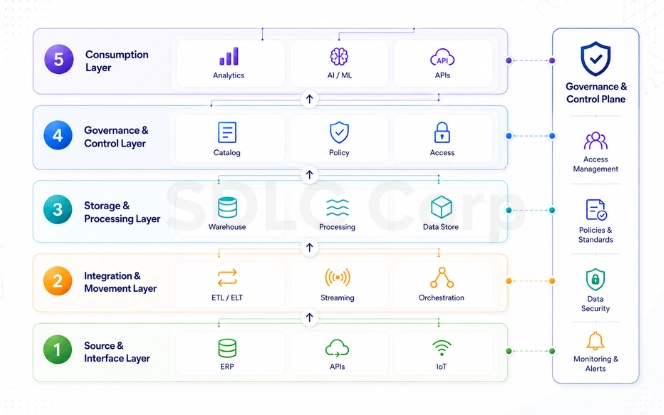
Use these layers to decide ownership and service boundaries. Integration teams should not own every downstream business model. Governance teams should not become the bottleneck for every schema change. Consumption teams should not bypass policy because the architecture never made the policy layer reusable.
- Source and interface layer: capture, APIs, CDC, and event contracts.
- Storage and processing layer: curated zones, tables, and compute choices.
- Governance layer: catalog, lineage, quality, identity, and access policy.
- Consumption layer: reporting, applications, retrieval, and model-serving inputs.
Layer definitions matter because they decide where contracts, ownership, and failure isolation live. IBM's overview of data architecture describes the same responsibilities in vendor-neutral terms.
Batch, Near-Real-Time and Event-Driven Data
Choose data movement from the business decision window. Batch is appropriate when minutes or hours are acceptable and simplicity matters, typically running on a 1-hour to 24-hour schedule with data freshness measured in hours.
Near-real-time patterns, usually micro-batches every 1 to 15 minutes, are useful when fresher data improves decisions without requiring event-by-event action.
Event-driven streaming targets end-to-end latency of roughly 100 milliseconds to 5 seconds. It is justified when the business must react to individual changes quickly and can support the additional state, replay, ordering, idempotency, and observability requirements that a real-time data architecture introduces.
Set the freshness SLO against those windows. A daily report tolerates a 24-hour lag, an operational dashboard usually needs 5 to 15 minutes, and fraud or inventory decisions need sub-second delivery.
Latency, freshness and trade-offs for each data movement pattern
| Pattern | Typical latency | Freshness SLO | Best for | Main trade-off |
|---|---|---|---|---|
| Batch | 1 to 24 hours | Hours to one day | Reporting, reconciliation, historical loads | Stale between runs |
| Near-real-time | 1 to 15 minutes | Minutes | Operational dashboards, alerting, inventory views | More orchestration to run and monitor |
| Event-driven | 100 ms to 5 seconds | Sub-second to seconds | Fraud checks, personalization, live inventory | State, replay, ordering and idempotency cost |
Warehouse, Lake and Lakehouse Patterns
Warehouse, lake, and lakehouse patterns are storage components inside the wider architecture. Place them according to workload needs: certified high-concurrency reporting, flexible raw-data retention, governed open-table analytics, or a deliberate combination.
In practice that means a warehouse such as Snowflake or BigQuery, a lakehouse such as Databricks, or object storage with open table formats, chosen on workload fit rather than brand.
Keep metadata, lineage, access policy, and contracts consistent across storage boundaries. Choose between a warehouse, lake, or lakehouse based on workload type, governance requirements, latency, cost, and team capability. The AWS Analytics Lens and Google Cloud's lakehouse overview set out the trade-offs behind each pattern.
How the three storage patterns compare across workload, governance and cost
| Pattern | Best for | Governance | Cost profile | Watch out for |
|---|---|---|---|---|
| Warehouse | Certified reporting and high-concurrency BI | Strong, built in | Higher per query, predictable | Cost of large raw or semi-structured data |
| Data lake | Raw retention, exploration, ML feature prep | Needs added tooling | Low storage, variable compute | Turning into a swamp without a catalog |
| Lakehouse | Shared analytics and ML on open table formats | Good, with table format support | Storage and compute separated | Operational complexity and skills needed |
Metadata, Lineage and the Semantic Layer
Metadata, lineage, and the semantic layer are what keep a distributed architecture understandable. Without them, teams build technically correct pipelines that still fail because users cannot discover the right dataset, interpret the right definition, or trace where a value changed.
Keep the metadata layer practical: business terms, ownership, quality state, lineage, usage context, and access policy.
Transformation and semantic definitions are commonly managed in dbt, with orchestration in Airflow or an equivalent scheduler, so definitions stay versioned alongside the pipelines that produce them.
That gives both analytics and AI teams a reusable way to find trusted data and explain how it should be used.
- Track business meaning, ownership, and technical lineage together.
- Use the semantic layer to reduce metric drift across teams.
- Publish metadata where both analysts and platform teams can use it.
- Treat lineage as an operational dependency, not a documentation extra.
Metadata is how an architecture becomes navigable instead of tribal. The DAMA-DMBOK body of knowledge covers the underlying metadata, quality, and stewardship disciplines in more depth.
Metadata management and data catalog tooling give this layer its implementation pattern.
Security and Policy-Based Access
Security should stay at the control-plane level: identity, policy enforcement, segmentation, encryption, masking, and auditability. The detailed privacy controls, tokenization choices, and permission-aware retrieval patterns belong in the security and privacy article.
That boundary matters because architecture teams need reusable policy placement, not case-by-case control essays inside the pillar. Put the principle here, then link to the detailed control design where specialist teams can go deeper.
- Centralize policy enforcement where possible instead of embedding it everywhere.
- Carry identity and access metadata across ingestion and consumption paths.
- Make auditability and lineage part of security design, not afterthoughts.
- Use the dedicated security and privacy article for privacy-pattern detail and threat-model specifics.
Architecture should show where controls live and which platform layer owns them. The control-specific articles should explain how those controls are implemented in practice.
Control detail sits with the data security and privacy design for enterprise AI.
Designing for Analytics and AI
Analytics and AI consume the same architecture differently. Analytics needs trusted metrics, stable joins, and clear dimensional models.
AI also needs reproducible AI and ML pipelines, policy-aware access, and operational paths that support training, retrieval, scoring, or human review. The architecture should show those needs without implying one mandatory product pattern for all use cases.
When the decision is who owns data products and how shared discovery, metadata, and policy services support them, compare the data mesh and data fabric operating models. That operating-model choice sits within this broader reference architecture rather than replacing it.
Feature stores can be useful when teams need reusable structured features across training and low-latency serving. They are optional, not universal.
Many AI systems rely instead on curated tables, APIs, vector retrieval, or event streams. The architecture goal is to make those consumption paths governed, reproducible, and observable.
- Design for multiple AI consumption patterns: training, retrieval, scoring, and human review.
- Use feature services only where they solve a real reuse or latency problem.
- Keep data contracts and lineage visible across every consumption path.
- Support both analytics and AI without forcing them into one access method.
Enterprise AI readiness depends more on governed, reproducible consumption paths than on any one storage product.
Enterprise AI data readiness and reusable data products carry the deeper implementation detail.
This article stops at the data architecture boundary. Model training, deployment, prompt and retrieval operations, and the MLOps versus LLMOps distinction sit in the AI operating model, not here. For that side of the boundary, see AI model monitoring in production.
A Practical Migration Approach
A practical migration approach starts by identifying the business decisions that need better data first, then sequencing domains, interfaces, and control-plane capabilities around them. Large estates do not become modern through one wholesale replacement. They modernize through governed slices with clear boundaries and measurable outcomes.
Use the reference architecture to decide the target-state principles and control planes, then let cloud strategy, integration strategy, and storage-pattern decisions guide the technical path for each slice.
That keeps the migration roadmap tied to architecture instead of mixing every design choice into one long article.
- Sequence by domain and business decision, not by tool category alone.
- Build shared control-plane capabilities early so each migration slice reuses them.
- Use coexistence patterns where replacement would slow value unreasonably, and plan cutovers with tested data migration practices.
- Link migration work back to target-state architecture decisions explicitly.
Migration should make the architecture more coherent with each step, not just move workloads around. The same discipline applies when modernizing legacy data pipelines, where each slice has to keep existing reports correct while the underlying design changes.
Sequence the migration around cloud target-state decisions, supported where needed by cloud consulting services, and let integration strategy drive interface-pattern and contract design.
When the bottleneck sits in the application estate rather than the data platform alone, use application modernization for the interface, workflow, and replacement-path decisions outside this architecture scope.
For reference implementations, Microsoft's unified data platform architecture guidance describes ownership boundaries across data-management, application, and data landing zones. The OpenLineage API provides a vendor-neutral model for recording dataset, job, and run lineage events.
Conclusion
A modern enterprise data architecture is not defined by whether the organization chooses a warehouse, lakehouse, mesh, or fabric. Its strength comes from clear ownership, reusable contracts, governed data, observable pipelines, and consumption paths that serve analytics and AI equally well.
Layers give teams a shared map of responsibility. The control plane keeps metadata, identity, lineage, and policy consistent while individual technologies change underneath. Migration then becomes a sequence of governed slices tied to business decisions rather than one large replacement programme.
Start with the boundaries: name an owner for every cross-layer contract, publish the interfaces, and make quality and lineage visible before scaling new workloads onto the platform. Architecture that answers those questions gives data engineering a stable base, and stays supportable as new pipelines, platforms, and AI use cases arrive.
Frequently Asked Questions
It is the design that connects source systems to governed storage, processing, data products, analytics and AI consumption. It defines integration patterns, storage choices, quality and metadata practices, access policies and operational ownership so teams can rely on consistent and auditable information.
No. Modern architecture can run in cloud, on premises or hybrid environments.
The core decisions about layering, governance and integration apply regardless of location. Cloud offers scalable storage and managed services, but on premises or hybrid setups are valid when data residency, latency or legacy constraints demand them.
No. The right platform depends on workload, governance needs, latency expectations, team skills and cost constraints. Warehouses excel at governed, high performance reporting. Lakes scale for large raw datasets. Lakehouses can bridge both, but they add their own operational tradeoffs that must match business requirements.
No. Many workloads are well served by batch or near-real-time patterns which reduce operational complexity and cost. Real-time streaming is appropriate when systems must react immediately to events, but it requires addressing ordering, idempotency and increased monitoring overhead.
A semantic layer provides consistent business definitions and reusable metrics so multiple teams and tools interpret measures and entities the same way. It reduces duplicate calculations, improves trust in reports and models, and enables governed self service by exposing versioned, testable business logic.
Prioritize domains with the most value or risk, create reusable ingestion and semantic patterns, validate new outputs in parallel with legacy pipelines, and retire components only after thorough dependency checks and stakeholder sign off. This phased approach minimizes disruption and builds operational repeatability.